
Apostille in Spain: Ensuring Document Validity Abroad
Sorting out legal paperwork as a non-European Union resident in Spain can quickly become stressful, especially when vital documents need to be officially recognized by local authorities. For international professionals and students, understanding how an apostille works is often the key to unlocking crucial services or meeting immigration requirements. This guide explains the apostille process for legal document recognition, helping you avoid mistakes and ensure your home country records are accepted in Spain.
Table of Contents
- What Is An Apostille And How It Works
- Types Of Documents Requiring Apostille
- Apostille Process For Immigration To Spain
- Legal Framework And Hague Convention Rules
- Common Errors And How To Avoid Them
- Costs, Timeframes, And Practical Tips
Key Takeaways
| Point | Details |
|---|---|
| Apostille Certification | An apostille is essential for validating public documents for international use, simplifying legal recognition across member countries. |
| Document Types | Common documents requiring an apostille include birth certificates, academic diplomas, and marriage licenses, among others. |
| Immigration Requirements | For immigration to Spain, specific document types must be apostilled, and each requires careful preparation and handling. |
| Avoiding Errors | Common mistakes in the apostille process can cause delays; thorough document verification is crucial before submission. |
What Is an Apostille and How It Works
An apostille is a specialized certification that validates the authenticity of public documents for international legal recognition. Issued under the 1961 Hague Convention, this unique certificate simplifies document verification across borders, allowing governments and institutions to quickly confirm the legitimacy of critical paperwork.
Living legally in Spain shouldn't be difficult.
View services and pricesNot sure which procedure you need? Find out in 2 min
Questions? Message us on WhatsApp
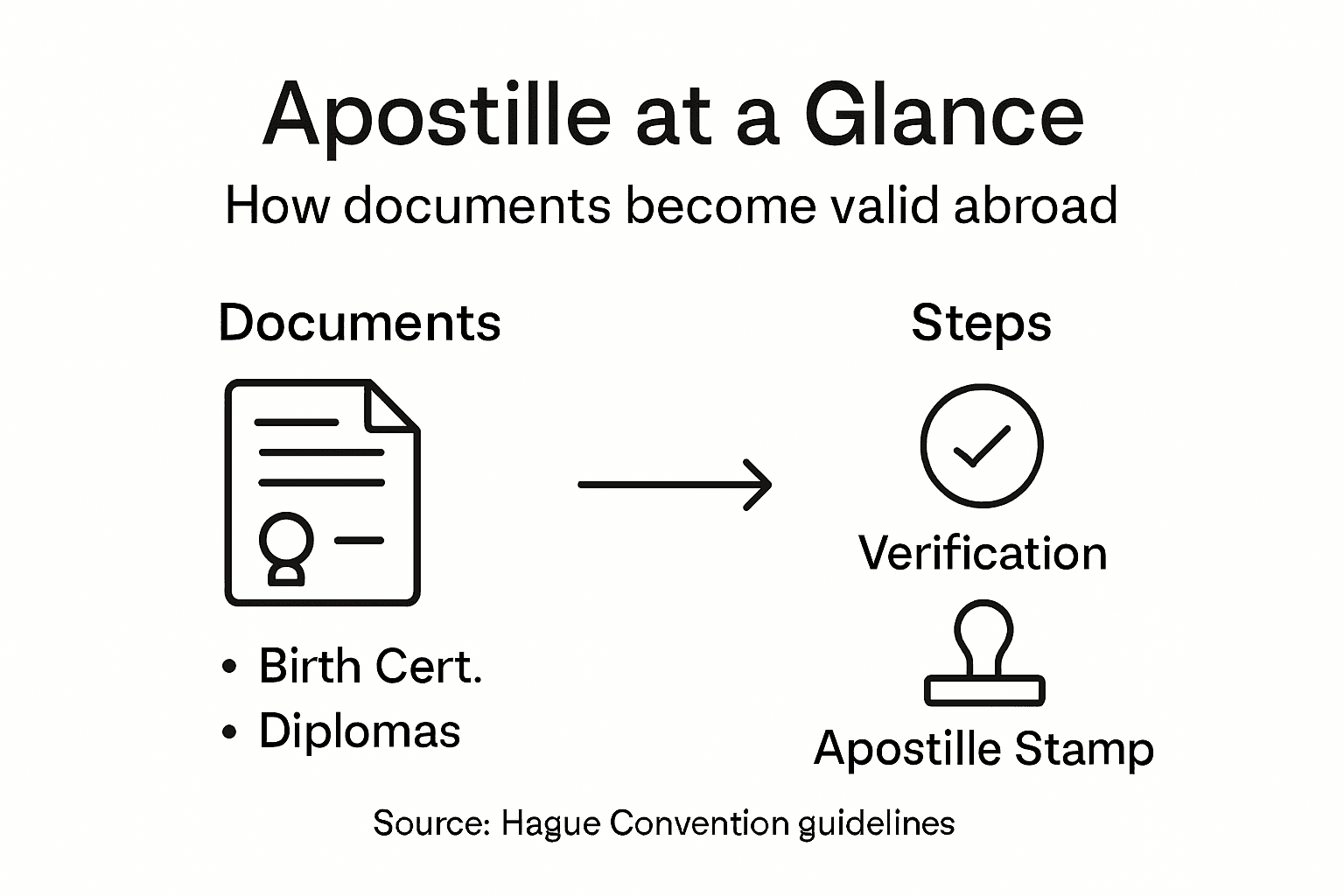
The apostille process involves several key steps designed to ensure document credibility. Here’s how it typically works:
- Origination: The document must be an official public record from a government agency, court, or notary
- Verification: A designated state authority checks the document’s authenticity
- Certification: An official apostille stamp is attached, confirming the document’s validity
- International Recognition: Documents become legally acceptable in Hague Convention member countries
Public documents that commonly require apostilles include:
- Birth certificates
- Marriage licenses
- Academic diplomas
- Criminal background checks
- Corporate registration documents
- Court judgments
Authentication certificates verify the signatures, stamps, and seals on these important documents, ensuring they meet international legal standards. This process transforms local paperwork into globally recognized credentials.
An apostille is not just a stamp—it’s a bridge that connects legal systems across different countries.
The practical significance of an apostille extends far beyond simple paperwork. For expatriates, students, and professionals working internationally, this certification can mean the difference between smooth transitions and bureaucratic roadblocks.
Pro tip: Always verify the specific apostille requirements of your destination country, as individual nations may have unique additional documentation needs.
Types of Documents Requiring Apostille
Navigating the world of document authentication requires understanding which specific papers need an apostille. A wide range of public documents can be apostilled, depending on their origin and intended use in international contexts.
Personal and official documents that typically require apostille certification include:
-
Government-issued documents:
- Birth certificates
- Death certificates
- Marriage licenses
- Divorce decrees
- Adoption certificates
-
Educational documents:
- Academic diplomas
- University transcripts
- Professional certifications
- Academic degree certificates
-
Legal and corporate documents:
- Court judgments
- Powers of attorney
- Notarized contracts
- Corporate registration papers
- Certificates of good standing
Business-related documents often need special attention. Corporate documents such as articles of incorporation require careful authentication to ensure international legal validity.
Not all documents are created equal—some require more rigorous verification than others.
The specific requirements can vary significantly depending on the destination country and the type of document. Some jurisdictions have stricter authentication processes, especially for sensitive documents like criminal background checks or immigration papers.
It’s crucial to understand that the need for an apostille depends on both the document’s origin and the destination country’s specific regulations. Some countries may require additional layers of certification beyond a standard apostille.

Pro tip: Always consult the specific embassy or consulate of your destination country to confirm exact apostille requirements for your particular documents.
Apostille Process for Immigration to Spain
Navigating the apostille process for Spanish immigration requires understanding the specific steps and authorized certification authorities responsible for document validation. Expatriates and international professionals must carefully prepare their documents to ensure smooth processing.
The apostille process for immigration documents in Spain involves several critical stages:
-
Document Preparation
- Gather original public documents
- Ensure documents are issued by official government agencies
- Check document condition and legibility
-
Verification of Document Authenticity
- Confirm document originates from recognized authority
- Validate signatures and official seals
- Ensure document meets Spanish legal standards
Key Authorities for Apostille Issuance:
- Governance Secretaries of High Courts of Justice
- Territorial Managers of the Ministry of Justice
- Deans of Notarial Colleges
- Provincial Government Delegations
Precision matters: One small error can derail your entire immigration document process.
Different types of documents require specific handling during the apostille process. Step by Step Spanish Residency Application Made Easy provides additional guidance for navigating these complex requirements.
Documents typically requiring apostille for Spanish immigration include:
- Birth certificates
- Marriage licenses
- Academic diplomas
- Professional certifications
- Criminal background checks
- Employment verification letters
The authentication process can take several weeks, so planning ahead is crucial. Some documents might require additional translations or notarizations before receiving an apostille.
Here’s an at-a-glance comparison of apostille process variations by document type:
| Document Type | Typical Requirements | Common Challenges |
|---|---|---|
| Birth/Marriage Certificates | Official copy, seal, translation | Delays if document is outdated |
| Academic Diplomas | University authenticity, notarized | Errors in name matching legal IDs |
| Criminal Background Checks | Recent issue date, police seal | Processing time varies by country |
| Corporate Documents | Registration proof, legal seal | Country-specific legalization steps |
This table helps you anticipate differences based on your paperwork type.
Pro tip: Always request multiple certified copies of your apostilled documents and store them securely in both physical and digital formats.
Legal Framework and Hague Convention Rules
The Apostille Convention represents a pivotal international treaty designed to streamline document authentication across borders. Established in 1961, this legal framework fundamentally transformed how public documents are recognized internationally, eliminating complex and time-consuming legalization procedures.
Key Principles of the Hague Convention:
- Simplify document authentication between member states
- Establish a standardized apostille certification process
- Eliminate multiple layers of bureaucratic verification
- Facilitate seamless international document recognition
The convention specifically covers several important document categories:
- Court orders
- Legislative acts
- Notarial deeds
- Official certificates
- Administrative documents
International legal cooperation begins with recognizing each other’s official documentation.
Certification rules for public documents are meticulously defined to ensure authenticity. The convention explicitly excludes certain document types from apostille certification, including:
- Diplomatic documents
- Consular papers
- Direct commercial or customs administrative documents
Spain, as a signatory to the Hague Convention, follows these standardized protocols for document authentication. The process involves verifying the signature and official seal of competent authorities, creating a universal mechanism for document validation.
Geographical Scope:
- Currently, over 120 countries participate in the convention
- Covers most European and South American nations
- Continuously expanding international legal recognition
Pro tip: Always verify your specific country’s exact apostille requirements, as nuanced differences can exist between member states.
Common Errors and How to Avoid Them
Common document authentication mistakes can significantly delay your immigration process and create unnecessary bureaucratic challenges. Understanding these potential pitfalls is crucial for ensuring smooth document processing in Spain.
Typical Apostille Errors:
- Submitting documents to incorrect authorities
- Incomplete or incorrectly filled forms
- Misunderstanding Hague Convention membership requirements
- Insufficient document preparation
- Outdated or improperly certified documents
Document Verification Checklist:
- Confirm original document authenticity
- Verify state/federal issuing authority
- Ensure document signatures are original
- Check document expiration dates
- Validate notarization requirements
Small mistakes can transform a straightforward process into a bureaucratic nightmare.
Notarization requirements create significant complexity for international document processing. Each country has unique guidelines, making thorough research essential.
Key Warning Signs:
- Inconsistent document formatting
- Missing official seals or stamps
- Photocopies instead of original documents
- Unsigned or improperly signed paperwork
- Documents older than six months
Understanding the nuanced differences between apostille and full legalization can prevent costly processing delays. Some countries require additional authentication steps beyond the standard apostille certification.
Pro tip: Always maintain digital and physical copies of your original documents, and double-check every detail before submission.
Costs, Timeframes, and Practical Tips
Processing times and fees for apostille services vary widely depending on jurisdiction and submission method. Expatriates and professionals should budget both time and money carefully when preparing international documents.
Cost Range for Apostille Services:
- State-level documents: $3 - $20 per document
- Federal-level documents: Varies by processing speed
- Expedited services: Additional fees apply
- International shipping: Extra costs
Processing Timeframes:
- Standard mail processing: 3-7 weeks
- Walk-in services: Same day to 1 week
- Expedited courier options: 3-5 business days
- Emergency/urgent processing: Potential 24-48 hour turnaround
Efficiency is not about speed, but about strategic planning.
Document authentication options require careful consideration of urgency and budget. Applicants should compare different submission methods to optimize their apostille process.
Submission Method Comparison:
- Mail-in: Lowest cost, longest processing time
- Walk-in: Fastest processing, moderate fees
- Courier/Expedited: Highest cost, quickest turnaround
- Online submission: Emerging option with varying efficiency
Understanding potential additional expenses is crucial. Translation costs, notarization fees, and potential resubmission charges can significantly impact your total budget.
Below is a practical guide comparing apostille submission methods for efficient planning:
| Method | Cost Level | Processing Speed | Best For |
|---|---|---|---|
| Mail-in | Low | Slowest (weeks) | Non-urgent, budget-minded |
| Walk-in | Moderate | Fast (same day) | Urgent, local applicants |
| Courier | High | Fast (days) | International, time-bound |
| Online | Varies | Unpredictable | Tech-savvy, urban applicants |
Use this chart to select the most suitable option for your situation.
Pro tip: Create a dedicated folder with digital and physical copies of all documents to streamline the apostille process and avoid unexpected delays.
Simplify Your Apostille Needs for Spain with Expert Legal Support
Dealing with apostille certification and immigration paperwork can be overwhelming and time-consuming. This article highlights challenges such as verifying document authenticity, navigating the Hague Convention rules, and avoiding common authentication errors. If you are preparing vital documents like birth certificates or academic diplomas for use in Spain, ensuring flawless apostille certification is critical to prevent delays or rejections.
Experience peace of mind by leveraging Vive Legal’s fully online legal consultancy platform. We combine automated precision with professional review to streamline your immigration and residency procedures including document review, form preparation, and appointment scheduling. Our secure client portal keeps you informed every step of the way so you never miss deadlines or critical updates.
Take control today and eliminate uncertainty from your apostille and residency applications. Visit Uncategorized Archives - Vive Legal for useful resources and get started immediately at https://vive.legal. Empower your journey to Spain with expert help designed for expatriates, students, professionals, and EU citizens alike.
Frequently Asked Questions
What is an apostille?
An apostille is a certification that validates the authenticity of public documents for legal recognition in international contexts, ensuring that they are accepted across borders.
What types of documents typically require an apostille?
Common documents that require an apostille include birth certificates, marriage licenses, academic diplomas, criminal background checks, and corporate registration documents.
How does the apostille process work in Spain?
The apostille process in Spain involves gathering original public documents, verifying their authenticity, and then having them certified by authorized authorities before receiving the official apostille stamp.
What are the common errors to avoid when obtaining an apostille?
Common errors include submitting documents to incorrect authorities, providing outdated paperwork, failing to meet notarization requirements, and not ensuring that signatures are original and properly validated.
Recommended
Living legally in Spain shouldn't be difficult.
View services and pricesNot sure which procedure you need? Find out in 2 min
Questions? Message us on WhatsApp