
Arraigo Laboral in Spain: Securing Legal Work Status

Confusion about labor residency rules can delay your move to Spain, even for skilled American or Latin American professionals. Many workers underestimate the details of arraigo laboral or believe common myths that slow the application process. Over 40 percent of expats mistakenly think a lengthy work history is required when, in reality, this permit is designed for individuals ready to contribute legally and build a stable life. Here you will uncover what really matters when applying and how to avoid setbacks at each step.
Table of Contents
- Defining Arraigo Laboral And Common Myths
- Types Of Arraigo And Key Differences
- Legal Requirements For Labor Residency
- How To Prove Employment And Prepare Documents
- Rights, Renewal Limits, And Legal Risks
- Comparing Arraigo Laboral With Other Options
Key Takeaways
| Point | Details |
|---|---|
| Understanding Arraigo Laboral | Arraigo Laboral is a pathway for foreign professionals to obtain legal work authorization in Spain, requiring a minimum two-year residence and a formal job contract. |
| Types of Arraigo | Spain offers multiple Arraigo pathways, with distinct requirements focusing on social integration, employment, training, and family connections. |
| Documentation Accuracy | Thorough and accurate documentation is essential for successful applications; any errors can lead to rejection. |
| Legal Compliance | Maintaining compliance with renewal criteria and legal requirements helps avoid risks such as revocation or expulsion from Spain. |
Defining arraigo laboral and common myths
The arraigo laboral represents a critical legal pathway for foreign professionals seeking legitimate work authorization in Spain. This specialized residence permit offers a structured mechanism for migrants who have been living irregularly to transition into legal employment status. Residence regulations for migrants provide specific conditions that make this possible.
Living legally in Spain shouldn't be difficult.
View services and pricesNot sure which procedure you need? Find out in 2 min
Questions? Message us on WhatsApp
To qualify for arraigo laboral, applicants must meet several key requirements. First, they need to demonstrate continuous residence in Spain for at least two years. Second, they must secure a formal job contract offering a minimum of 20 hours per week. Importantly, this permit is unique because it allows individuals to regularize their status without requiring previous work documentation - the job contract actually becomes conditioned on receiving the authorization.
Several persistent myths surround arraigo laboral that can confuse potential applicants. Contrary to popular belief, the work period does not need to be continuous, and the authorization itself includes a work permit. Documentation guidelines emphasize the importance of properly translated and legalized records, which many migrants incorrectly overlook. Another common misconception is that individuals need an extensive work history in Spain - in reality, the program is designed to facilitate integration for those who demonstrate commitment and potential.
Pro tip: Always consult with an immigration specialist who understands the nuanced requirements of arraigo laboral to maximize your chances of successful application.
Types of arraigo and key differences
Spain offers multiple arraigo pathways designed to accommodate diverse migration scenarios and individual circumstances. Five distinct types of arraigo exist, each addressing specific legal and social integration needs for foreign residents seeking to establish their status legally.
The first category is arraigo social, which focuses on individuals who have established significant social connections in Spain. This type requires demonstrating substantial community integration, often through local relationships, community involvement, or extended residence. The second type, arraigo sociolaboral, targets migrants who have secured employment and can provide a formal work contract. This pathway is particularly attractive for professionals seeking to transition from irregular to legal employment status.
Immigration regulations outline three additional arraigo types with unique requirements. Arraigo socioformativo is designed for individuals committed to educational pursuits, requiring enrollment in recognized training programs. Arraigo familiar provides opportunities for parents or caregivers of European Union nationals with disabilities. The most recent addition, arraigo de segunda oportunidad, offers a pathway for previous residents who might have lost their initial legal status.
Each arraigo type varies significantly in terms of permit duration, ranging from one to five years. The specific requirements differ based on factors such as employment contracts, family ties, educational commitments, and social integration levels. Understanding these nuanced differences is crucial for successfully navigating the complex Spanish immigration system.
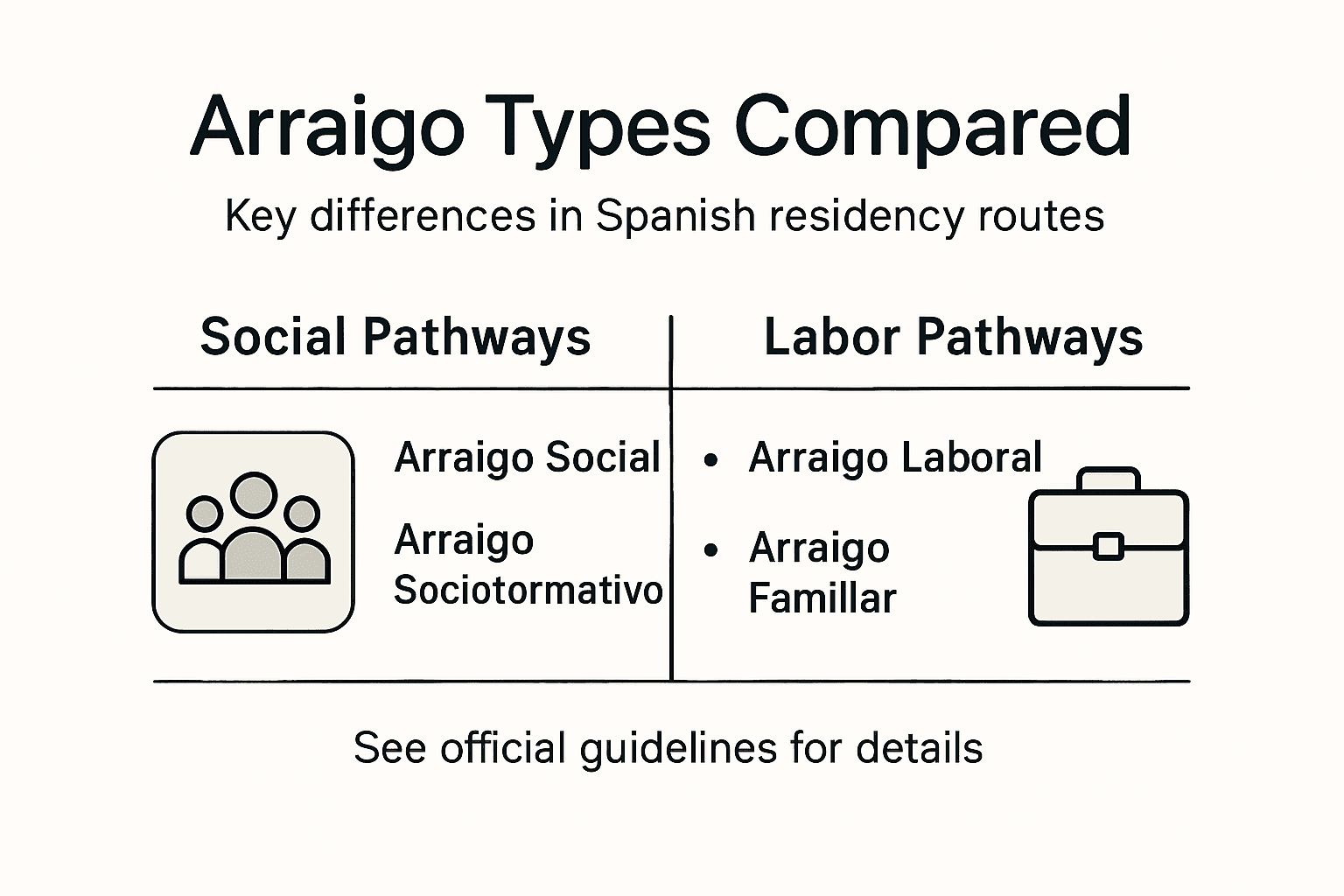
Here’s a summary comparing the different types of arraigo in Spain:
| Arraigo Type | Main Requirement | Permit Duration | Ideal Applicant |
|---|---|---|---|
| Arraigo laboral | Valid work contract, 2 years’ stay | 1 year | Employed professionals |
| Arraigo social | Social integration, local ties | 1-2 years | Community-connected migrants |
| Arraigo socioformativo | Enrollment in training program | Up to 2 years | Students or trainees |
| Arraigo familiar | Care for EU national with disability | Varies (case-by-case) | Caregivers or parents |
| Arraigo segunda oportunidad | Previous legal residency | Up to 5 years | Ex-residents seeking return |
Pro tip: Carefully document and prepare comprehensive evidence specific to your chosen arraigo type, as precise documentation can significantly improve your approval chances.
Legal requirements for labor residency
Navigating the legal landscape for labor residency in Spain requires a thorough understanding of specific documentation and procedural requirements. Comprehensive legal documentation outlines critical criteria that foreign professionals must meet to obtain their work authorization. The process demands meticulous attention to detail and strict adherence to Spanish immigration regulations.
The fundamental legal requirements for labor residency are multifaceted and stringent. Applicants must demonstrate continuous residence in Spain for a minimum of two years, with a critical caveat that total absences cannot exceed 90 days during this period. A clean criminal record is mandatory, both in Spain and in the applicant’s country of origin. Equally important is proving established labor relations, which requires documented employment for at least six months. This employment documentation must be formal, transparent, and verifiable by Spanish authorities.
Beyond basic residency requirements, applicants must navigate additional legal hurdles. They cannot be subject to any existing expulsion orders or have previous immigration violations. The legal framework, established under the Spanish Organic Law 4/2000, emphasizes integration and legitimate employment as core principles. Each requirement serves as a critical checkpoint to ensure that incoming workers contribute positively to Spain’s social and economic ecosystem. Prospective residents must provide comprehensive documentation, including work contracts, proof of residence, tax records, and personal identification documents.
Pro tip: Consult with an immigration specialist early in your process to ensure all documentation meets the precise legal standards and to identify potential challenges before applying.
How to prove employment and prepare documents
Successful arraigo laboral applications hinge on presenting comprehensive and meticulously prepared employment documentation. Employment verification requirements are stringent, demanding applicants provide multiple layers of evidence demonstrating their professional engagement in Spain.
The primary documentation for proving employment includes several critical components. Work contracts must be original or certified copies, formally signed by both employer and employee. These contracts should guarantee a minimum of 20 hours of work per week and comply with sector-specific labor regulations. Supplementary documents might include pay slips, social security registration records, official employer declarations, and potentially judicial resolutions verifying employment history. Work contract specifications require careful attention to ensure they meet immigration standards.

Document preparation involves multiple critical steps beyond simply collecting employment records. All non-Spanish documents must be professionally translated by authorized translators and either legalized or apostilled, depending on the document’s origin country. Applicants need to compile a comprehensive package including the official application form, proof of continuous residence, criminal background certificates from both Spain and their home country, and complete identification documentation. The process demands precision - even minor errors or inconsistencies can result in application rejection.
Below is a quick reference for critical documentation steps during arraigo laboral application:
| Step | Key Action | Common Mistake to Avoid |
|---|---|---|
| Employment Evidence | Submit signed work contract & pay slips | Missing certified signatures |
| Translation & Legalization | Use authorized translator, apostille docs | Unofficial translations |
| Continuous Residence Proof | Provide rental records, utility bills | Incomplete address information |
| Criminal Record Certificates | Obtain from Spain and home country | Not updating recent certificates |
Pro tip: Create a dedicated folder with color-coded sections for each document type and maintain digital backups of all original paperwork to streamline your application process.
Rights, renewal limits, and legal risks
The arraigo laboral permit represents a critical pathway to legal residency, but comes with specific rights and potential legal complexities. Temporary residence regulations provide a one-year authorization that grants significant protections and opportunities for migrant workers in Spain.
Beneficiaries of this permit are entitled to comprehensive rights including healthcare access, educational opportunities for dependent minors, and full labor protections under Spanish employment law. However, the permit is not unconditional. Legal compliance requirements mandate strict adherence to renewal criteria. Renewal depends on maintaining continuous employment, meeting updated documentation standards, and demonstrating ongoing integration into Spanish society. Critically, any interruption in employment or failure to meet procedural requirements can jeopardize the permit’s status.
The legal risks associated with arraigo laboral are substantial and multifaceted. Potential consequences of non-compliance include permit revocation, potential expulsion proceedings, and future restrictions on re-entry. Applicants must understand that this is an exceptional regularization pathway, not a permanent residency guarantee. Misrepresentation of employment, incomplete documentation, or failure to meet ongoing criteria can result in immediate legal consequences. The regulatory framework emphasizes that each renewal is a fresh assessment of the individual’s legal and professional standing.
Pro tip: Maintain meticulous records of all employment documentation and proactively track renewal deadlines to minimize risks of legal status interruption.
Comparing arraigo laboral with other options
Arraigo residency pathways represent diverse strategies for migrants seeking legal status in Spain, each tailored to specific personal circumstances. Unlike other arraigo types, arraigo laboral distinguishes itself through its explicit focus on employment as the primary mechanism for obtaining residency.
Each arraigo type addresses unique migration scenarios. Arraigo social centers on social integration and community connections, requiring extensive proof of local ties. In contrast, immigration pathways reveal that arraigo laboral specifically targets individuals with demonstrable work experience. Arraigo socioformativo differs significantly by linking residency to participation in authorized training programs, making it ideal for students or professionals seeking educational advancement. Arraigo familiar provides a pathway for those with immediate family care responsibilities, particularly focusing on caregivers of EU nationals with disabilities.
The key differentiating factors among these pathways include eligibility requirements, documentation standards, and long-term residency potential. Arraigo laboral demands proof of work relations for at least six months and two years of residence, whereas other types might prioritize social connections, educational commitments, or family responsibilities. This specialization means that professionals with substantial work history in Spain have a distinct advantage through the laboral pathway, offering a more direct route to legal residency compared to alternative arraigo options.
Pro tip: Carefully assess your individual circumstances and gather comprehensive documentation specific to your chosen arraigo type to maximize your chances of successful application.
Secure Your Arraigo Laboral Permit with Expert Online Support
Navigating the complex legal requirements and document preparation for arraigo laboral can be overwhelming. Many applicants face challenges proving continuous residence, obtaining perfectly translated and legalized documents, and ensuring their work contracts meet all official standards. Your goal is clear: gain legal work status in Spain smoothly and confidently without risking costly errors or delays.
Take control of your application process today with the streamlined services offered by Vive Legal. From personalized diagnostics to meticulous document review and expert form preparation, Vive Legal combines advanced technology with human expertise to increase your chances of approval. Don’t let paperwork or bureaucratic hurdles hold you back. Start your legal residency journey with confidence and convenience by visiting Vive Legal now.
Frequently Asked Questions
What is arraigo laboral in Spain?
Arraigo laboral is a legal pathway for foreigners to secure work authorization in Spain after living there irregularly. It allows migrants to transition to legal employment status by obtaining a specialized residence permit.
What are the main requirements for applying for arraigo laboral?
To qualify for arraigo laboral, applicants must demonstrate continuous residence in Spain for at least two years and secure a formal job contract offering a minimum of 20 hours per week.
How does arraigo laboral differ from other types of arraigo?
Arraigo laboral specifically focuses on individuals with employment, whereas other types, such as arraigo social, emphasize social connections, and arraigo socioformativo is linked to education and training programs.
What documentation is needed to prove employment when applying for arraigo laboral?
Applicants need to submit a signed work contract, pay slips, and documents that verify their employment status. All necessary documents must be properly translated and legalized if needed.
Recommended
Living legally in Spain shouldn't be difficult.
View services and pricesNot sure which procedure you need? Find out in 2 min
Questions? Message us on WhatsApp