
Automate Spanish immigration: your 2026 process guide

TL;DR:
- Automation has streamlined routine tasks like form filling, appointment booking, and case monitoring.
- Reputable platforms ensure data security and compliance with GDPR standards for personal information.
- Combining automation with professional legal review provides the best outcomes in Spanish immigration processes.
Spanish immigration paperwork has a reputation for being slow, confusing, and endlessly manual. That reputation is outdated. Process automation, meaning the use of digital tools and platforms to handle routine tasks without human intervention at every step, has fundamentally changed how expatriates, workers, and students manage their residency applications in Spain. From filling out forms to booking appointments and tracking case updates, a growing number of steps can now run on autopilot. This guide breaks down exactly which parts of the Spanish immigration process can be automated, which tools make it possible, and how to stay protected while doing it.
Living legally in Spain shouldn't be difficult.
View services and pricesNot sure which procedure you need? Find out in 2 min
Questions? Message us on WhatsApp
Table of Contents
- Understanding immigration process automation in Spain
- Key steps in the Spanish immigration process that can be automated
- Popular automation tools and platforms for Spanish immigration
- Ensuring compliance, security, and personal data protection
- Our perspective: Automation is empowering, but human oversight still matters
- Automate your Spanish immigration with expert support
- Frequently asked questions
Key Takeaways
| Point | Details |
|---|---|
| Simplifies complex paperwork | Automation helps you avoid bureaucracy and repetitive data entry in the Spanish immigration process. |
| Improves speed and accuracy | Digital tools minimize errors and speed up visa and residency applications for expatriates, workers, and students. |
| Security is crucial | Choosing trusted platforms that comply with Spanish data laws keeps your personal information safe. |
| Expert support boosts success | Combining automation with legal advice ensures you don’t miss important details or deadlines. |
Understanding immigration process automation in Spain
Process automation in immigration means using software to complete, submit, and monitor tasks that would otherwise require hours of manual effort. In the context of Spain, this is especially relevant because the country’s immigration system involves multiple government portals, specific form formats, and strict deadlines that vary by permit type.
Spain’s digital government infrastructure includes systems like Mercurio, used for managing immigration appointment queues, and RedSara, which connects different public administration bodies. Automation tools interact with these systems to pre-fill forms, check availability, and send real-time notifications when something changes in your case.
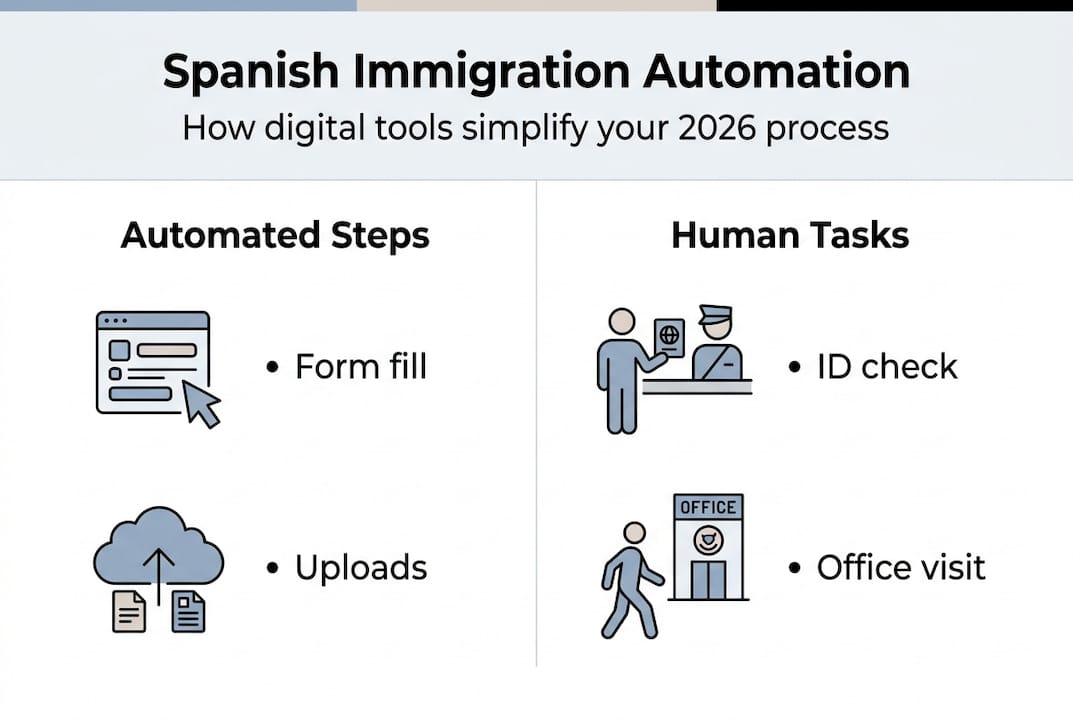
Streamlining immigration in Spain is no longer just for tech-savvy applicants. Platforms designed for this purpose handle the repetitive, error-prone tasks so you can focus on gathering the right documents and understanding your specific requirements.
Here is a quick look at how automation maps to different applicant types:
| Applicant type | Primary automation benefit |
|---|---|
| Expatriate | Appointment scheduling, form pre-fill |
| Foreign worker | Document checklist, deadline alerts |
| International student | Renewal reminders, status tracking |
| EU citizen | UE registration form automation |
The tasks most suited to automation include:
- Application form completion: Software pulls your data and fills standard fields accurately.
- Document gathering checklists: Platforms generate personalized lists based on your permit type.
- Appointment scheduling: Automated systems monitor official portals and book slots when they open.
- Payment processing: Integrated payment tools handle the Modelo 790 fee submission.
- Notification tracking: You receive alerts at each stage without checking portals manually.
Automated platforms significantly reduce the time required for routine immigration filings, which means fewer delays and less back-and-forth with government offices. For anyone juggling work, study, or family responsibilities, that time saving is not a luxury. It is a necessity.
Key steps in the Spanish immigration process that can be automated
Not every part of your immigration journey is automatable, but many of the most time-consuming steps are. Understanding where automation applies helps you plan smarter.
Here is a numbered overview of the standard immigration workflow and where automation fits in:
- Pre-application eligibility check: Platforms assess your situation and recommend the right permit.
- Document compilation: Automated checklists flag missing items before you submit.
- Form preparation: Software completes official forms using your profile data.
- E-signature and payment: Digital signatures and fee payments are processed online.
- Appointment booking: Systems monitor government portals and secure slots automatically.
- Submission confirmation: You receive immediate confirmation and a case reference number.
- Notification tracking: Status updates arrive by email or app without manual checking.
Not all procedures offer the same level of automation. Here is a comparison:
| Process | Automatable steps | Manual steps still required |
|---|---|---|
| NIE application | Form fill, payment | In-person biometric appointment |
| TIE renewal | Document check, booking | Physical document drop-off in some cases |
| UE registration | Full form submission | None in most cases |
| Arraigo social | Eligibility check, form prep | Social integration report review |
The arraigo social process is a good example of a procedure where automation handles the preparation work, but a human still needs to review the social report and verify supporting evidence. Similarly, renewing NIE for students benefits from automated reminders and form preparation, but the biometric appointment itself cannot be skipped.
Error reduction is one of the biggest advantages here. Manual form completion leads to mistakes that cause rejections. Automated systems cross-check your entries against official requirements before submission.
Pro Tip: Set up automated deadline alerts at least 90 days before your permit expires. Many rejections happen not because of eligibility issues, but because applicants miss the renewal window.
Digital platforms now handle over 70% of initial residency applications in major cities, which tells you that this is no longer an experimental approach. It is the new standard.
Popular automation tools and platforms for Spanish immigration
Knowing which tools to use is just as important as knowing which steps to automate. The market has expanded quickly, and not all platforms are equal in terms of coverage, security, or legal expertise.
Legal tech platforms have made it possible to submit and monitor applications fully online in Spain. Vive Legal is one example of a platform that combines AI-driven form preparation with professional legal review, covering permits including NIE, TIE, UE registration, and Arraigo. The platform’s client portal gives you real-time case tracking and document storage in one place.
When evaluating any platform, check for these features:
- Permit coverage: Does it handle your specific visa or residency type?
- Document review: Does a qualified professional verify your submission before it goes out?
- Appointment automation: Can it monitor and book official slots on your behalf?
- Notification system: Does it send alerts at each stage of your case?
- Integration support: Can it connect with tools like Google Drive for document uploads?
- Transparent pricing: Are fees clearly listed with no hidden charges?
For students, study center immigration management features are particularly useful because they allow institutions to manage multiple student applications from a single dashboard. For workers and families, individual case tracking with personalized checklists is the priority.
Security is a non-negotiable factor. Any platform you use will handle sensitive personal data including passport scans, financial records, and biometric information. Look for platforms that use end-to-end encryption, comply with GDPR (the EU’s General Data Protection Regulation), and clearly state how long they retain your data.

Pro Tip: Before uploading any document, search the platform’s name alongside terms like “data breach” or “complaint” to check its track record. Reputable services are transparent about their security practices.
For broader guidance on navigating digital tools for immigration, the Spain immigration blog guides offer updated breakdowns of platform features and regulatory changes throughout 2026.
Statistic: Over 70% of initial residency applications in Spain’s major cities are now processed through digital platforms, reflecting how mainstream automation has become for immigration procedures.
Ensuring compliance, security, and personal data protection
Convenience should never come at the cost of your legal standing or personal security. When you automate immigration tasks, you are sharing some of the most sensitive documents you own. Knowing how reputable platforms handle that data is essential.
Spain operates under the EU’s GDPR framework, which sets strict rules for how personal data must be collected, stored, and used. Automated systems are held to the same data protection standards as traditional legal service providers in Spain, which means any platform you use must comply with these obligations regardless of whether it is a law firm or a tech company.
Here is what to look for when reviewing a platform’s privacy practices:
- Clear privacy policy: It should state exactly what data is collected and why.
- Data retention limits: Your documents should not be stored indefinitely after your case closes.
- Third-party sharing disclosure: You should know if your data is shared with any external parties.
- Right to erasure: You should be able to request deletion of your data at any time.
- Secure transmission: Look for HTTPS and end-to-end encryption on all uploads.
For compliance for TIE applications, this is especially important because the TIE (Tarjeta de Identidad de Extranjero) involves biometric data, which carries stricter protection requirements under Spanish law.
Common risks to watch out for include phishing sites that mimic official government portals, unofficial “appointment booking” services that charge fees without delivering results, and outdated platforms still using old form versions that no longer match current requirements.
“Reputable platforms publish their privacy policies in plain language, not legal jargon. If you cannot understand what a platform does with your data after reading their policy, that is a red flag.”
Always cross-reference any platform’s stated procedures with official sources like the Secretaría de Estado de Migraciones to confirm that the forms and processes it uses are current.
Our perspective: Automation is empowering, but human oversight still matters
We have seen how automation removes real barriers for people navigating Spain’s immigration system. For someone who does not speak Spanish fluently, does not understand bureaucratic terminology, or simply does not have time to monitor government portals daily, these tools are genuinely life-changing.
But here is what many automation-first conversations miss: software catches what it is programmed to catch. Edge cases, unusual employment histories, gaps in residence, or documents from countries with non-standard formats can slip through automated checks without triggering a warning. A platform might confirm your form is complete while missing a nuance that an experienced immigration lawyer would catch immediately.
Our view is that the best outcomes come from combining digital efficiency with professional review. Automation handles the volume and the routine. Human expertise handles the judgment calls. The Spain immigration guidance available through Vive Legal reflects this philosophy: AI-driven tools for speed, legal professionals for accuracy.
Do not treat automation as a replacement for understanding your own case. Use it as a powerful assistant, not a substitute for informed decision-making.
Automate your Spanish immigration with expert support
If reading this guide has made you realize how much time and stress you could save, the next step is straightforward. Vive Legal brings together the automation tools described here with qualified legal oversight, so your application does not just move faster. It moves correctly.
Whether you are starting a new residency application or managing a renewal, Vive Legal immigration automation covers the full process from eligibility check to submission confirmation. If you are working toward regularization, the 2026 regularization service provides dedicated support for that pathway. Students and interns can also access tailored help through the internship residence support service. Every case gets 24-hour digital submission capability and direct access to legal guidance when you need it.
Frequently asked questions
Can I automate my entire Spanish immigration process online?
Most steps like applications, notifications, and appointment scheduling can be automated, but some cases may still require manual document submission or in-person visits. Automated platforms significantly reduce the time required for routine immigration filings, though certain biometric appointments remain mandatory.
Is it safe to upload my personal documents to automation platforms?
Reputable services use strong data protection measures, but always check the platform’s privacy policy and security credentials before sharing documents. Automated systems are held to the same data protection standards as traditional legal service providers in Spain.
Which immigration tasks benefit most from automation in Spain?
Application form completion, appointment scheduling, and updates or renewals are the main tasks simplified by automation. Digital platforms now handle over 70% of initial residency applications in major cities, making these tools mainstream rather than optional.
Do automated tools keep up to date with changing immigration laws?
Major platforms continually update to comply with new rules, but verify with a legal advisor for complex or unique situations. Legal tech platforms have made it possible to submit and monitor applications fully online in Spain, but professional review remains the safest backstop for unusual cases.
Recommended
Living legally in Spain shouldn't be difficult.
View services and pricesNot sure which procedure you need? Find out in 2 min
Questions? Message us on WhatsApp