
Avoid residency rejection in Spain: top reasons & tips

Getting rejected for residency in Spain is more common than most applicants expect. Even well-organized candidates can stumble when a single document is missing, a financial threshold is misunderstood, or the wrong visa category is selected. Schengen short-stay visa refusals hover around 15%, and similar risks apply to longer-term residency applications when documentation falls short. Understanding exactly where applications break down is the most effective way to protect your time, money, and legal status in Spain. This article walks you through the most frequent causes of rejection and gives you practical, actionable solutions for each one.
Table of Contents
- Understanding residency application criteria in Spain
- Incomplete or incorrect documentation
- Financial insufficiency and proof of income mistakes
- Health insurance and background check failures
- Visa category mismatch and misunderstood eligibility
- Comparison of rejection causes and practical solutions
- How Vive Legal can help you succeed
- Frequently asked questions
Key Takeaways
| Point | Details |
|---|---|
| Document accuracy matters | Missing or incorrect forms are the main reason most Spain residency applications fail. |
| Financial proof is crucial | Applicants must provide clear evidence of income above legal minimums for approval. |
| Insurance and checks required | Valid health insurance and a clean background are mandatory for all applicants. |
| Choose the right visa | Matching your residency type to your personal situation prevents category-based rejection. |
| Professional help increases success | Legal experts can help check, submit, and appeal residency applications for better outcomes. |
Understanding residency application criteria in Spain
Spain’s residency system is built on a clear set of requirements, but the details vary significantly depending on which permit you are applying for. Before you submit anything, you need to understand what the authorities are actually looking for.
Living legally in Spain shouldn't be difficult.
View services and pricesNot sure which procedure you need? Find out in 2 min
Questions? Message us on WhatsApp
Every application, regardless of visa type, must generally include:
- A valid passport with sufficient remaining validity
- Proof of income or financial means above the legal threshold
- Valid health insurance that meets Spanish legal standards
- A clean criminal record certificate from your home country
- Completed and correctly signed official forms
- Proof of accommodation in Spain
The challenge is that documentation risks are similar across non-lucrative and digital nomad residency categories when applicants underestimate what is required. A non-lucrative visa demands passive income proof. A digital nomad visa requires evidence of remote work contracts. These are not interchangeable.
Misunderstandings about legal requirements are extremely common. Many applicants assume that meeting one or two criteria is enough, when in reality every single requirement must be satisfied simultaneously. You can review EU long-term residence requirements to understand what a fully approved application looks like, and browse Spain immigration guides for category-specific breakdowns.
Incomplete or incorrect documentation
Documentation errors are the single biggest reason residency applications get denied. This is not just about missing a form. It includes submitting outdated certificates, providing translations that are not officially certified, or filling in fields incorrectly on government forms.
Here is a numbered checklist of the most common documentation mistakes:
- Submitting a criminal record certificate that is more than three months old
- Using unofficial or uncertified translations of foreign documents
- Forgetting to include apostille stamps on documents issued abroad
- Providing bank statements that do not cover the required time period
- Leaving mandatory fields blank or using incorrect personal data on official forms
- Failing to include proof of health insurance that meets Spanish coverage standards
Missing or invalid documentation is cited as a leading cause of residency application failure. The frustrating part is that these errors are entirely preventable. If you are applying for a training or internship permit, review the specific internship visa documentation requirements, as they differ from standard work permits.

Pro Tip: Before submitting your application, create a physical or digital checklist of every required document. Have someone else review it against the official requirements. A second set of eyes catches errors that familiarity makes invisible.
Financial insufficiency and proof of income mistakes
Spain’s immigration authorities need to be confident that you can support yourself without becoming a burden on public services. Financial insufficiency is one of the most common and most avoidable reasons for rejection.
The most frequent financial documentation mistakes include:
- Submitting bank statements that show inconsistent or irregular deposits
- Providing income proof that is outdated by more than three months
- Failing to meet the minimum income threshold for your specific visa category
- Mixing personal and business accounts without clear explanation
- Not converting foreign currency amounts into euros with official exchange rate documentation
Rejection rates rise sharply when applicants lack clear and consistent financial documentation. For 2026, the general benchmark for non-lucrative residency is roughly 400% of the IPREM (Indicador Público de Renta de Efectos Múltiples), Spain’s public income reference index, per month. That figure increases for each additional family member included in the application.
If you are applying through a social roots pathway, understanding the arraigo social requirements will clarify what financial evidence is expected in that specific context. Always use official bank-issued statements, not screenshots or app exports.
Health insurance and background check failures
Health insurance and criminal background checks are two areas where applicants often assume they are covered, only to discover at the point of rejection that their policy or certificate did not meet the required standards.
“Adequate insurance and clear background checks are non-negotiable for approval.”
For health insurance, Spanish authorities require policies that:
- Provide full coverage in Spain with no co-payments or deductibles
- Are valid for the entire duration of the requested permit
- Are issued by a company authorized to operate in Spain
- Cover hospitalization, emergency care, and repatriation
Applications frequently fail when health insurance policies lack adequate coverage. Travel insurance policies, even comprehensive ones, almost never qualify. You need a dedicated expat health insurance plan.
On the background check side, any undisclosed criminal history or a certificate that does not cover the required countries of residence can trigger automatic rejection. If you have lived in multiple countries, you may need certificates from each one. EU citizens applying for family-based permits should check the EU family card requirements to confirm what background documentation applies to their situation.
Visa category mismatch and misunderstood eligibility
Choosing the wrong visa category is a surprisingly common mistake, and it results in rejection even when every document is perfectly prepared. The Spanish immigration system has distinct pathways for workers, students, retirees, digital nomads, and family members, and each has its own eligibility rules.
Here is a step-by-step approach to matching your situation to the right category:
- Define your primary purpose for staying in Spain: work, study, retirement, or family reunification
- Identify whether your income is active (employment or freelance) or passive (investments, pensions, rental income)
- Check whether your employer or client is based in Spain or abroad
- Confirm your nationality, as EU and non-EU citizens follow entirely different legal tracks
- Review the specific eligibility criteria for the two or three categories that seem to fit your situation
- If you are transitioning from student to worker status, review the student to worker eligibility pathway before applying
Visa refusals are commonly linked to applicants misunderstanding which residency category applies to their circumstances. A retiree applying under a non-lucrative visa when they actually perform occasional freelance work is a classic example of a category mismatch that leads to denial.
Pro Tip: If you are unsure which category fits your profile, do not guess. A 30-minute consultation with an immigration specialist costs far less than a rejected application and the months of delay that follow.
Comparison of rejection causes and practical solutions
Bringing all these rejection risks together, here is a side-by-side reference to help you identify vulnerabilities in your own application and address them before submission.
| Rejection cause | Why it happens | Practical solution |
|---|---|---|
| Incomplete documentation | Missing forms, outdated certificates, no apostille | Use a full checklist; verify expiry dates on every document |
| Financial insufficiency | Low or inconsistent income proof | Provide 6 months of official bank statements; confirm IPREM thresholds |
| Invalid health insurance | Travel or basic policies that do not meet Spanish standards | Purchase a dedicated expat policy with full Spain coverage |
| Background check issues | Missing certificates from prior countries of residence | Request certificates from every country lived in for the past 5 years |
| Wrong visa category | Misidentifying your income type or purpose of stay | Map your profile to eligibility criteria before choosing a category |
| Form errors | Incorrect data, blank fields, wrong signatures | Have a legal professional review forms before submission |
Rejection risk rises significantly when more than one of these criteria is missed at the same time. If your situation is complex or you have previously been rejected, explore extraordinary regularization solutions as an alternative pathway.
How Vive Legal can help you succeed
Knowing the reasons for rejection is valuable. Having a team that actively prevents them is even better. At Vive Legal, we combine AI-powered document review with licensed immigration professionals to catch errors before they reach the authorities.
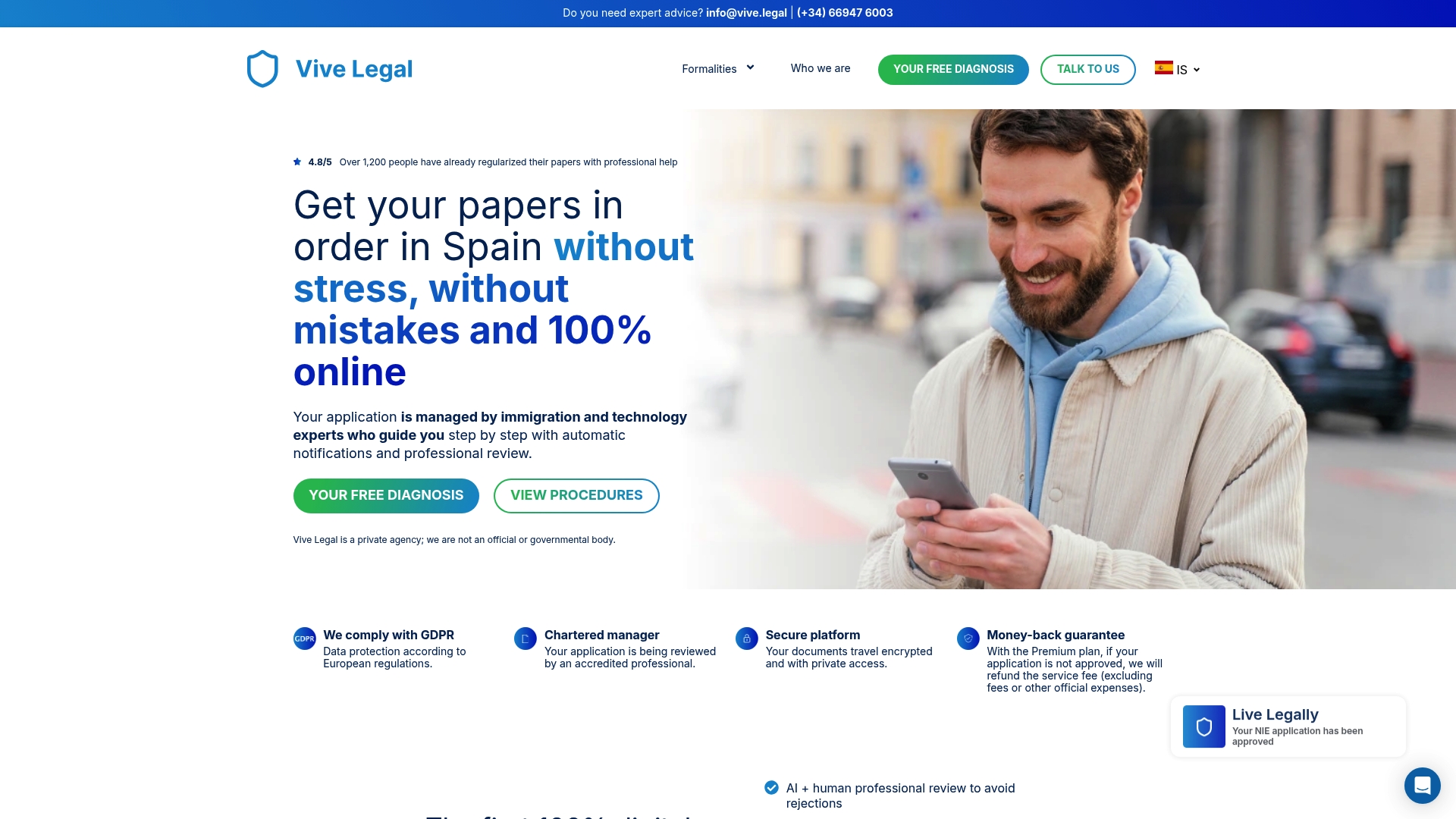
Our platform handles everything digitally: form preparation, document verification, appointment scheduling, and real-time case tracking through a secure client portal. Whether you need expert residency support for a first-time application, help navigating a job search in Spain while maintaining legal status, or TIE application support after your visa is approved, we manage the process from start to finish. No guesswork, no missed deadlines, and no surprises. Our transparent pricing and satisfaction guarantee mean you always know what you are paying for and what to expect.
Frequently asked questions
What is the most common reason for residency rejection in Spain?
Incomplete or incorrect documentation leads to the majority of residency rejections, including missing certificates, expired documents, and uncertified translations.
How much money do I need to show for residency approval in Spain?
The required amount depends on your visa type and is updated annually based on the IPREM index. For non-lucrative residency in 2026, income thresholds are set at approximately 400% of the monthly IPREM, with higher amounts required for dependents.
Can I appeal a residency rejection in Spain?
Yes, you can file a formal appeal or submit a corrected application after rejection. Legal assistance is strongly recommended because appeals require precise legal strategy and strict deadlines.
Does health insurance coverage affect residency approval?
Absolutely. Insufficient health insurance is one of the most frequent causes of denial, particularly when applicants submit travel policies instead of dedicated expat coverage.
Which visa category is right for my situation?
Eligibility depends on your purpose of stay, income type, and nationality. Misidentifying your category is a leading cause of refusal, so consulting an immigration expert before applying is always worth the investment.
Recommended
Living legally in Spain shouldn't be difficult.
View services and pricesNot sure which procedure you need? Find out in 2 min
Questions? Message us on WhatsApp