
Master Case Tracking for Immigration in Spain: Complete Guide

Tracking your immigration case in Spain can feel like navigating a maze blindfolded. You submit your documents, receive a case number, and then wait. Days turn into weeks, and uncertainty grows. Many expatriates believe delays mean rejection, but the reality is different. Spain’s immigration system processes over 3.5 million residence applications annually, and most delays stem from batch processing, not denials. Understanding how to track your case effectively transforms anxiety into control. This guide walks you through every official channel, required information, status codes, and proactive strategies to monitor your immigration journey with confidence.
Table of Contents
- Why tracking your immigration case matters
- Official channels for case tracking in Spain
- What details do you need for case tracking?
- Understanding case status updates and codes
- Common pitfalls, delays, and escalation strategies
- Best practices for proactive and efficient tracking
- How Vive Legal helps with case tracking and immigration
- Frequently asked questions
Key Takeaways
| Point | Details |
|---|---|
| Track weekly for updates | Checking your case status every week helps prevent missed deadlines and unexpected setbacks. |
| Know the right portals | Always use the official Sede Electrónica or Ministerio del Interior to ensure accurate status information. |
| Keep your records | Save screenshots and logs each time you check your case to safeguard your legal rights. |
| Understand status codes | Recognizing what codes mean empowers you to respond quickly and avoid delays. |
| Escalate delays smartly | If your case stalls, contact officials with your documented logs and seek professional advice. |
Why tracking your immigration case matters
Staying on top of your immigration case isn’t just about satisfying curiosity. It’s about protecting your legal status and future in Spain. When you miss a notification requesting additional documents, known as a requerimiento, your application can be denied outright. These requests typically give you 10 to 15 days to respond, and the clock starts ticking whether you see the notice or not.
Living legally in Spain shouldn't be difficult.
View services and pricesNot sure which procedure you need? Find out in 2 min
Questions? Message us on WhatsApp
Spain’s digital transformation has reduced in-person visits to immigration offices, but this shift places more responsibility on you to monitor your case actively. The country now processes applications for over 3.5 million foreigners holding valid residence documents as of December 2025, with student permits increasing significantly after recent reforms. This volume means your case moves through batch processing systems, where updates happen in waves rather than continuously.
Consider these critical reasons to track your case regularly:
- Avoid automatic denials from missed requerimientos or deadline expirations
- Plan your life around realistic timelines instead of guessing
- Catch errors early before they become permanent record issues
- Respond quickly to status changes that require immediate action
“The difference between a successful application and a denial often comes down to timely responses. Applicants who check weekly catch issues that others miss entirely.”
Delays are common across major cities like Madrid and Barcelona, where processing times can stretch three months beyond official estimates. However, Spain’s 2026 centralized digital platform promises greater transparency. Until then, systematic tracking remains your best defense against bureaucratic uncertainty. For broader context on navigating Spanish immigration, explore our Spain immigration guides covering various residence pathways.
Official channels for case tracking in Spain
Spain offers multiple official channels for checking your immigration case status, but not all provide the same level of detail or accessibility. Understanding which platform to use and when can save you hours of frustration.

The primary tracking method is the Sede Electrónica portal, which provides the most comprehensive and up-to-date information. This platform requires your case number (número de expediente), NIE or DNI, and date of birth. For certain procedures, you’ll need digital authentication through Cl@ve or an electronic certificate.
Alternative tracking methods include:
- SMS alert system by registering your phone number during application submission
- Phone inquiry to your local immigration office, though wait times can exceed 30 minutes
- Ministerio del Interior portal at interior.gob.es, offering similar functionality with a different interface
- Direct form entry without authentication for basic status checks
Here’s how the main platforms compare:
| Platform | Authentication Required | Update Frequency | Detail Level | Best For |
|---|---|---|---|---|
| Sede Electrónica | Sometimes (Cl@ve/certificate) | Daily | High | Comprehensive tracking |
| Ministerio del Interior | No | Daily | Medium | Quick checks |
| SMS Alerts | No | When status changes | Low | Passive monitoring |
| Phone Inquiry | No | Real-time | High | Complex questions |
The 2026 update will centralize these systems into a single dashboard, but until then, cross-referencing between platforms can reveal discrepancies or updates one system hasn’t yet reflected.
Pro Tip: Bookmark only official .gob.es URLs and verify the security certificate before entering personal information. Scam sites mimicking government portals have increased, targeting applicants with fake status checks that harvest data.
For EU citizens navigating registration requirements, our guide on EU Registration requirements explains how tracking differs from standard residence applications.
What details do you need for case tracking?
Accurate information entry is the foundation of successful case tracking. Missing a single digit or transposing numbers can return error messages that waste your time and increase stress.
Every tracking method requires these essential details:
- Expediente number: Your unique case identifier, typically 10-12 digits, found on your application receipt
- NIE or DNI: Your foreigner identification number or Spanish national ID
- Date of birth: In DD/MM/YYYY format, exactly as it appears on your passport
- Passport number: Required for non-EU applicants on certain portals
For authenticated access through Cl@ve or electronic certificate, you’ll need to set up your digital identity beforehand. Cl@ve is easier for most applicants, requiring only a one-time registration with your NIE and a mobile phone. Electronic certificates involve downloading software and can be more complex.
Common mistakes that trigger error messages include:
- Entering NIE with hyphens or spaces when the system expects continuous digits
- Using MM/DD/YYYY date format instead of the European DD/MM/YYYY standard
- Copying the expediente number incorrectly from email confirmations
- Forgetting leading zeros in shorter case numbers
Pro Tip: Create a secure digital note or password manager entry with all your tracking information formatted exactly as each portal requires. Include the date you last checked and the status you saw. This log becomes crucial evidence if you need to prove you monitored your case diligently.
If you’re pursuing specific pathways like Arraigo Social or EU Long-Term Residence, your expediente number format may differ slightly. Always use the exact number from your official receipt, not any reference numbers from preliminary consultations.
Understanding case status updates and codes
Spanish immigration offices use specific status codes that can seem cryptic without context. Learning to interpret these codes transforms raw data into actionable intelligence about your application’s progress.
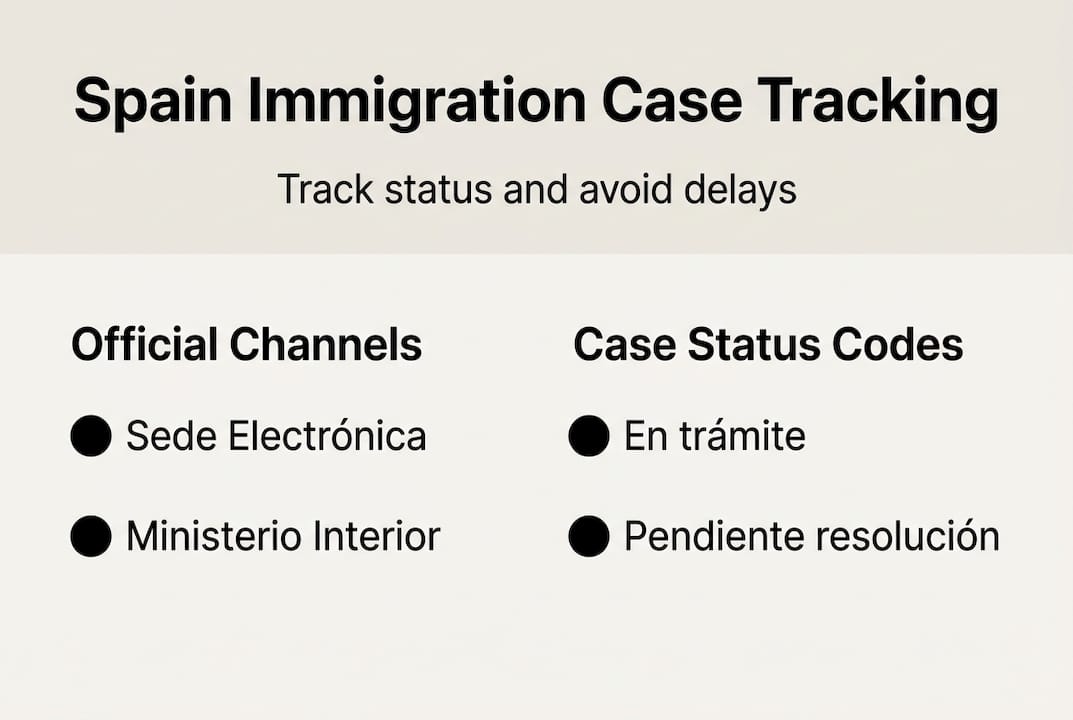
Common status codes include:
| Status Code | Meaning | Your Next Action |
|---|---|---|
| En trámite | In process | Continue monitoring weekly |
| Resuelto favorable | Approved | Schedule TIE card pickup |
| Resuelto no favorable | Denied | Review denial reasons, consider appeal |
| Documentación pendiente | Documents needed | Submit requested items immediately |
| Pendiente de resolución | Awaiting decision | No action needed, check regularly |
| Archivado | Archived/closed | Contact office to understand why |
En trámite is the status you’ll see most often. It simply means your case is moving through the system. Don’t panic if it stays here for weeks. Processing times vary wildly by province and application type.
Resuelto favorable is what you’re waiting for. Once you see this, you typically have 30 days to collect your residence card. The portal may provide additional instructions or appointment links.
Documentación pendiente requires immediate attention. Log into the authenticated portal for details about which documents are needed. You usually have 10-15 days to respond, and missing this deadline often results in automatic denial.
“Status updates typically batch on Thursdays following weekly processing reviews. If you check Friday morning and see no change from the previous week, the next likely update window is the following Thursday evening.”
Not all changes appear in real time. Immigration offices update their systems in batches, often weekly or biweekly. This means your case might have progressed, but the digital system hasn’t reflected it yet. If you see conflicting information between portals, the Sede Electrónica typically has the most current data.
Transitional codes like “Pendiente de resolución” indicate your case has completed initial review and awaits final decision. This stage can last days or months depending on office workload.
For specialized applications like EU Family Card options or the Student to Worker pathway, additional status codes may appear related to labor market tests or family relationship verification.
Common pitfalls, delays, and escalation strategies
Even with diligent tracking, problems arise. Knowing the most frequent pitfalls and how to address them can mean the difference between a successful application and starting over.
Three critical mistakes derail more cases than any others:
-
Ignoring requerimientos: When the system shows “Documentación pendiente,” you must act within the specified timeframe. Set a calendar alert for three days before the deadline as a safety buffer.
-
Inconsistent monitoring: Checking once at the start and once at the expected completion date misses crucial mid-process updates. Weekly checks catch issues while you still have time to fix them.
-
Misunderstanding batch timing: Expecting daily updates leads to unnecessary anxiety. Updates typically process after Thursdays, so checking Friday mornings is more productive than random daily checks.
If your case exceeds typical processing times for your application type, escalation becomes necessary. Standard processing ranges from 20 days for EU registration to 90 days for work permits, though major city backlogs can extend this by three months.
Escalation steps:
- Document everything: Save screenshots of every status check with dates
- Request a cita previa (prior appointment) at your local immigration office
- Bring your expediente number, all submitted documents, and your tracking log
- If the office provides no resolution, consider filing a formal complaint (reclamación)
- Engage legal counsel if delays approach six months beyond standard processing
Pro Tip: For applications in Madrid or Barcelona, build an extra 60-90 days into your timeline expectations. These offices handle the highest volumes and consistently run behind schedule. Planning for delays reduces stress and prevents hasty decisions.
Certain pathways like internship residence have stricter timelines tied to academic calendars. If you’re on a time-sensitive track, escalate earlier rather than waiting for standard processing windows to expire.
Best practices for proactive and efficient tracking
Transforming case tracking from a reactive chore into a proactive system gives you control and peace of mind throughout your immigration journey.
Implement these strategies for optimal tracking:
- Set recurring reminders: Use your phone’s calendar to schedule weekly checks every Friday morning, aligning with Thursday batch updates
- Create a tracking spreadsheet: Log each check date, status seen, and any changes from the previous week
- Screenshot everything: Save visual proof of each status, including the full URL and timestamp
- Use multiple verification methods: Cross-reference Sede Electrónica with the Ministerio del Interior portal monthly
- Enable SMS alerts: Register your phone number if you haven’t already to receive automatic notifications
Professional legal services with online client dashboards add another layer of oversight. These platforms often integrate directly with official systems, providing consolidated views of your case alongside expert interpretation of status changes.
If family members or legal representatives assist with your application, share your tracking credentials securely. Use a password manager to grant access without exposing your master passwords. This ensures someone else can monitor your case if you’re traveling or unavailable.
Pro Tip: Set up a dedicated email folder for all immigration-related correspondence. Filter messages containing your expediente number automatically into this folder so you never miss an official communication buried in your inbox.
Consider the timing of your checks strategically. Avoid checking late at night when you can’t take immediate action if you discover a requerimiento. Friday mornings after Thursday updates give you the full business day to respond if needed.
For complex cases involving multiple family members or simultaneous applications, create separate tracking logs for each expediente. Mixing information between cases causes confusion and potential missed deadlines.
How Vive Legal helps with case tracking and immigration
Navigating Spain’s immigration system alone means juggling multiple portals, decoding status updates, and hoping you catch every critical notification. Professional support transforms this reactive scramble into a managed, transparent process.
Vive Legal provides a secure online dashboard that consolidates all your case information in one place. Instead of checking multiple government portals, you log into a single interface showing real-time updates, document status, and upcoming deadlines. Our system monitors official channels continuously, alerting you immediately when your status changes or action is required.
Our legal experts interpret status codes in plain language, explaining exactly what each update means for your timeline and next steps. When a requerimiento appears, we don’t just notify you—we review what’s needed, help gather the correct documents, and ensure your response meets all technical requirements before submission.
This integrated approach eliminates the most common causes of application delays and denials. You’re never left wondering if you missed something or submitted the wrong format. Our platform tracks every interaction, creating an audit trail that protects you if questions arise about your case management.
Whether you’re pursuing extraordinary regularization, arraigo social, or any other residence pathway, our technology and expertise work together to maximize your approval chances. Explore our full range of online immigration services to see how we can support your specific situation.
Frequently asked questions
How often should I check the status of my immigration case in Spain?
Check at least once weekly, preferably on Friday mornings after Thursday batch updates, and always within 48 hours of submitting new documentation.
What does ‘documentación pendiente’ mean in my status?
‘Documentación pendiente’ means the immigration office requires additional documents. You typically have 10-15 days to respond, so act immediately to avoid automatic denial.
Which official portal should I use for case status tracking?
Use the Sede Electrónica portal for the most comprehensive updates, or the Ministerio del Interior site for quick checks without authentication.
What information do I need at hand to check my case?
You need your expediente number, NIE or DNI, and date of birth. Some portals also require your passport number or digital authentication credentials.
What should I do if my case is delayed for months?
Save all tracking logs, escalate via cita previa at your local office, and consider legal counsel if delays exceed six months beyond standard processing times for your application type.
Recommended
Living legally in Spain shouldn't be difficult.
View services and pricesNot sure which procedure you need? Find out in 2 min
Questions? Message us on WhatsApp