
Essential guide to data protection in Spanish legal services

TL;DR:
- Spain enforces strict data protection laws with significant fines for non-compliance, especially in legal services.
- Legal providers must follow core obligations like providing privacy notices and maintaining records, even for small firms.
- Cross-border data transfers in immigration cases require safeguards like SCCs or derogations to ensure GDPR compliance.
When the Spanish data protection authority, the AEPD, levied €35.5M in fines in 2024 alone, it sent a clear signal that privacy compliance is no longer optional, especially for legal service providers. If you are an expatriate managing immigration documents in Spain, or a legal advisor helping clients with residency permits, the rules governing your personal data are tighter than most people realize. This guide cuts through the regulatory noise and gives you a practical, no-nonsense look at what data protection means in the context of Spanish legal services, who is responsible, what can go wrong, and how to stay protected.
Living legally in Spain shouldn't be difficult.
View services and pricesNot sure which procedure you need? Find out in 2 min
Questions? Message us on WhatsApp
Table of Contents
- Why data protection matters in Spanish legal services
- Core data protection obligations for legal service providers
- Handling cross-border data in expat and immigration cases
- Managing high-risk data and breach notification duties
- The missing reality: Practical pitfalls and overlooked risks
- How Vive Legal supports compliance for expats and law firms
- Frequently asked questions
Key Takeaways
| Point | Details |
|---|---|
| AEPD enforcement rising | Fines for privacy breaches are up 19 percent, making compliance critical for legal providers. |
| Cross-border transfers need safeguards | Sending data to non-adequate countries requires SCCs or contract necessity exceptions. |
| High-risk data requires extra steps | Handling biometrics or sensitive immigration data means performing DPIAs and quick breach reporting. |
| Resources exist for small firms | SME guides from the AEPD help solo lawyers and boutique law firms manage compliance affordably. |
Why data protection matters in Spanish legal services
Spain’s data protection framework is built on two pillars: the EU’s General Data Protection Regulation (GDPR) and the Spanish Organic Law on Data Protection, known as the LOPDGDD. Together, they create a strict set of rules for anyone processing personal information, and legal service providers sit right at the center of that obligation.
The AEPD is the enforcement arm of this framework. It investigates complaints, conducts audits, and issues fines. In 2024, AEPD enforcement actions targeted sectors with poor transparency practices and unlawful data processing, and the legal sector was not exempt. Fines can reach €20 million or 4% of global annual turnover, whichever is higher.
For expatriates, the stakes are even more personal. Immigration cases require sharing sensitive documents such as passports, biometric residence cards, work contracts, criminal background checks, and health records. These documents reveal not just your identity, but your legal status in a foreign country. A data breach in an immigration case is not just a privacy violation. It can directly affect your residency rights.
Here is what makes immigration cases especially high-risk from a data standpoint:
- Identity and biometric data are processed at nearly every stage of an immigration procedure
- Legal status information (undocumented, student visa, pending renewal) is considered sensitive in practice
- Third-party sharing with embassies, consulates, and government bodies increases exposure
- Digital platforms handling immigration processes face increasing scrutiny for cybersecurity practices
Legal service providers handling expat legal services must also navigate recent trends, including stricter transparency requirements and marketing restrictions. You cannot simply collect a client’s email address during an immigration consultation and then add them to a newsletter without explicit, separate consent.
“AEPD’s 2024 annual report specifically flagged transparency failures and unlawful processing as the most sanctioned categories, making these the top compliance risks for any legal service operating in Spain.”
Pro Tip: If you are using a legal advisor or platform for tasks like modifying student to work permits, ask them directly: “What is your legal basis for processing my data?” A compliant provider should answer this without hesitation.
Core data protection obligations for legal service providers
Knowing the risk is one thing. Understanding what the law actually requires is where most small firms fall short. The AEPD 2025-2030 strategic plan confirms that no sector-specific guide exists for law firms, but SME guidelines apply to small offices and solo practitioners, known as autónomos in Spain.
Here are the key obligations every legal service provider must meet:
- Identify the legal basis for processing each type of client data (contract performance, legal obligation, or legitimate interest)
- Provide a clear privacy notice to clients before or at the time of data collection, in plain language
- Keep a Record of Processing Activities (RoPA), a documented inventory of what data is collected, why, and how long it is kept
- Apply security measures proportionate to the sensitivity of data processed, including encryption for digital files
- Train staff on data handling procedures and limit access on a need-to-know basis
- Respond to subject access requests within one month of receipt
For immigration law specifically, the legal basis is typically contract performance (processing data to complete a service the client requested) or compliance with a legal obligation (submitting required documents to authorities).
| Obligation | Who it applies to | Deadline or frequency |
|---|---|---|
| Privacy notice | All legal service providers | At point of data collection |
| Record of Processing Activities | Firms with 250+ employees or high-risk data | Ongoing, updated regularly |
| Security assessment | All processors of sensitive data | At least annually |
| Staff training | All staff accessing client data | At least once per year |
| Subject access response | All controllers | Within 30 days of request |
You can find current compliance resources for law firms that translate these obligations into practical steps. Additionally, reviewing service agreements and data policies on any platform you use can tell you a great deal about how your information is being handled.
Pro Tip: Even if your firm has fewer than 10 employees, you are still required to maintain a RoPA if you regularly process sensitive data categories like immigration status or biometric information. “Small” does not mean exempt.
Handling cross-border data in expat and immigration cases
One of the most overlooked aspects of immigration law is that it almost always involves cross-border data transfers. When a legal advisor sends your documents to a foreign embassy, uploads files to a consulate portal, or forwards information to an authority in your home country, they are triggering international transfer rules under the GDPR.
A cross-border transfer occurs any time personal data moves outside the European Economic Area (EEA). Countries within the EEA, plus a short list of countries with EU adequacy decisions (like Japan and the UK), are considered safe. Everyone else is classified as a non-adequate country, and that is where things get complicated.
For transfers to non-adequate countries, legal service providers must rely on one of the following:
- Standard Contractual Clauses (SCCs): Pre-approved contract terms issued by the European Commission that create binding obligations on the recipient
- Binding Corporate Rules: Used by large multinationals, rarely applicable to small law firms
- Derogations: Exceptions such as contract necessity, where the transfer is essential to perform the service the client requested
International transfers require either SCCs or a recognized derogation like contract necessity when data flows to non-adequate countries. For immigration consultants, the “contract necessity” derogation is the most practical option when sending a client’s passport copy to their home country’s consulate.
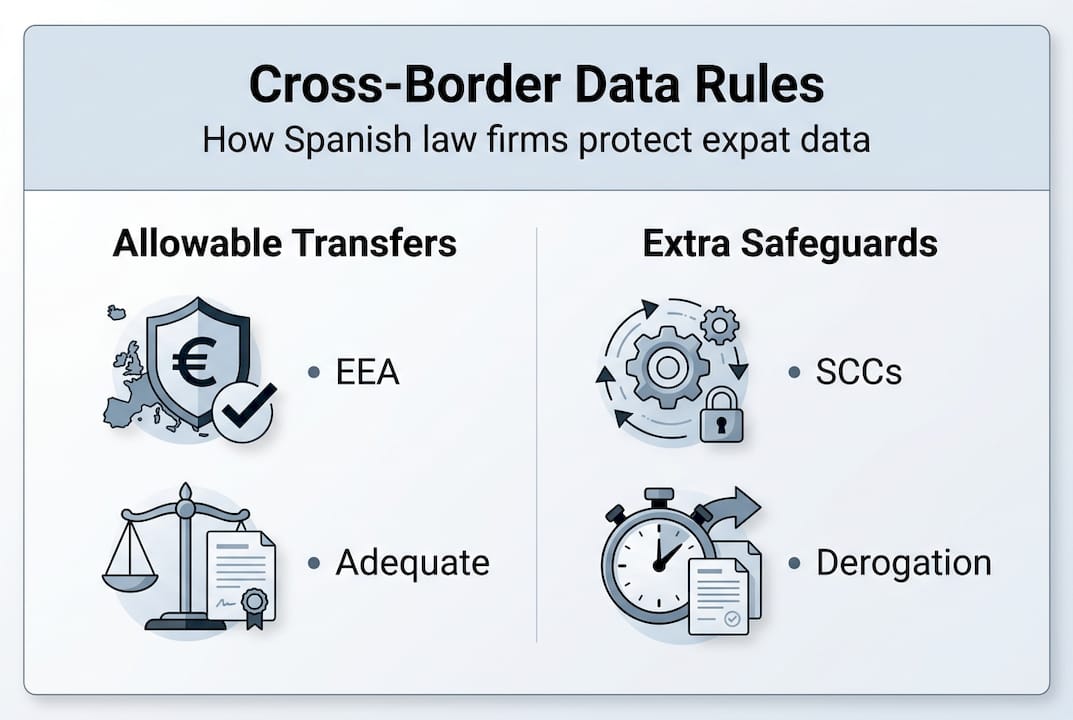
Key comparison: EEA vs. non-EEA data transfers
| Transfer destination | Safeguard required | Common example in immigration |
|---|---|---|
| EEA country | None | Sending files to German embassy in Madrid |
| Adequate country (e.g., UK) | None | Sharing with UK Home Office |
| Non-adequate country (e.g., Morocco) | SCCs or derogation | Apostille documents sent to Moroccan consulate |
Study centers that manage immigration management for study centers often handle exactly these kinds of cross-border transfers on behalf of international students, making compliance especially important.
Statistic callout: If a cross-border transfer is part of a data breach that puts individuals’ rights at risk, the AEPD must be notified within 72 hours. That window starts the moment the breach is discovered, not when it is confirmed. You can review how cross-border data clauses are typically structured in compliant service agreements.
Managing high-risk data and breach notification duties
Not all personal data carries the same legal weight. Biometric data, health information, and immigration case files are classified as special category data under GDPR, and they trigger additional obligations for anyone processing them.

The most significant of these obligations is the Data Protection Impact Assessment, or DPIA. This is a formal risk analysis that must be completed before you begin processing high-risk data. High-risk processing involving biometrics or AI-powered legal tools requires a DPIA, and any data breach presenting a risk to individuals’ rights must be reported to the AEPD within 72 hours.
Here is the step-by-step process if a breach occurs:
- Identify the breach and stop further data exposure immediately
- Assess the risk level: Does this affect sensitive data? Could it harm someone’s residency status?
- Notify the AEPD within 72 hours using their official online notification portal if there is any risk to individual rights
- Notify affected individuals without undue delay if there is a high risk of harm to them personally
- Document everything: Record the nature of the breach, what data was involved, and every action taken
“The 72-hour clock starts ticking from the moment you become aware of a breach, not when you finish investigating it. Waiting until you have the full picture is one of the most common and costly mistakes firms make.”
Real-world example: An immigration advisor accidentally emails a client’s passport scan and visa application to the wrong person. That single error involves biometric and immigration status data, triggers a DPIA review, and likely requires both AEPD notification and client notification. Reviewing how Privacy Policy requirements are structured can help firms understand what must be disclosed to clients about breach procedures.
Pro Tip: Create a one-page internal breach response checklist and keep it accessible to everyone in the office. In a high-stress moment, nobody should be searching for the AEPD notification portal for the first time.
The missing reality: Practical pitfalls and overlooked risks
Regulations tell you what to do. Experience tells you what people actually do, and the gap between those two things is where most compliance failures live.
The uncomfortable truth is that many small law firms and immigration consultants in Spain treat data protection as a one-time checkbox. They generate a template privacy policy, file it away, and consider themselves compliant. But the AEPD is increasingly focused on real-world enforcement in legal tech and AI-assisted platforms, where DPIAs and breach notifications are frequently skipped despite heightened scrutiny.
The most overlooked risks we see in practice:
Loose handling of embassy and consulate transfers. Many firms treat these as routine administrative steps, not data transfers requiring legal safeguards. That is a compliance gap that can become an expensive problem.
Template documents with no real customization. A DPIA that does not reflect your actual tools and workflows offers zero legal protection. The AEPD auditors know what a generic template looks like.
Annual audits replacing ongoing awareness. Data protection is not a once-a-year event. Quarterly reviews, especially after onboarding new software, are far more effective than annual checkups.
You can find practical, up-to-date immigration compliance insights that translate regulatory changes into actionable steps for both individuals and legal service providers navigating this landscape.
How Vive Legal supports compliance for expats and law firms
Navigating Spanish immigration procedures while staying data-compliant is genuinely complex. You should not have to choose between getting your paperwork done quickly and knowing your personal information is handled correctly.
Vive Legal immigration services integrate data security directly into the immigration process, using encrypted document handling, transparent privacy practices, and professional oversight at every step. Whether you need help with arraigo social processes or managing an EU Family Card handling procedure, every case is managed through a secure digital platform designed to meet GDPR and LOPDGDD requirements. You get fast, professional immigration support without sacrificing your privacy rights.
Frequently asked questions
What is the AEPD and why does it matter for legal services?
The AEPD is Spain’s data protection authority responsible for enforcing privacy rules and issuing fines; it actively monitors legal and immigration service providers, as shown by its €35.5M in fines issued in 2024 alone.
How quickly must a Spanish law firm report a data breach?
If individuals’ rights are at risk, the firm must report the breach to the AEPD within 72 hours of discovery, regardless of whether the investigation is complete.
What are non-adequate countries in data transfers?
These are countries outside the EEA without an EU adequacy decision, requiring legal firms to use SCCs or contract necessity as a safeguard before transferring any client data.
Does the AEPD provide sector-specific data protection guides for lawyers?
There are no exclusive guides for the legal sector, but the AEPD’s 2025-2030 plan provides SME tools and compliance resources that apply directly to small law firms and solo practitioners.
Recommended
Living legally in Spain shouldn't be difficult.
View services and pricesNot sure which procedure you need? Find out in 2 min
Questions? Message us on WhatsApp