
Data security steps for Spanish immigration in 2026

TL;DR:
- Proper data security and document handling are essential to prevent application delays or rejections.
- Using official certified processes, secure storage, and timely updates ensures compliance with Spanish immigration requirements.
- Professional legal assistance helps applicants navigate complex procedures and avoid common security mistakes.
One overlooked document error can suspend your Spanish residency application for up to three months. That’s not a warning buried in fine print. It’s a documented consequence that catches thousands of applicants off guard every year, often because they treat data security as an IT problem rather than a legal one. This guide explains exactly how to protect your sensitive information, organize your files correctly, and meet every compliance requirement for residency and regularization procedures in Spain. From apostilles to encrypted uploads, what you handle before you submit matters just as much as what you send.
Living legally in Spain shouldn't be difficult.
View services and pricesNot sure which procedure you need? Find out in 2 min
Questions? Message us on WhatsApp
Table of Contents
- Why data security matters in Spanish legal immigration processes
- Document handling and digital submissions: Key rules for 2026
- Most common data security mistakes in Spanish residency applications
- Best practices for protecting your data in Spanish legal processes
- What most applicants get wrong about data security in Spanish legal filings
- Let legal experts help you stay secure and compliant
- frequently asked questions
Key Takeaways
| Point | Details |
|---|---|
| Strict document rules | Submissions must use valid, apostilled, and securely organized documents for acceptance. |
| Secure digital handling | Using certified digital tools and encrypted storage reduces risk of application delays or rejections. |
| Avoid common pitfalls | Mistakes like expired documents or insecure delivery can cause suspensions of up to three months. |
| Pro guidance helps | Legal professionals help ensure security and compliance, boosting application success rates. |
Why data security matters in Spanish legal immigration processes
Spanish immigration procedures are governed by strict legal standards that go far beyond simply filling out a form. Every document you submit becomes part of an official legal record, and how you handle, store, and transmit those documents carries real consequences. Many applicants underestimate this layer of responsibility until something goes wrong.
The stakes are significant. Digital submissions require digital certificates, correct document validation, and verified identity tools for 2026 regularization applications to avoid delays or suspensions. This means submitting through unofficial channels or with improperly certified documents is not just a minor procedural slip. It can trigger immediate complications.
Here’s what poor data handling actually leads to:
- Application suspensions lasting up to three months
- Full rejections requiring you to restart the process
- Loss of your submission window, especially critical during the April to June 2026 intake period
- Financial and personal stress from extended legal limbo
- Risk of exposing sensitive personal data to unauthorized parties
Secure document management, on the other hand, does the opposite. It keeps your case clean, your timeline predictable, and your personal information protected. Meeting data privacy obligations under Spanish law is not optional. It’s part of the application itself.
“The single biggest mistake applicants make is treating their immigration documents like regular files. They’re legal instruments. How you handle them defines whether your case moves forward or stalls.”
Pro tip: Always use official digital submission platforms and only upload documents that carry a certified digital signature or official apostille. Third-party file sharing tools like personal email or consumer cloud drives are not compliant platforms for legal submissions.
Think of your document workflow as a chain. Every link matters. A single weak point, whether it’s an unencrypted email or an expired certificate, can compromise the entire application.
Document handling and digital submissions: Key rules for 2026
The 2026 regularization window runs from April to June. That timeline is fixed. If your documents aren’t in order before that window closes, you wait. Understanding the exact requirements for compliant submission is what separates successful applicants from those who face avoidable setbacks.
Documents for legal immigration must be apostilled and sworn translated, and valid within the prescribed timeframe. Missing any one of these conditions triggers application issues that can set your process back by months.
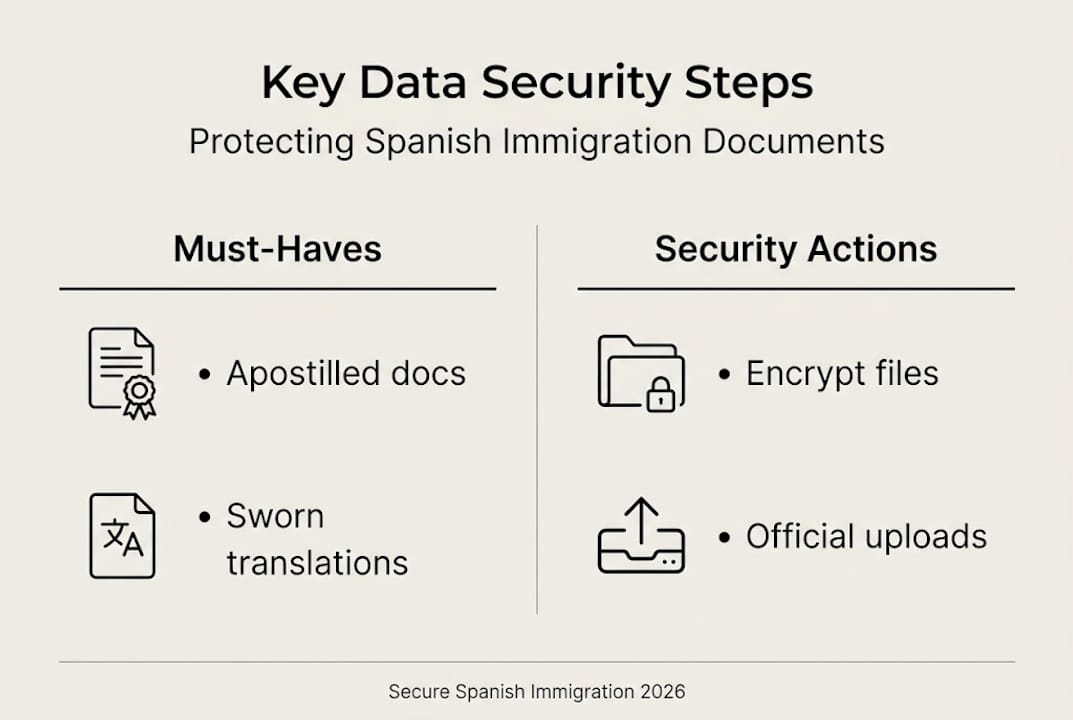
Here’s a clear breakdown of what compliant documents look like:
| Document type | Required validity | Security measure required | Example documents |
|---|---|---|---|
| Civil registry records | Under 90 days | Official apostille | Birth certificate, marriage record |
| Criminal background check | Under 90 days | Official apostille + sworn translation | Police clearance certificate |
| Employment or income proof | Under 180 days | Official stamp or notarization | Pay slips, tax records |
| Educational certificates | Per institution rules | Official apostille + sworn translation | University diplomas |
| Identity documents | Must be current and valid | Digital certificate for submission | NIE, passport, national ID |
For study center submissions, additional certification from your institution may be required depending on your residency category.
Here’s the step-by-step process for secure digital delivery:
- Download documents from official sources only. Government portals and certified institutions are your starting point.
- Check validity dates before doing anything else. Documents that expire before your submission date are useless.
- Get apostilles applied through the official channels of the issuing country.
- Commission sworn translations from a translator certified by the Spanish Ministry of Foreign Affairs.
- Convert files to PDF/A format, which is the standard for archival legal documents.
- Apply your digital certificate using the official Spanish government digital signature tools.
- Upload through the official submission platform designated for your specific residency category.
Pro tip: Keep encrypted digital copies of every document before submission. Use a tool like AES-256 encryption for file storage. If the platform has an issue during upload, you’ll need clean originals ready to resubmit immediately.

Most common data security mistakes in Spanish residency applications
Even well-prepared applicants make avoidable errors. The problem is that most of these mistakes feel minor in the moment but carry outsized consequences. Late or invalid documents can result in three-month suspensions or outright rejections in Spanish immigration processes. That’s not a theoretical risk. It’s a routine outcome for applicants who don’t follow protocol.
Here’s a side-by-side comparison of secure versus insecure handling practices:
| Practice area | Safe approach | Risk-prone approach |
|—|—|—|
| Document transmission | Official encrypted portal | Personal email with attachment
| File storage | Password-protected encrypted folder | Desktop folder without protection
| Document certification | Official apostille from issuing country | Self-certified or uncertified copies
| Translation | Ministry-certified sworn translator | Free online translation tool
| Internet connection | Private, secured network | Public Wi-Fi at a café or library
The five most common mistakes applicants make are:
- Missing apostilles: Documents from outside Spain require apostille certification. Without it, they’re not legally valid.
- Using expired documents: Even if your document was valid when you gathered it, if it expires before submission, it’s rejected.
- Wrong translator: Only translators officially certified by the Spanish Ministry of Foreign Affairs produce legally accepted sworn translations.
- Using public Wi-Fi: Any document access or upload done over an unsecured network exposes your personal data.
- Not backing up files: Platform outages happen. Without a secure backup, you may lose progress or have to recertify documents.
A single missed deadline or an invalid file doesn’t just slow things down. It resets your clock by up to three months, which during a tight application window can mean waiting an entire year before your next opportunity.
The fix isn’t complicated. Build a checklist, check every document against it twice, and never upload anything without first verifying its current validity.
Best practices for protecting your data in Spanish legal processes
Early document gathering and secure organization are the clearest predictors of a successful application. This isn’t just good advice. It’s what Spanish immigration legal experts consistently recommend to avoid rejections and suspensions.
Follow this security checklist for every stage of your application:
- Create a dedicated folder structure: Label folders by document type (Identity, Criminal, Financial, Educational). Never mix categories.
- Name files clearly: Use a format like LastName_DocumentType_Date.pdf. This prevents version confusion during submission.
- Apply encryption to stored files: Use tools like 7-zip with AES-256 or built-in OS encryption before saving anything to cloud storage.
- Use a password manager: Every account connected to your immigration process needs a unique, strong password.
- Enable two-factor authentication: Official government portals and legal platforms support this. Use it.
- Back up to two separate locations: One local encrypted drive and one secure cloud folder.
- Review your TIE application security requirements before final submission to confirm format and certification standards are met.
Using professional legal assistance adds another layer of protection. A qualified immigration advisor reviews your documents before they reach the official system, catching errors that software can’t detect. That second set of eyes has stopped countless applications from being flagged.
“In my experience, the applicants who succeed aren’t necessarily better organized by nature. They’re the ones who followed a clear, repeatable process every single time and asked for help when they hit a wall.”
Pro tip: Set calendar reminders for every document’s expiration date. If a document expires within 30 days of your planned submission, renew it now. Don’t wait.
What most applicants get wrong about data security in Spanish legal filings
Here’s an uncomfortable truth: most applicants think data security is about firewalls and passwords. It’s not. Or rather, it’s not only that.
In our experience working with immigration cases across Spain, human handling errors cause far more application failures than digital breaches. An improperly labeled file, a forgotten apostille, a sworn translation from the wrong provider. These are not technology failures. They’re process failures.
The myth that digital security tools alone protect your case leads applicants to invest in the wrong things. They use encrypted cloud storage but email sensitive files in plain text. They enable two-factor authentication but submit documents through unofficial platforms.
Real security in legal immigration is structural. It comes from understanding your privacy policy details responsibilities, following a strict document protocol, and checking your work before it leaves your hands. Prevention through structure beats any reactive fix. The applicants who never face suspensions aren’t the ones with the best software. They’re the ones who built the right habits and got expert eyes on their case before hitting submit.
Let legal experts help you stay secure and compliant
Managing your own immigration paperwork in Spain is possible, but it requires precision that’s hard to maintain without professional support. One mishandled file or expired certificate can unravel weeks of preparation.
At vive.legal, our team combines legal expertise with secure digital tools to manage your residency process from start to finish. Whether you’re preparing for the 2026 regularization window or navigating a specific permit category, we review every document, verify compliance requirements, and handle submissions through certified channels. You get a secure client portal, step-by-step updates, and professional oversight at every stage. Stop guessing and start your application with the confidence that comes from working with specialists who do this every day.
frequently asked questions
What digital tools are needed for secure Spanish immigration applications in 2026?
Digital certificates, official submission platforms, and encrypted file storage are the three core tools required. Digital submissions require digital certificates for all 2026 regularization and residency applications.
How long are official documents valid for Spanish legal processes?
Most documents must be less than 90 to 180 days old at submission. Documents must be valid within these timeframes or they will be rejected outright.
What happens if I miss a deadline or submit the wrong file?
Your application can be suspended for three months or fully rejected. Late or invalid documents lead to three-month suspensions, making timing and accuracy absolutely critical.
Do I need professional legal help to submit immigration documents securely?
Professional support is not legally required, but it significantly reduces the risk of errors that delay or derail your application. An experienced advisor catches issues before they reach the official system.
Recommended
Living legally in Spain shouldn't be difficult.
View services and pricesNot sure which procedure you need? Find out in 2 min
Questions? Message us on WhatsApp