
Defining Residency in Spain: Key Rules and Impacts

Sorting fact from fiction about residency in Spain can quickly become overwhelming for expatriates and foreign workers. Misunderstanding the difference between simply being present and achieving legal residency in Spain risks more than missed paperwork—it can impact your right to work, healthcare access, and even your ability to stay in the country. This guide tackles common myths, the actual administrative processes, and the clear distinctions that matter for both European Union and non-European Union citizens.
Table of Contents
- Residency In Spain: Core Definition And Myths
- Main Residency Types: EU And Non-EU Citizens
- Key Requirements For Residency Permits
- Legal Framework And Recent Reforms
- Rights, Responsibilities, And Tax Implications
- Common Mistakes And How To Avoid Them
Key Takeaways
| Point | Details |
|---|---|
| Legal Residency is Essential | Simply being present in Spain does not equate to legal residency; proper documentation and registration are required. |
| EU vs. Non-EU Requirements | EU citizens must register after three months; non-EU citizens need a residence permit before arriving in Spain. |
| Healthcare and Rights | Legal residency grants access to public healthcare and educational services, essential for integration. |
| Tax Obligations | Residents must report worldwide income if they stay more than 183 days in Spain, highlighting the need for tax compliance. |
Residency in Spain: Core Definition and Myths
Residency in Spain sounds straightforward until you actually start researching it. Then you hit a wall of conflicting information, half-truths, and assumptions that could derail your entire relocation plan. The core issue? Most people confuse simply being present in Spain with legally residing there. These are two completely different things, and the gap between them has serious consequences for your legal status, employment eligibility, and access to services.
Living legally in Spain shouldn't be difficult.
View services and pricesNot sure which procedure you need? Find out in 2 min
Questions? Message us on WhatsApp
Let’s start with the actual definition. Legal residency in Spain means you have obtained the proper documentation and registration that authorizes you to live in the country for a specified period. This is not the same as tourism or a short visit. For EU citizens, the rules differ from non-EU nationals, but both groups need to understand their specific requirements. Non-EU nationals must secure a residence permit before arriving, while EU citizens have more flexibility but still need to register under certain conditions. The distinction matters because your legal status determines what you can and cannot do.
Here’s where myths commonly derail people. Many believe that simply renting an apartment and living there for months automatically makes them a legal resident. False. Others assume that having a Spanish bank account, opening a business, or working for a local employer means they’re legally resident. Also false. What actually establishes legal residency is obtaining the required documentation from Spanish immigration authorities and, when applicable, registering with the municipal registry (Padrón). The timeline varies depending on your situation. EU citizens moving to Spain need to register after three months of residence if their stay will exceed that duration. Non-EU nationals must have their residence permit approved before they even arrive.
Another persistent myth? That you can simply “stay” in Spain and sort out the paperwork later. This approach creates a murky legal situation where you’re working without authorization, cannot access healthcare or education benefits properly, and risk fines or deportation. One more false belief: that all residence permits last the same length of time. They don’t. Duration depends on your specific category—work visas, family reunification permits, student visas, and retirement visas all have different validity periods and renewal requirements.
Understanding Spain’s living and working conditions from official sources helps clarify these distinctions. What remains constant across all categories is this: your legal residency status affects employment opportunities, healthcare access, taxation, and your ability to travel freely outside Spain.
Pro tip: _Confirm your specific residency category before taking any action toward relocation, as documentation requirements and timelines differ drastically between EU citizens, non-EU workers, students, and family members joining existing residents.
Main Residency Types: EU and Non-EU Citizens
The path to legal residency in Spain splits into two fundamentally different routes depending on your citizenship. This distinction is not just bureaucratic window dressing. It affects which documents you need, how long approval takes, what rights you have, and even how much you’ll spend. Understanding which category applies to you is your first critical decision.
EU Citizens: Freedom of Movement Advantages
If you hold citizenship from any European Union member state, congratulations. You benefit from the right to freedom of movement, one of the core principles of EU law. This means you don’t need a visa to enter Spain or live there. However, freedom of movement does not mean freedom from registration. This is where many EU citizens stumble. You can arrive and stay up to three months without any formal notification. After three months, though, the rules change. You must register with Spanish authorities if your stay will exceed that timeframe. This registration process, while simpler than what non-EU citizens face, is mandatory. EU citizens typically register through local municipal offices or immigration authorities depending on their region, and the process requires proof of residence, identification, and sometimes proof of financial means or health insurance.
Your rights as an EU resident include access to employment without a work permit, ability to open businesses, and increasingly, access to public healthcare and education. However, these rights come with obligations. Spain can still reject your residency if you’re deemed a threat to public order or if you lack sufficient resources to support yourself.
Non-EU Citizens: The Visa and Permit Framework
Non-EU nationals face a completely different reality. You cannot simply arrive in Spain and figure things out later. You must obtain a residence permit before entering Spain in most cases. Understanding EU freedom of movement rights helps clarify why non-EU citizens need pre-authorization while EU citizens don’t. The non-EU residency framework includes multiple categories: work visas for employees and self-employed individuals, student visas for academic programs, family reunification permits for joining relatives already in Spain, investor visas for those with significant capital, and special permits for specific situations.

Each non-EU category has different validity periods. A work visa might last one year initially, renewable annually. A student visa typically covers the length of your studies plus a grace period. Family reunification permits often span longer periods. The application process requires extensive documentation: employment contracts, proof of income, housing arrangements, medical certificates, criminal record checks, and in many cases, proof of financial resources. Processing times range from four weeks to several months depending on the category and your specific circumstances.
Key Differences at a Glance
EU citizens can move and reside freely without pre-authorization but must register after three months. Non-EU nationals must secure approval before arrival. EU citizens access employment and business rights automatically. Non-EU nationals need specific permits matching their intended activity. Both groups eventually need documentation proving their legal residency status in Spain, whether that’s a registration certificate for EU citizens or a residence permit card for non-EU nationals.
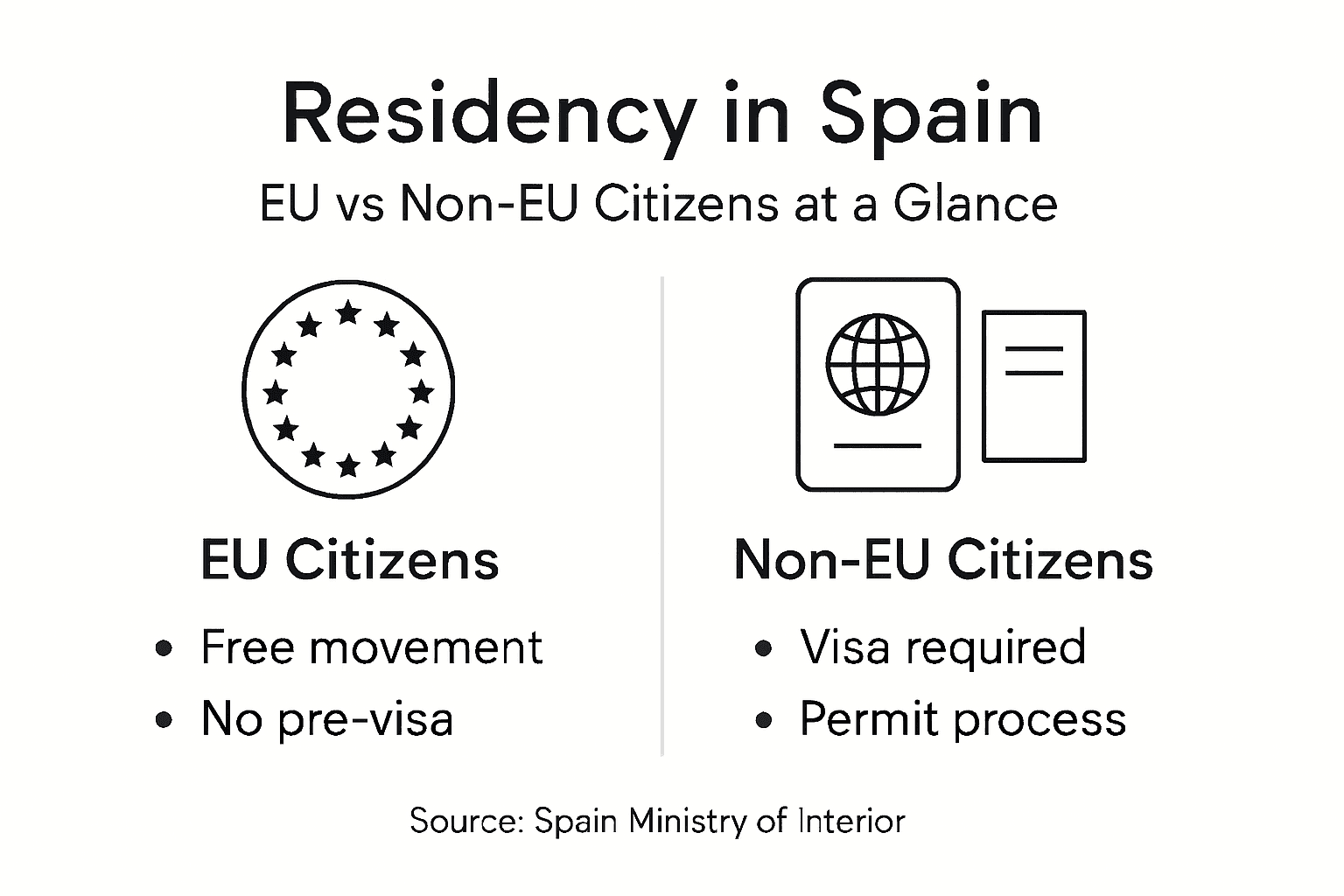
Pro tip: Verify your exact citizenship status and eligibility category at least three months before your intended move to Spain, as documentation requirements and processing timelines differ dramatically between EU and non-EU pathways.
To better understand the two main pathways to legal residency in Spain, consider this side-by-side comparison:
| Criteria | EU Citizens | Non-EU Citizens |
|---|---|---|
| Need visa before arrival | No, entry is visa-free | Yes, permit required before arrival |
| Registration deadline | After 3 months of stay | Upon arrival, with residence permit |
| Main approval authority | Municipal or immigration office | Spanish embassy or consulate |
| Proof of financial means | Usually required, less strict | Required, higher minimums |
| Access to employment | Yes, no work permit needed | Only if permit allows employment |
| Typical processing time | 1-4 weeks | 4-12 weeks or longer |
| Permit renewal periods | Varies, generally less strict | Defined by permit category |
Key Requirements for Residency Permits
You cannot simply fill out a form and hope for approval. Spanish immigration authorities demand specific documentation and evidence before they’ll grant you legal residency. The requirements differ based on your residency category, but certain core elements appear across almost every application. Understanding what you need to provide, and gathering it correctly, dramatically increases your approval odds and reduces delays that could cost you months.
Documentation and Financial Proof
Spanish authorities want assurance that you can support yourself without becoming a burden on the state. This means proving financial stability through bank statements, employment contracts, or proof of income. The exact amount required varies by region and your specific situation, but you’ll typically need to demonstrate monthly income or savings reserves. For EU citizens, the bar tends to be lower than for non-EU nationals, but both groups must provide evidence. Alongside financial proof, you need documentation establishing your right to accommodation in Spain. This could be a rental contract, proof of property ownership, or a letter from someone offering you housing. Spanish authorities will verify this address is legitimate.
Health insurance is another critical requirement. Spain requires residents to have valid health coverage, whether through employment, private insurance, or enrollment in the Spanish healthcare system. You’ll need proof of this coverage as part of your application. Additionally, you must obtain a foreigner identification number (NIE), which becomes your legal identifier throughout your residency period. The NIE application happens simultaneously with your residency permit application, and you cannot proceed without it.
Here is a summary of key residency documentation you will need to prepare:
| Requirement | Purpose | Notes |
|---|---|---|
| Passport or national ID | Proof of identity | Valid, unexpired document |
| Proof of accommodation | Establish address | Lease, title deed, or host letter |
| Health insurance | Meet coverage law | Private or public policy accepted |
| Financial proof | Show self-sufficiency | Income, savings, or job contract |
| Criminal record certificate | Ensure good conduct | Recent, translated if needed |
| Residency forms (e.g., EX-17) | Administrative process | Specific to permit type |
| Fee payment receipt | Procedure completion | Paid via form MOD 790 012 |
Criminal Record and Background Clearance
Spain performs criminal background checks on all residency applicants. You’ll need an official criminal record certificate from your home country, typically obtained within the three months before your application. If you’ve lived in other countries during the past five years, you may need certificates from those jurisdictions as well. The certificate must state “no convictions” or be translated and certified if it’s in another language. This requirement exists across all residency categories. Even minor offenses can complicate your application, so transparency with your legal representative becomes critical if you have any history.
Forms and Administrative Requirements
The Spanish government uses specific forms for residency applications. The most common form is the EX-17, used for standard residence permit applications by non-EU nationals. You’ll also need to complete form MOD 790 012 for fee payment. Understanding residency permit procedures includes knowing exactly which forms apply to your situation. The process requires submitting these forms to your nearest Spanish embassy or consulate if you’re applying from outside Spain, or to the relevant immigration office if you’re already in the country. Your application package will include the completed forms, all supporting documentation, proof of fee payment, and copies of your identification.
Processing timelines typically range from four to twelve weeks, depending on the complexity of your case and the volume of applications the office is handling. Submit everything together and in order. Incomplete applications get returned, resetting your timeline entirely. Once approved, you’ll receive your residency permit card or certificate, depending on your category.
Pro tip: Gather all original documents plus certified copies at least six weeks before you plan to submit your residency application, as document authentication and translation services often have waiting periods that could delay your overall timeline.
Legal Framework and Recent Reforms
Spain’s residency laws didn’t exist in a vacuum. They’re part of a constantly evolving legal system shaped by European Union directives, national legislation, and recent reforms designed to modernize how the country handles migration and integration. As an expatriate considering or navigating residency in Spain, understanding this legal backdrop helps you anticipate changes and comprehend why certain requirements exist. The framework has shifted noticeably in recent years, and knowing those shifts protects you from relying on outdated information.
Spain’s Migration Management Evolution
Spain’s legal framework for residency sits within the broader EU migration management system. The country has undergone significant legislative reforms to strengthen its legal migration systems and asylum procedures, aligning itself with European Commission standards and directives. These reforms address border control efficiency, reception conditions for new arrivals, and processing timelines for residency applications. Spain’s government has actively worked to streamline bureaucratic procedures that previously created bottlenecks lasting months. One tangible result is improved processing times for certain residency categories and better coordination between immigration offices across different regions. However, reforms also mean stricter documentation requirements and more thorough background verification. The Spanish immigration system continues evolving, with the European Commission providing support for legislative developments aimed at making processes more transparent and standardized.
Spain’s migration management approach reflects these EU aligned standards. What this means practically is that you cannot assume procedures from five years ago still apply. Requirements change, forms get updated, and processing methods improve or shift. Staying informed about current legal requirements becomes essential.
Healthcare and Social Integration Legal Changes
One of the most significant recent reforms affects your access to healthcare and social services based on residency status. Legal changes since 2018 have anchored residency as the basis for entitlement to healthcare and social services, fundamentally changing how integration works in Spain. Previously, accessing public healthcare required additional steps and documentation. Now, establishing legal residency creates an immediate pathway to healthcare enrollment and social service eligibility. This reform acknowledges that residents contribute to Spanish society and deserve equal protection and services.
These changes extend beyond healthcare. They affect your access to education, unemployment benefits, housing assistance, and other social programs. The legal principle underlying these reforms is universal access and equity for all legal residents regardless of origin. This represents a significant shift toward integration and away from provisional status uncertainty. For EU citizens, these reforms largely formalized what already existed. For non-EU residents, they created genuine rights previously tied to employment or sponsorship. Understanding this legal foundation helps you recognize why residency status matters so fundamentally to your life in Spain.
Practical Implications of the Legal Framework
These legal reforms mean several things for your residency strategy. First, your legal residency status determines access to fundamental services, not your employment status alone. Second, Spain continues aligning with EU standards, making the country’s processes increasingly transparent and standardized. Third, legal changes often happen without dramatic announcements, which is why consulting current resources before starting your application proves critical. Your rights and obligations expand or shift as legislation evolves.
Pro tip: Verify the current legal requirements with official Spanish government sources or qualified immigration professionals no more than two weeks before submitting your residency application, as legislative updates can affect documentation requirements or processing procedures.
Rights, Responsibilities, and Tax Implications
Residency in Spain comes with a bundle of rights that make your life there functional and fair. It also comes with obligations that many people underestimate until their first tax season arrives. The balance between these rights and responsibilities shapes your entire experience as a resident, and misunderstanding either side can create serious legal and financial problems.
Your Rights as a Legal Resident
Once you establish legal residency, you gain access to fundamental services and protections. Access to healthcare through Spain’s public system becomes your right, allowing you to receive medical treatment on the same basis as Spanish citizens. This is substantial. You can visit doctors, access emergency care, receive preventive services, and obtain prescriptions without paying out-of-pocket costs for most treatments. Education rights also expand. Children of residents can attend public schools at no tuition cost. Adult residents can access vocational training and continuing education programs. You gain the right to work without additional permits or restrictions, regardless of nationality. EU residents have always had this right, but non-EU residents gain employment authorization the moment their residency permit activates.
Social security protections represent another critical right. As a resident, you’re entitled to unemployment benefits if you lose your job, family allowances if you have children, disability benefits if applicable, and pension contributions if you’re employed. These aren’t charity. They’re part of the social contract you enter by becoming a legal resident and contributing to the system. You also gain property ownership rights, the ability to open businesses, and access to legal protections that Spanish citizens enjoy.
Tax Obligations and the 183 Day Rule
Here’s where many people encounter unwelcome surprises. Spain considers you a tax resident if you spend more than 183 days in the country during a calendar year. This is not negotiable and applies regardless of your residency status. Once you cross that 183-day threshold, you must file Spanish income tax returns on your worldwide income. Yes, worldwide. Not just Spanish income. If you’re working remotely for a foreign company while living in Spain, you owe Spanish taxes on that income. If you have rental income from property outside Spain, you report it to the Spanish tax authority.
The 183-day rule means you cannot simply live in Spain and pretend your foreign income doesn’t exist. Spain’s tax residency obligations form a core responsibility that catches many unprepared residents. Tax authorities track your days in Spain through multiple methods including airline records, bank transactions, and municipal registry data. Attempting to hide income or misrepresent your tax residency status leads to penalties, back taxes with interest, and potential prosecution. The Spanish tax authority takes this seriously.
The tax rate itself depends on your income level, but Spain’s progressive tax system can take 20 to 45 percent of income depending on your earnings. Additionally, you’ll pay social security contributions if you’re employed, property taxes if you own real estate, and value-added tax on purchases. These costs add up significantly and should factor into your financial planning before you move.
Other Legal Responsibilities
Beyond taxes, legal residents must comply with Spanish laws. This sounds obvious, but it includes registering your residence address with local authorities, respecting employment regulations, following housing codes, and maintaining proper documentation. You must renew your residency documentation before expiration. You’re required to have valid health insurance throughout your residency. You cannot engage in unauthorized work or business activities. You must respect traffic laws, environmental regulations, and all other Spanish legislation.
Pro tip: Consult a Spanish tax advisor or accountant during your first month of residency to understand your specific tax obligations and establish proper documentation systems, as tax compliance mistakes made in year one become increasingly costly to correct later.
Common Mistakes and How to Avoid Them
Residency applications fail for reasons that have nothing to do with eligibility. People get denied, delayed, or forced to restart because they make preventable errors. These mistakes cluster around specific patterns, and knowing them means you can dodge these pitfalls entirely. Learning from others’ failures costs you nothing except attention.
Timing and Documentation Delays
The most common mistake? Waiting too long to start the process. Many people think they can arrive in Spain, settle in, and handle residency paperwork at their leisure. Wrong. Non-EU nationals especially need to apply before arrival, meaning you should begin the process three to four months before your intended move date. EU citizens who delay registration beyond three months face penalties and administrative complications. By the time you realize you need to apply, you’ve already wasted weeks you could have used for preparation.
Running parallel to timing problems is incomplete or incorrect documentation. You gather most of your documents, assume it’s enough, and submit. Then the immigration office rejects your application because your bank statements are missing three months of history, or your employment contract doesn’t include specific required language, or your criminal record certificate wasn’t obtained within the proper timeframe. Understanding residency application timelines helps you plan submission dates around processing periods. Document requirements vary subtly by category and region. A checklist from someone else’s successful application might miss items relevant to your situation.
Avoid this by creating a detailed documentation checklist specific to your residency category and obtaining everything before you submit anything. If a requirement states “within the last three months,” do not obtain it four months early. If forms require official seals or certifications, do not submit photocopies. When in doubt, contact the immigration office handling your case directly and ask for clarification rather than guessing.
Confusing Different Legal Statuses
Many people conflate visas, residency permits, and registrations as though they’re identical. They’re not. A visa allows you to enter Spain. A residency permit authorizes you to live there. Registration documents your presence for administrative purposes. You might have a visa but not yet residency status. You might have residency permission but not yet completed registration. These are sequential steps, not simultaneous achievements. Distinguishing between visa and residency requirements prevents costly misunderstandings about your legal status.
Some people believe that having temporary residency makes them eligible for permanent residency immediately. It doesn’t. Temporary residency typically lasts one to three years before renewal. Only after holding valid temporary residency for a specified period (usually five years) can you apply for permanent residency. Others think tax registration means they have immigration approval. Tax registration and immigration residency are separate processes handled by different government agencies. You can have one without the other, creating gaps in your legal standing.
Registration and Tax Compliance Oversights
Failure to register residence promptly creates immediate legal consequences. EU citizens who don’t register after three months face fines. Non-EU residents who haven’t registered cannot legally work or access services. Yet many people assume registering happens automatically or will happen eventually. It won’t. You must actively go to municipal authorities and complete the registration process yourself. Delaying this step leaves you in legal limbo regardless of your residency permit status.
Tax registration represents another critical oversight. You cannot simply live and work in Spain without registering with tax authorities. If you’re self-employed or running a business, you must register immediately. If you’re employed, your employer handles some registration, but you still need to register personally for tax purposes. Ignoring this creates back tax liability, penalties, and potential prosecution. The moment you become a tax resident (183 days or more in Spain), tax obligations activate regardless of whether you’ve formally registered.
Pro tip: Create a master timeline starting with your target move date and working backward, assigning specific deadlines for each documentation requirement and application step, then submit everything at least two weeks before immigration office deadlines to avoid last-minute rejections.
Take Control of Your Residency Journey in Spain Today
Navigating the complex rules and requirements of residency in Spain can be overwhelming. Whether you are an EU citizen needing to register after three months or a non-EU national applying for a residence permit before arrival, the risk of missing deadlines or submitting incomplete documents is real. Don’t let confusing legal procedures or changing regulations hold you back from securing your legal status. With Vive Legal’s streamlined digital services, you gain access to professional support tailored to your exact residency category, clear guidance on documentation, and real-time case tracking to keep stress at bay.
Ready to simplify your residency process and increase your chances of approval? Visit Vive Legal now and start with a personalized residency diagnostic. Explore how you can benefit from document review, form preparation, and appointment scheduling all handled online. Learn more about how we support expatriates, workers, students, and EU citizens in Spain by checking out our Uncategorized Archives - Vive Legal. Don’t wait until last minute pitfalls become costly setbacks. Take action today to secure your future in Spain with confidence.
Frequently Asked Questions
What is the difference between legal residency and simply being present in Spain?
Legal residency means you have the appropriate documentation and registration to live in Spain for a specified period, while simply being present refers to visiting as a tourist without official residency status.
How long can EU citizens stay in Spain without registration?
EU citizens can stay in Spain for up to three months without any formal notification. After three months, they must register with the authorities if they intend to stay longer.
What do non-EU citizens need to do before arriving in Spain?
Non-EU citizens must obtain a residence permit before entering Spain. This involves applying for the permit through a Spanish embassy or consulate and providing specific documentation.
What are the key requirements for obtaining residency in Spain?
Key requirements include proof of identity, accommodation, financial stability, health insurance, criminal record clearance, and completion of necessary application forms, among others.
Recommended
Living legally in Spain shouldn't be difficult.
View services and pricesNot sure which procedure you need? Find out in 2 min
Questions? Message us on WhatsApp