
Digital Certificate Spain: Key for Online Residency

More than 90 percent of American and European residents in Spain now handle official paperwork online. Whether you are an expatriate or an international student, understanding digital certificates could save you hours of in-person visits and paperwork frustration. These secure electronic IDs are vital for everything from residency applications to accessing healthcare. You’ll discover exactly how digital certificates simplify Spanish immigration procedures and how efficient online legal support can make your journey smoother.
Table of Contents
- What Is A Digital Certificate In Spain?
- Digital Certificate Types And Main Uses
- How Digital Certificates Work For Residents
- Legal Framework And Security Safeguards
- Obtaining And Renewing Your Certificate Online
- Risks, Common Issues, And Alternatives
Key Takeaways
| Point | Details |
|---|---|
| Digital Certificates Ensure Secure Online Identification | Digital certificates serve as official electronic IDs in Spain, enabling residents to perform administrative tasks online with verified identity. |
| Types of Digital Certificates Cater to Various Needs | Different digital certificate types exist, offering various levels of security and functionality for individuals and businesses. |
| Legal Framework Provides Robust Security Protocols | The legal infrastructure around digital certificates guarantees the security and validity of online transactions, requiring strict compliance with EU regulations. |
| Proactive Management is Essential | Users should renew their digital certificates in advance and safeguard their credentials to ensure uninterrupted access to online services. |
What Is a Digital Certificate in Spain?
A digital certificate in Spain is an official electronic identification document that verifies an individual’s identity for online administrative procedures. Issued by authorized government entities like the National Mint and Stamp Factory, these digital credentials provide secure authentication for residents conducting official transactions without physical presence.
Living legally in Spain shouldn't be difficult.
View services and pricesNot sure which procedure you need? Find out in 2 min
Questions? Message us on WhatsApp
The digital certificate serves as a virtual counterpart to traditional identification methods, enabling individuals to sign documents electronically, access government services, and validate their identity across various online platforms. These electronic credentials contain encrypted personal information that allows Spanish authorities and institutions to confirm an individual’s identity with the same legal validity as in-person verification.
Typically, Spanish digital certificates include critical information such as the user’s full name, identification number (NIE or DNI), and an associated digital signature. They function through a sophisticated cryptographic system where public and private encryption keys authenticate the user’s identity. This mechanism ensures that online interactions remain secure, preventing unauthorized access and reducing the potential for identity fraud in digital environments.
Pro tip: When applying for your digital certificate, ensure you have all required identification documents prepared in advance to streamline the application process and avoid potential delays.
Digital Certificate Types and Main Uses
Spain offers several distinct digital certificate types designed to meet different identification and authentication needs. According to official regulations, these certificates are categorized into two primary classifications: standard digital certificates and recognized certificates with enhanced security guarantees. The standard certificates provide basic electronic identification, while recognized certificates offer more robust authentication mechanisms complying with stringent legal standards.
For individuals, the most common digital certificates include personal identification certificates, which enable secure online transactions, document signing, and access to government services. Business and legal entities have specialized electronic certificates such as signature certificates for representatives, organizational seal certificates, and web authentication certificates. These varied certificate types ensure that different stakeholders can securely interact with digital platforms while maintaining legal validity under European Union regulations.
The main uses of digital certificates in Spain span multiple administrative and professional domains. Individuals can utilize these certificates for tax declarations, social security interactions, healthcare system access, and educational platform registrations. Companies leverage digital certificates for official communications, contract signing, bidding processes, and regulatory compliance reporting. Each certificate type incorporates sophisticated cryptographic mechanisms that authenticate the user’s identity and protect against potential digital fraud.
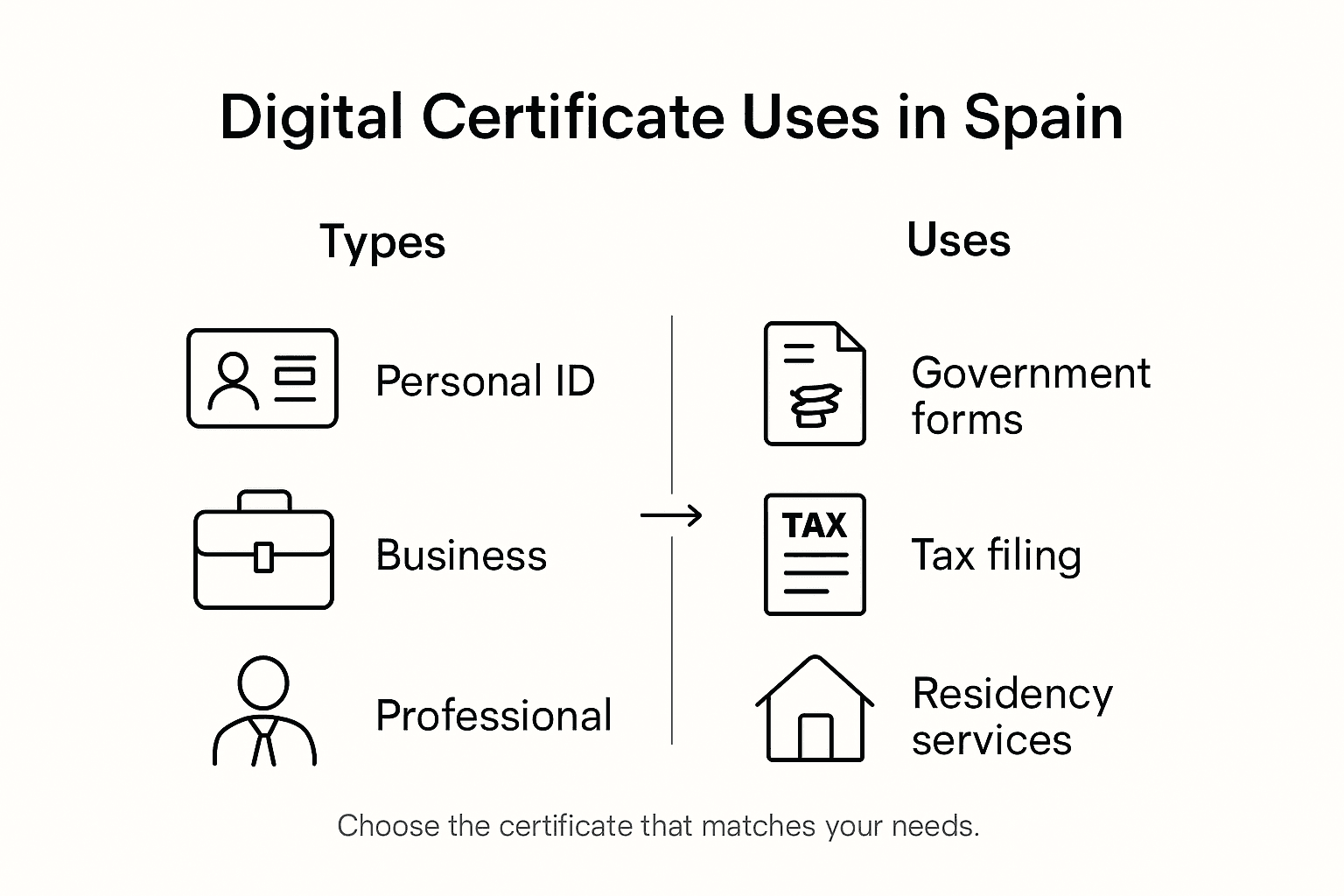
Here’s a summary comparing the main types of digital certificates in Spain:
| Certificate Type | Intended User | Security Level | Typical Use Cases |
|---|---|---|---|
| Standard Digital Certificate | Individuals | Basic authentication | Personal tax filing, form submissions |
| Recognized Certificate | Individuals/Entities | Enhanced authentication | Signing contracts, legal documents |
| Organizational Seal | Businesses | Advanced, multi-user | Official company communications |
| Web Authentication Certificate | Organizations | Very high, server-level | Secure website logins, service access |
Pro tip: Choose a digital certificate type that precisely matches your specific professional or personal requirements to ensure maximum functionality and legal compliance.
How Digital Certificates Work for Residents
Digital certificates provide residents in Spain with a comprehensive electronic identification system that transforms how individuals interact with government and administrative services. Issued by the Spanish Royal Mint (FNMT-RCM), these certificates serve as a secure online ID with full legal validity equivalent to traditional physical identification methods. The system enables residents to complete numerous administrative procedures without physical presence, dramatically simplifying bureaucratic processes.
The operational mechanism of digital certificates involves sophisticated cryptographic technology that authenticates a user’s identity through public and private encryption keys. When a resident uses their digital certificate, the system verifies their unique electronic signature against stored credentials, ensuring secure and legally recognized transactions. This process allows individuals to electronically sign documents, submit tax declarations, access social security platforms, request official certificates, and interact with various governmental institutions with the same legal standing as in-person interactions.

Residents can obtain and utilize digital certificates across multiple platforms and services. The process typically involves registering through authorized government websites, verifying personal identity documents, and generating unique cryptographic keys. Once activated, these certificates can be used across multiple devices, including computers, smartphones, and tablets, providing flexibility and convenience for accessing essential administrative services. The robust security protocols embedded in these digital certificates protect against identity theft and unauthorized access, giving residents confidence in their online interactions.
Pro tip: Regularly update your digital certificate and maintain secure storage of your private encryption keys to ensure uninterrupted access to online governmental services.
Legal Framework and Security Safeguards
The legal infrastructure surrounding digital certificates in Spain is robust and comprehensive, designed to ensure maximum security and reliability of electronic transactions. Under the European Union’s eIDAS Regulation 910/2014 and complementary Spanish Law 6/2020, these electronic identification systems are governed by stringent trust-based regulations that protect users’ digital identities and ensure the legal validity of online interactions.
The security mechanisms of digital certificates are built on sophisticated cryptographic principles that safeguard user information. Certification authorities adhere to strict protocols where private encryption keys remain exclusively controlled by the certificate holder, preventing unauthorized access or potential misuse. These digital certificates incorporate multiple layers of security, including advanced encryption techniques, identity verification processes, and time-limited validity periods that require periodic renewal and re-authentication.
Key legal protections embedded in the digital certificate framework include comprehensive mechanisms for certificate management. Users can proactively manage their digital credentials by requesting renewals, implementing temporary suspensions, or permanently revoking certificates if needed. The legal framework ensures that electronic signatures carry the same legal weight as traditional handwritten signatures, providing individuals and businesses with a secure and legally recognized method of conducting official transactions, signing documents, and verifying their digital identity across various administrative platforms.
Pro tip: Familiarize yourself with the specific renewal and revocation procedures for your digital certificate to maintain uninterrupted access and compliance with current legal requirements.
Obtaining and Renewing Your Certificate Online
Digital certificate acquisition in Spain has been streamlined to provide residents with a convenient and secure online process. Individuals can obtain their FNMT Digital Private Individual Certificate through a straightforward online application that involves identity verification, either by completing an in-person verification at authorized offices or utilizing advanced video identification technologies. The entire process is designed to be user-friendly, allowing applicants to download their certificate directly on the device used for the application.
The certificate application typically requires several key documents and steps. Applicants must provide valid identification, such as a DNI (national identity document) or NIE (foreign identification number), and have access to a compatible digital device with internet connectivity. The verification process involves submitting personal information, undergoing identity confirmation, and generating unique cryptographic keys that will be associated with the digital certificate. Some applicants may need to schedule an in-person verification appointment, while others can complete the entire process through online video verification.
Renewal of digital certificates is equally streamlined, with most certificates offering a convenient renewal window. Users can typically initiate the renewal process within 60 days before the current certificate’s expiration, using their existing certificate for authentication. This approach ensures continuity of digital identification services and minimizes potential interruptions in accessing online administrative platforms. The renewal process often requires minimal documentation, as the user’s previous identity verification remains valid, making it a quick and efficient procedure for maintaining continuous digital certification.
Pro tip: Always start the renewal process at least 30 days before your current digital certificate expires to avoid potential gaps in your online administrative access.
Risks, Common Issues, and Alternatives
Digital certificates in Spain come with potential security risks that users must carefully navigate. Transferring digital certificates to third parties can expose individuals to significant threats such as unauthorized actions, identity impersonation, and increased vulnerability to cyberattacks. Since these digital credentials carry the same legal weight as a handwritten signature, protecting them becomes paramount for maintaining personal and professional security.
Users frequently encounter common issues that can disrupt their digital certificate usage. These challenges include forgotten passwords, device compatibility problems, and missed renewal deadlines. To address these limitations, Spain offers alternative authentication systems like the Cl@ve system, which provides two distinct modes of access. The Cl@ve PIN option supports occasional use, while the Cl@ve Permanente mode offers more comprehensive access for individuals requiring frequent digital interactions without the complexity of traditional certificate installation.
When evaluating digital identification options, residents must carefully balance security requirements with convenience. While digital certificates provide robust protection, they demand more technical management compared to simpler authentication methods. Some users might find alternative systems more user-friendly, especially those less comfortable with complex technological procedures. Understanding the specific security protocols, renewal processes, and potential risks associated with each digital identification method allows individuals to make informed decisions that best suit their personal and professional needs.
The following table highlights risks, common issues, and alternatives related to digital certificates:
| Challenge | Potential Impact | Solution or Alternative |
|---|---|---|
| Forgotten passwords | Access denial, missed deadlines | Password recovery, secure backups |
| Device incompatibility | Inability to use certificate | Update software, use alternatives |
| Missed renewal | Service interruptions | Calendar reminders, early renewal |
| Security risks (sharing) | Unauthorized transactions, fraud | Use Cl@ve system, never share keys |
Pro tip: Maintain a secure backup of your digital certificate credentials and set calendar reminders for renewal to prevent unexpected access interruptions.
Simplify Your Residency Journey with Expert Support at Vive Legal
Obtaining or renewing a digital certificate in Spain can feel overwhelming given the complex legal framework and strict renewal procedures described above. If you are struggling with navigating identification verification, managing document submissions, or avoid missing crucial deadlines such as certificate renewals this is the moment to take control. Vive Legal specializes in guiding expatriates, workers, and EU citizens through residency procedures while ensuring compliance with all Spanish and European regulations.
Trust Vive Legal’s blend of advanced digital tools and professional expertise to handle your immigration formalities smoothly. Access personalized diagnostics, expert document reviews, and secure appointment scheduling all from a single platform. Avoid delays and errors associated with managing legal documents independently. Visit Vive Legal today to streamline your digital certificate and residency processes with confidence and receive step-by-step support from application to renewal. Take the first step now to protect your legal status in Spain without stress.
Frequently Asked Questions
What is a digital certificate in Spain?
A digital certificate in Spain is an official electronic identification document that verifies an individual’s identity for online administrative procedures, enabling secure authentication for various online transactions.
What are the main types of digital certificates available?
The main types of digital certificates include standard digital certificates for individuals, recognized certificates for enhanced security, organizational seals for businesses, and web authentication certificates for organizations.
How do I obtain a digital certificate online?
To obtain a digital certificate online, you must complete an application, verify your identity through authorized offices or video identification, and generate unique cryptographic keys associated with the certificate.
What should I do if I forget my digital certificate password?
If you forget your digital certificate password, you can recover it through the password recovery process or by utilizing secure backups to regain access.
Recommended
Living legally in Spain shouldn't be difficult.
View services and pricesNot sure which procedure you need? Find out in 2 min
Questions? Message us on WhatsApp