
Document Preparation Workflow Spain: Step-by-Step Guide

Every American expat or international student in Spain faces intense pressure to get residency paperwork approved quickly and accurately. With Spanish immigration authorities rejecting nearly 25 percent of applications due to missing or incorrect documents, digital solutions have become a lifeline for applicants needing speed and convenience. This guide breaks down every step of the online process, showing you how to collect, upload, and review your paperwork so your residency application stands out for its completeness and professionalism.
Table of Contents
- Step 1: Collect Required Personal and Legal Information
- Step 2: Upload and Organize Documentation Securely Online
- Step 3: Complete Forms and Schedule Appointments Digitally
- Step 4: Review Submission for Accuracy and Compliance
- Step 5: Track Status and Receive Notifications Through Portal
Quick Summary
| Key Insight | Explanation |
|---|---|
| 1. Gather All Essential Documents | Collect full legal name, passport, birth certificate, and proof of financial means for residency application. |
| 2. Ensure Secure Document Upload | Use platforms with encryption to securely upload your documents, maintaining organization throughout the process. |
| 3. Verify Accuracy Before Submission | Double-check all documents and forms for accuracy to avoid delays or rejections of your residency application. |
| 4. Track Application Status Regularly | Log into the immigration portal weekly to monitor your application status and respond promptly to any requests. |
| 5. Utilize Pro Tips for Efficiency | Create dedicated folders for documents and maintain backup copies to streamline your application and safeguard your information. |
Step 1: Collect Required Personal and Legal Information
Preparing your document workflow for Spanish residency starts with meticulously gathering all essential personal and legal documentation. This foundational step requires careful attention to detail and understanding of specific Spanish legal data requirements.
Living legally in Spain shouldn't be difficult.
View services and pricesNot sure which procedure you need? Find out in 2 min
Questions? Message us on WhatsApp
Your personal information collection must include comprehensive details such as full legal name, passport information, birth certificate, academic credentials, professional qualifications, and current contact information. For non European Union citizens, additional documentation like work contracts, proof of financial means, and health insurance verification become critical. Pay special attention to gathering original documents with apostille certification when required, ensuring each paper meets the strict authentication standards mandated by Spanish immigration authorities.
When compiling your documentation, prioritize accuracy and completeness. Translations of non Spanish documents must be completed by certified translators, and all paperwork should be organized chronologically. Keep digital and physical copies of every submitted document, creating a comprehensive portfolio that demonstrates your eligibility for residency.
Pro tip: Always request multiple certified copies of key documents like birth certificates and academic credentials to streamline your application process and have backup documentation readily available.
Step 2: Upload and Organize Documentation Securely Online
Transitioning your carefully collected documents into a secure digital format marks a critical stage in your Spanish residency application process. Understanding secure document upload protocols becomes essential for protecting your personal information throughout the digital submission process.

When uploading documents, select a platform with robust encryption and multi factor authentication. Start by scanning original documents at high resolution ensuring clarity and readability. Convert files to PDF format which maintains document integrity and prevents accidental modifications. Name each file systematically using a consistent naming convention that includes document type and date for easy reference. Create separate folders for different document categories like identification papers, academic credentials, professional certifications, and financial records to maintain organized digital archives.
Verify each uploaded document meets the specific technical requirements specified by Spanish immigration authorities. Check file size limitations, accepted document formats, and ensure scanned images are clear with no shadows or cutoff edges. Always maintain backup copies of your digital submissions on a secure external hard drive or encrypted cloud storage as an additional safety measure.
Pro tip: Use a dedicated email address exclusively for immigration document communications to enhance security and maintain a clear audit trail of your application process.
Here’s a summary of key security features to look for when uploading official documents online:
| Security Feature | Description | Benefit for Applicants |
|---|---|---|
| Encryption | Data is transmitted and stored securely | Protects sensitive personal data |
| Multi-factor Authentication | Requires two or more verification methods | Reduces risk of unauthorized access |
| File Access Controls | Restricts document access to authorized users | Prevents data leaks and tampering |
| Audit Logs | Records all activity on the platform | Enables tracking and accountability |
Step 3: Complete Forms and Schedule Appointments Digitally
Navigating the digital landscape of Spanish residency applications requires strategic form completion and precise appointment scheduling. While no specific external research sources were provided, the process demands meticulous attention to detail and technological savvy.
Begin by creating an account on the official immigration platform, ensuring you use a consistent email address and strong password. Carefully review each digital form before submission, double checking that all personal information matches your original documents exactly. Pay special attention to dropdown menus, required fields, and sections that might require additional documentation uploads. When scheduling appointments, select time slots that provide ample preparation time and align with your document readiness. Most digital platforms offer calendar views with available time ranges specialized for different residency application types.
Utilize browser autofill features cautiously and always manually verify each entered detail. Screenshot or save PDF copies of completed forms for your personal records. Some digital platforms offer progress tracking features that allow you to monitor your application status in real time. If the system offers a checklist or progress indicator, use these tools to ensure you have completed all necessary steps before final submission.
Pro tip: Create a dedicated digital folder on your computer to store screenshots and copies of every form and submission to maintain a comprehensive and organized application archive.
Step 4: Review Submission for Accuracy and Compliance
As you approach the final stages of your Spanish residency application, conducting a meticulous document review process becomes critical to ensure successful submission. This comprehensive review will help you identify and correct potential errors that could delay or compromise your application.
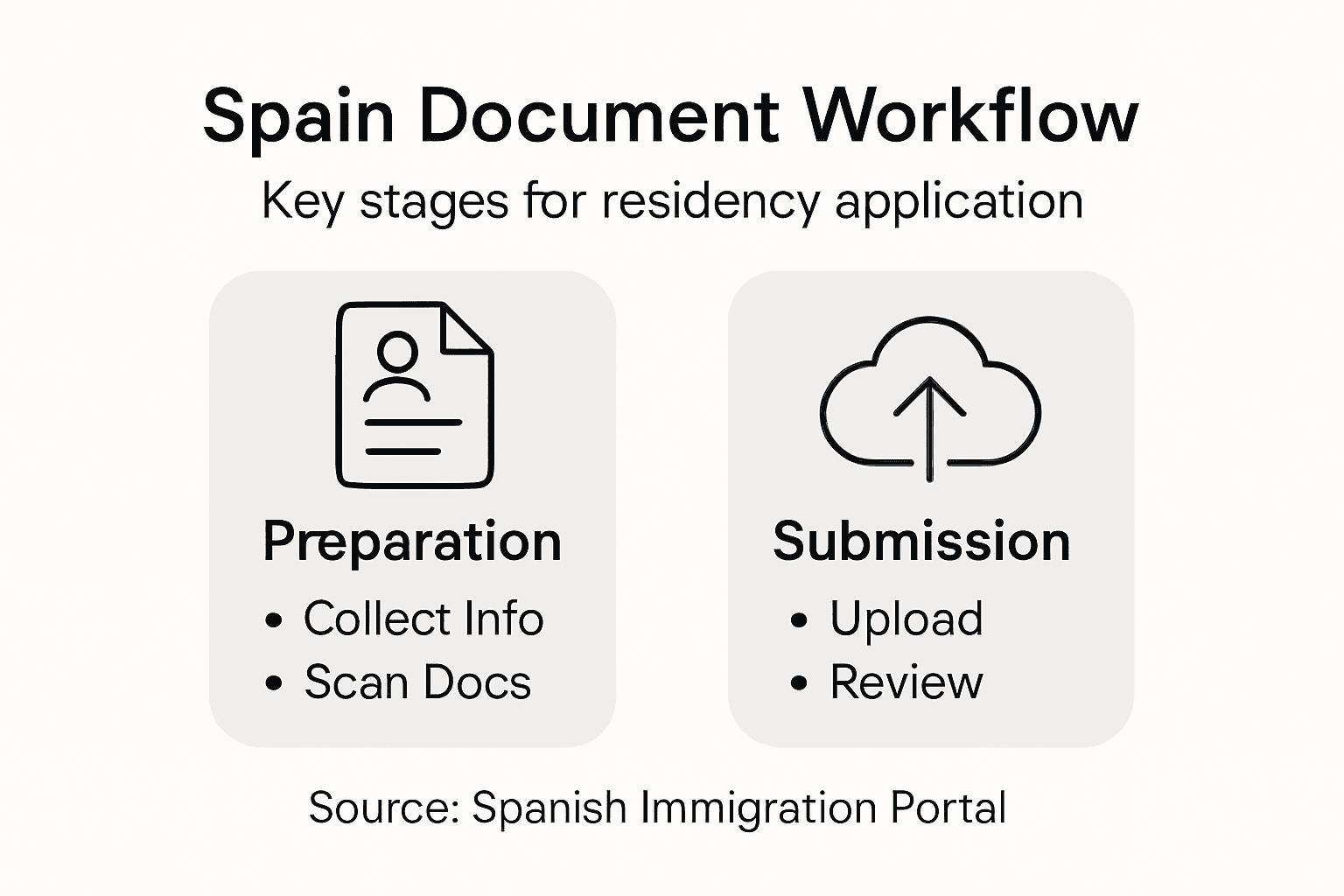
Begin by creating a systematic checklist that covers every aspect of your submission. Compare each uploaded document against your original paperwork, verifying that names, dates, and identification numbers are identical across all materials. Check that all required fields are completed with precise and consistent information. Pay special attention to translation accuracy if any documents are not originally in Spanish, ensuring professional certified translations meet official standards. Verify that digital file formats match the specified requirements and that scan quality allows for complete readability.
Consider conducting a final review during a different time of day or after a short break to help you approach the documents with fresh eyes. This strategy can help you catch subtle errors you might have overlooked during previous reviews. If possible, ask a trusted friend or fellow expat to perform a secondary review to provide an additional layer of scrutiny. Double check that all digital signatures are properly applied and that you have included every mandatory document specified in the application guidelines.
Pro tip: Create a digital checklist with screenshots of each verified document to track your review progress and maintain a clear record of your submission preparation.
Step 5: Track Status and Receive Notifications Through Portal
After submitting your application, staying informed about its progress becomes crucial. The official immigration status portal provides a comprehensive tracking system designed to keep applicants updated throughout their residency process.
Start by logging into your account using the credentials established during your initial application submission. Locate the application tracking section and enter your unique reference number or NIE identifier. Most portals offer real time status updates categorized by different processing stages such as received, under review, additional documentation required, or decision pending. Enable email and SMS notifications to ensure you receive instant updates about any changes or requests related to your application. Pay close attention to any system generated messages that might require immediate action or additional document submission.
Set aside time each week to check your application status systematically. Some platforms offer estimated processing timelines and progress percentage indicators that can help manage your expectations. If the online portal provides a communication channel or messaging system, use it to send quick clarification queries or upload supplementary documents promptly when requested. Keep all login credentials secure and consider using a password manager to maintain access to your immigration portal.
Pro tip: Create a dedicated email folder and notification system specifically for your residency application to ensure you never miss a critical communication.
Compare the most common Spanish residency application tracking portal statuses:
| Status | Meaning | Typical Next Step |
|---|---|---|
| Received | Application submitted, not reviewed | Wait for review or further updates |
| Under Review | Authorities evaluating your documents | No action, monitor for requests |
| Additional Documents Required | More information needed from applicant | Upload requested files promptly |
| Decision Pending | Final decision being prepared | Await approval or further instructions |
Simplify Your Spanish Residency Document Preparation with Expert Support
Preparing and organizing your personal and legal documents for Spanish residency can be overwhelming. From gathering certified translations to ensuring every uploaded file meets security standards and immigration requirements, the process demands precision and attention to detail. Mistakes or missing paperwork can cause avoidable delays or rejections — issues you can prevent with professional guidance. Vive Legal specializes in streamlining this complex workflow by offering trusted services like personalized document review, form completion, and appointment scheduling, all within a secure digital environment.
Take control of your residency journey today by partnering with Vive Legal. Benefit from automated tools combined with expert oversight to reduce errors and receive real-time case tracking through our secure client portal. Don’t let document confusion hold you back. Visit Vive Legal now to experience a modern, transparent, and efficient alternative to traditional gestorías that puts your peace of mind first.
Frequently Asked Questions
What personal and legal information do I need to gather for the document preparation workflow?
To initiate the document preparation workflow for residency in Spain, you need to collect personal documents such as your full legal name, passport information, birth certificate, academic credentials, and current contact details. For non-European Union citizens, additional documents like work contracts and proof of financial means are also required.
How do I securely upload my documents for my Spanish residency application?
To upload your documents securely, choose a platform that offers strong encryption and multi-factor authentication. Ensure you scan your original documents in high resolution, convert them to PDF format, and organize them into categorized folders for easy access.
What steps should I take to complete forms and schedule appointments online?
Begin by creating an account on the official immigration platform, and carefully fill out each form, ensuring that your information matches your original documents exactly. When scheduling appointments, select convenient time slots that allow you to prepare all necessary documentation in advance.
How can I ensure my submission is error-free and compliant with requirements?
Conduct a thorough review of your submission by comparing all documents against your original paperwork. Check for accuracy in names, dates, and identification numbers, and consider using a checklist to confirm that all necessary documents are included before you submit.
What should I do to track the status of my residency application?
After submitting your application, log into your account on the immigration portal to monitor its status. Set aside time weekly to check for updates and enable notifications to stay informed about any requests for additional information or documents.
Recommended
Living legally in Spain shouldn't be difficult.
View services and pricesNot sure which procedure you need? Find out in 2 min
Questions? Message us on WhatsApp