
Document review for Spanish residency: steps and tips

TL;DR:
- Spanish immigration review evaluates document authenticity, completeness, and legal compliance, not just existence.
- Proper legalization, translation, and timing of documents are critical to avoid rejection.
- Applicants succeed by meticulously ensuring technical accuracy and document validity throughout the process.
Gathering every document on the official checklist feels like finishing the race. It isn’t. When your application lands at a Spanish immigration office, it enters a formal verification stage that goes far beyond counting pages, and this is precisely where thousands of applications stall or fail each year. Spanish authorities assess residency and visa applications for completeness, authenticity, and eligibility, meaning a single expired certificate or an unofficially translated bank statement can send months of preparation back to square one. This guide breaks down exactly what document review means in a Spanish immigration context, how it works for different applicant types, and what you can do right now to avoid the most common traps.
Living legally in Spain shouldn't be difficult.
View services and pricesNot sure which procedure you need? Find out in 2 min
Questions? Message us on WhatsApp
Table of Contents
- What document review means in immigration contexts
- Core steps of document review for Spanish residency
- Comparison: Document review for EU vs. non-EU applicants
- Technicalities: Legalization, translation, and document validity
- Why most Spanish residency refusals come from document review—and what to do differently
- Need help with your Spanish residency documents?
- Frequently asked questions
Key Takeaways
| Point | Details |
|---|---|
| Document review is critical | Spanish authorities analyze every residency application for accuracy, completeness, and formal compliance. |
| Technicalities matter | Incorrect translations, expired documents, or missed authentication requirements can derail approvals. |
| EU vs. non-EU process | EU and non-EU applicants face different review procedures and risks during Spanish immigration. |
| Proactive preparation helps | Double-checking validity periods and legal requirements prevents the most frequent document review issues. |
What document review means in immigration contexts
In most legal fields, document review has a specific meaning. It refers to reviewing documents to determine relevance and legal privilege before disclosing them to another party, usually in litigation or regulatory proceedings. Immigration is a completely different world.
In Spanish immigration, document review is not about privilege or relevance. It is a formal, evidence-based verification process run by Spanish authorities, specifically the Extranjería offices, consulates, and in some cases the police, who assess whether your application is complete, authentic, and legally eligible for the permit you are requesting.
“In the context of immigration to Spain, applicants effectively undergo document review by Spanish authorities when assessing residency or visa applications for completeness, authenticity, and eligibility.” This distinction matters because most applicants prepare their papers as if they are filing a tax form, when they are actually presenting a legal case.
Here is what this verification stage actually covers:
- Completeness: Every required document is present, including supporting evidence.
- Authenticity: Official documents are genuine, properly issued, and not altered.
- Legalization and apostille: Foreign documents carry the correct certification for use in Spain.
- Translation: Non-Spanish documents have been translated by a sworn translator recognized in Spain.
- Eligibility: The documents collectively prove that you meet the specific legal criteria for the permit type.
The practical impact is significant. You can have every document the authority listed, and still face a refusal if one document is three months past its validity window or lacks an apostille stamp. Explore more about Spanish immigration in the Spain immigration guides published by our team.
Core steps of document review for Spanish residency
Now that you understand what document review means in this context, let’s walk through the actual sequence your application goes through, step by step.
-
Initial submission check. The clerk or processing officer performs a first scan to confirm the required documents are physically present. At some offices this is the only point where you can add missing papers on the spot. If something is obviously absent, the application may be returned immediately.
-
Formal completeness review. Officers check that each document is the correct type, issued by the correct authority, and applicable to your specific situation. A general financial statement is not the same as a certified bank statement showing three months of balances.
-
Authenticity and legalization verification. Officers confirm that foreign-issued documents carry the correct endorsement. For most countries in the Hague Convention, this means an apostille. For countries outside the Convention, documents need full diplomatic legalization through the Spanish consulate in the issuing country.
-
Translation review. Documents in any language other than Spanish must be translated by a sworn (jurado) translator officially recognized in Spain. A bilingual friend’s translation, regardless of how accurate, will not be accepted.
-
Accuracy cross-check. The details in your documents must align. If your criminal record certificate lists a different address from your rental contract, or your insurance policy covers fewer days than your visa requires, this inconsistency triggers a flag.
-
Eligibility assessment. Finally, the reviewing officer evaluates whether the totality of your documentation proves you meet the legal criteria, whether that is financial self-sufficiency, a valid employment contract, or proof of kinship. A formal review verifies authenticity, accuracy, and completeness of documents, and without passing this stage a residency permit simply cannot be granted.
Typical documents required across most residency applications include:
- Valid passport with sufficient remaining validity
- Criminal record certificate (apostilled and translated)
- Proof of financial means (bank statements, income statements, pension letters)
- Private health insurance that covers Spain fully
- Completed application forms (modelo EX) signed and dated
- Proof of accommodation (rental contract, property title, or host letter)
For specific permit pathways, such as the student visa process or the internship visa steps, the required supporting documents vary considerably, so always verify the exact list for your specific route.
Pro Tip: Check expiration dates on every document, not just your passport. Criminal record certificates are typically valid for only three months in Spain. If yours expires during the processing window, you may need to request a new one mid-application.
Comparison: Document review for EU vs. non-EU applicants
The document review experience is not the same for everyone. The process varies by route, whether you are registering as an EU citizen or applying as a third-country national, but the core principle remains evidence-based verification.
| Criteria | EU citizens | Non-EU (third-country) applicants |
|---|---|---|
| Main document | Passport or EU national ID | Valid national passport |
| Registration type | EU citizen registration (certificado de registro) | Residence permit or TIE card |
| Legalization required? | Generally not for EU documents | Yes, apostille or full legalization |
| Sworn translation required? | Only for non-Spanish, non-EU official documents | Yes, for most non-Spanish documents |
| Financial proof | Required for non-active residents | Required, often with stricter thresholds |
| Health coverage | Proof of public coverage or private insurance | Full private insurance mandatory for many routes |
| Processing risk level | Moderate | High (greater scrutiny, more documents) |
| Common pitfall | Incomplete padrón registration | Missing apostille or expired criminal record |
For EU citizens, the process centers on the EU registration requirements, which typically involves proving identity, residence in Spain, and economic activity or self-sufficiency. The bar is lower in terms of the number of required documents, but errors still cause delays.
For non-EU applicants, the scrutiny is significantly more intense. Every document from a foreign country is a potential rejection point. Officers check legalization carefully because fraudulent documents in non-EU applications are a known issue, so the verification is thorough by design.

EU citizens with non-EU family members face a hybrid situation. The family member must apply for a EU family card process, which involves both the EU citizen’s registration documents and the non-EU family member’s identity and relationship documents, all properly legalized and translated.
Pro Tip: If you are a non-EU applicant, do not assume that because a document is in English, it is automatically ready for submission. Spanish authorities require sworn translation into Spanish regardless of the document’s original language.
Technicalities: Legalization, translation, and document validity
Even applicants with perfect eligibility profiles run into technical refusals. This is where the real preparation happens.
Apostille vs. legalization. An apostille is a standardized certificate attached to a document by the issuing country’s designated authority, confirming the document’s authenticity for use in other Hague Convention countries. Spain is a member of the Convention, so most applicants from the United States, the United Kingdom, or Australia need apostilles on their official documents. For countries outside the Convention, full diplomatic chain legalization is required, which involves multiple official steps through foreign ministries and Spanish consulates.
Sworn translation. Spain requires that all non-Spanish documents be translated by a translator officially recognized (sworn) by the Spanish Ministry of Foreign Affairs. Online translators, agency translations, and even certified professional translators in your home country do not qualify unless they hold this specific Spanish recognition. The translation must be complete, not summarized, and must include any stamps or seals visible on the original.
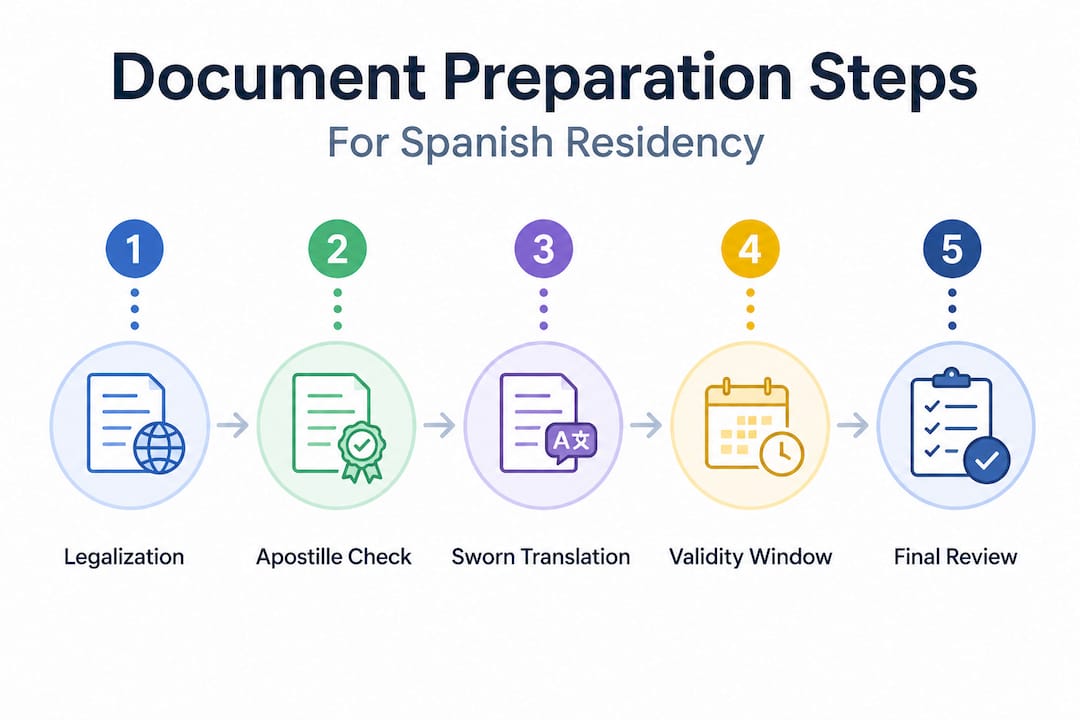
Validity windows. This is the most common surprise refusal. Many documents have specific validity windows that Spanish authorities enforce strictly. Eligibility documents like proof of financial means, health insurance, and criminal record certificates carry authentication requirements and tight validity periods.
| Document type | Typical validity window | Apostille required? | Sworn translation required? |
|---|---|---|---|
| Criminal record certificate | 3 months | Yes (non-EU) | Yes (if not in Spanish) |
| Bank statements | 3 months | No | Yes (if not in Spanish) |
| Health insurance certificate | Active at submission | No | Yes (if not in Spanish) |
| Birth/marriage certificate | No strict window, but recent preferred | Yes (non-EU) | Yes (if not in Spanish) |
| Employment contract | Must be current | No | Yes (if not in Spanish) |
| Medical certificate (NLV) | 3 months | No | Yes (if not in Spanish) |
Common technical traps that trip up even well-prepared applicants include:
- Apostille on a copy, not the original. The apostille must be on the actual issued document, not a photocopy.
- Translation not matching the apostilled version. If the apostille is dated and the translation was done on an earlier version of the document, authorities may reject the pairing.
- Insurance policy gaps. Some policies exclude certain conditions or have deductibles that do not meet Spain’s residency requirements.
- Bank statements from the wrong account. Statements must reflect funds accessible to you, not a joint or business account where ownership is unclear.
For long-term residency planning, understanding the long-term residence rules in advance helps you build a document strategy that holds up across multiple applications over the years.
Why most Spanish residency refusals come from document review—and what to do differently
Here is a candid observation drawn from handling hundreds of cases: most people who get refused are not ineligible. They qualify. The problem is that their documentation did not prove it to the standard the reviewing officer needed to approve it.
This is the uncomfortable truth that conventional wisdom about immigration rarely addresses. The advice you get from forums and general guides almost always focuses on eligibility criteria: do you earn enough, have you lived here long enough, do you have a clean record? These are important questions. But they are not where most applications break down.
The real failure points are technical and logistical. A criminal record that expired two weeks before the appointment. An insurance policy that covers 99% of medical needs but excludes repatriation. A translation done by a highly qualified professional who does not hold Spanish recognition. These are not eligibility failures. They are process failures.
The applicants who succeed consistently are the ones who think like an auditor, not like a checklist user. A checklist user confirms that a document exists. An auditor confirms that the document is valid, correctly formatted, properly authenticated, recently issued, and logically consistent with every other document in the file.
Practically, this means building a document timeline, not just a document list. Work backwards from your submission date. If your criminal record is only valid for three months, count back from your appointment date and request it accordingly. Do the same for bank statements and medical certificates.
Three steps to avoid the most common document review failures:
- Request documents in the right sequence. Start with the ones with the shortest validity windows last. Passports and birth certificates come first. Bank statements and criminal records come last.
- Verify legalization before translation. Always get your apostille before sending documents for sworn translation. This prevents the mismatch problem where your translated version does not match your apostilled version.
- Cross-check all personal details. Run a final comparison across every document in your file. Name spelling, date of birth, address, and nationality must be identical or explained with a supplementary document.
The arraigo social process is a particularly good example of where these details matter most, since it involves assembling evidence from multiple years and sources, all of which must align perfectly.
Need help with your Spanish residency documents?
The gap between understanding the process and executing it correctly is where most applicants lose time and money. If you have read this far, you already know that document review in Spain is precise, technical, and unforgiving of small errors.
At Vive Legal, we combine professional legal expertise with smart automation to review your documents before they reach the authorities. Our platform flags expiration dates, missing legalizations, and translation gaps in advance, so you submit with confidence. Whether you need regularization assistance for a complex case or a straightforward TIE application service, our team manages every step online, from diagnostic to appointment. You get full visibility into your case without the stress of navigating Spanish bureaucracy alone.
Frequently asked questions
Can I submit documents in English to the Spanish authorities?
No. Unless specifically stated for a particular procedure, documents in English must be translated by a sworn translator officially recognized by the Spanish Ministry of Foreign Affairs before submission.
What happens if my documents are a few days past their validity window?
Documents past their official validity window can result in immediate rejection or a requirement to provide updated versions, since validity windows and formalities are treated as strict legal requirements, not guidelines.
Do EU citizens need a TIE card in Spain?
No. EU citizens typically register on the municipal register (padrón) and obtain a green EU registration certificate, while the TIE card is for British citizens and other third-country nationals who must hold a physical residence card.
What are the most common reasons for document review failure?
Most failures stem from expired documents, missing or incorrect apostilles, and uncertified translations. Technical mismatches between documents in the same application file are also a leading cause of refusals and resubmissions.
Recommended
Living legally in Spain shouldn't be difficult.
View services and pricesNot sure which procedure you need? Find out in 2 min
Questions? Message us on WhatsApp