
Empadronamiento in Spain: Essential Guide for Legal Residency

Most foreigners assume empadronamiento is only for people who already have their papers sorted. That belief is wrong, and it costs people months or even years of progress toward legal residency. Mandatory for everyone in Spain over 183 days, regardless of nationality or immigration status, empadronamiento is your official entry into the municipal registry and your proof of address for healthcare, schools, and residency applications. Whether you are a student, a seasonal worker, or an expat building a new life, this guide breaks down what empadronamiento is, why it matters more than most people realize, how to get it, and the mistakes that can quietly erase your progress.
Table of Contents
- What is empadronamiento and who needs it?
- Benefits of empadronamiento for expats, workers, and students
- Step-by-step: How to register in the padrón municipal
- Renewal and continuity: Key rules for non-EU and temporary residents
- What most guides miss: Empadronamiento as your immigration clock
- Streamline your empadronamiento and legal residency
- Frequently asked questions
Key Takeaways
| Point | Details |
|---|---|
| Universal requirement | Anyone living in Spain over 183 days must register in the padrón, regardless of immigration status. |
| Proof for all services | Empadronamiento is essential for accessing health care, schools, and starting any immigration process. |
| Start early—no residency card needed | You can (and should) register before obtaining legal residency to count time toward arraigo and regularization. |
| Critical renewal deadlines | Non-EU residents must renew empadronamiento every 2 years to avoid losing years counted toward legal stay. |
| Continuity is key | Gaps or missed renewals can reset your immigration progress; stay vigilant with documentation. |
What is empadronamiento and who needs it?
Empadronamiento is your registration in the padrón municipal, the official local population registry managed by each city or town council (ayuntamiento). Think of it as telling the Spanish government: “I live here.” It is not a residency permit, and it does not grant you legal immigration status. But it is the foundation for almost everything else.
Living legally in Spain shouldn't be difficult.
View services and pricesNot sure which procedure you need? Find out in 2 min
Questions? Message us on WhatsApp
Municipal registration for all residents serves as proof of address for healthcare, schools, and residency applications. That means it applies to Spanish nationals, EU citizens, and non-EU nationals alike. If you are spending more than 183 days a year in Spain, you are legally required to register, full stop.
Here is what empadronamiento unlocks for you:
- Access to public health services at your local health center
- Enrollment of children in local public schools
- Eligibility for social benefits and municipal programs
- A valid proof of address for immigration paperwork
- The official start of your residency timeline for future applications
That last point is the one most people miss. Your empadronamiento date is essentially your immigration clock. It is the timestamp that proves how long you have been living in Spain, and it feeds directly into processes like arraigo formativo and other regularization routes.
“Only legal residents need to register” is one of the most damaging myths in Spain’s expat community. Anyone staying long-term should register immediately, regardless of their current legal status.
The UK government guide for British nationals in Spain also confirms this: registration in the padrón is a recommended first step even before obtaining a TIE card. The same logic applies to every nationality.
If you are exploring options like a job search in Spain visa or any other pathway, your empadronamiento date will be scrutinized. Gaps or a late start can weaken your application significantly.
Benefits of empadronamiento for expats, workers, and students
Understanding who needs empadronamiento is only the beginning. Let’s look at why it is such a powerful step for every foreign resident.
The practical benefits are immediate. Once registered, you can access public healthcare, register your children in school, and use municipal services. But the strategic benefits are what really matter for anyone navigating Spain’s immigration system.

Empadronamiento establishes your length of stay for regularization and is the first documentation step even for those without legal residency. In other words, it builds your case before you even file a single immigration form.
Here is a comparison of key benefits by resident type:
| Benefit | Expat | Worker | Student |
|---|---|---|---|
| Public healthcare access | Yes | Yes | Yes |
| School enrollment for children | Yes | Yes | Limited |
| Proof of address for immigration | Yes | Yes | Yes |
| Residency timeline start | Yes | Yes | Yes |
| Social benefits eligibility | Yes | Yes | Partial |
| Driving license registration | Yes | Yes | Yes |
For anyone on the path to arraigo social, the registration date is not just useful, it is essential. You typically need to prove three years of continuous, documented presence in Spain. Without a solid empadronamiento record, that proof simply does not exist.
The arraigo and citizenship path depends on building seniority through consistent registration. Every month you delay is a month you cannot count later.
Here is a numbered breakdown of the strategic steps empadronamiento enables:
- Locks in your official arrival date in the municipal system
- Provides the address proof needed for NIE and TIE applications
- Starts the clock for arraigo, long-term residency, and citizenship
- Establishes eligibility for social services and municipal benefits
- Supports tax residency determination after 183 days
Pro Tip: Even if you are staying with a friend or family member and do not have your own rental contract, you can still register using the property owner’s authorization. Do not wait until you have your own lease. Register now and protect your timeline. You can find more detailed breakdowns of each process in the immigration guides on Vive Legal’s blog.
A thorough empadronamiento guide confirms that registration is open to everyone and that delaying it for any reason is a strategic mistake.
Step-by-step: How to register in the padrón municipal
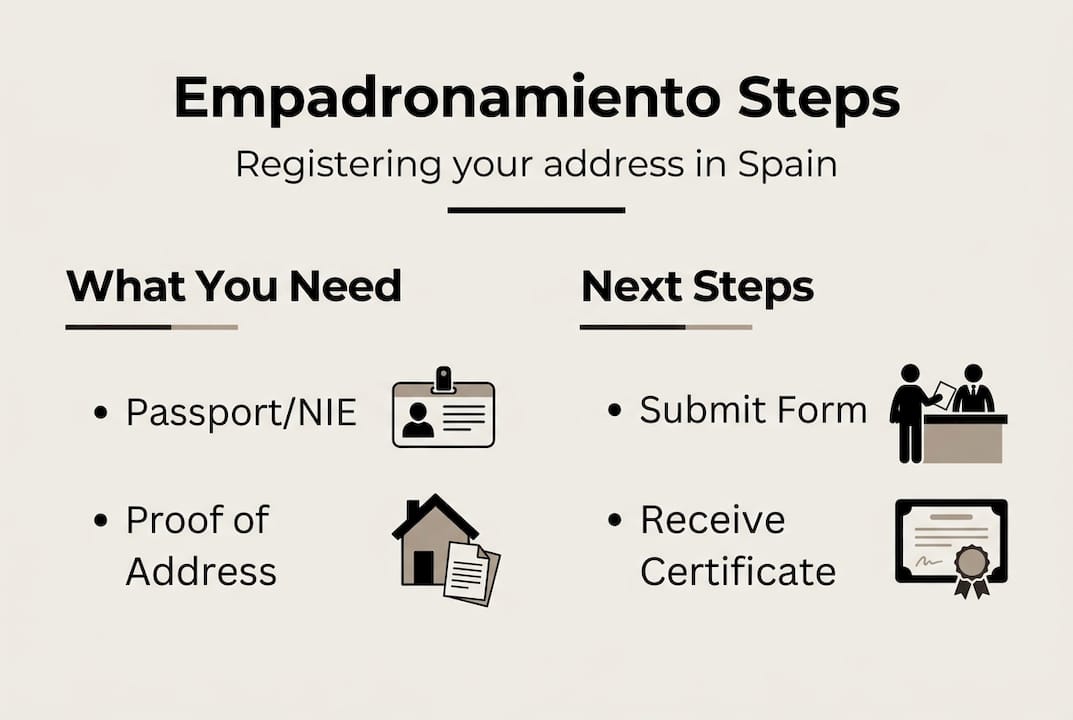
Ready to apply? Here is a step-by-step guide to make the registration process stress-free.
- Book your appointment (cita previa). Most ayuntamientos require an appointment. You can book online through the municipal website or by calling the local office. In smaller towns, walk-ins are often accepted.
- Gather your documents. You will need a valid passport or NIE, plus proof of address. Accepted proof includes a rental contract, a recent utility bill, or a signed authorization from the property owner.
- Attend your appointment. Bring originals and photocopies of all documents. The staff will verify your information and enter it into the padrón.
- Receive your proof of registration. You will get either a volante de empadronamiento (informal proof) or a certificado de empadronamiento (formal document). Know which one you need before you go.
Here is a quick document checklist:
| Document | Where to get it |
|---|---|
| Valid passport or NIE | Your home country or Spanish authorities |
| Rental contract | Your landlord |
| Utility bill with Referencia Catastral | Your landlord or energy provider |
| Owner authorization (if not on lease) | Property owner, signed and with their ID copy |
| Family relationship proof (if applicable) | Civil registry or embassy |
The process is free and often same-day in smaller towns, though larger cities like Madrid or Barcelona may have longer processing times due to volume.
Pro Tip: When using a utility bill as proof of address, make sure it includes the Referencia Catastral, the unique property identification number. Bills without it are sometimes rejected. Ask your landlord for a bill that clearly shows this reference before your appointment.
Once registered, you can use your empadronamiento to move forward with processes like EU registration, EU long-term residence, or even an EU family card if applicable to your situation.
Renewal and continuity: Key rules for non-EU and temporary residents
You have registered. Now protect your status with ongoing diligence, especially if your residency is not yet permanent.
This is where many people make a costly mistake. They register once, feel relieved, and forget about it. Then, two years later, they discover they have been quietly removed from the registry without any warning.
Non-EU residents must renew every 2 years or risk automatic deregistration, known as baja. This is not a fine or a warning. It is a silent erasure from the system.
Here is what you need to know about renewal:
- Non-EU citizens without permanent residency must renew empadronamiento every 2 years
- EU citizens and permanent residents are not subject to the same renewal requirement
- Municipalities send renewal notices, but they are not always reliable or delivered
- Missing renewal triggers automatic baja, removing you from the registry
- Forgetfulness causes automatic baja and resets the clock for future arraigo and citizenship applications
That last point deserves emphasis. If you are working toward arraigo social, which typically requires three continuous years of residence, a single missed renewal can break that continuity. You may have to start counting from zero.
Municipalities have also tightened their rules in recent years to prevent abuse of the system. They cross-check registrations more carefully and conduct periodic reviews. Keeping your documents current and your address up to date is not optional.
If you are pursuing Spanish nationality, the continuity of your empadronamiento record will be examined closely. Any gap is a red flag.
Pro Tip: Set a recurring digital reminder every 22 to 23 months, not 24. This gives you a buffer to gather documents and book your appointment before the deadline hits. Always keep a physical and digital copy of your most recent certificado de empadronamiento in a safe place.
What most guides miss: Empadronamiento as your immigration clock
Most articles on empadronamiento treat it as a bureaucratic checkbox. Fill out the form, get the stamp, move on. But that framing misses the deeper reality of how Spain’s immigration system actually works.
For many foreigners, especially those without legal residency yet, empadronamiento is the only official record of their presence in Spain. It is the timestamp that immigration authorities use to evaluate your history. No empadronamiento means no verifiable presence, even if you have been living in the country for years.
We see this pattern repeatedly: people delay registration because they feel uncertain about their status, or they assume it is only for people with papers. Then they apply for arraigo social and discover their three-year clock only started two years ago. That gap cannot be recovered.
The uncomfortable truth is that most application rejections are not about missing paperwork. They are about gaps and non-continuity in empadronamiento records. A missed renewal, a change of address not updated, a period of staying with a friend without registering. These are the silent killers of regularization cases.
Start early. Update every time you move. Renew before the deadline. Treat your empadronamiento record like the legal asset it actually is.
Streamline your empadronamiento and legal residency
Navigating Spain’s municipal and immigration systems is manageable when you know the rules, but the details matter enormously. A wrong document, a missed renewal, or a misunderstanding about which certificate you need can set your case back significantly.
Vive Legal provides multilingual, expert guidance for every step of your empadronamiento and immigration journey. From securing your initial registration to preparing documentation for an arraigo social application, the platform combines professional oversight with digital efficiency. Whether you need help organizing your documents, tracking your renewal dates, or moving forward with full regularization services, the team is ready to support you. Get started with a free initial consultation and take the guesswork out of your residency process.
Frequently asked questions
Do I need empadronamiento if I am in Spain without legal papers?
Yes. Empadronamiento is mandatory regardless of immigration status for anyone staying more than 183 days, and it is often the first and most important step toward regularization.
How often do I need to renew my empadronamiento as a non-EU citizen?
Non-EU residents must renew every 2 years to avoid automatic deregistration, which can break the continuity needed for arraigo and citizenship applications.
What documents do I need for the empadronamiento process?
You need a valid passport or NIE, plus proof of address such as a rental contract, a utility bill with Referencia Catastral, or a signed authorization from the property owner, and sometimes proof of family relationship.
What’s the difference between the volante and the certificado de empadronamiento?
The volante is an informal confirmation of registration used for everyday purposes, while the certificado is a formal document required for official immigration and legal procedures, and it typically must be less than three months old.
Recommended
Living legally in Spain shouldn't be difficult.
View services and pricesNot sure which procedure you need? Find out in 2 min
Questions? Message us on WhatsApp