
Essential compliance steps for migrant families in Spain

TL;DR:
- Proper documentation and clear organization are crucial for successful regularization in Spain.
- Families should choose the appropriate legal route based on residence duration and community ties.
- Early application and understanding flexible evidence standards improve chances of approval and legal status.
Most migrant families assume that legal compliance in Spain is mainly a paperwork problem. Gather enough documents, hand them in, and you’re done. But the real challenge is knowing which evidence actually matters, in what order to present it, and which deadlines can make or break your case. Spain’s new regularization rules have introduced both new opportunities and new complexity. This guide walks you through the legal framework, the documentation, the application steps, and what comes after approval so your family can move from uncertainty to secure, recognized residency.
Living legally in Spain shouldn't be difficult.
View services and pricesNot sure which procedure you need? Find out in 2 min
Questions? Message us on WhatsApp
Table of Contents
- Understanding Spain’s compliance framework for migrant families
- Key documentation: Evidence for proving residence and eligibility
- Navigating the application process: Step-by-step guide
- After approval: Securing long-term compliance and work eligibility
- Our expert take: Compliance strategies most families overlook
- Get real support for your compliance journey
- Frequently asked questions
Key Takeaways
| Point | Details |
|---|---|
| Legal frameworks matter | Spain’s compliance process follows clear permit and regularization pathways that migrant families must understand. |
| Evidence is essential | Organized documentation increases chances of successful residency approval and avoids common rejection risks. |
| Deadlines drive success | Acting early—especially around crucial dates like April 16—prevents missed opportunities and secures provisional work rights. |
| Transition planning pays | Post-approval, migrant families should prepare for ordinary regime transitions and ongoing compliance to maintain legal status. |
| Expert help is available | Specialized legal support streamlines the application process and increases regularization success for families in Spain. |
Understanding Spain’s compliance framework for migrant families
Legal compliance in Spain means more than avoiding trouble. It means having a recognized, documented status that allows you to work, access services, and build a future without fear of removal. Regularization is the formal process of converting an undocumented or irregular situation into a legal one, and Spain’s 2026 reforms have expanded the pathways available to migrant families.
There are several main permit categories families should know about. Extraordinary regularization is the newest route, designed specifically for long-term residents who can prove continuous time in Spain. Arraigo permits (social, labor, and family) are established pathways tied to community ties or work history. Work permits follow separate rules once you’re already in a legal regime. Each route has its own eligibility window, documentation requirements, and transition logic.
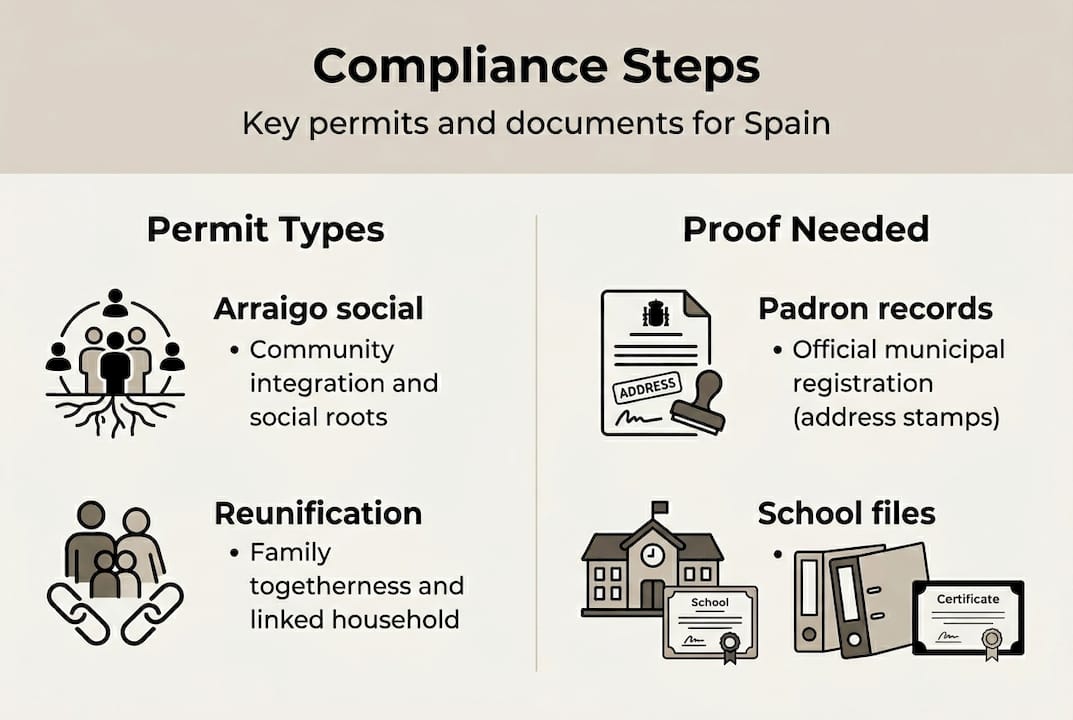
Here’s a quick comparison of the main permit types:
| Permit type | Main requirement | Typical duration |
|---|---|---|
| Extraordinary regularization | Proven continuous residence | 1 year, renewable |
| Arraigo social | 3 years residence + social ties | 2 years |
| Arraigo laboral | 2 years + work evidence | 2 years |
| Work permit | Job offer or contract | 1 year, renewable |
A few key points to keep in mind:
- Provisional work rights begin from the moment your application is admitted for processing
- After one year on an extraordinary regularization permit, you can transition to ordinary regimes such as work or arraigo
- Families can apply jointly in many cases, which simplifies coordination
- Children’s school enrollment records count as supporting evidence for the family unit
“After one year, permit holders transition to ordinary regimes like work or arraigo, with provisional work rights active from the date of admission.”
For families considering the arraigo social route, the key is documenting genuine community integration: local ties, time spent, and social network. The extraordinary regularization pathway, on the other hand, is time-sensitive and requires acting before specific cutoff dates. Understanding which route fits your situation is the first decision that shapes everything else.
Key documentation: Evidence for proving residence and eligibility
Documentation is where most applications succeed or fail. Spain’s 2026 regulations have introduced more flexible proof standards, which is actually good news. But flexibility only helps if you know what counts and how to present it.

The most important document is your historical padrón certificate (certificado de empadronamiento histórico). This official municipal record shows how long you’ve been registered at a Spanish address. It’s the backbone of most residency claims. You request it from your local town hall (ayuntamiento), and it’s free.
Beyond the padrón, acceptable supporting documents include:
- Utility bills (electricity, gas, water) in your name or your landlord’s name tied to your address
- School enrollment certificates for your children, which simultaneously prove your presence and your children’s integration
- Medical records or appointment history from Spanish public health centers
- Bank statements showing activity in Spain during the claimed period
- Criminal background certificates from Spain and your country of origin (support letters are accepted if obtaining them is genuinely difficult)
Here’s a quick reference for document types and their purpose:
| Document | Purpose | Where to get it |
|---|---|---|
| Historical padrón | Proves duration of residence | Local ayuntamiento |
| School records | Proves family presence | Child’s school |
| Medical records | Corroborates continuous stay | Health center |
| Utility bills | Shows address linkage | Supplier or landlord |
| Criminal certificate | Confirms clean record | Police, consulate |
Applications can be submitted online or by phone (060) starting April 16, 2026. In-person submission is also available at immigration offices.
Pro Tip: Organize all your documents chronologically, not by type. A timeline of evidence tells a clearer story than a stack of loose papers. Label each document with the date range it covers, and include a one-page index at the front.
Families often miss that required immigration forms have changed alongside the new rules. Using outdated forms is one of the most common and most avoidable reasons for rejection. Similarly, understanding which proofs of residency are legally recognized under the new framework saves time and prevents costly delays.
Navigating the application process: Step-by-step guide
Knowing what to submit is only half the challenge. Knowing how to submit it, and in what order, is what actually gets applications approved.
Follow these steps to move through the process cleanly:
- Determine your eligibility route. Based on your years in Spain and current situation, identify whether extraordinary regularization, arraigo, or another permit applies.
- Gather and organize documentation. Use the chronological approach described above. Confirm each document is current and certified where required.
- Complete the correct application forms. Make sure you’re using 2026-updated versions. Double-check names, NIE numbers, and addresses for consistency across all documents.
- Submit your application. Apply online or call 060 from April 16 onwards. Online submission through Sede Electrónica requires a digital certificate or Cl@ve PIN.
- Track your case status. Use the online tracking system to monitor progress. You’ll receive updates when your application moves to each new stage.
- Respond to any requests for additional documentation within the given timeframe. Missing these response windows is a common and serious mistake.
- Attend biometric appointment for TIE card issuance after approval is granted.
Common hurdles families run into:
- Missing the April 16 application window for extraordinary regularization
- Submitting documents in the wrong language without a certified translation
- Using outdated forms from older regulatory periods
- Not tracking case status and missing supplementary requests
Pro Tip: Set calendar reminders for every deadline in your process, including your application date, any response windows, and your TIE procedures appointment. A missed date can set your case back by months.
For ongoing guidance and updates on immigration tips, staying current with regulatory changes is part of smart compliance management. The regularization application process has specific nuances that change with each regulatory cycle, so relying on current information matters.
After approval: Securing long-term compliance and work eligibility
Approval is not the finish line. It’s the start of a new phase, and how you manage it determines whether your family stays on solid legal ground long term.
Here’s what to expect after your application is approved:
- Resolution timeline: Most cases are resolved within 3 months of submission
- TIE issuance: The physical residence card (TIE) is issued within approximately one month of formal approval
- Work rights: These are provisional from the moment of admission and become fully formalized once the permit is issued
After the first year on an extraordinary regularization permit, you must transition to an ordinary legal regime. Your options include:
- Work permit renewal if you have a valid employment contract
- Arraigo social if your community ties qualify
- EU long-term residence after five years of continuous legal residence
- Job search authorization if you’re between contracts
Did you know? Data from Spain’s 2005 regularization shows each regularized person contributed an average of €4,500 annually in fiscal terms, with increased formal employment and no measurable pull effect on irregular migration.
These empirical benchmarks matter because they confirm that regularization is not just a personal benefit. It’s a stable, economically positive outcome for the whole system.
Pro Tip: Start planning your transition to an ordinary regime about 6 months before your first permit expires. Gather employment evidence, update your padrón, and consult with a specialist to confirm which route you qualify for. Waiting until the last month is one of the most common reasons families fall back into irregular status.
Our expert take: Compliance strategies most families overlook
Most families focus on whether they have enough documents. That’s the wrong question. The better question is whether your documents tell a clear, consistent story of continuous presence and community integration.
Spain’s new flexible proof standards are a genuine opportunity. Regulators are now more willing to accept indirect evidence, such as a neighbor’s testimony, a community organization letter, or medical appointment records, when formal documents are missing. Families who understand this get approvals that others miss.
What we consistently see is that families who apply early and stay organized throughout do better than families who wait for the “perfect” moment. There’s no perfect moment. There are only open windows and closed ones.
The 2005 regularization data also tells us something critical: the families who regularized early enough to participate fully in formal employment saw the biggest gains. Delaying compliance doesn’t just create legal risk. It delays economic participation.
Finally, don’t treat arraigo compliance as a fallback. For many families, it’s actually the most stable and appropriate long-term route. Plan for it from the beginning rather than discovering it after an extraordinary regularization expires.
Get real support for your compliance journey
Navigating Spain’s immigration system is complex, and a single misstep can cost your family months of progress. You don’t have to figure this out alone.
At Vive Legal, we specialize in exactly this: guiding migrant families through every stage of the regularization process, from choosing the right permit route to preparing documentation, submitting applications, and managing post-approval transitions. Our platform combines expert legal oversight with digital tools that track your case at every step. Whether you’re starting fresh or need help correcting a stalled application, our team is ready to help you move forward with confidence. Visit Vive Legal to start your personalized compliance process today.
Frequently asked questions
What are the most important documents for compliance in Spain?
Historical padrón registration, utility bills, school or medical records, and criminal certificates are the core evidence for residency regularization. Support letters are accepted when official criminal certificates are genuinely difficult to obtain.
How long does the permit approval process take for migrant families?
Approval is typically resolved in 3 months, and the TIE residence card is issued within approximately one month after formal approval is granted.
Can work rights start before full ordinary regime transition?
Yes. Provisional work rights are granted from the moment your application is admitted and continue through the first year until you transition to an ordinary regime like work or arraigo.
Did past regularizations have negative public effects?
No. Empirical data from 2005 shows increased formal employment, higher fiscal contributions averaging €4,500 per person annually, and no measurable pull effect on irregular migration.
Recommended
Living legally in Spain shouldn't be difficult.
View services and pricesNot sure which procedure you need? Find out in 2 min
Questions? Message us on WhatsApp