
Why EU registration matters: essential guide for residency in Spain

Many EU citizens arrive in Spain with a simple assumption: their passport is enough. It isn’t. Spanish law requires all EU, EEA, and Swiss citizens who stay longer than 90 days to formally register, and EU/EEA/Swiss citizens must register within 3 months to maintain legal status and access their rights. Skipping this step doesn’t just mean missing a piece of paper. It means blocked bank accounts, rejected rental contracts, and healthcare delays. This guide walks you through what registration actually means, who needs it, how to do it, and what happens if you don’t.
Table of Contents
- What EU registration really means and who must do it
- Key benefits of registering as an EU resident in Spain
- Requirements and step-by-step process for EU registration
- Renewal, permanent residency, and risks of non-compliance
- Our take: why registration isn’t just a formality—what most guides miss
- Need hassle-free help with your EU registration?
- Frequently asked questions
Key Takeaways
| Point | Details |
|---|---|
| Registration is mandatory | All EU/EEA/Swiss citizens staying over 90 days in Spain must register for the green certificate and NIE. |
| Unlocks key services | EU registration enables access to work, banking, healthcare, housing, and other essential services. |
| No expiry, but conditions | The certificate does not expire, but you can lose your rights if you’re absent from Spain or breach rules. |
| Skipping brings risks | Failing to register can lead to fines and major administrative headaches, even if enforcement is rare. |
| Edge cases matter | Students, retirees, and non-EU family members have unique requirements—get advice to avoid mistakes. |
What EU registration really means and who must do it
Let’s clear up the most common confusion first. EU registration in Spain produces two key documents: the Certificado de Registro (a green certificate confirming your legal residence) and the NIE (Número de Identificación de Extranjero), which is your unique identification number for all legal and fiscal activity in Spain. Think of the NIE as your Spanish social security number, tax ID, and administrative fingerprint rolled into one.
Living legally in Spain shouldn't be difficult.
View services and pricesNot sure which procedure you need? Find out in 2 min
Questions? Message us on WhatsApp
Registration is mandatory for EU/EEA/Swiss citizens staying over 90 days, and it applies across the board:
- Workers (employed or self-employed)
- Students enrolled in Spanish institutions
- Retirees with sufficient income or pension
- Family members of EU citizens (though non-EU family members follow a separate process and must apply for a residence card, not the green certificate)
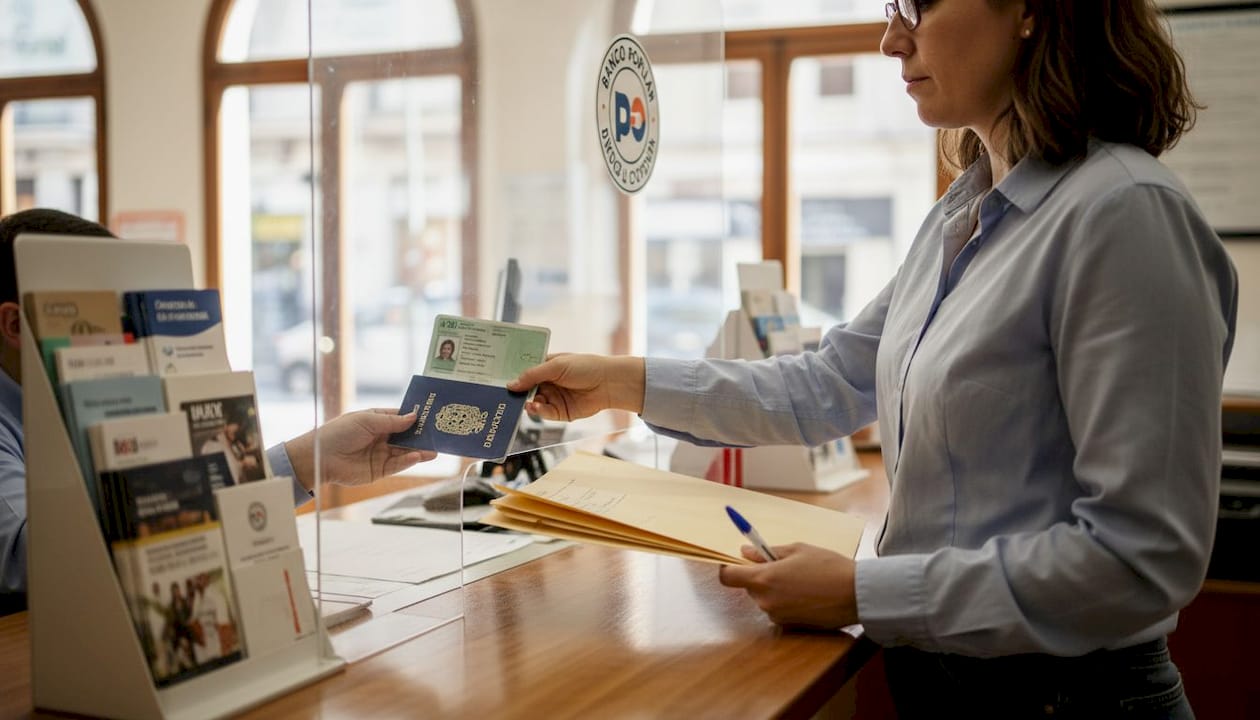
It’s worth noting that your legal right to reside in Spain as an EU citizen exists from the moment you arrive. But as evidence of registration is required by banks, employers, landlords, and public services, that right is practically useless without the certificate.
“The right to reside is real, but without the certificate, you’ll struggle to prove it to anyone who matters.”
The legal framework behind all of this is EU Directive 2004/38/EC, which Spain implemented through Royal Decree 240/2007 (RD 240/2007). These rules exist to protect you, not burden you. They give you a formal, recognized status that unlocks the full range of rights you’re entitled to. You can explore the full scope of EU registration requirements to understand exactly what applies to your situation.
Key benefits of registering as an EU resident in Spain
Once you hold that green certificate and NIE, a surprising number of doors open. It’s not just about legal compliance. It’s about functioning normally in Spanish society.
Here’s what registration directly enables:
- Opening a bank account (most Spanish banks will not proceed without an NIE)
- Signing a rental or purchase contract for property
- Getting a Spanish driver’s license or transferring your existing one
- Accessing public healthcare through the Spanish health system
- Starting employment or registering as self-employed (autónomo)
- Enrolling children in public schools
- Starting a business or signing commercial contracts
The certificate is required for banking, contracts, healthcare, and work, and the NIE is required for work contracts and tax identification. Without it, you’re essentially invisible to the Spanish administrative system.
| Situation | Without registration | With registration |
|---|---|---|
| Opening a bank account | Refused or very limited | Standard process |
| Signing a rental contract | Often rejected | Accepted |
| Accessing public healthcare | Emergency only | Full access |
| Starting employment | Blocked by employer | Fully eligible |
| Buying property | Extremely complicated | Straightforward |
Pro Tip: Even if you’re only planning to stay for a few months past the 90-day mark, register early. The NIE takes time to process, and you’ll need it before you urgently need it, not after.
For a deeper look at how the NIE for legal and tax purposes works in practice, it’s worth reviewing the specific requirements before you start the process.
Requirements and step-by-step process for EU registration
The process is more straightforward than most people expect, but the document requirements vary depending on your situation. Here’s how it breaks down.
Documents required by applicant type:
| Applicant type | Key documents needed |
|---|---|
| Worker (employed) | Employment contract or employer letter |
| Self-employed | Registration with Hacienda (Tax Agency) |
| Student | Enrollment certificate, health insurance |
| Retiree | Proof of pension/income, health insurance (S1 or private) |
| Family member (EU) | Proof of relationship, sponsor’s registration |
Applicants need proof of employment, sufficient financial resources, health insurance, or student enrollment depending on their category. Students and retirees often get tripped up here because they assume their passport alone is sufficient.
Here’s the step-by-step process:
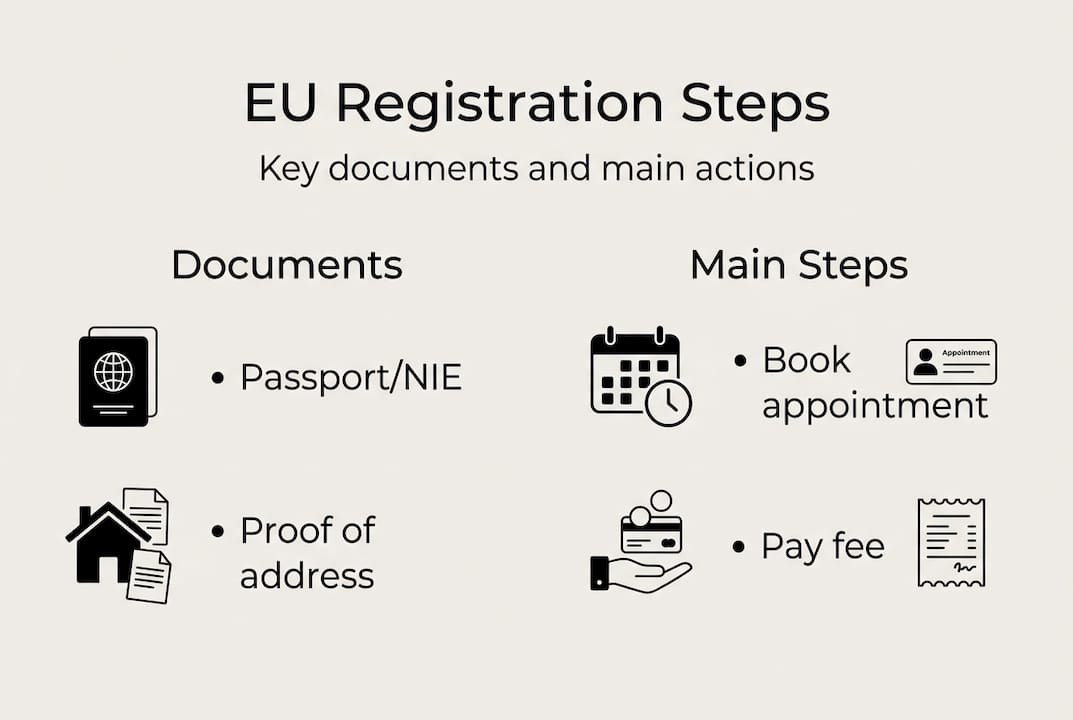
- Register on the padrón at your local town hall (Ayuntamiento). This is your proof of address in Spain.
- Complete form EX-18, the official application for EU citizen registration.
- Gather your documents according to your applicant type (see table above).
- Pay the fee, which is typically between €12 and €16 (Tasa 012).
- Book an appointment at the Oficina de Extranjería or designated police station.
- Attend your appointment and submit all documents in person.
- Receive your green certificate on the same day in most cases.
Register on the padrón, complete form EX-18, pay the fee, and book at Extranjería or police are the core steps, and the order matters.
Pro Tip: Bring originals AND photocopies of every document. Many offices will not make copies for you, and missing a photocopy can mean rescheduling your appointment entirely.
If you’re planning ahead for the long term, it’s worth understanding permanent residency eligibility from the start. And if you’re registering alongside a non-EU spouse or partner, the EU family member registration process runs on a separate track.
Renewal, permanent residency, and risks of non-compliance
Here’s something that surprises many people: the EU registration certificate does not have an expiry date. Once issued, it remains valid indefinitely. But that doesn’t mean your rights are locked in forever.
Your residency rights depend on maintaining continuous, legal residence in Spain. Specifically, you can lose those rights if:
- You are absent from Spain for more than 6 months in any single year
- You become an unreasonable burden on the Spanish state (relying on social assistance without prior contributions)
- You are absent for 12 consecutive months for specific reasons like military service or serious illness (these are exceptions, not the rule)
- You engage in fraud or abuse of the registration system
As the certificate does not expire but rights can be lost through absence or dependency, the practical advice is simple: maintain your residence and keep records of your presence in Spain.
After 5 years of continuous legal residence, you become eligible for permanent residency (Residencia de Larga Duración). This status is significantly more stable. It removes most conditions attached to your initial registration and gives you stronger protection against expulsion.
Key stat: Fines for non-compliance can reach €500 to €10,000, though enforcement against EU citizens is rare. The bigger practical risk is administrative: denied services, blocked contracts, and complications at the border.
If you’re approaching the five-year mark, now is the time to look at how to upgrade to permanent residency and what documentation you’ll need to make that transition smoothly.
Our take: why registration isn’t just a formality—what most guides miss
Most articles about EU registration in Spain treat it as a checklist. Do these steps, get this certificate, done. But we’ve seen what happens when people treat it that way, and the reality is more nuanced.
The biggest mistake isn’t skipping registration entirely. It’s delaying it. People arrive, get busy, assume their EU status protects them, and then hit a wall three months later when they try to open a bank account or sign a lease. That wall is avoidable.
There’s also a false sense of security that comes with EU citizenship. Your legal right to reside in Spain is real, but as we’ve seen, residency proof for expats is what actually matters in daily life. The right without the proof is like having a ticket you can’t show at the door.
Enforcement against EU citizens is genuinely rare. But the risk isn’t a fine. The risk is being the person at the bank who can’t open an account, or the job applicant whose contract gets stalled, or the person trying to return to Spain after a long trip and facing questions they can’t answer cleanly. Registration takes a few hours. The problems it prevents can take months to untangle.
Don’t let EU status lull you into avoidable stress. Register early, keep your documents updated, and treat the certificate as the foundation of your life in Spain, not an optional extra.
Need hassle-free help with your EU registration?
EU registration is manageable, but getting every document right on the first attempt is harder than it looks. A missing photocopy, an incorrect form, or a misunderstood requirement can mean starting over.
At Vive Legal, we handle the entire process online so you don’t have to figure it out alone. Whether you need help with EU registration as a worker, student, retiree, or family member, our team reviews your documents, prepares your forms, and guides you through every step. If you’re already registered and thinking about what comes next, we also offer long-term residence support to help you make the transition to permanent status with confidence. Fast, compliant, and fully online.
Frequently asked questions
Is it really mandatory for EU citizens to register in Spain?
Yes. If you stay longer than 90 days, Spanish law requires EU/EEA/Swiss citizens to register for the Certificado de Registro and obtain an NIE. Registration is legally required after 90 days with no exceptions for employment status or nationality within the EU.
Can I work or open a bank account without registering?
It’s almost impossible. Most banks and employers require the NIE for work and banking to process accounts or contracts, and attempting either without it typically results in rejection or significant delays.
How long does the EU certificate last?
The registration certificate does not expire, but rights are not indefinite. You can lose your residency rights if you are absent from Spain for more than 6 months per year or become reliant on state aid.
What happens if I don’t register?
You may face fines up to €10,000 for non-compliance, and you will almost certainly encounter serious difficulties with healthcare, employment, and contracts. Enforcement is rare but the practical consequences are immediate.
How do requirements differ for family members?
Non-EU family members must apply for a separate residence card through a different process, while EU family members follow the separate process for non-EU family and are not covered by the standard green certificate application.
Recommended
Living legally in Spain shouldn't be difficult.
View services and pricesNot sure which procedure you need? Find out in 2 min
Questions? Message us on WhatsApp