
7 Key Examples of Legal Documents for Spanish Immigration

Every American arriving in Spain faces an immediate challenge with paperwork. The process of proving your identity, securing official documents, and meeting legal requirements is the biggest hurdle for newcomers. Over 60 percent of residency application delays are caused by missing or incorrect documentation. Understanding exactly which papers you need and how Spanish authorities review them helps avoid frustration and costly mistakes when building your new life abroad. This guide unpacks the essentials for hassle-free residency.
Table of Contents
- Passport And Certified Copies For Identity Verification
- NIE Application Forms For Legal Identification In Spain
- Proof Of Legal Entry And Visa Requirements
- Financial Statements To Demonstrate Income Sufficiency
- Empadronamiento Certificate For Residency Address
- Health Insurance Proof For Visa Compliance
- Criminal Record Certificate And Apostille Process
Quick Summary
| Takeaway | Explanation |
|---|---|
| 1. Keep Valid Passport Copies | Always have at least two certified copies of your passport to prevent loss or administrative challenges during the immigration process. |
| 2. Complete NIE Forms Accurately | Ensure all details on your NIE application forms match exactly to avoid delays or rejections in your residency applications. |
| 3. Maintain Financial Documentation | Keep digital and physical copies of recent financial statements to demonstrate income sufficiency for various visa applications. |
| 4. Obtain Empadronamiento Certificate | Register your residency in Spain with a local certificate to enable access to municipal services and fulfill immigration requirements. |
| 5. Authenticate Criminal Record Certificates | Ensure your criminal record is properly translated and apostilled as required for various visa types to avoid complications. |
1. Passport and Certified Copies for Identity Verification
When navigating Spanish immigration procedures, your passport serves as the ultimate gateway to establishing your legal identity. These critical documents are more than just travel accessories they are your official proof of who you are in a foreign system.
Living legally in Spain shouldn't be difficult.
View services and pricesNot sure which procedure you need? Find out in 2 min
Questions? Message us on WhatsApp
Passports play a pivotal role in immigration processes by providing comprehensive personal identification that Spanish authorities recognize internationally. When applying for residency permits or other legal documents, you will need to present an original passport or certified document copies that confirm your foreign status.
The authentication process requires more than just having a passport. Your document must be:
- Valid and not expired
- Containing clear personal information
- Bearing an official government seal
- Translated into Spanish if originally issued in another language
Key considerations for passport documentation include ensuring all personal details match exactly across different application forms. Mismatched information can trigger delays or potential rejections in your immigration process.
Pro tip: Always maintain at least two certified copies of your passport separate from the original document to protect against potential loss or unexpected administrative requirements.
2. NIE Application Forms for Legal Identification in Spain
The NIE (Número de Identidad de Extranjero) serves as your critical legal identification number when establishing your official status in Spain. Understanding how to properly complete your NIE application forms is essential for navigating Spanish administrative processes.
Every foreign resident in Spain requires an NIE number to conduct fundamental legal and financial activities. Key functions of the NIE include:
- Opening a bank account
- Signing employment contracts
- Paying taxes
- Purchasing property
- Accessing healthcare services
- Registering with local authorities
The NIE application process involves submitting official documentation that verifies your identity, purpose of stay, and legal status. This typically requires presenting your passport, proof of address, and specific forms detailing your reasons for obtaining the identification number.
When completing NIE forms, accuracy is paramount. Any discrepancies between your application documents can cause significant delays or potential rejection. Carefully review all personal information multiple times before submission to ensure complete precision.
Pro tip: Prepare digital and physical copies of all required documents before initiating your NIE application to streamline the entire administrative process.
3. Proof of Legal Entry and Visa Requirements
Navigating Spain’s legal entry requirements is a critical first step for any foreign resident seeking to establish official status. Understanding visa entry regulations can mean the difference between smooth immigration and potential legal complications.
Visa requirements vary significantly depending on your specific immigration purpose:
- Work visas for employment opportunities
- Student visas for academic programs
- Family reunification permits
- Long-term residency applications
Each visa type demands specific documentation proving your legal right to enter and remain in Spain. This typically includes:
- Valid passport with minimum six months remaining
- Proof of financial sustainability
- Health insurance coverage
- Background check documents
- Specific purpose documentation (work contract or university acceptance)
The Spanish immigration system requires meticulous attention to detail. Even minor discrepancies in your entry documentation can result in application delays or potential rejection. Ensuring every document is accurate and complete is crucial for a successful immigration process.
Pro tip: Always maintain both digital and physical copies of your visa and entry documents in separate secure locations to protect against potential loss or administrative challenges.
4. Financial Statements to Demonstrate Income Sufficiency
Proving your financial stability is a critical requirement for successfully navigating Spanish immigration processes. Financial statements serve as your official testament to having sufficient resources for sustainable living in Spain.
Key financial documentation requirements include:
- Bank statements from past three to six months
- Proof of steady income sources
- Employment contracts
- Salary certificates
- Freelance or self employment documentation
- Investment income statements
Spanish immigration authorities meticulously review these documents to ensure you can support yourself without becoming a public burden. Minimum financial thresholds vary depending on your specific visa type:
- Student visas require demonstrating enough funds to cover tuition and living expenses
- Work visas need proof of sustainable income matching job market standards
- Family reunification permits demand comprehensive financial evidence
When preparing financial statements, transparency and completeness are crucial. Inconsistent or incomplete financial documentation can trigger immediate application rejection. Ensure all documents are:
- Officially translated into Spanish
- Authenticated by relevant financial institutions
- Showing consistent and verifiable income streams
- Dated within the last three months
Pro tip: Maintain digital and physical copies of all financial statements organized chronologically to expedite your immigration application process and quickly respond to any administrative requests.
5. Empadronamiento Certificate for Residency Address
The Empadronamiento certificate represents your official municipal registration document proving your residential address in Spain. This seemingly simple piece of paper holds significant weight in your immigration journey, serving as a critical link between you and local Spanish authorities.
What the Empadronamiento certificate demonstrates:
- Proof of actual residence in a specific municipality
- Official confirmation of your local address
- Verification of your physical presence in Spain
- Eligibility for local municipal services
To obtain this essential document, you will need to visit your local town hall or municipal office with specific supporting documents. Required materials typically include:
- Valid passport or residence permit
- Rental contract or property ownership deed
- Utility bill in your name
- Completed registration form
The municipal registration process involves presenting these documents and receiving an official certificate that validates your residential status. This document becomes crucial for numerous administrative procedures including healthcare registration, school enrollment, and further immigration applications.
Key considerations when preparing your Empadronamiento:
- Ensure all documents are current
- Translations must be officially certified
- Address details must match across all submitted paperwork
- Renewals are typically required every few years
Pro tip: Request multiple certified copies of your Empadronamiento certificate during initial registration to streamline future administrative processes and always keep a digital backup.
6. Health Insurance Proof for Visa Compliance
Health insurance documentation represents a critical checkpoint in your Spanish immigration journey. Proving comprehensive medical coverage is not just a bureaucratic requirement but a fundamental demonstration of your ability to sustain yourself while residing in Spain.
Comprehensive health insurance must cover:
- Full medical emergencies
- Hospitalization expenses
- Routine medical treatments
- Minimum coverage of 30000 euros
- Valid throughout entire Spanish territory
- Applicable for entire duration of residence permit
Visa authorities require specific characteristics in your health insurance documentation:
- Official documentation in Spanish or certified translation
- Issued by recognized international or Spanish insurance provider
- Explicit statement of comprehensive medical coverage
- No exclusionary clauses limiting essential treatments
- Renewable and transferable insurance policy
When selecting health insurance, international residents must carefully evaluate policies that meet Spanish immigration standards. Key considerations include:
- Public versus private insurance options
- Comprehensive versus minimal coverage plans
- Cost effectiveness
- Speed of medical service access
- Network of available healthcare providers
Most visa categories require different levels of medical insurance. Students, workers, and retirement visa applicants will have nuanced requirements that demand careful documentation preparation.
Pro tip: Request an official insurance certificate specifically formatted for immigration purposes and maintain both digital and physical copies to expedite your application process.
7. Criminal Record Certificate and Apostille Process
Navigating the criminal record certificate and apostille process is a critical step in your Spanish immigration journey. These documents serve as official proof of your legal standing and are essential for establishing trust with Spanish immigration authorities.
Criminal record certificates must:
- Be issued by your home country’s official agency
- Cover a specific time period
- Demonstrate no significant legal infractions
- Be translated into Spanish
- Contain official government seals
The apostille authentication process involves several crucial steps:
- Obtaining original criminal record document
- Securing certification from issuing government agency
- Receiving official Hague Convention apostille stamp
- Translating document by certified Spanish translator
Typical requirements for different visa categories:
- Work visas require full criminal background check
- Student visas need limited criminal history documentation
- Long term residency permits demand comprehensive legal verification
- Retirement visas require extensive personal background screening
Common challenges in this process include timing document preparation, ensuring proper translation, and meeting specific Spanish legal standards. Accuracy and attention to detail are paramount to avoid potential application rejections.
Pro tip: Request multiple certified copies of your criminal record certificate and apostille during initial processing to streamline future administrative requirements and maintain backup documentation.
Below is a comprehensive table summarizing the key requirements and processes for Spanish immigration procedures as discussed in the provided article.
| Document/Procedure | Description | Key Considerations |
|---|---|---|
| Passport and Certified Copies | Proof of identity through an internationally recognized document. | Ensure it is valid, sealed, translated into Spanish, and personal details match across forms. |
| NIE Application Forms | Legal identification number required for administrative processes in Spain. | Verify the accuracy of all details in forms and gather necessary documents like proof of address and purpose of stay. |
| Proof of Legal Entry | Documents ensuring legal entry, including various visa types. | Maintain valid visas for your purpose, correctly translated and authenticated, backed by a valid passport. |
| Financial Statements | Demonstration of financial sustainability through official records. | Provide consistent, well-translated income evidence; adhere to required minimum thresholds per visa type. |
| Empadronamiento Certificate | Municipal registration proving residency in Spain. | Match submitted information across documentation; obtain and store multiple certified copies for future use. |
| Health Insurance Proof | Evidence of comprehensive health insurance covering medical needs in Spain. | Coverage must include emergencies, hospitalization, and routine treatments; ensure policy validity and compliance with Spanish requirements. |
| Criminal Record Certificate | Records verifying legal standing, required for visa processes. | Secure official government-verified documents with translations and the Hague Convention apostille as required. |
Simplify Your Spanish Immigration Process with Expert Legal Support
Navigating the complex world of Spanish immigration requires precise handling of key documents like passports, NIE applications, visa paperwork, and financial proof. Many face challenges with document accuracy, timely submissions, and understanding the exact requirements for Empadronamiento certificates or health insurance proof. These hurdles can cause delays and unnecessary stress when applying for residency or work permits in Spain.
Vive Legal offers a streamlined and reliable solution to these challenges. Our platform specializes in assisting expatriates, workers, students, and EU citizens through every step of their immigration journey by combining advanced automation with expert legal review. From personalized diagnostics and document review to appointment scheduling and case tracking, Vive Legal ensures your application is precise and complete, helping you avoid costly mistakes.
Take control of your immigration journey today with Vive Legal
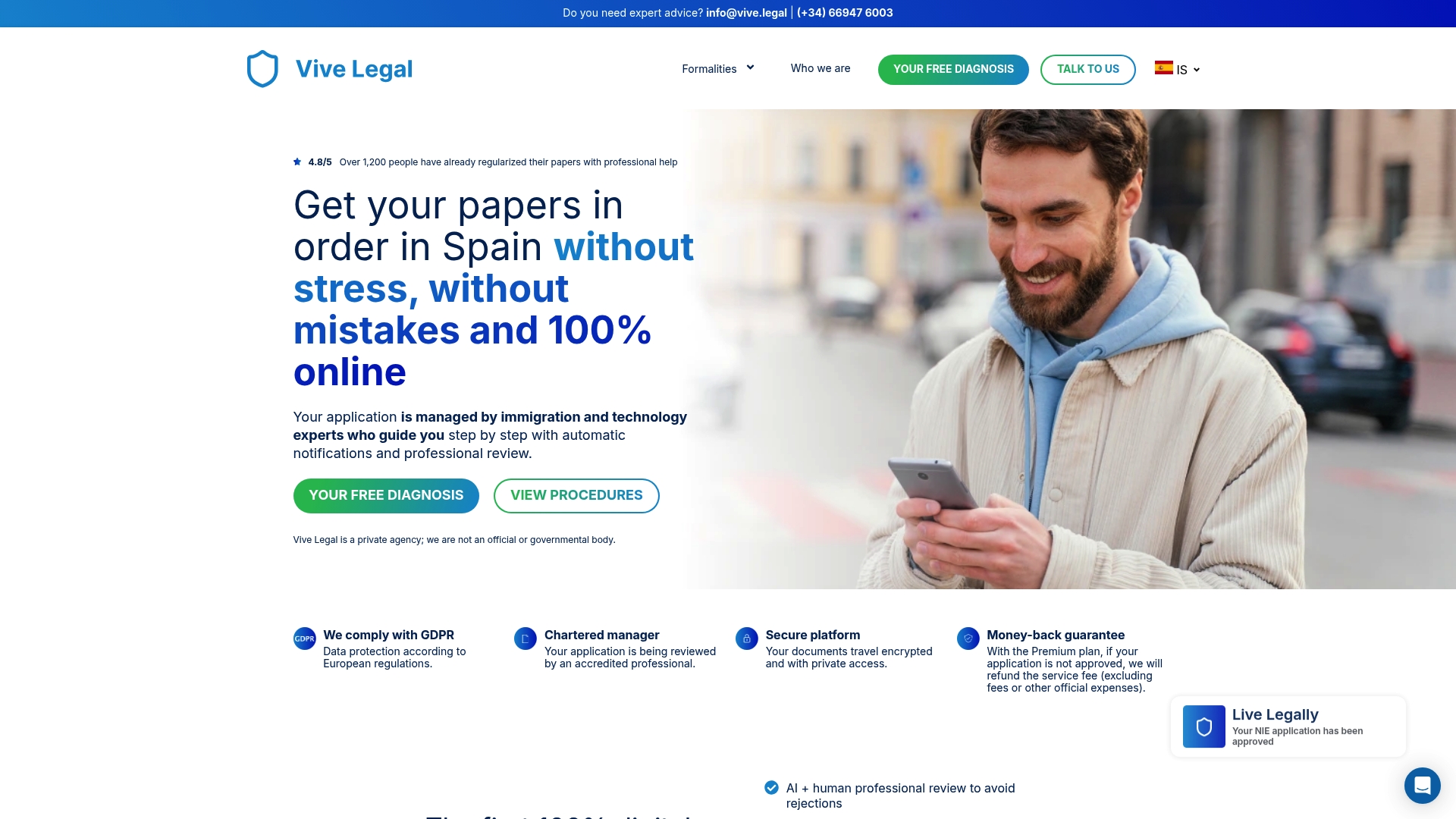
Get started now by visiting Vive Legal and discover how our fully online, secure legal consultancy can save you time and increase your chances of approval. Don’t let complex paperwork stand in your way—trust our expertise to guide you confidently through Spain’s immigration system.
Frequently Asked Questions
What legal documents are essential for applying for Spanish residency?
The most important legal documents include your valid passport, an NIE (Número de Identidad de Extranjero), proof of legal entry and visa requirements, financial statements, the Empadronamiento certificate, health insurance proof, and a criminal record certificate. Prepare these documents carefully to ensure a smooth application process.
How can I obtain my NIE number for residing in Spain?
To obtain your NIE number, fill out the necessary application form, submit it alongside your passport and proof of address to the relevant authorities. Make sure to review your application for accuracy and submit all required materials to minimize delays.
What is the purpose of the Empadronamiento certificate in Spain?
The Empadronamiento certificate serves as official proof of your residence in a specific municipality in Spain. You can obtain it by registering at your local town hall with documents like your passport and rental contract.
What information should I include in my financial statements for an immigration application?
Your financial statements should include bank statements, proof of steady income, and any relevant job contracts or investment income statements. Ensure all documents are officially translated into Spanish and accurately reflect your financial situation to avoid rejection.
How do I ensure my health insurance meets Spanish immigration requirements?
Your health insurance must cover a comprehensive range of medical services and meet minimum coverage amounts. Choose a policy from an authorized provider and request an official certificate formatted for immigration purposes to verify compliance.
What is the apostille process for my criminal record certificate?
The apostille process involves obtaining your criminal record from your country’s official agency, then securing a certification from that agency followed by a Hague Convention apostille stamp. Ensure the document is translated into Spanish and keep multiple certified copies for your records.
Recommended
Living legally in Spain shouldn't be difficult.
View services and pricesNot sure which procedure you need? Find out in 2 min
Questions? Message us on WhatsApp