
Expatriate worker requirements in Spain 2026 guide

Navigating Spain’s work visa landscape can feel overwhelming, especially when conflicting advice floods online forums and government websites seem to change overnight. Many expatriates assume they need a job offer before even researching visa options, or believe irregular status automatically disqualifies them from legal residency. The reality is more nuanced. Spain offers multiple pathways for foreign workers in 2026, from traditional employer-sponsored permits to post-2025 Arraigo reforms that legalize undocumented residents. This guide cuts through the confusion, explaining eligibility criteria, application steps, and strategic choices to help you secure legal status efficiently.
Table of Contents
- Overview Of Spain’s Expatriate Worker Visa Options In 2026
- Step-By-Step Visa Application And Residency Process For Expatriate Workers
- Residency Legalization Options For Irregular Expatriate Workers: Arraigo Paths Post-2025 Reforms
- Choosing The Best Visa And Residency Path: Expert Insights And Practical Considerations For 2026
- How Vive Legal Can Assist Expatriate Workers With Their Visa And Residency In Spain
Key takeaways
| Point | Details |
|---|---|
| Multiple visa routes exist | Spain offers standard work visas, HQP permits, Digital Nomad visas, and EU Blue Cards depending on your qualifications and salary. |
| Employer sponsorship is critical | Most work permits require a Spanish company to initiate authorization before you apply at a consulate. |
| Arraigo paths legalize irregular status | Post-2025 reforms introduced four Arraigo types allowing undocumented workers to gain residency with proof of integration. |
| Processing times vary widely | Standard visas take 20 to 90 days for employer authorization, while Arraigo can process faster with proper documentation. |
| Legal guidance prevents costly errors | Regional variations in integration reports and documentation requirements make expert consultation essential for approval. |
Overview of Spain’s expatriate worker visa options in 2026
Spain’s immigration system offers distinct visa categories tailored to skill levels, employment types, and salary thresholds. Understanding which route matches your profile determines whether you face labor market tests, accelerated processing, or regional bureaucratic hurdles.
Living legally in Spain shouldn't be difficult.
View services and pricesNot sure which procedure you need? Find out in 2 min
Questions? Message us on WhatsApp
The standard employee work visa requires your employer to prove no qualified Spanish or EU candidate can fill the position. This labor market test adds weeks to processing and often fails in competitive sectors. Expatriate workers in Spain primarily need work and residence visas such as the standard employee work visa, Highly Qualified Professional (HQP) visa, Digital Nomad Visa, or EU Blue Card, requiring employer sponsorship, minimum salary thresholds (e.g., €32,000+ for HQP), qualifications, private health insurance, and no criminal record. The HQP visa eliminates this test if you earn at least €32,000 annually and hold relevant qualifications. Processing accelerates because authorities assume high earners fill genuine skill gaps.
Digital Nomad visas suit remote workers employed by non-Spanish companies, requiring proof of stable income exceeding €2,646 monthly. The EU Blue Card targets highly skilled professionals with job offers paying 1.5 times Spain’s average salary, though HQP visas often provide more flexibility for intra-company transfers.
All routes demand core documents: a clean criminal record from your home country and any nation where you’ve lived over six months, private health insurance covering your stay, proof of employer sponsorship or contract, and evidence of qualifications matching your role. Missing a single apostilled document can delay approval by months.
Visa type comparison
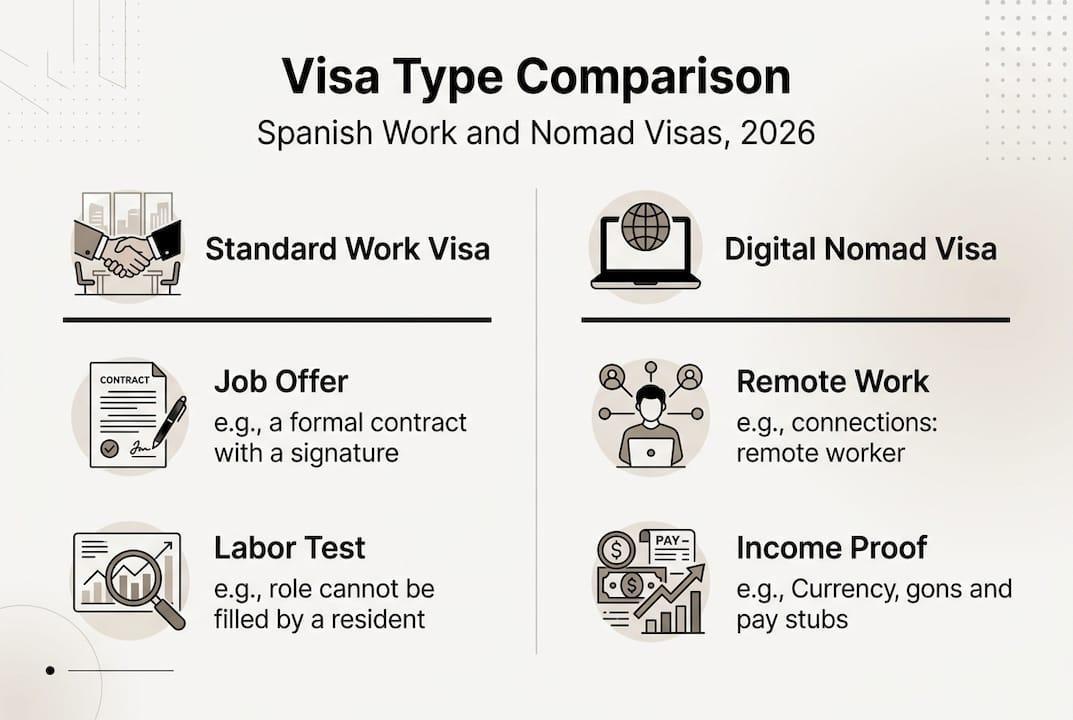
| Visa Type | Eligibility | Minimum Salary | Processing Time |
|---|---|---|---|
| Standard work visa | Any job offer, labor test required | No minimum | 60 to 90 days |
| HQP visa | Qualified professionals, no labor test | €32,000+ annually | 20 to 45 days |
| Digital Nomad | Remote work for foreign employer | €2,646 monthly | 30 to 60 days |
| EU Blue Card | Highly skilled roles | 1.5x national average | 45 to 90 days |
Common eligibility criteria across visa types:
- Valid passport with at least 12 months remaining validity
- Apostilled criminal background check issued within 90 days
- Private health insurance policy with no copays covering Spanish territory
- Employer sponsorship letter detailing role, salary, and contract duration
- Academic credentials or professional certifications relevant to position
- Proof of accommodation in Spain or intent to secure housing
Pro Tip: If your salary exceeds €32,000 and you hold a university degree or equivalent professional experience, prioritize the HQP visa route to bypass labor market tests and cut processing time nearly in half compared to standard permits.
Step-by-step visa application and residency process for expatriate workers
Securing legal worker status in Spain follows a two-phase structure: employer authorization in Spain, then your consular visa application abroad. Missteps in either phase restart the clock, so understanding the sequence prevents frustrating delays.
Your Spanish employer initiates the process by filing a work authorization request with the regional immigration office where the company operates. Authorities verify the job offer, company registration, and compliance with labor regulations. The work visa process requires employers to apply for authorization in Spain (20 to 90 days), then employees apply for visas at consulates; post-arrival, obtain TIE within 30 days. Standard permits take 60 to 90 days, while HQP applications often clear in 20 to 45 days due to streamlined review.
Once Spain approves the authorization, your employer receives official notification. You then schedule an appointment at the Spanish consulate in your home country or legal residence. Bring originals and copies of all required documents: authorization approval, passport, criminal record, health insurance policy, medical certificate, and passport photos meeting biometric standards. Consulates often require additional proof like bank statements showing financial solvency or rental agreements.
After visa approval, you have up to 90 days to enter Spain. Within 30 days of arrival, you must apply for your Tarjeta de Identidad de Extranjero (TIE) at the local immigration office. This physical card serves as your legal residence permit and work authorization. Missing the 30-day deadline triggers penalties and potential permit cancellation.
Sequential application steps:
- Secure job offer from Spanish employer willing to sponsor work authorization
- Employer submits authorization request to regional immigration office with contract and company documents
- Wait 20 to 90 days for authorization approval depending on visa type and regional workload
- Schedule consular appointment in home country upon receiving authorization notification
- Attend consulate interview with complete documentation package and biometric data
- Receive visa stamp in passport, typically within 10 to 20 business days
- Enter Spain within 90 days of visa issuance to activate residence status
- Apply for TIE card at local immigration office within 30 days of arrival
- Collect TIE card after fingerprinting and final document verification
Pro Tip: Begin gathering apostilled documents three months before your employer files authorization. Consulates reject expired criminal records or insurance policies, and obtaining replacements from abroad adds weeks of delay. Consider consulting legal professionals to review your application package before submission.
Residency legalization options for irregular expatriate workers: Arraigo paths post-2025 reforms
If you’ve been living in Spain without legal status, the post-2025 Arraigo reforms offer four distinct pathways to regularization. These routes recognize that many undocumented workers contribute to Spanish society and economy, providing structured mechanisms to transition from irregular to legal residence.
Arraigo types after 2025 reforms include Social (2 years residence plus integration report or job), Laboral (2 years plus 6 months work), Familiar (no minimum residence for parents of minors), and Formation (training-based), granting initial 1 to 5 year permits. Arraigo Social requires two years of continuous residence proven through empadronamiento (municipal registration), utility bills, or rental contracts. You must also obtain an integration report from your municipality confirming social ties, or secure a one-year employment contract. This route suits workers who’ve built community connections but lack formal work history.
Arraigo Laboral demands two years of residence plus proof of at least six months of employment, even if that work was informal. Labor inspections or witness testimony can validate undocumented work periods. This pathway targets workers who contributed economically despite lacking permits.
Arraigo Familiar eliminates residence duration requirements for parents of Spanish-born minors or those with deep family roots in Spain. If you’re the parent of a Spanish citizen child, you qualify immediately regardless of how long you’ve lived in the country.
Arraigo por Formación, the newest category, allows residence based on enrollment in vocational training programs that lead to employment. This suits younger workers seeking to formalize status while building skills.
Arraigo pathway comparison
| Arraigo Type | Minimum Residence | Work Requirement | Integration Report | Initial Permit Length |
|---|---|---|---|---|
| Social | 2 years | 1-year contract OR report | Required if no contract | 1 year, renewable |
| Laboral | 2 years | 6 months proven work | Not required | 1 year, renewable |
| Familiar | None for parents of minors | Not required | Not required | 5 years |
| Formation | Variable | Training enrollment | Municipality report | 1 year, renewable |
Common documentation requirements:
- Empadronamiento certificates covering residence period with no gaps exceeding 90 days
- Utility bills, rental contracts, or school enrollment records proving continuous presence
- Integration report from municipality (Social and Formation routes)
- Employment contract or labor inspection records (Laboral route)
- Birth certificates and family relationship proof (Familiar route)
- Clean criminal record from Spain and home country
Pro Tip: Integration reports vary significantly by municipality. Some town halls issue them within weeks, while others take months and require extensive interviews. Consult lawyers familiar with your region’s specific requirements to avoid rejection based on technicalities. The 2026 extraordinary regularization window offers additional flexibility, so explore whether you qualify for expedited processing.
Choosing the best visa and residency path: expert insights and practical considerations for 2026
Selecting between employer-sponsored visas and Arraigo routes depends on your current status, qualifications, and timeline. Making the wrong choice costs months of processing time and potential legal complications.
Decision factors to evaluate:
- Current immigration status: legal visitors can pursue standard visas, while irregular residents need Arraigo or extraordinary regularization
- Skill level and salary: professionals earning over €32,000 should prioritize HQP visas for fast processing
- Job offer availability: employer sponsorship opens standard visa routes but requires companies willing to navigate bureaucracy
- Residence duration: two years of documented presence unlocks Arraigo Social or Laboral options
- Family ties: parents of Spanish minors qualify immediately for Arraigo Familiar
- Timing urgency: 2026 extraordinary regularization offers expedited processing for eligible applicants
Visa routes vs. Arraigo options
| Pathway | Pros | Cons | Typical Timeline |
|---|---|---|---|
| HQP Visa | Fast processing, no labor test, renewable | Requires €32,000+ salary, qualifications | 20 to 45 days |
| Standard Work Visa | Accessible for any job offer | Labor market test, slower processing | 60 to 90 days |
| Arraigo Social | Legalizes irregular status, no salary minimum | Requires 2 years residence, integration report | 30 to 60 days |
| Arraigo Laboral | Recognizes informal work, no integration report | Must prove 6 months employment | 30 to 60 days |
| 2026 Regularization | Expedited processing, flexible criteria | Limited time window, specific eligibility | 15 to 45 days |
Legal consultation becomes invaluable when navigating regional variations in integration reports, employment verification standards, and documentation requirements. Immigration lawyers familiar with 2026 policy updates can identify the fastest route for your situation and prevent application rejection due to technical errors.
Pro Tip: If you qualify for the HQP visa based on salary and credentials, apply immediately rather than waiting for potential policy changes. For irregular residents, the 2026 extraordinary regularization program offers a limited window before June to legalize status with reduced documentation requirements. Missing this deadline means reverting to standard Arraigo timelines.
Stay compliant by maintaining continuous empadronamiento registration, keeping utility bills and rental contracts organized, and avoiding absences from Spain exceeding 90 days per year. These proofs become critical evidence in Arraigo applications and TIE renewals. Common pitfalls include letting empadronamiento lapse during address changes, failing to apostille foreign documents properly, or assuming verbal job offers satisfy employment contract requirements.
How Vive Legal can assist expatriate workers with their visa and residency in Spain
Navigating Spain’s immigration bureaucracy demands precision, and small documentation errors derail applications. Vive Legal specializes in streamlining visa and residency processes for expatriate workers, combining AI-powered document review with expert legal oversight to maximize approval rates.
Our platform handles everything from initial eligibility assessments to final TIE card collection. For workers pursuing Arraigo Social, we prepare complete application packages in days, not weeks, ensuring integration reports meet regional standards and residence proofs satisfy immigration authorities. If you qualify for the 2026 extraordinary regularization, we expedite submissions to meet the June deadline.
Whether you need employer authorization support, consular appointment preparation, or post-arrival TIE processing, Vive Legal’s immigration services provide transparent pricing, secure document portals, and real-time case tracking. Schedule a consultation to identify your optimal pathway and avoid costly delays.
What are the most common questions about expatriate worker requirements in Spain?
What documents are needed to apply for a work visa in Spain?
You need an apostilled criminal record from your home country issued within 90 days, private health insurance with full Spanish coverage, proof of employer sponsorship or job contract, academic credentials matching your role, a valid passport with 12+ months validity, and passport photos meeting biometric standards. Missing apostilles or expired documents cause immediate rejection.
Can I apply for residency if I’ve been living irregularly in Spain?
Yes, through Arraigo pathways introduced in post-2025 reforms. Arraigo Social requires two years of documented residence plus an integration report or job contract, while Arraigo Laboral needs two years plus six months of proven work. Parents of Spanish minors qualify immediately for Arraigo Familiar regardless of residence duration. The 2026 extraordinary regularization offers additional flexibility.
How long does the work visa process usually take in 2026?
Standard work visas take 60 to 90 days for employer authorization in Spain, followed by 10 to 20 days for consular visa processing. HQP visas accelerate this to 20 to 45 days total due to streamlined review. After entering Spain, you must obtain your TIE card within 30 days, adding another 15 to 30 days for appointment scheduling and card issuance.
What is the Arraigo Social route and who qualifies?
Arraigo Social legalizes irregular residents who’ve lived in Spain continuously for two years, proven through empadronamiento and utility bills. You must either secure a one-year employment contract or obtain an integration report from your municipality confirming social ties like language skills, community involvement, or family connections. This route suits workers who lack formal employment history but demonstrate integration into Spanish society.
Do I need a job offer before researching visa options?
No, understanding visa categories before securing employment helps you target roles that match HQP salary thresholds or identify employers experienced with sponsorship processes. Research the job search legal framework first, then approach companies that fit your visa pathway. Some visas like Digital Nomad permits don’t require Spanish employers at all.
Recommended
Living legally in Spain shouldn't be difficult.
View services and pricesNot sure which procedure you need? Find out in 2 min
Questions? Message us on WhatsApp