
Family reunification in Spain: bring your loved ones home

TL;DR:
- Family reunification in Spain is a complex legal process that depends heavily on the sponsor’s nationality and residence status. Eligibility, documentation, and procedures vary significantly between EU citizens and non-EU residents, requiring careful preparation and understanding of multiple legal frameworks. Properly collecting, authenticating, and translating documents is crucial to prevent delays or rejections in family reunification applications.
Bringing your family to Spain sounds simple until you try to figure out exactly who qualifies, which documents you need, and which legal pathway applies to your situation. Many families spend months confused about whether a parent, a sibling, or a spouse can even be included in a reunification application. Spanish immigration law combines national rules with EU directives, and the resulting system has specific categories, strict eligibility conditions, and different procedures depending on whether the sponsor is an EU citizen or a non-EU resident. This guide cuts through that confusion and walks you through everything you need to know.
Living legally in Spain shouldn't be difficult.
View services and pricesNot sure which procedure you need? Find out in 2 min
Questions? Message us on WhatsApp
Table of Contents
- What is family reunification?
- Who qualifies for family reunification in Spain?
- How does family reunification differ for EU citizens and non-EU residents?
- Practical steps for the family reunification process in Spain
- Our take: what most guides miss about family reunification in Spain
- How Vive Legal can help with your family reunification journey
- Frequently asked questions
Key Takeaways
| Point | Details |
|---|---|
| Legal pathway explained | Family reunification lets legal residents bring close relatives to Spain within strict categories. |
| Eligibility criteria | Spouses, minor children, and dependent ascendants qualify but must meet proof and dependency requirements. |
| Distinct procedures | EU citizens and non-EU nationals face different family reunification regimes. |
| Application steps matter | Attention to documents and specific conditions is crucial for approval. |
| Expert support recommended | Navigating nuances and exceptions is easier with professional legal guidance. |
What is family reunification?
Family reunification generally refers to a legal pathway that lets people who are lawfully living in a country join certain close family members so the family can live together in one place. In Spain, this pathway is formalized through both Spanish national law and European Union legislation, which means there are two overlapping frameworks you need to understand.
The EU Family Reunification Directive (Council Directive 2003/86/EC) sets the minimum standards that all EU member states must follow for third-country nationals (people who are not EU citizens) who want to bring relatives to join them. Spain has implemented these standards and added its own national requirements on top, particularly around income thresholds, housing conditions, and documentation.
“Family reunification provides a legal right for residents to live with close family members, but eligibility is carefully defined and conditions must be met before any application is approved.”
It is worth understanding that reunification is not a general open-door policy. It is a structured legal mechanism with defined categories of eligible relatives and real conditions attached. Below is a quick overview of the two key frameworks:
| Framework | Who it applies to | Key features |
|---|---|---|
| EU Directive 2003/86/EC | Non-EU sponsors with legal residence | Covers spouse, minor children, and in some cases dependent parents over 65 |
| EU Free Movement Directive 2004/38/EC | EU citizen sponsors | Broader scope, covers spouse, registered partner, children, and dependent relatives |
Understanding which framework applies to you is the very first step. If your sponsor is an EU citizen living in Spain, the EU Family Card Spain route may apply, and it typically offers more flexibility than the general immigration regime.
Who qualifies for family reunification in Spain?
Not every relative automatically qualifies. Spanish and EU rules define a relatively narrow list of eligible family members, and meeting that definition requires specific documentation. Eligible family members are limited and may require proof of relationship and, for certain relatives, dependency, need, and eligibility conditions.
Here is who can typically be included in a reunification application under the general (non-EU) regime:
- Spouse or registered partner: Must be legally married or in a recognized civil partnership. Polygamous marriages where a previous spouse already resides in Spain are not accepted.
- Minor children: Biological or legally adopted children under 18, including children of the spouse.
- Children over 18 with disabilities: If they are objectively unable to provide for their own needs, they may qualify.
- Dependent ascendants (parents or grandparents): Generally must be over 65 years old AND financially dependent on the sponsor. Under-65 ascendants may qualify only in exceptional humanitarian circumstances.
There are several practical nuances worth noting. The sponsor must have held legal residence in Spain for at least one year before submitting the reunification application. In addition, the sponsor must have been granted or be in the process of renewing a residence permit valid for at least one more year. This is a commonly overlooked requirement that delays many families.

| Relative | Standard requirement | Additional condition |
|---|---|---|
| Spouse | Valid marriage certificate | Not legally separated or divorced |
| Minor child | Birth certificate | Under 18, in sponsor’s legal custody |
| Dependent parent (65+) | Proof of age and dependency | Financial dependency on sponsor required |
| Dependent parent (under 65) | Proof of humanitarian need | Exceptional circumstances only |
Pro Tip: Start collecting official documents early. Marriage certificates and birth certificates from non-EU countries almost always need to be apostilled (officially authenticated) and translated by a sworn translator. This process alone can take several weeks depending on the issuing country.
The Spanish Family Card is a specific permit for family members of Spanish nationals and may involve a slightly different set of requirements than reunification for non-EU residents. If your sponsor is a Spanish citizen rather than a foreign resident, make sure you are applying under the correct regime. Similarly, sponsors who already hold EU Long-Term Residence status may have access to slightly broader reunification rights under Spanish law.
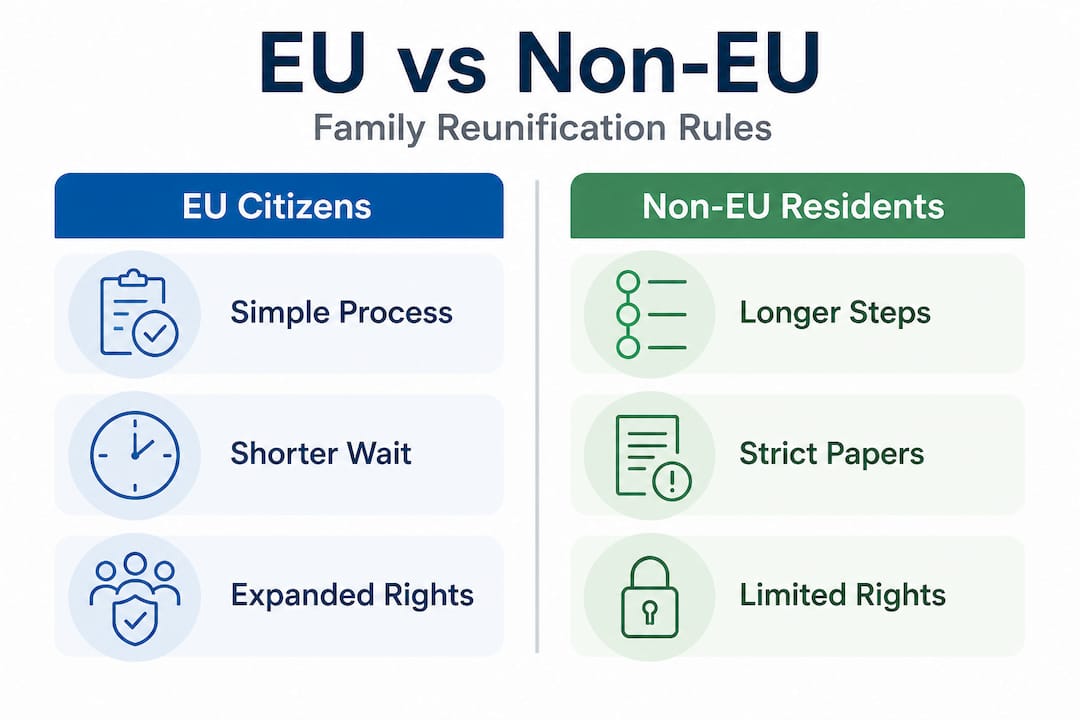
How does family reunification differ for EU citizens and non-EU residents?
Understanding eligibility is only part of the equation. Many families must navigate separate legal regimes depending on the sponsor’s nationality and residence status. Spain distinguishes between sponsors who are third-country nationals under the family reunification directive and EU citizens and their family members, who can follow a separate regime with different procedures and scope.
For EU citizens living in Spain, the applicable framework is the EU Free Movement Directive, which Spain has transposed into national law. Under this regime:
- The eligible family members are broader. They include spouses, registered partners, direct descendants under 21 (or over 21 if dependent), and dependent direct relatives in the ascending line (parents, grandparents).
- Extended family members, such as partners in long-term relationships, may also be considered in some circumstances.
- Processing can be faster and less document-intensive compared to the general immigration route.
“EU citizens exercising their free movement rights in Spain can bring a wider circle of family members than non-EU sponsors, with fewer income and housing conditions attached.”
For non-EU residents, the process is governed by the Spanish Foreigners Law (Ley Orgánica 4/2000) and the EU Family Reunification Directive. The conditions are stricter:
- Income requirements: The sponsor must demonstrate sufficient economic resources to support the family. In practice, this usually means income above a multiple of the IPREM (Spain’s public income reference index).
- Adequate housing: Sponsors must prove they have accommodation suitable in size and conditions for the reunited family.
- Minimum residence period: At least one year of legal residence in Spain, with at least one more year remaining on the permit.
The EU Registration Spain process applies specifically to EU citizens registering their residency in Spain, and it is a key step before any family member application can proceed under the EU free movement route. The two systems really do operate separately, and mixing them up is a surprisingly common mistake that causes applications to be submitted under the wrong framework entirely.
Practical steps for the family reunification process in Spain
Once you know which procedure applies, here is how to move forward with the Spanish reunification process in practical terms. Spanish consular guidance limits reunification to specific family categories and describes the conditions and documentation requirements for each one.
- Confirm eligibility: Verify that the sponsor meets the minimum residence requirement (one year of legal residence, permit valid for at least one more year) and that the relative falls within an eligible category.
- Gather documentation: Collect your residence permit, proof of income, proof of housing, and all relationship documents (marriage certificate, birth certificates). Every foreign document must be apostilled and translated by a sworn translator into Spanish.
- Check income and housing thresholds: Calculate whether your income exceeds the required IPREM multiple for your family size. The housing inspection or proof of adequate accommodation must also be current.
- Submit the application in Spain: The sponsor submits the reunification application at a Spanish immigration office (Oficina de Extranjería). Once approved, the family member applies for a reunification visa at the Spanish consulate in their home country.
- Family member obtains the visa and travels to Spain: After visa approval, the family member has 90 days to enter Spain.
- Apply for the residence card in Spain: Once in Spain, the family member must apply for a TIE (Tarjeta de Identidad de Extranjero, or foreigner identity card) within 30 days of entry.
Common mistakes that derail applications include submitting documents without proper apostilles, misidentifying the legal regime (EU vs. non-EU), providing income evidence that does not cover the right time period, and failing to translate all documents into Spanish.
Pro Tip: If your situation involves any edge cases, such as a dependent parent under 65, a child from a previous relationship, or a partner in an unmarried relationship, get professional legal advice before submitting. These cases require stronger evidentiary packages, and a poorly built application is much harder to correct after the fact than to prepare correctly from the start. Immigration specialists who understand the current Arraigo Social Spain requirements can also help you identify whether alternative regularization routes might be more appropriate for your family’s circumstances.
Our take: what most guides miss about family reunification in Spain
After helping many families work through Spain’s reunification process, we have noticed a pattern that no standard checklist fully captures. Most families come to us believing their case is straightforward. In reality, the difference between an approved application and a rejected one almost never comes down to eligibility. It comes down to how the documentation is prepared.
Spanish immigration officers do not interpret “good enough” evidence favorably. A marriage certificate that lacks an apostille, a translation done by a non-sworn translator, or a financial statement that covers three months instead of the required six months will get an application rejected or suspended, even if the family relationship is completely genuine and legally valid. We have seen this happen repeatedly with dependency proofs for parents. Families submit a letter from a doctor saying the parent has health issues. That is not dependency. Dependency means documented financial reliance, often requiring bank statements, proof of the parent’s income (or lack thereof), and a written explanation of the financial support relationship.
The humanitarian exception for parents under 65 is another area where applications routinely fail. This exception exists in theory, but in practice, Spanish authorities apply it very narrowly. Submitting a medical report alone is rarely sufficient. You typically need a combination of medical documentation, evidence of the parent’s inability to support themselves, and a formal explanation of why reunification in Spain is the only viable option.
The broader lesson is that preparation quality matters more than most people expect. Spending time on our Spain immigration guides before you start gathering documents can save you months of delays. Understanding the legal distinctions between EU and non-EU regimes, knowing exactly what dependency means under Spanish law, and building a complete evidentiary package from the start are the factors that actually move applications forward.
How Vive Legal can help with your family reunification journey
Family reunification in Spain involves multiple moving parts: eligibility analysis, document preparation, sworn translations, income verification, and coordinating applications across two countries. Missing a single step can set your timeline back by months.
At Vive Legal, we guide families through every stage of this process using a combination of professional legal expertise and smart digital tools. From your first eligibility check to final document submission, our platform keeps your case organized and your family informed at every step. Whether you are navigating the Extraordinary Regularization 2026 program or submitting a family reunification application under the standard or EU regime, we offer personalized case analysis, document review, and appointment management all in one place. If your relative qualifies for EU Family Card assistance, our team can prepare and review the full application so nothing falls through the cracks.
Frequently asked questions
Can siblings be reunified with residents in Spain?
No. Under both Spanish national law and the EU directive, eligible categories are limited to spouses, minor children, and dependent ascendants. Siblings are not included.
How long does the family reunification process take?
Most applications require several months for full approval, depending on documentation completeness, the family category, and consular processing times in the home country.
Is it possible to reunite dependent parents under 65?
Only in exceptional humanitarian cases. The standard eligibility threshold is being over 65 and financially dependent on the sponsor in Spain.
Do EU citizens in Spain follow the same reunification process?
No. EU citizens follow a separate regime under EU free movement law, which is generally simpler and covers a broader range of family members than the process for non-EU residents.
Recommended
Living legally in Spain shouldn't be difficult.
View services and pricesNot sure which procedure you need? Find out in 2 min
Questions? Message us on WhatsApp