
Family Reunification Spain: Securing Residency for Loved Ones

Many Latin American families in Spain feel both hope and anxiety when navigating the complex steps of family reunification. Spanish immigration rules require clear proof of relationships, income, and housing, making the process feel overwhelming for newcomers. Understanding the requirements for official documentation and learning how to avoid common mistakes can help families stay together legally and build a stable future in Spain.
Table of Contents
- Defining Family Reunification In Spain
- Eligibility Criteria And Who Qualifies
- Step-By-Step Application Process Explained
- Required Documents And Evidence Needed
- Legal Rights And Obligations For Reunified Families
- Common Pitfalls And How To Avoid Rejection
Key Takeaways
| Point | Details |
|---|---|
| Family Reunification Eligibility | Applicants must meet specific legal criteria, including demonstrating a legitimate family relationship and having financial stability. |
| Comprehensive Documentation Required | Thorough and accurate documentation is crucial for successful applications, including proof of identity and financial means. |
| Legal Rights and Obligations | Reunified families gain access to social services, but must also comply with ongoing immigration regulations and legal responsibilities. |
| Common Application Pitfalls | Common reasons for rejection include incomplete documentation and insufficient financial proof, emphasizing the need for meticulous preparation. |
Defining Family Reunification in Spain
Family reunification represents a critical legal pathway for Latin American immigrants seeking to bring their loved ones to Spain legally and permanently. This process allows qualifying family members to obtain residency permits, enabling families separated by migration to reunite under Spanish immigration regulations.
Living legally in Spain shouldn't be difficult.
View services and pricesNot sure which procedure you need? Find out in 2 min
Questions? Message us on WhatsApp
To qualify for family reunification, applicants must meet specific legal criteria defined by Spanish immigration law. These requirements typically include:
- Demonstrating a legitimate family relationship (spouse, children, parents)
- Holding a valid long-term residency permit in Spain
- Proving sufficient financial means to support reunited family members
- Having appropriate housing accommodations for additional family members
- Presenting comprehensive documentation verifying familial connections
The legal framework for family reunification is complex and varies depending on the specific family relationship. Key rights of migrant families provide important context for understanding these nuanced regulations. Immediate family members like spouses and minor children generally have more straightforward paths compared to extended family members.
Spain’s immigration system recognizes different categories of family reunification, each with unique requirements and processing timelines. These categories include direct family reunification for nuclear family members and extended family reunification for dependent relatives who can demonstrate economic dependency.
Important Considerations:
- Processing times vary based on family relationship type
- Complete and accurate documentation is crucial
- Each application undergoes individual assessment
- Legal representation can significantly improve approval chances
Pro tip: Consult with an immigration specialist early in the process to understand specific requirements for your unique family situation and minimize potential application complications.
Eligibility Criteria and Who Qualifies
Family reunification in Spain involves specific legal requirements that determine which family members can successfully apply for residency. Family reunification rights are carefully defined to protect both immigrant families and national immigration policies.
The primary categories of eligible family members typically include:
- Spouse or legally registered domestic partner
- Minor children (under 18 years old)
- Dependent children over 18 with documented disabilities
- Parents of the primary resident under specific dependency conditions
- Dependent siblings in exceptional circumstances
To be eligible, the primary resident must meet critical preconditions:
- Hold a valid long-term Spanish residency permit
- Demonstrate stable and sufficient income
- Provide proof of adequate housing accommodations
- Have been legally residing in Spain for at least one year
- Show no criminal record that would prevent family reunification
Key Eligibility Factors include proving financial stability, legal relationship documentation, and meeting specific dependency requirements. The immigration authorities conduct thorough assessments to verify the authenticity of family connections and economic capability to support additional family members.
Dependency is not just about age, but involves demonstrating genuine economic and emotional interdependence between family members.
Different family members have varying requirements. For instance, minor children have more straightforward paths compared to adult dependent relatives who must provide extensive documentation proving economic necessity and familial relationship.
Here’s how eligibility and application complexity vary by family member type:
| Family Member Type | Eligibility Complexity | Key Evidence Required |
|---|---|---|
| Spouse/Partner | Straightforward | Marriage certificate, proof of legal partnership |
| Minor Children | Simple | Birth certificate, custody documentation |
| Dependent Parents | Moderate | Proof of financial and emotional dependency |
| Adult Siblings | High | Extensive dependency evidence, legal affidavits |
Pro tip: Compile comprehensive documentation early, including birth certificates, marriage licenses, and financial records to streamline your family reunification application process.
Step-by-Step Application Process Explained
Family reunification in Spain requires a systematic and carefully documented approach. Family reunification process involves multiple stages that demand precision and thorough preparation from the primary resident and their family members.
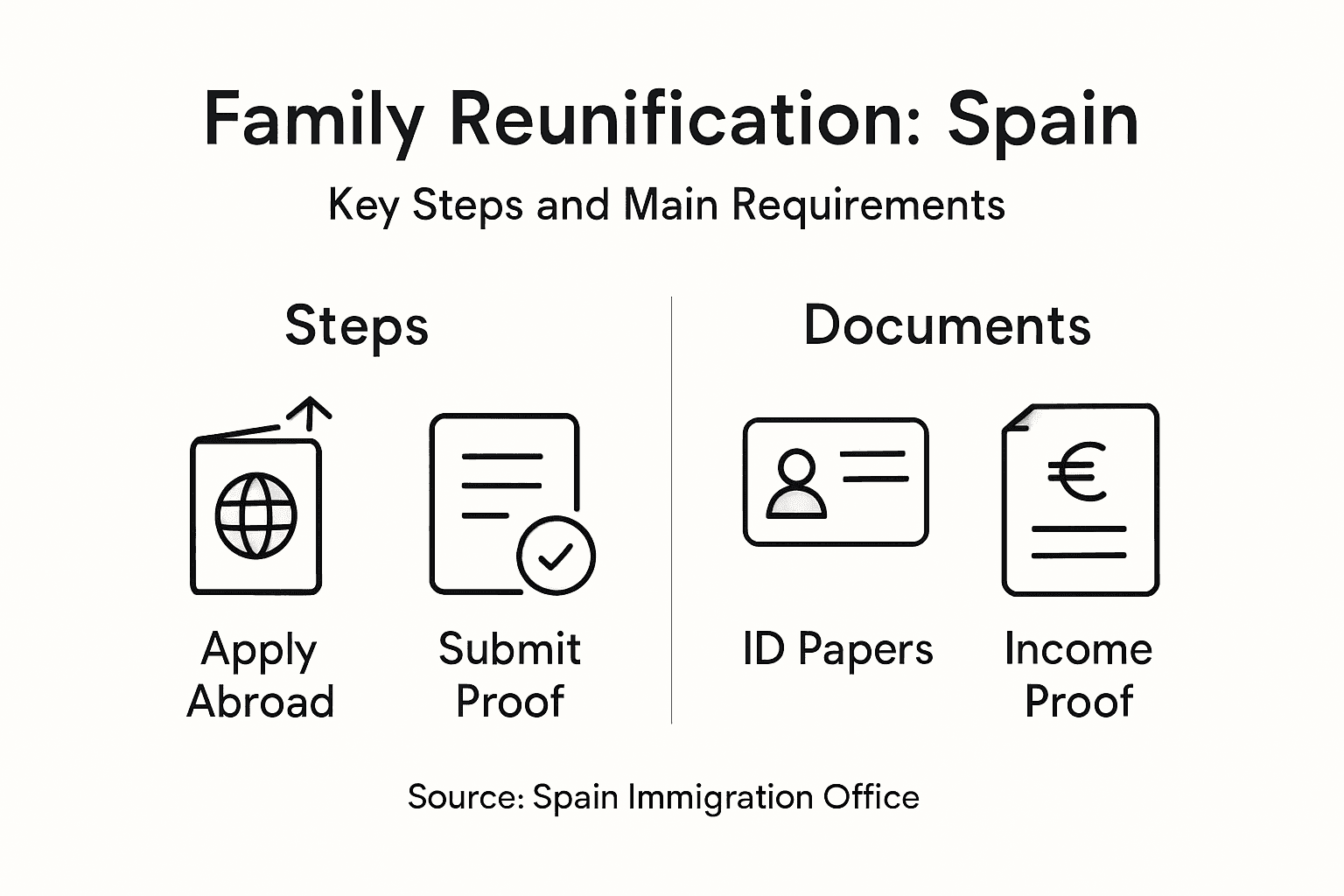
The application process typically follows these critical stages:
- Sponsorship Preparation
- Confirm one year of legal residence in Spain
- Gather proof of stable income
- Prepare housing accommodation documentation
- Verify clean criminal record
- Document Compilation
- Birth certificates
- Marriage or partnership documentation
- Proof of familial relationships
- Financial statements
- Housing capacity certificates
- Initial Application Submission
- File application at local Immigration Office
- Pay required processing fees
- Submit comprehensive documentation package
- Await initial administrative review
Meticulous documentation is the cornerstone of a successful family reunification application in Spain.
After initial approval, the sponsored family member must complete additional steps. This includes applying for a visa at the Spanish consulate in their home country, entering Spain legally, and obtaining a Foreigner’s Identity Card within three months of arrival.
Critical Timing Considerations:
- Applications have specific submission windows
- Documentation has strict validity periods
- Incomplete applications can cause significant delays
- Each step has precise procedural requirements
Pro tip: Create a detailed checklist and maintain copies of all submitted documents to track your family reunification application effectively and minimize potential administrative complications.
Required Documents and Evidence Needed
Successful family reunification in Spain demands a comprehensive and meticulously organized collection of official documentation. The immigration authorities require precise evidence to validate family relationships, financial stability, and legal eligibility.
Primary Documentation Categories:
-
Identity Verification Documents
- Valid passport for sponsor and family members
- Original birth certificates
- Marriage or partnership legal certificates
- Passport-sized photographs
-
Financial Proof Documents
- Recent income tax returns
- Employment contract or salary statements
- Bank statements demonstrating financial stability
- Proof of steady income for past 12 months
-
Residency and Legal Status Evidence
- Current Spanish residency permit
- Proof of legal residence duration
- Criminal background clearance certificate
- Social security registration documents
Original documents must be officially translated into Spanish by a certified translator to be considered valid.
Specific documentation requirements vary depending on the family member’s relationship to the primary resident. For instance, minor children require different supporting documents compared to adult dependent parents or siblings.
Additional Specialized Documentation:
- Disability certificates for dependent adult children
- Proof of economic dependency
- Housing capacity verification
- Medical insurance coverage documents
- Educational records (for minor children)
Pro tip: Create digital and physical copies of all documents, ensuring they are certified, translated, and organized chronologically to expedite the family reunification application process.
Below is a summary of document requirements by document type:
| Document Type | Who Provides It | Typical Purpose |
|---|---|---|
| Proof of Identity | Sponsor and Relative | Confirm legal identity |
| Financial Statements | Sponsor | Show income stability |
| Housing Certificates | Sponsor | Validate living space |
| Dependency Evidence | Dependent Relatives | Justify economic ties |
Legal Rights and Obligations for Reunified Families
Family reunification in Spain grants significant legal protections and responsibilities for both sponsors and reunified family members. Family reunification rights encompass comprehensive access to social services and integration opportunities within Spanish society.
Key Legal Rights Include:
- Right to live in Spain
- Access to public healthcare system
- Permission to work legally
- Enrollment in educational institutions
- Social security benefits
- Free movement within European Union
Critical Legal Obligations:
- Maintain valid residence permits
- Renew documentation before expiration
- Register with local municipal authorities
- Comply with Spanish immigration regulations
- Report significant life changes
Reunified family members must actively maintain their legal status through continuous compliance with immigration requirements.
Specific Documentation Responsibilities:
- Annual permit renewals
- Updated employment documentation
- Proof of continuous residence
- Medical insurance coverage verification
- Criminal background maintenance
Family reunification obligations extend beyond initial entry, requiring ongoing engagement with Spanish administrative systems. Each family member must demonstrate active integration and legal adherence to maintain their residency status.
Pro tip: Create a comprehensive tracking system for all legal documents and renewal dates to ensure consistent compliance with Spanish immigration regulations.
Common Pitfalls and How to Avoid Rejection
Family reunification applications are complex legal processes fraught with potential complications that can lead to immediate rejection. Family reunification process challenges require meticulous attention to detail and comprehensive documentation preparation.
Most Common Rejection Triggers:
- Incomplete documentation
- Insufficient financial proof
- Inadequate housing verification
- Missing critical deadlines
- Improperly translated documents
- Inconsistent relationship documentation
- Failure to meet income threshold requirements
Critical Documentation Red Flags:
- Expired supporting documents
- Incomplete financial statements
- Unverifiable family relationship evidence
- Lack of official translations
- Missing signature or certification
Administrative precision determines success in family reunification applications.
Financial requirements often represent the most challenging aspect of applications. Sponsors must demonstrate consistent income stability that exceeds minimum thresholds, typically requiring verifiable earnings at least 150% of the national minimum wage.
Strategic Preparation Recommendations:
- Obtain certified document translations
- Maintain comprehensive financial records
- Create redundant document copies
- Consult immigration legal specialists
- Track application submission timelines meticulously
Pro tip: Engage an immigration lawyer to conduct a comprehensive pre-submission document review, identifying and addressing potential weaknesses before official application.
Simplify Your Family Reunification Journey with Professional Guidance
Navigating the complex family reunification process in Spain can be overwhelming. From gathering detailed documentation to meeting strict eligibility requirements and avoiding common pitfalls, the path to securing residency for your loved ones demands precision and expert knowledge. This article highlights critical steps like proving financial stability, submitting accurate documents, and understanding legal obligations that can make or break your application.
Take control of your family’s future today with personalized legal support from Vive Legal. Our platform specializes in immigration and residency procedures in Spain, offering:
- Comprehensive document review and preparation
- Step-by-step guidance tailored to your specific family situation
- Efficient online management with secure case tracking
Avoid costly delays and application rejections by leveraging the expertise of professionals who blend advanced technology with human oversight. Discover how Vive Legal transforms the family reunification experience into a clear and manageable process. Visit our landing page or explore our helpful resources in the Uncategorized Archives to start your journey. Act now to bring your family together under one roof with confidence and clarity.
Frequently Asked Questions
What is family reunification in Spain?
Family reunification in Spain is a legal process that allows immigrants to bring qualifying family members to live with them in Spain, enabling families separated by migration to reunite under specific immigration regulations.
Who qualifies for family reunification in Spain?
Eligible family members include spouses, minor children, dependent children with disabilities, and parents who meet specific dependency conditions. Each category has its own criteria for eligibility.
What documents are required for the family reunification application?
Required documents typically include identity verification documents (passports, birth certificates), financial proof (income tax returns, bank statements), and residency evidence (legal permits). Each family member may have additional specific requirements.
What are common reasons for family reunification application rejection?
Common reasons for rejection include incomplete documentation, insufficient financial proof, inadequate housing verification, and failure to meet strict deadlines or income requirements. Thorough preparation can help avoid these pitfalls.
Recommended
Living legally in Spain shouldn't be difficult.
View services and pricesNot sure which procedure you need? Find out in 2 min
Questions? Message us on WhatsApp