
First-time residency in Spain: step-by-step guide 2026

TL;DR:
- Spain’s residency process varies significantly for EU and non-EU citizens, requiring different steps.
- Preparing documents, understanding deadlines, and booking appointments ahead are vital for a smooth move.
- Expert guidance can prevent common errors, delays, and ensure quick access to essential services.
Moving to Spain for the first time is exciting, but the residency process can feel like navigating a maze with no map. Between appointments, documents, deadlines, and different rules for EU and non-EU citizens, it’s easy to feel overwhelmed before you even pack a bag. The good news? The process is completely manageable once you understand the steps, the order they go in, and what to avoid. This guide breaks down everything you need to know, from choosing the right visa pathway to confirming your legal status and accessing essential services once you arrive.
Living legally in Spain shouldn't be difficult.
View services and pricesNot sure which procedure you need? Find out in 2 min
Questions? Message us on WhatsApp
Table of Contents
- Understanding Spain’s residency options for first-timers
- What to prepare before leaving for Spain
- Arriving in Spain: First steps for legal residency
- Verifying your residency status and accessing essential services
- What most first-timers get wrong: Lessons from years of helping expats
- How Vive Legal makes your residency journey easier
- Frequently asked questions
Key Takeaways
| Point | Details |
|---|---|
| Know your pathway | Identify whether you need an EU registration, a Digital Nomad Visa, or another permit before arrival. |
| Prepare documents early | Gather all necessary originals, apostilles, translations, and insurance before moving to avoid costly delays. |
| Act fast upon arrival | Register address and apply for NIE or TIE quickly to stay compliant and access services. |
| Double-check approval | Confirm official residency status to unlock public healthcare, banking, and more. |
| Expert help matters | Professional guidance prevents mistakes and saves time during Spain’s complex residency process. |
Understanding Spain’s residency options for first-timers
Before you do anything else, you need to know which residency pathway applies to you. Spain treats EU/EEA citizens and non-EU citizens very differently, and mixing up the two can cost you weeks of wasted effort.
EU and EEA citizens have it relatively straightforward. You can enter Spain visa-free and stay up to 3 months, but for longer stays, you must register at your local town hall (empadronamiento) within the first week, then obtain your NIE and EU Registration Certificate within 3 months of arrival. The green paper certificate is your proof of legal residency as an EU citizen.
Non-EU citizens face a more involved process. You must apply for a visa before entering Spain, and the right visa depends on your situation:
- Non-lucrative visa: For those with passive income or savings, no work allowed in Spain.
- Student visa: For enrolled students at accredited Spanish institutions.
- Work visa: Requires a Spanish employer to sponsor you.
- Digital Nomad Visa (DNV): For remote workers employed by foreign companies. To qualify, you need a minimum income of ~€2,520 to €2,849 per month (200% of Spain’s minimum wage), no more than 20% of your income from Spanish clients, and at least 3 years of professional experience or a relevant degree.
Here’s a quick comparison to help you orient yourself:
| Pathway | Who it’s for | Key requirement | Timeline |
|---|---|---|---|
| EU Registration | EU/EEA citizens | NIE + empadronamiento | Within 3 months |
| Non-lucrative visa | Non-EU, no work | Proof of income/savings | 1 to 3 months |
| Digital Nomad Visa | Non-EU remote workers | Min. income + foreign employer | 1 to 3 months |
| Student visa | Non-EU students | Enrollment letter | 1 to 2 months |
One thing many first-timers miss: the NIE application is required for almost every legal and financial transaction in Spain, from opening a bank account to signing a lease. Getting it early is not optional. It’s foundational.
What to prepare before leaving for Spain
With your options clear, the next step is preparing everything needed so you can hit the ground running. The biggest mistakes happen not in Spain but before you even board the plane.
For EU citizens, the core documents include:
- Valid passport or national ID
- Proof of address in Spain (rental contract or letter from host)
- Proof of income, employment, or financial self-sufficiency
- Private or public health insurance
For non-EU citizens, the list is longer:
- Valid passport (minimum 1 year validity beyond your intended stay)
- Completed visa application form
- Proof of financial resources (bank statements, contracts, pension proof)
- Full private health insurance with no copays or deductibles
- Criminal background check, apostilled and translated into Spanish
- Medical certificate, also apostilled
Apostilling means getting an official stamp that verifies a document’s authenticity for international use. Any document issued in your home country must be apostilled before Spanish authorities will accept it. Translations must be done by a sworn translator recognized in Spain, not just any bilingual friend.
Health insurance is another area where people underestimate the requirements. For most non-lucrative visas, Spain requires full private coverage with no gaps. Check the non-lucrative visa fee structure and insurance minimums carefully before purchasing a policy.
A common mistake that blocks access to services for EU citizens is skipping the padrón (town hall registration). Without it, you cannot access public healthcare, enroll children in school, or prove your residency for other applications.
Pro Tip: Create a master document folder before you leave, both physical and digital. Label everything clearly, make certified copies of originals, and keep digital backups in cloud storage. Losing a key document in Spain can set your entire timeline back by weeks.

Arriving in Spain: First steps for legal residency
Preparation done, it’s time to move. Here’s what to do as soon as you arrive in Spain to secure your residency.
The order of operations matters. Doing things out of sequence can create bureaucratic loops that are frustrating and time-consuming to untangle.
For EU citizens:
- Register at your local town hall (empadronamiento) within the first week.
- Apply for your NIE at the foreigner’s office or national police station.
- Apply for your EU Registration Certificate (green paper) within 3 months.
- Set up private or public health insurance.
- Open a bank account using your NIE.
For non-EU citizens:
- Enter Spain on your approved visa.
- Register at your local town hall (empadronamiento) as soon as possible.
- Apply for your TIE (Tarjeta de Identidad de Extranjero, your physical residency card) at the national police station within 30 days of arrival.
- Set up private health insurance if not already done.
- Register for social security if working legally.
Here’s a timeline overview to keep you on track:
| Action | Who | Deadline | Where |
|---|---|---|---|
| Empadronamiento | EU + non-EU | Week 1 | Town hall (Ayuntamiento) |
| NIE application | EU + non-EU | Within 3 months | Police/foreigner’s office |
| EU Registration | EU citizens | Within 3 months | Police/foreigner’s office |
| TIE application | Non-EU | Within 30 days | National police station |
| Health insurance | Non-EU | Before TIE appointment | Private insurer |
After arrival, non-EU residents must apply for TIE within 30 days and register their padrón. Missing either deadline creates complications that can delay your entire residency timeline. For those planning to stay long-term, understanding long-term EU residence requirements from the start helps you plan for the future.
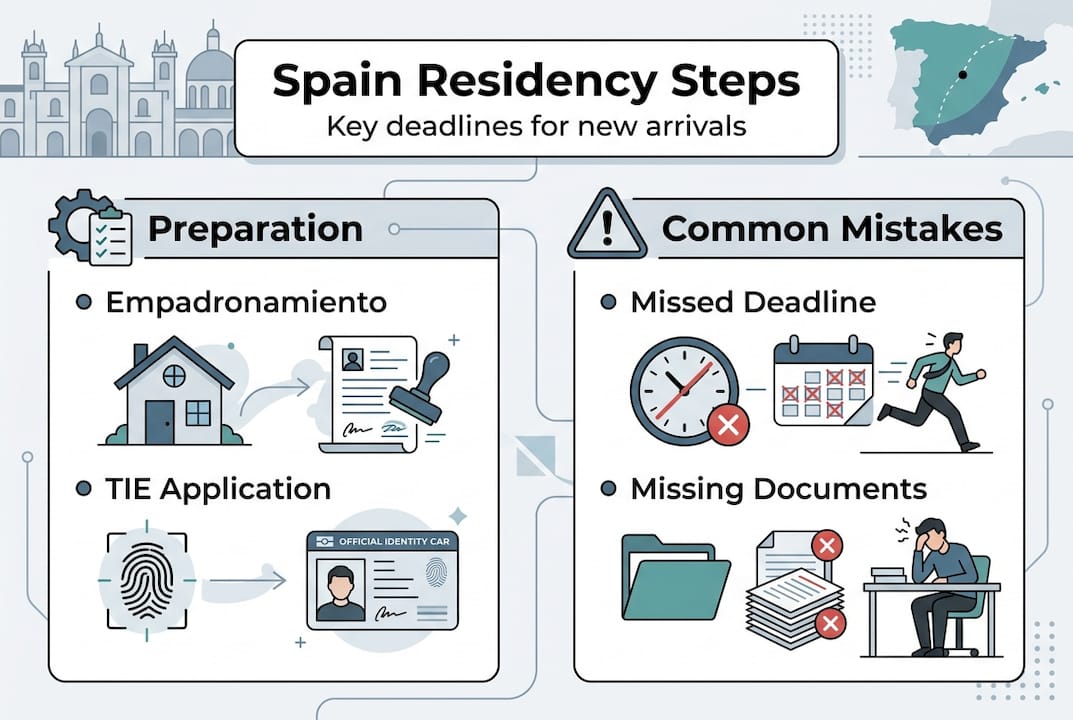
Pro Tip: Book your police appointments online before you even land in Spain. Slots fill up fast, especially in major cities like Madrid and Barcelona. Some expats wait 3 to 6 weeks for an open slot if they wait until after arrival.
Verifying your residency status and accessing essential services
Once you’ve navigated the initial applications, the final task is checking your status and tying up practical loose ends.
After submitting your applications, you’ll need to confirm approval and pick up your documents. For EU citizens, legalizing EU residency means receiving your green certificate and verifying it’s correctly issued with your full name, NIE, and registration date. For non-EU citizens, the TIE card is your primary proof of legal status and must be renewed before it expires.
Here’s how to access key services once your residency is confirmed:
- Healthcare: EU citizens can use their EHIC card initially, then apply for a TSI card (Tarjeta Sanitaria Individual) through the local health center. Non-EU residents need private full coverage for their visa, but may qualify for public healthcare once they meet residency and contribution requirements.
- Banking: Most Spanish banks require your NIE, passport, and proof of address. Some banks offer non-resident accounts, but a resident account gives you access to better services.
- Tax registration: If you spend more than 183 days per year in Spain, you become a tax resident. Register with the Agencia Tributaria (Spanish tax authority) and understand your obligations early.
- Social security: Required if you’re working legally in Spain. Register at the Tesorería General de la Seguridad Social with your NIE and employment contract.
Important: Delays in verifying your residency status can block access to healthcare, banking, and other essential services. Do not assume approval means everything is in order. Follow up proactively and check for errors on your documents immediately after receiving them.
For broader guidance on navigating Spain’s immigration landscape, the Spain immigration guides at Vive Legal cover a wide range of situations and updates.
What most first-timers get wrong: Lessons from years of helping expats
Here’s something most guides won’t tell you: following a checklist is not enough. Spain’s bureaucracy is not just about having the right documents. It’s about having them in the right format, submitted in the right order, at the right office, on the right day.
We’ve seen clients arrive with complete document sets and still face rejections because a translation wasn’t certified by a sworn translator, or because they booked the wrong type of appointment. These aren’t rare edge cases. They’re common.
The most overlooked step is building a realistic appointment timeline before you arrive. Most people assume they can walk in and handle things within a week. In practice, appointment slots for NIE and TIE applications in cities like Madrid or Barcelona can be booked out for weeks. That delay cascades into delayed banking, delayed healthcare registration, and delayed work start dates.
We’ve also seen clients underestimate the Arraigo Social option, which offers a path to residency for those who’ve already been living in Spain informally. It’s not widely advertised, but for the right person, it’s a powerful tool.
The contrarian truth? Investing in expert guidance at the start almost always costs less than fixing errors later. A rejected application means restarting timelines, repaying fees, and sometimes leaving Spain to reapply from your home country.
How Vive Legal makes your residency journey easier
Now that you understand the process, here’s how professional support can make a real difference at every stage.
Vive Legal specializes in exactly the kind of end-to-end residency support that first-time expats need most. From your initial diagnostic to document review, form preparation, and appointment scheduling, every step is managed through a secure online portal with real-time updates. Whether you need help with your TIE residency card, EU registration, or troubleshooting a stalled application, you get a single point of contact who knows your case. No chasing offices, no guessing at forms. Just a clear path forward, backed by legal expertise and smart automation.
Frequently asked questions
What is the NIE and how do I get it as a first-time expat?
The NIE (Número de Identificación de Extranjero) is Spain’s foreigner ID number, required for virtually every legal and financial transaction. You apply at the local police station or foreigner’s office with your passport and supporting documents, and EU citizens must obtain it within 3 months of arrival.
What’s the fastest way for non-EU remote workers to gain residency?
The Digital Nomad Visa is the most direct route, allowing non-EU remote workers to apply from their home consulate or from within Spain. You’ll need proof of remote employment, minimum income of ~€2,520 per month, and documentation showing no more than 20% of income comes from Spanish clients.
Do I need private health insurance, or will public coverage be enough?
It depends on your citizenship status. EU citizens can use an EHIC card initially and then transition to the TSI public health card, while non-EU residents need private full coverage for their visa and may access public healthcare later once eligible.
What happens if I miss a residency application deadline?
Missing deadlines can delay your residency approval and cut off access to healthcare, banking, and other local services until you regularize your status, which often requires starting parts of the process over.
Recommended
Living legally in Spain shouldn't be difficult.
View services and pricesNot sure which procedure you need? Find out in 2 min
Questions? Message us on WhatsApp