
How to gather supporting documents for Spanish residency
TL;DR:
- Accurate document preparation and official formatting are essential to avoid application delays or denials.
- Knowing your specific applicant category determines required documents, supporting forms, and submission procedures.
- Professional assistance helps ensure compliance with complex requirements and streamlines the residency application process.
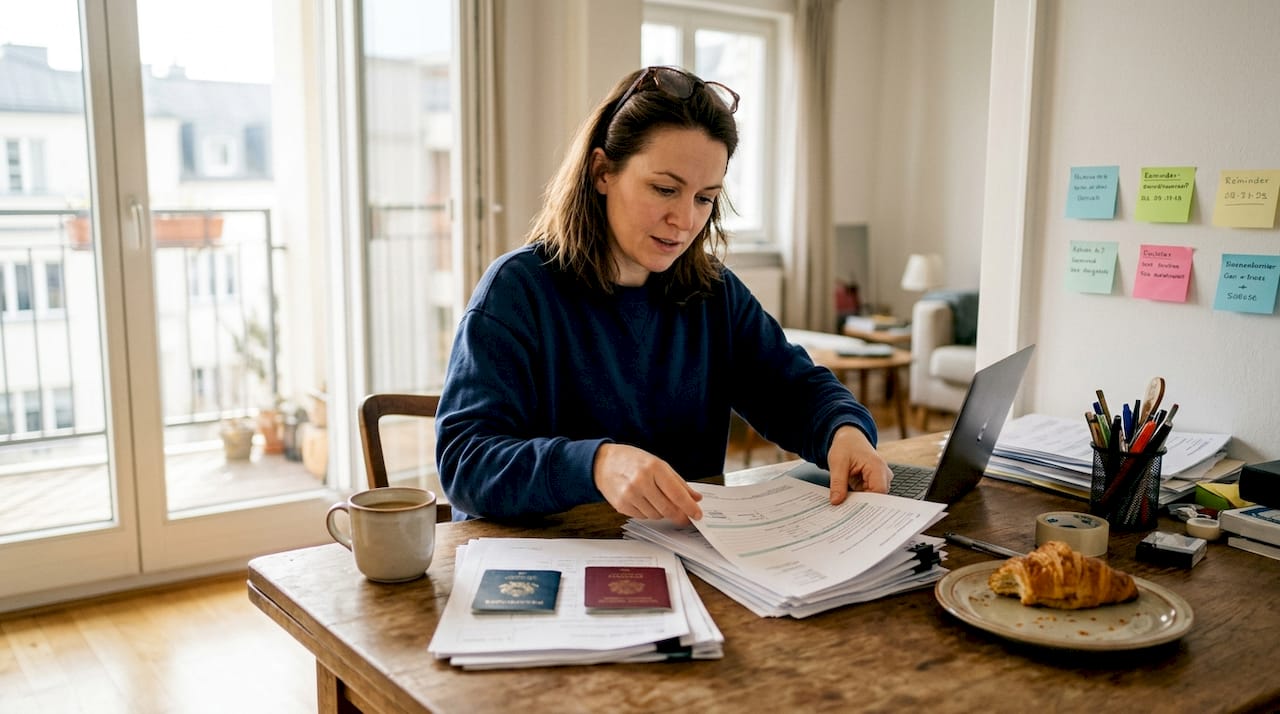
Missing a single document in your Spanish residency application can cost you months of waiting, a wasted consulate appointment, or an outright denial. The process is not just about collecting papers; it’s about getting the right papers, in the right format, at the right time. This guide walks you through every step: identifying your applicant category, building your checklist, formatting documents to official standards, and troubleshooting the surprises that catch even well-prepared applicants off guard. Whether you’re a non-EU worker, an EU citizen, a student, or a retiree, you’ll find evidence-based strategies here that cut through the confusion and help you move forward with confidence.
Living legally in Spain shouldn't be difficult.
View services and pricesNot sure which procedure you need? Find out in 2 min
Questions? Message us on WhatsApp
Table of Contents
- Know your residency category and what it requires
- Documents checklist and official formatting rules
- Step-by-step process for gathering and submitting your documents
- Troubleshooting common issues and special cases
- What most guides miss: The ‘local proof’ reality and how to beat the backlog
- Get professional help for a stress-free application
- Frequently asked questions
Key Takeaways
| Point | Details |
|---|---|
| Document needs vary by category | Non-EU residents, EU citizens, students, and family all require different sets of supporting documents to apply for Spanish residency. |
| Official checklist is vital | Always verify requirements with your local Spanish consulate, as they override generic online guides and change frequently. |
| Apostille and Spanish translation mandatory | Every foreign public document must be apostilled or legalized and sworn translated unless originally in Spanish. |
| Common mistakes cause delays | Missing financial proof, health insurance, or formatting errors are the top reasons applications are delayed or refused. |
| Prepare for last-minute issues | Lost documents, minor applicants, or inconsistent requirements can be addressed if you anticipate common hurdles early. |
Know your residency category and what it requires
The first thing Spanish immigration authorities want to know is who you are in legal terms. Your applicant category determines everything: which forms you fill out, which documents you gather, and which office handles your case. Getting this wrong from the start is one of the most common reasons applications stall.
Spain recognizes several distinct applicant types. Non-EU nationals applying for a non-lucrative visa, an employment visa, or an Arraigo permit each face different requirements. EU, EEA, and Swiss citizens follow a separate registration pathway with a lighter document load but still specific obligations. International students, retirees, and family members of residents all have their own document sets.
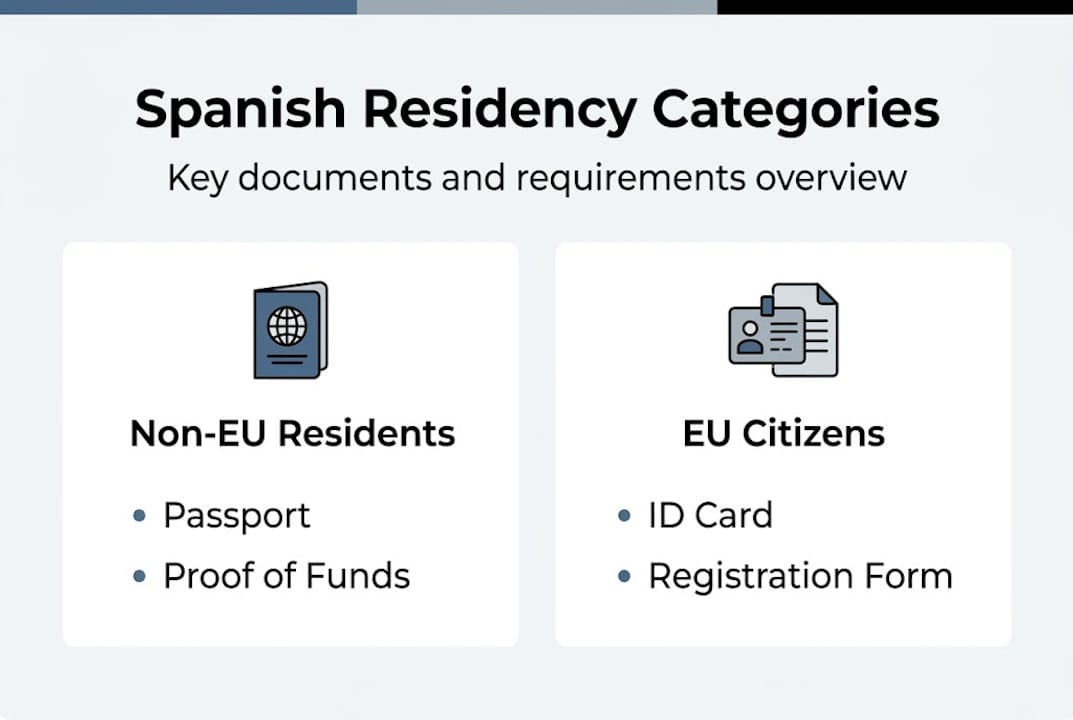
Here’s a quick comparison to orient you:
| Applicant type | Key documents required | Special notes |
|---|---|---|
| Non-EU resident | Passport, proof of funds, medical certificate, criminal record | Core supporting documents must be apostilled |
| EU/EEA/Swiss citizen | Passport/ID, proof of economic activity or funds | Fewer requirements but registration is mandatory |
| International student | Passport, admission letter, enrollment proof, funds | Must show €600/month minimum |
| Retiree (non-lucrative) | Passport, pension statement, health insurance, funds | 400% IPREM threshold applies |
| Family member | Relationship proof, sponsor’s residency docs, passport | Additional notarized forms required |
For EU citizens, the EU registration steps are simpler than most expect, but skipping them still leads to fines and complications. Students doing internships should review the internship residence process separately, as it has distinct academic and employer documentation requirements.
One number worth keeping in mind: application volume surged 46% after 2025 reforms, meaning consulates are busier than ever. Errors or incomplete files get deprioritized fast. Precise preparation is no longer optional; it’s your competitive advantage.
Always cross-check your category against the official Exteriores.gob.es checklist for your specific consulate jurisdiction. Requirements vary by location, and the official source is always the final word.
Documents checklist and official formatting rules
Once you know your category, the next task is compiling your documents exactly as Spanish authorities require them. Not just the right papers, but the right versions, with the right stamps, in the right language.
Core documents for most applicants:
- Valid passport (minimum 1 year validity beyond your intended stay)
- Completed visa or NIE application form (EX forms, depending on category)
- Passport-size photos meeting Spanish biometric standards
- Proof of financial means (bank statements, pension letters, or employment contracts)
- Private health insurance valid in Spain with no copayments or deductibles
- Criminal background certificate from your country of residence
- Medical certificate confirming no contagious diseases
Additional documents by applicant type:
- Students: University admission letter, proof of enrollment, and evidence of accommodation
- Retirees: Official pension statement translated and apostilled
- Family members: Birth or marriage certificates proving the relationship, plus the sponsor’s valid residency document
Now, here’s where many applicants lose weeks of progress: formatting. All foreign documents must be apostilled (or legalized, if your country hasn’t signed the Hague Convention) and officially sworn translated into Spanish. This is non-negotiable.

| Requirement | Details | Validity |
|---|---|---|
| Apostille | Attached to original foreign public documents | Issued within 90 days of application |
| Sworn translation | By a certified Spanish court interpreter | Must match apostilled original |
| Criminal record | Issued by national authorities | No older than 90 days |
| Medical certificate | From licensed physician | No older than 90 days |
| Bank statements | Showing sufficient funds | Typically last 3 months |
For more context on document standards and updates, the immigration guides at Vive Legal are regularly updated to reflect current consulate expectations.
Pro Tip: Batch your apostille and sworn translation requests together. Sending multiple documents to the same apostille authority and the same sworn translator at once can save you 2 to 8 weeks compared to handling them one at a time.
Step-by-step process for gathering and submitting your documents
Knowing what you need is half the battle. Gathering and submitting it correctly is the other half. Here’s a clear sequence that minimizes errors and avoids last-minute scrambles.
- Build your master checklist. Start with your category’s official list from the consulate website. Add every document, including extras like photos and application fee receipts.
- Request originals early. Criminal records, birth certificates, and pension letters can take weeks to arrive. Order them the moment you decide to apply.
- Secure apostilles. Submit your foreign public documents to the designated authority in your country. In the US, this is typically the Secretary of State’s office.
- Arrange sworn translations. Once apostilled documents return, send them immediately to a certified sworn translator for Spanish translation.
- Book your consulate or Extranjería appointment. Do this as early as possible. Apply at the Spanish consulate in your country of residence first; after arrival, apply for your TIE or NIE within one month.
- Make complete copies. Prepare one full set of originals and one full set of clear photocopies for every document.
- Organize your file. Use a labeled folder with documents in the exact order listed on the consulate checklist.
Warning: Incomplete financial proof and missing health insurance documentation are the top two reasons Spanish residency applications get refused. Double-check both before your appointment.
Timeline reality: from starting document collection to having a complete, apostilled, and translated file typically takes 6 to 12 weeks. If you’re also navigating the Spanish nationality process in parallel, build in extra buffer time.
Pro Tip: Always carry your original documents in your carry-on bag when traveling to your appointment, never in checked luggage. Lost luggage before a consulate visit is a nightmare that’s entirely avoidable.
Troubleshooting common issues and special cases
Even thorough preparation can hit unexpected walls. Here’s how to handle the most common edge cases without losing momentum.
Lost or expired passport: File a police report immediately and contact your country’s embassy for an emergency replacement. Your consulate appointment may need to be rescheduled, so notify them as soon as possible to avoid losing your slot entirely.
Minors in the application: Children require their own set of documents, including:
- Birth certificate (apostilled and translated)
- Both parents’ consent forms if only one parent is traveling or applying
- Custody documentation if applicable
- The minor’s own passport or travel document
Apostille or translation delays: If a delay threatens your appointment date, contact the consulate proactively. Some consulates allow you to submit a pending document confirmation letter and provide the final document shortly after. Never assume they will accommodate this without asking first.
Inconsistent checklists: You may find that the checklist on the consulate website differs from what expat forums describe. Always prioritize the official consulate source, but prepare for the broader list just in case.
For applicants bringing family member documents, the relationship proofs must be especially precise. A marriage certificate from a country with a different legal format may require additional notarization beyond a standard apostille.
Important: Requirements vary by consulate jurisdiction and can change without notice. Always verify your specific requirements directly with your consulate before submitting. Incomplete applications often trigger rectification requests, which add weeks or months to your timeline.
If you receive a rectification request, respond within the stated deadline with exactly the documents requested. Include a cover letter referencing your application number and the specific items being corrected.
What most guides miss: The ‘local proof’ reality and how to beat the backlog
Here’s something the standard checklist articles won’t tell you: the official list is a floor, not a ceiling. Spanish consulates have significant discretion, and what one office accepts without question, another may push back on. We’ve seen applicants with identical profiles get very different outcomes based purely on which consulate they applied through.
The 46% surge in appointments following 2025 reforms has made this worse. Overloaded consulates are less forgiving of ambiguity. A document that was fine two years ago might now trigger a rectification request simply because an officer interprets the requirement more strictly.
Our strongest advice: treat the official checklist as your minimum, then prepare for everything that could be requested. Check expat forums specific to your consulate city. Call or email the consulate directly to confirm current expectations. And if a document is even slightly borderline, get it apostilled and translated anyway. The cost of an unnecessary translation is always less than the cost of a delayed application.
Local knowledge matters more than any generic guide, including this one.
Get professional help for a stress-free application
Gathering residency documents is manageable when you know exactly what’s needed. But one overlooked requirement or a formatting error can send you back to square one.
At Vive Legal, we specialize in taking the guesswork out of Spanish residency applications. Our team reviews your specific situation, prepares your full document file, and handles appointment coordination so nothing falls through the cracks. Whether you’re pursuing long-term residence or navigating a complex internship residence case, we provide personalized guidance backed by legal expertise. Stop second-guessing your checklist and start your application with a team that knows exactly what each consulate expects.
Frequently asked questions
What is the apostille and when do I need it for Spanish residency?
An apostille is an official certification that validates foreign public documents for use in other countries. You need it for virtually every non-Spanish document in your residency application, and a sworn Spanish translation must accompany it.
How much money do I need to prove for non-lucrative or student visas in Spain?
For a non-lucrative visa, you must demonstrate at least 400% of IPREM (roughly €28,800 per year as of 2026); student visa applicants must show at least €600 per month.
Which documents must be officially translated into Spanish?
Every foreign public document included in your application must be translated by a sworn Spanish interpreter, unless the document was originally issued in Spanish.
Can I submit photocopies or do I need original documents?
You must bring both the originals and clear photocopies of every document to your appointment. Submitting only photocopies without originals is one of the fastest ways to get your file rejected on the spot.
What should I do if the consulate asks me to fix or send more documents?
Respond as quickly as possible with exactly the documents specified. Incomplete applications frequently lead to rectification requests that delay your case by weeks or result in outright refusal if left unaddressed.
Recommended
Living legally in Spain shouldn't be difficult.
View services and pricesNot sure which procedure you need? Find out in 2 min
Questions? Message us on WhatsApp