
How to apply for Spanish citizenship: step-by-step guide
TL;DR:
- Over 20,099 Spanish citizenship applications were rejected in 2024 due to strict exam and record checks.
- Eligibility depends on residency length, exact documents, language and civics exams, and clean criminal records.
- Success requires careful preparation, regular case monitoring, and quick responses to official requests.
Getting Spanish citizenship sounds straightforward until you see the numbers. Over 20,099 applications were rejected in 2024 alone, many from people who thought they had everything in order. Stricter exam requirements, tighter police record checks, and more rigorous document review have made the process genuinely demanding. But rejection is not inevitable. If you understand exactly who qualifies, what documents are required, and how the current process works, you can approach your application with real confidence. This guide gives you a practical, up-to-date roadmap built around the rules that actually apply in 2026.
Living legally in Spain shouldn't be difficult.
View services and pricesNot sure which procedure you need? Find out in 2 min
Questions? Message us on WhatsApp
Table of Contents
- Who can apply for Spanish citizenship?
- Essential documents and evidence required
- Step-by-step process: How to apply for Spanish citizenship
- What to do if your application is delayed or rejected
- A smarter mindset for Spanish citizenship success
- How Vive Legal can help with your Spanish citizenship application
- Frequently asked questions
Key Takeaways
| Point | Details |
|---|---|
| Eligibility matters most | Many applications fail due to misunderstanding residency, exam, or police record requirements. |
| Documents must be precise | Missing paperwork or errors cause more rejections than you might expect. |
| Digital systems increase scrutiny | Since 2024, Spanish authorities more quickly but strictly review all submissions. |
| Appeals are possible | Rejected applicants can appeal, but careful preparation is vital for success. |
Who can apply for Spanish citizenship?
Eligibility is the foundation of every successful application. Before you collect a single document, you need to confirm which pathway applies to you, because the requirements differ significantly depending on your situation.
The most common route is citizenship by residency. The vast majority of the 250,000 people who received Spanish nationality in 2024 acquired it this way. Generally, you need ten years of continuous legal residence in Spain. However, several groups qualify with shorter periods:
- Two years: Citizens of Latin American countries, the Philippines, Equatorial Guinea, Portugal, and Andorra, as well as Sephardic Jews
- One year: People born in Spain, those married to a Spanish citizen for at least one year, widows or widowers of Spanish nationals, and people born outside Spain to a Spanish parent
- Five years: Recognized refugees
Beyond residency, other pathways include citizenship by descent (if a parent or grandparent was Spanish), citizenship by marriage, and special circumstances such as adoption or statelessness. If you are an EU citizen already registering as an EU resident in Spain, your residency period still counts toward the ten-year threshold.
In 2026, all residency-based applicants must meet these core requirements:
- Legal, continuous residence for the required period
- DELE A2 language exam (Spanish proficiency), unless you completed ESO in Spain or hold a Spanish university degree
- CCSE civics exam (knowledge of Spanish society and culture), with the same ESO exemption
- Clean criminal record in Spain and in your country of origin
- Good civic conduct, which is assessed holistically
One critical point: stricter enforcement around exam results and police records has driven rejection rates up sharply since 2024. Even a cancelled police record can trigger scrutiny. Authorities now look at the full picture, not just your current status.
For family-based applicants, EU Family Card requirements follow a different framework entirely, so make sure you are applying through the right channel from day one.
“Eligibility is not just about years lived in Spain. It is about the quality and completeness of the evidence you provide for every single requirement.”
Pro Tip: Confirm your eligibility category before you start collecting documents. Applying under the wrong residency period is one of the most common and most avoidable mistakes.
Essential documents and evidence required
Once you have verified your eligibility, the next challenge is assembling a complete, correctly formatted document package. This is where most applications fall apart. A record number of applications in 2024 were rejected precisely because of missing or incomplete documentation.
Here is the core document checklist every applicant needs:
- Valid passport (original and certified copy)
- NIE (Número de Identificación de Extranjero) as NIE identity proof
- Empadronamiento (municipal registration certificate, dated within three months)
- Criminal record certificate from Spain (Registro Central de Penados)
- Criminal record certificate from your country of origin, apostilled and officially translated
- DELE A2 certificate (or proof of exemption)
- CCSE certificate (or proof of exemption)
- Birth certificate, apostilled and officially translated into Spanish
- Proof of legal residence covering the full required period (TIE cards, residence permits, or EU registration certificates)
- Completed application form (Modelo 790 fee payment receipt included)
For married applicants, add a certified marriage certificate. For those applying through descent, genealogical documents and the Spanish parent’s birth certificate are also required. You can review the full list of required nationality documents on the official service page.
| Requirement | Common rejection reason |
|---|---|
| Criminal record certificate | Expired, missing apostille, or untranslated |
| DELE/CCSE certificates | Wrong exam level or expired validity |
| Birth certificate | Missing apostille or poor translation quality |
| Residence proof | Gaps in coverage or outdated TIE card |
| Empadronamiento | Older than three months at submission |
Pro Tip: Every foreign document must carry an apostille stamp and a sworn translation into Spanish. A translation done by a non-certified translator is grounds for immediate rejection, even if the content is accurate.
If you are applying as a Spanish Family Card holder, your document set will differ slightly, so always cross-reference requirements against your specific category before submitting.
Step-by-step process: How to apply for Spanish citizenship
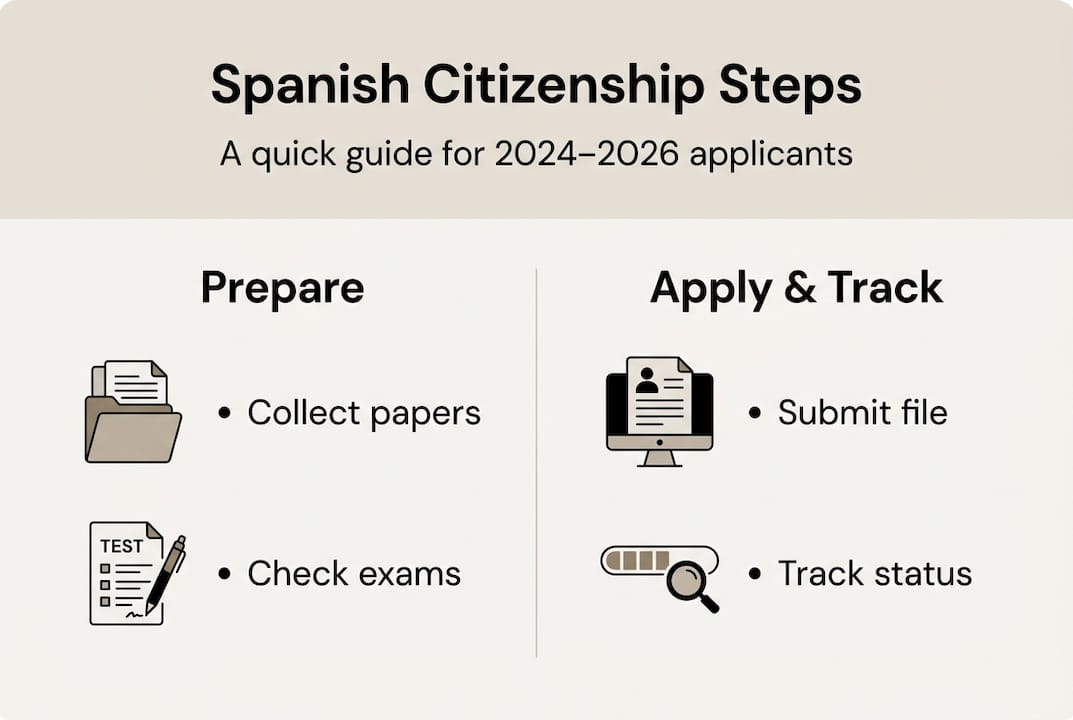
With your documents ready, you can move through the application process. The steps below reflect the current 2026 procedure, including the digital submission system introduced in recent years.
- Confirm eligibility and gather documents: Use the checklist above and verify every document is current, apostilled where required, and correctly translated.
- Pass your exams: Book and complete the DELE A2 and CCSE exams if you are not exempt. Certificates must be valid at the time of submission.
- Pay the application fee: Complete the Modelo 790 (code 026) fee payment online or at a bank. Keep the stamped receipt.
- Submit your application online: Since 2024, most applicants submit through the Spanish Ministry of Justice’s digital portal. Paper submissions are still accepted in limited cases, but digital is now the standard.
- Await acknowledgment: You will receive a reference number. Use it to track your case status through the official portal.
- Respond to any requests: If the registry requests additional documents (a “requerimiento”), you typically have ten business days to respond. Missing this window can result in automatic rejection.
- Receive the resolution: Approval or rejection is issued by the Ministry of Justice. Approved applicants then swear an oath before a civil registry judge.
- Register as a Spanish citizen: After the oath, register your new status at the Civil Registry and apply for your Spanish DNI and passport.
Automated digital processing has improved processing speed, but it has not lowered the bar for scrutiny. In fact, automated systems flag inconsistencies faster than manual review ever did.
| Stage | Estimated timeframe |
|---|---|
| Document preparation | 4 to 12 weeks |
| Exam scheduling and results | 4 to 8 weeks |
| Application review | 6 to 18 months |
| Oath and registration | 2 to 4 weeks after approval |
Over 244,000 citizenship applications were processed in 2024, with 20,099 rejected. Tracking your status regularly and responding quickly to any official requests is essential. You can find updates on the full citizenship process and recent changes for applicants as rules evolve.

What to do if your application is delayed or rejected
Even well-prepared applicants sometimes face delays or rejections. Knowing your options before this happens puts you in a much stronger position.
If your application is delayed beyond the standard review window (typically 12 months), you can file a “silencio administrativo negativo” appeal, treating the non-response as a denial and escalating to the administrative courts. This is a legitimate and increasingly common route.
If your application is formally rejected, you have two main options:
- Administrative appeal (recurso de alzada): Filed within one month of the rejection notice. You challenge the decision within the Ministry of Justice itself.
- Judicial appeal (recurso contencioso-administrativo): Filed within two months if the administrative appeal fails or is not pursued. This goes to the courts.
For a successful appeal, you will need:
- The original rejection notice with stated grounds
- Updated or corrected versions of any flagged documents
- A legal argument addressing each rejection reason specifically
- Sworn translations of any new foreign documents
- Evidence of continuous residence if that was questioned
Record rejections in 2024 were frequently caused by incomplete submissions or tighter exam and police record checks. Automated review systems catch these issues immediately, which means your appeal must be precise and well-documented.
“An appeal is not a second chance to submit the same file. It is your opportunity to prove, specifically and with evidence, why the rejection was wrong.”
If citizenship is not achievable right now, consider building toward it through alternative paths. Arraigo Social recourse can regularize your status if you lack sufficient residence history, while EU Long-Term Residence gives you stable legal standing while your residency years accumulate.
A smarter mindset for Spanish citizenship success
Here is something most guides will not tell you: the biggest obstacle for most applicants is not the paperwork. It is the assumption that following the process once, correctly, is enough.
We see this constantly. Someone spends months gathering documents, passes their exams, and submits confidently, only to receive a requerimiento for a detail they overlooked. Then they miss the ten-day response window because they were not monitoring the portal. That single lapse can cost over a year.
The applicants who succeed treat this process like a live project, not a one-time submission. They check the portal regularly. They read official bulletins for rule changes. They do not rely on advice from friends who applied three years ago, because the rules in 2026 are genuinely different from what they were in 2022 or even 2023.
Being proactive also means understanding why applications get rejected before yours does. The Ministry of Justice publishes resolution data. The rejection reasons are not secret. Study them. If police records are triggering rejections, address yours explicitly in your file. If exam certificates are being questioned, include your original score reports alongside the certificate.
For up-to-date immigration advice that reflects current enforcement patterns, make sure your sources are current, not cached from a forum post three years ago.
How Vive Legal can help with your Spanish citizenship application
Navigating the Spanish citizenship process in 2026 means staying on top of shifting requirements, tight deadlines, and a digital system that flags errors fast. That is a lot to manage on your own.
At Vive Legal, we combine professional legal oversight with smart automation to make sure your application is complete, correctly formatted, and submitted on time. Our team reviews every document, flags translation issues before they become rejection reasons, and tracks your case status so you never miss a requerimiento. If your application has already been rejected, our citizenship case support team can assess your grounds for appeal and build a stronger file. We also offer regularization services for applicants who need to strengthen their residency history first. You have worked hard to get here. Let us help you close the gap.
Frequently asked questions
Why are so many Spanish citizenship applications rejected?
Most rejections result from incomplete documents, stricter exam requirements, or police record issues that applicants failed to address proactively before submitting.
Can I apply for Spanish citizenship with a cancelled police record?
Recent enforcement now considers even cancelled records during review, so you must disclose your full police history and provide context or supporting documentation when relevant. Stricter checks apply across all record types.
How long does the Spanish citizenship application process take in 2026?
Automated processing has improved speed for straightforward cases, but complex or incomplete applications can still take well over a year from submission to resolution.
What language exams are required for Spanish citizenship?
Most applicants must pass the DELE A2 (Spanish language proficiency) and the CCSE (civics knowledge) exam. You are exempt from the CCSE if you completed ESO in Spain, and stricter enforcement of these requirements has been a key driver of recent rejections.
Recommended
Living legally in Spain shouldn't be difficult.
View services and pricesNot sure which procedure you need? Find out in 2 min
Questions? Message us on WhatsApp