
How to change your residency address in Spain easily
TL;DR:
- Updating the padrón is mandatory when you move in Spain, but updating the TIE is only required at renewal.
- The padrón and TIE are separate records; changing one does not automatically update the other.
- Proper documentation and understanding of legal regulations help avoid bureaucratic delays and conflicts.
Moving to a new home in Spain sounds exciting until you realize the paperwork involved. For expatriates, foreign workers, and international students, updating a residency address means navigating two separate systems, the padrón (municipal register) and immigration records, each with its own rules, timelines, and potential pitfalls. Many people get conflicting advice from officials, miss critical steps, or waste weeks on unnecessary procedures. This guide cuts through the confusion and walks you through exactly what you need to do, in the right order, with no guesswork.
Living legally in Spain shouldn't be difficult.
View services and pricesNot sure which procedure you need? Find out in 2 min
Questions? Message us on WhatsApp
Table of Contents
- Understanding the requirements to change your residency address in Spain
- Documents needed and steps to prepare before updating your address
- How to officially update your address: Step-by-step process
- Troubleshooting common issues and understanding special cases
- What most guides miss about changing your residency address in Spain
- Need help with your Spanish residency? Vive Legal makes it easy
- Frequently asked questions
Key Takeaways
| Point | Details |
|---|---|
| TIE card update not always needed | You do not need a new TIE card just for an address change unless you are also renewing. |
| Always update the padrón | Register your new address with the local municipal authority, especially after moving. |
| Document preparation is key | Gather all required documents in advance, such as the new padron certificate and proof of address. |
| Expect regional differences | Procedures can vary across Spain, so check local requirements and seek help if needed. |
| Expert support saves time | Legal professionals can help you navigate complex cases and avoid unnecessary problems. |
Understanding the requirements to change your residency address in Spain
Before you pack a single box, it helps to understand what “changing your address” actually means legally in Spain. There are two distinct systems at play, and they do not automatically sync with each other.
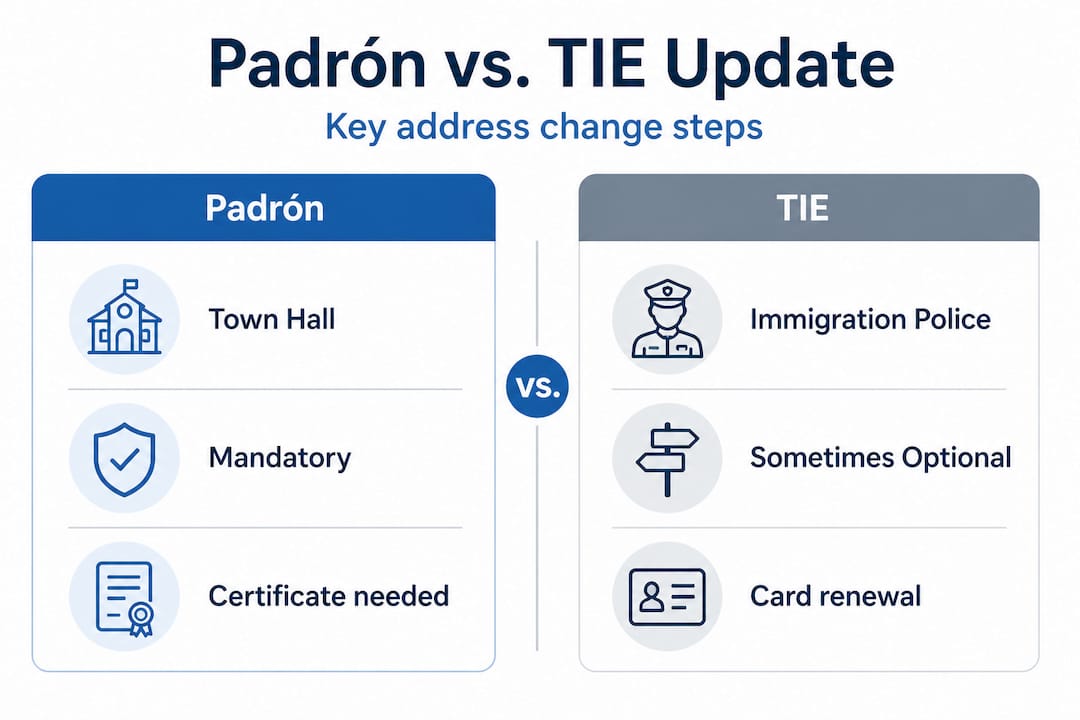
The padrón municipal is the local population register managed by your town hall (ayuntamiento). Every resident, regardless of nationality, must be registered here. The TIE (Tarjeta de Identidad de Extranjero, or Foreign Identity Card) is the physical residency card issued by the National Police to non-EU nationals. These are separate records, and updating one does not automatically update the other.
When is updating your address mandatory?
Updating your padrón is always mandatory when you move. Spanish law requires all residents to keep their municipal registration current. This is not optional. Your padrón record affects everything from school enrollment to healthcare access and even your eligibility for certain residency renewals.
Updating your TIE is a different story. According to Spanish immigration regulations, notification to police does not require new TIE issuance, and a TIE address update is not mandatory unless you are already renewing. This surprises many people who assume they need a brand new card every time they move.
For UK nationals post-Brexit, the rules are slightly different. Since the UK left the EU, British citizens in Spain are treated as non-EU residents. They must re-register on the padrón for their new address and renew their TIE if the address change coincides with card expiry.
If you are working toward EU long-term residence status, keeping your padrón current is especially critical, as continuous residence documentation is a core requirement.
Quick comparison: padrón vs. TIE address update
| Requirement | Padrón update | TIE address update |
|---|---|---|
| Mandatory? | Yes, always | No, only at renewal |
| Where to go | Local ayuntamiento | National Police station |
| Timeline | Within days of moving | At next TIE renewal |
| Affects renewals? | Yes, directly | Indirectly |
| Applies to EU citizens? | Yes | N/A (EU citizens use green certificate) |
Key legal clarification: Article 209 of the Reglamento de Extranjería (Spain’s immigration regulation) confirms that an address change alone does not legally require a new TIE card. If an official tells you otherwise, you have the right to cite this regulation.
Pro Tip: Always request a copy of your new padrón certificate (volante de empadronamiento) immediately after registering. It is free, takes minutes, and you will need it for almost every immigration procedure going forward.
Documents needed and steps to prepare before updating your address
After understanding your obligations, you need to gather the right documents and prepare before updating your address. Walking into a town hall without the correct paperwork is one of the most common time-wasters we see.
Core documents you will need
- Valid passport or national ID (original plus photocopy)
- Current TIE or NIE (your foreign identification number, even if the card is expired)
- Proof of new address: a signed lease agreement, a recent utility bill (electricity, water, or gas), or a letter from your landlord
- Previous padrón certificate from your old municipality (if moving between cities)
- Completed padrón application form (available at the ayuntamiento or downloadable from their website)
For families moving together, each member needs their own documentation. Children require their birth certificates, and if the family is from outside the EU, all members’ TIE or NIE numbers must be included on the padrón application.
International students face a specific challenge: many student accommodations do not provide traditional utility bills. In these cases, a letter from the university confirming your address, or a landlord declaration (declaración del propietario), is generally accepted. However, acceptance varies by municipality, so confirm with your local ayuntamiento before your visit.
Why your padrón must be current before anything else
Your padrón certificate is the foundation of your entire address change process. Spanish immigration authorities rely on it to verify your place of residence during renewals. An outdated padrón can delay your TIE renewal, affect your social benefits, and in some cases, trigger questions about your actual residency continuity.

If you are mid-process on something like an EU registration or an arraigo social application, an address mismatch between your padrón and your submitted documents can cause your case to be flagged or rejected outright. Update the padrón first, always.
| Document | Where to get it | Typical wait time |
|---|---|---|
| Padrón certificate | Local ayuntamiento | Same day to 1 week |
| Lease agreement copy | Your landlord | Immediate |
| Utility bill | Your provider’s app or office | 1 to 3 days |
| Landlord declaration | Landlord (notarized optional) | 1 to 3 days |
| NIE/TIE photocopy | Self-prepared | Immediate |
Pro Tip: Many Spanish ayuntamientos now allow you to book your padrón appointment online and even submit documents digitally if you have a digital certificate (certificado digital) or Cl@ve PIN. Check your municipality’s website first to save a trip.
How to officially update your address: Step-by-step process
With all your documents prepared, you’re ready to start the official change process. Let’s break it down, step by step.
-
Register at your new ayuntamiento. Visit your local town hall in person or use the online portal if available. Submit your padrón application with all required documents. If you are moving within the same municipality, this is a simple update. If you are crossing into a new municipality, the new ayuntamiento will notify the old one automatically.
-
Collect your new padrón certificate. Once registered, request your volante de empadronamiento. Some offices issue it instantly; others mail it within a week. This document is your proof of new address for all subsequent steps.
-
Notify the National Police (if applicable). For non-EU residents, you should inform the immigration authorities of your new address. While Article 209 of the Reglamento de Extranjería confirms this does not require a new TIE card, some police offices may insist otherwise. Know your rights, but also pick your battles: if you are due for renewal soon, it may be easier to simply update the address at that point.
-
Update your address with other institutions. Notify your bank, employer, health center (centro de salud), and the Spanish tax agency (Agencia Tributaria) of your new address. These are separate from immigration records but equally important.
-
Flag the update for your next TIE renewal. Make a note in your calendar for when your TIE is due. At renewal, bring your updated padrón certificate so the new address is reflected on your new card.
-
Keep copies of everything. Store digital and physical copies of your new padrón certificate, lease, and any confirmation letters from the ayuntamiento.
If you are on a specific visa type, such as a residencia de prácticas (internship residence) or transitioning via a student to worker modification, your address records need to be consistent across all submitted documents. A mismatch can stall your case significantly.
For EU citizens or those with EU family members, the process is slightly simpler, but EU family card holders still need to ensure their padrón reflects their actual residence, as it feeds into renewal eligibility.
Real-world note: Online submission is available in many larger cities like Madrid and Barcelona, but smaller municipalities may still require in-person visits. Always check your ayuntamiento’s website before assuming digital options exist.
Pro Tip: If an official refuses your padrón registration without a valid legal reason, you can formally request a written refusal (negativa por escrito). This triggers a review process and usually resolves the issue quickly.
Troubleshooting common issues and understanding special cases
Completing the address change process doesn’t always go as planned. Here’s how to solve the most frequent challenges.
Conflicting advice from officials is probably the most common frustration. One police officer says you need a new TIE; another says you don’t. Both are citing the same law but interpreting it differently. The key is to know that the law is on your side. Keep a printed copy of Article 209 of the Reglamento de Extranjería with you.
Moving between municipalities triggers an automatic de-registration from your old padrón. This is handled administratively between the two town halls, but it is not instant. Non-EU temporary residents also face a two-year renewal cycle, meaning an address change mid-cycle needs to be carefully documented to avoid complications at the next renewal.
- Always register at the new ayuntamiento before de-registering from the old one, or do both simultaneously.
- Request a baja por cambio de domicilio (de-registration due to address change) confirmation from your old municipality.
- If you have a pending renewal, do not change your address mid-application unless absolutely necessary. Wait until the renewal is approved.
Bureaucratic delays happen. If your padrón certificate is taking more than two weeks, follow up in writing via email and keep a record. If you need the certificate urgently for a pending immigration appointment, explain this at the town hall. Many offices will expedite for documented immigration needs.
Students moving mid-year sometimes face landlords who are reluctant to sign a declaración del propietario. In this case, a university housing office letter or a co-tenant’s signed statement (with their own padrón certificate) can sometimes substitute. Check with your specific ayuntamiento.
Practical reminder: Your padrón registration is also the basis for accessing local public services, including healthcare and children’s schooling. An outdated address is not just an immigration problem; it affects your daily life in Spain.
For more guidance on navigating Spanish immigration procedures, the Vive Legal blog regularly covers updates, edge cases, and practical tips specific to expatriates and international residents.
Pro Tip: Set a recurring annual reminder to verify that your padrón is current. Many people forget to update it after a second or third move, which creates compounding problems at renewal time.
What most guides miss about changing your residency address in Spain
Most articles about this topic treat Spanish bureaucracy as a monolith. They give you a checklist and send you on your way. What they miss is the human element: the fact that two officials in the same building can give you opposite answers, and both will be completely confident they are right.
This is not incompetence. It is a structural issue. Spanish immigration law has layers of national regulation, regional implementation, and local discretion. The padrón system is managed at the municipal level, which means each of Spain’s over 8,000 municipalities technically has some latitude in how it handles registrations. The result is genuine variation in practice, even when the law is clear.
The real lesson here is that knowing the law is not enough. You also need to know how to present your case. Officials respond better when you arrive organized, calm, and with documentation that makes their job easier. A clean, clearly labeled folder with originals and photocopies of everything signals that you know what you are doing. It changes the dynamic of the interaction.
We have seen clients who were initially turned away from padrón registration because an official deemed their lease “insufficient,” only to return the next day with a landlord declaration and sail through the process. The law had not changed. The presentation had.
The other thing most guides miss is the downstream effect of getting this wrong. An outdated padrón does not just inconvenience you at your next immigration appointment. It can affect your access to the Spanish public health system, your children’s school enrollment, and even your eligibility for certain social benefits. For those working toward EU registration or long-term residency, a gap in padrón continuity can become a serious obstacle.
Proactivity is your best tool. Update your padrón the week you move, not the week before your renewal appointment.
Need help with your Spanish residency? Vive Legal makes it easy
Navigating Spain’s residency address change process is manageable when you know the rules, but it becomes genuinely stressful when you are dealing with a pending renewal, conflicting official advice, or a language barrier on top of everything else.

At Vive Legal, we specialize in exactly these situations. Our platform combines legal expertise with smart automation to guide you through every step of your residency procedures, from padrón preparation to full TIE card management. We review your documents, prepare your forms, schedule your appointments, and track your case through a secure client portal so you always know where things stand. Whether you are updating your address as part of a renewal or navigating a more complex situation, our team is ready to help you get it right the first time.
Frequently asked questions
Do I need a new TIE card if I only change my address in Spain?
No, a new TIE card is not generally required solely for an address change. You can update the address on your TIE at your next scheduled renewal instead.
What should UK nationals do after Brexit when moving in Spain?
UK citizens must re-register on the new padrón for their new address and renew their TIE at card expiry if the address has changed since the last issuance.
What happens if I move to a new municipality?
Moving to a new municipality triggers automatic de-registration from your old padrón, and you must register with your new local authority as soon as possible after moving.
Will changing my address affect my renewal cycle?
Changing your address does not reset your renewal cycle, but you must ensure all records, especially your padrón and TIE, reflect the same address at your next renewal appointment.
Recommended
Living legally in Spain shouldn't be difficult.
View services and pricesNot sure which procedure you need? Find out in 2 min
Questions? Message us on WhatsApp