
How to Prepare Residency Documents for Spain Easily

Applying for immigration residency in Spain can feel overwhelming when you face stacks of paperwork, strict deadlines, and evolving requirements. For Canadian professionals or European students, errors in your submission could mean long waits and missed opportunities. This article will guide you through each step of the application process, emphasizing precise documentation and accurate form completion so you can achieve legal status quickly and with confidence.
Table of Contents
- Step 1: Gather Essential Personal Information And Legal Documents
- Step 2: Select The Correct Residency Permit Type For Your Situation
- Step 3: Complete Forms With Accurate And Up-To-Date Data
- Step 4: Submit Paperwork Through Official Or Digital Platforms
- Step 5: Review And Track Application Status Until Approval
Quick Summary
| Key Insight | Explanation |
|---|---|
| 1. Gather all necessary documents | Collect personal identification, residence proof, and legal documents, ensuring originals and certified translations. |
| 2. Choose the right residency permit | Select a permit that fits your circumstances, considering financial status, purpose of stay, and application pathways. |
| 3. Accurately complete application forms | Ensure all forms have precise personal information and supporting details to avoid delays or rejections. |
| 4. Submit through proper channels | Use both in-person and digital submission methods, keeping copies and records of all submitted documents. |
| 5. Track your application status | Monitor application progress through online portals, SMS alerts, or in-person inquiries to stay updated on any requirements. |
Step 1: Gather essential personal information and legal documents
When preparing for Spanish residency, collecting the right personal and legal documents forms the critical foundation of your application process. Your success depends on assembling a comprehensive document portfolio that demonstrates your eligibility and background with precision and clarity.
Living legally in Spain shouldn't be difficult.
View services and pricesNot sure which procedure you need? Find out in 2 min
Questions? Message us on WhatsApp
Start by gathering your core personal identification documents, which typically include:
- A valid passport with at least one year of remaining validity
- Birth certificate (original and official translation)
- Proof of residence documentation from your current country
- Academic or professional credentials
- Employment records or job contract (if applicable)
- Criminal background check from your home country
Pay close attention to document requirements. Each paper must be original, and non-Spanish documents require certified translation by an authorized translator. Digital copies are insufficient - you will need physical, authenticated documents.
Organize your documents systematically in a secure folder, creating both physical and digital backups. This approach prevents potential loss and demonstrates your preparedness during the residency application process.
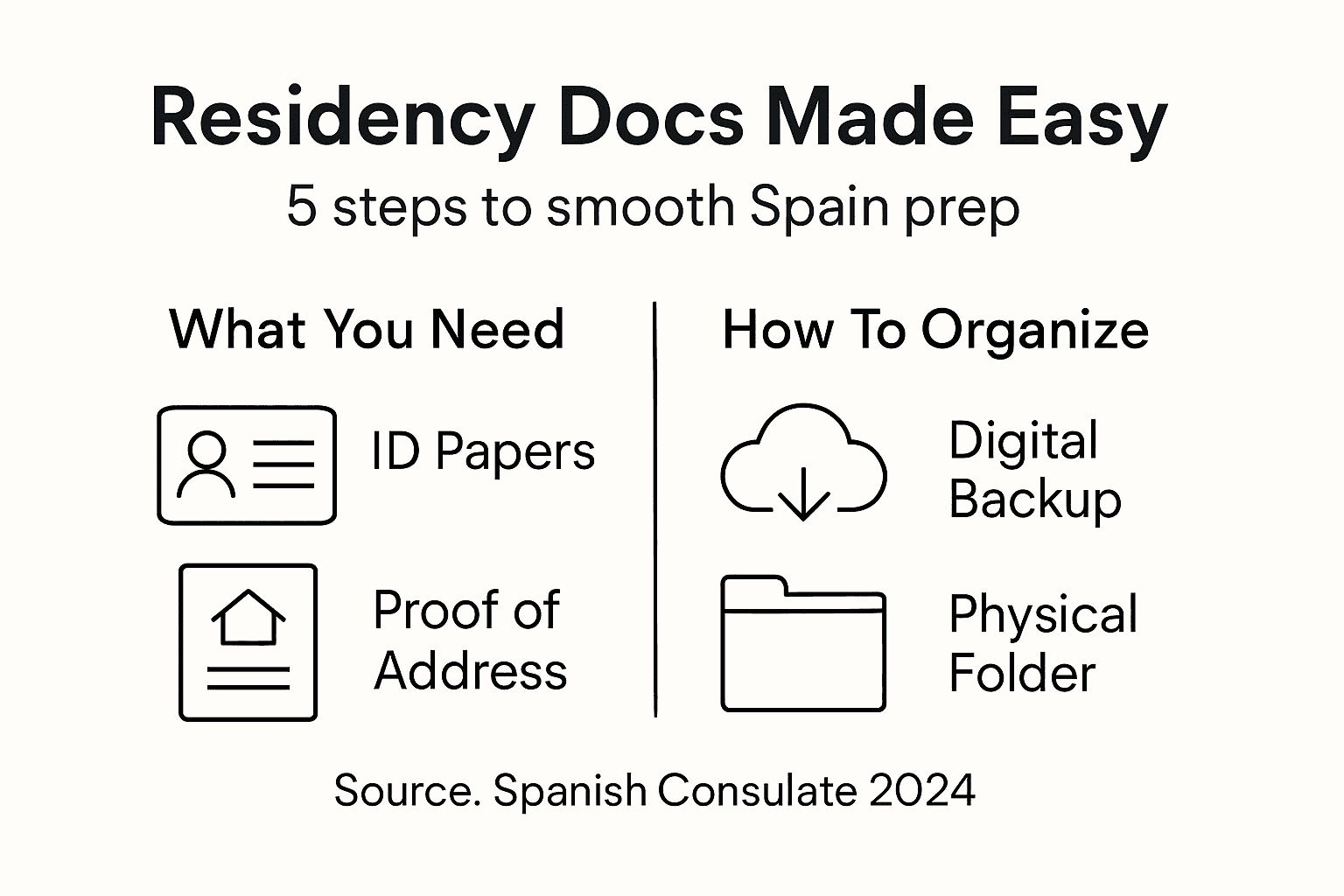
Pro tip: Contact the nearest Spanish consulate to confirm the most current document requirements, as immigration regulations can change periodically.
Step 2: Select the correct residency permit type for your situation
Selecting the appropriate residency permit is crucial for successfully establishing your legal status in Spain. Understanding the nuanced types of residency permits will help you navigate the complex immigration landscape and choose the pathway that best matches your personal and professional circumstances.
Spain offers several specialized residency permits tailored to different life scenarios:
- Non-lucrative residency: Perfect for financially independent individuals
- Work permits: For those with job offers or employment contracts
- Study permits: Designed for students pursuing academic programs
- Digital nomad visa: Ideal for remote workers and freelancers
- Entrepreneur and investor permits: For professionals launching businesses
- Family reunification permits: Allowing family members to join residents
Each permit type has specific financial, professional, and documentation requirements. Your choice depends on factors like your income, professional status, purpose of stay, and long-term goals. Carefully assess your situation to determine the most suitable permit, considering aspects like minimum income thresholds, health insurance requirements, and potential pathways to permanent residency.
To help you choose the best residency permit, here is a comparison of common options:
| Permit Type | Who It’s For | Key Requirement | Possible Pathway |
|---|---|---|---|
| Non-lucrative | Retirees, financially independent | Minimum savings/income | Permanent residency |
| Work Permit | Employees, job contract holders | Valid employment offer | Long-term residency |
| Study Permit | Students of academic programs | Enrollment in Spanish school | Work permit upgrade |
| Digital Nomad Visa | Remote workers, freelancers | Remote job and income proof | Family reunification |
| Entrepreneur/Investor | Business creators, investors | Investment/business plan | Golden Visa route |
This table illustrates the main differences in eligibility and paths for popular Spanish residency permits.
Choosing the wrong permit can lead to application rejection, so thorough research and potentially professional consultation are critical.
Pro tip: Consult with an immigration specialist to verify the most recent requirements for your specific permit type, as regulations can change frequently.
Step 3: Complete forms with accurate and up-to-date data
Compiling and submitting accurate documentation is a critical step in your Spanish residency application process. When filling out official application forms, precision and attention to detail can make the difference between smooth approval and potential rejection.
Ensure you complete each form section thoroughly and accurately by following these key guidelines:
- Verify personal information: Check passport details, birth date, and contact information
- Provide comprehensive employment history: Include current and previous job details
- Document travel background: Record international travel history accurately
- Update contact information: Include current email, phone number, and physical address
- Review health insurance details: Confirm coverage meets Spanish residency requirements
- Cross-reference supporting documents: Ensure form data matches accompanying paperwork
Small discrepancies in your application can trigger delays or automatic rejection, so meticulous accuracy is paramount.
Take your time when completing each form. Review every section multiple times, comparing information against your original documents. Consider using digital tools or having a trusted friend double-check your entries to minimize potential errors.

Pro tip: Make digital and physical copies of all completed forms before submission, ensuring you have a comprehensive record of exactly what was sent.
Step 4: Submit paperwork through official or digital platforms
Submitting your Spanish residency documents requires strategic navigation of both official and digital submission channels. Understanding the official application process is crucial to ensure your application receives proper consideration.
Your submission strategy should incorporate multiple approaches:
- In-person submissions: Visit local Non-nationals Office or police station
- Digital platform submissions: Utilize official government online portals
- Appointment scheduling: Book mandatory consultation slots in advance
- Document verification: Bring original documents for authentication
- Online renewal options: Use digital platforms for permit modifications
- Tracking applications: Monitor submission status through official channels
Precision in document submission can dramatically reduce processing time and minimize potential complications.
Prepare all necessary documentation before your submission, ensuring each document is current, translated if required, and perfectly organized. Digital submissions often require high-resolution scans, so invest time in creating clear, legible copies of your supporting materials.
Pro tip: Always retain digital and physical copies of submitted documents, including submission confirmations and tracking numbers, to maintain a comprehensive record of your application process.
Step 5: Review and track application status until approval
After submitting your residency documents, actively monitoring your application becomes critical to ensuring a smooth process. Understanding how to track application status will help you stay informed and respond quickly to any additional requirements.
Your application tracking strategy should include multiple approaches:
- Online government portal: Check real-time application updates
- SMS tracking: Send NIE number for instant status alerts
- Automated phone service: Call designated tracking number
- Email notifications: Set up digital communication channels
- Physical follow-up: Periodic in-person inquiries at local office
- Documentation preservation: Keep all submission records accessible
Application tracking requires patience and consistent, proactive engagement with official channels.
Prepare for potential requests for additional information by keeping your supporting documents organized and readily available. Some applications might require supplemental documentation or clarification, so maintaining communication readiness is essential.
Tracking your Spanish residency application efficiently can speed up your approval process. Here are popular methods and their benefits:
| Tracking Method | How It Works | Key Benefit |
|---|---|---|
| Online Gov Portal | Log in with credentials | Real-time updates |
| SMS Status Alerts | Send NIE for response | Instant notifications |
| Automated Phone Line | Call designated number | Voice guidance and status |
| In-person Inquiry | Visit local office | Face-to-face confirmation |
Each method provides a unique advantage depending on your preference and urgency.
Pro tip: Create a dedicated digital and physical folder for your residency application, storing all correspondence, tracking numbers, and supporting documents in one easily accessible location.
Simplify Your Spanish Residency Document Preparation Today
Gathering personal identification and selecting the correct residency permit can feel overwhelming and stressful. You face the challenge of avoiding costly errors and delays while ensuring every document is accurate and compliant. Whether you are applying for non-lucrative residency, work permits, or digital nomad visas, the stakes are high and the process complex.
Take control now with Vive Legal, the digital legal consultancy designed to ease your residency journey. Our platform offers a full suite of services including personalized document review, form preparation, and appointment scheduling. Enjoy peace of mind knowing your application is carefully monitored through a secure client portal, minimizing mistakes and maximizing your approval chances. Start your hassle-free process by exploring our resources in the Uncategorized Archives - Vive Legal and secure expert help on every step of your residency application. Don’t wait for delays and complications—visit Vive Legal and simplify your path to Spain residency today.
Frequently Asked Questions
What essential documents do I need to prepare for my residency application in Spain?
You will need your valid passport, birth certificate (with translation), proof of residence, academic or professional credentials, employment records, and a criminal background check. Gather these documents in a secure folder and create both physical and digital backups for easy access.
How do I choose the right residency permit type for Spain?
To select the correct residency permit, assess your personal situation, including your financial status and purpose of stay. Review the different types of permits—like non-lucrative residency, work permits, and digital nomad visas—and ensure your choice aligns with requirements such as minimum income and documentation.
What steps should I take to complete my residency application forms accurately?
Make sure to verify all personal information, provide a comprehensive employment history, and update your contact details accurately on the forms. Review each application form multiple times and consider having someone double-check your entries to minimize potential errors before submission.
How can I submit my residency documents to the Spanish authorities?
You can submit your residency documents either in person at a local Non-nationals Office or police station or through official digital platforms. Prepare all necessary documentation in advance and ensure each paper is authentic and translated as required for a smooth submission process.
How do I track the status of my residency application in Spain?
You can track your application status online through government portals, by sending your NIE number via SMS, or by calling designated tracking numbers. Stay proactive by checking your application consistently and preserving all your submission records for easy reference.
What should I do if I need to submit additional information after applying?
If your application requires additional information, maintain a well-organized folder of your supporting documents to respond quickly. Being prepared will help you comply with any requests from authorities and can potentially speed up your application’s approval process.
Recommended
Living legally in Spain shouldn't be difficult.
View services and pricesNot sure which procedure you need? Find out in 2 min
Questions? Message us on WhatsApp