
Immigration checklist for families moving to Spain: steps & tips

TL;DR:
- Proper documentation, timely application, and understanding visa options are crucial for a smooth family move to Spain.
- The family of Spanish citizens route offers faster, more accessible, and cost-free immigration pathways.
- Recent reforms and application backlogs highlight the importance of strategic planning and expert guidance.
Moving your entire family to Spain means every single person needs the right legal status before you settle in. One missed document, one wrong visa category, or one overlooked deadline can delay your move by months or leave a family member without legal protection. Spain’s immigration system has also shifted significantly in 2025 and 2026, with major reforms changing who qualifies, what documents are needed, and how long the process takes. This guide gives you a practical, step-by-step checklist covering every major pathway, the documents you need, realistic timelines, and the strategic insights most families only learn the hard way.
Living legally in Spain shouldn't be difficult.
View services and pricesNot sure which procedure you need? Find out in 2 min
Questions? Message us on WhatsApp
Table of Contents
- Understand your family’s immigration options
- Essential checklist: Documents and preparations
- Step-by-step timeline: Application to arrival
- Compare requirements: Resident vs. citizen family applications
- Expert perspective: The advantages (and pitfalls) most families miss
- Personalized help for your family’s Spain immigration journey
- Frequently asked questions
Key Takeaways
| Point | Details |
|---|---|
| Choose the right path | Families of Spanish citizens enjoy a faster, easier process while residents face stricter requirements. |
| Get your documents early | Apostilled and translated documents are critical for all family-based immigration procedures. |
| Mind the timelines | The typical family immigration journey takes 3-6 months, with several crucial deadlines. |
| Leverage expert help | Professional guidance helps families avoid delays and common mistakes during immigration. |
Understand your family’s immigration options
Before you jump into application steps, it’s essential to choose the most suitable immigration path for your family. Picking the wrong route wastes months and can result in a rejection that affects future applications. Spain offers several distinct pathways, and each one fits a different family situation.
Family reunification for residents is for non-EU residents already living legally in Spain who want to bring their spouse, children, or dependent parents. This route requires the sponsor to prove stable income, adequate housing, and at least one year of legal residence. It’s a solid option but comes with stricter financial thresholds than most families expect.
Family of Spanish citizens is often the fastest and most accessible route. The Spanish Family Card covers spouses, registered partners, dependent children up to 26 years old, and even caregivers. Critically, children up to 26 if dependent qualify under this pathway, and no financial proof is required except when proving dependency status. The visa is also free of charge.
EU Family Card applies when the sponsor is an EU citizen (not Spanish) exercising free movement rights in Spain. This route is governed by EU law and tends to be broader in eligibility. You can review the EU Family Card option if your family includes an EU national as the anchor.
Non-lucrative visa works well for families with passive income, pensions, or remote work earnings. It’s not technically a “family” visa, but it allows the whole family to apply simultaneously if each member meets the financial threshold. It’s an underused option worth considering.
Golden Visa: The Spain Golden Visa ended in April 2025. New applications are no longer accepted. Existing holders can still renew, and family members already included can maintain their status. If you were counting on this route, you’ll need to pivot.
The scale of demand for these permits has surged. Family permit applications rose 74.5% for families of Spanish nationals following the Reloex reforms, which means consulates and immigration offices are under significant pressure right now.
Quick comparison of main routes:
- Family of Spanish citizen: Free, fast, broad eligibility, no income proof for most
- Family reunification (resident): Paid, slower, strict income and housing proof
- EU Family Card: EU law protections, broad eligibility, moderate speed
- Non-lucrative visa: Requires passive income proof, but entire family applies together
- Arraigo Social: For long-term undocumented residents; learn more about the Arraigo Social route
Essential checklist: Documents and preparations
Once you know which visa or permit fits your family, gather these essentials to keep the process moving smoothly. Missing even one document at the consulate stage can reset your timeline entirely.
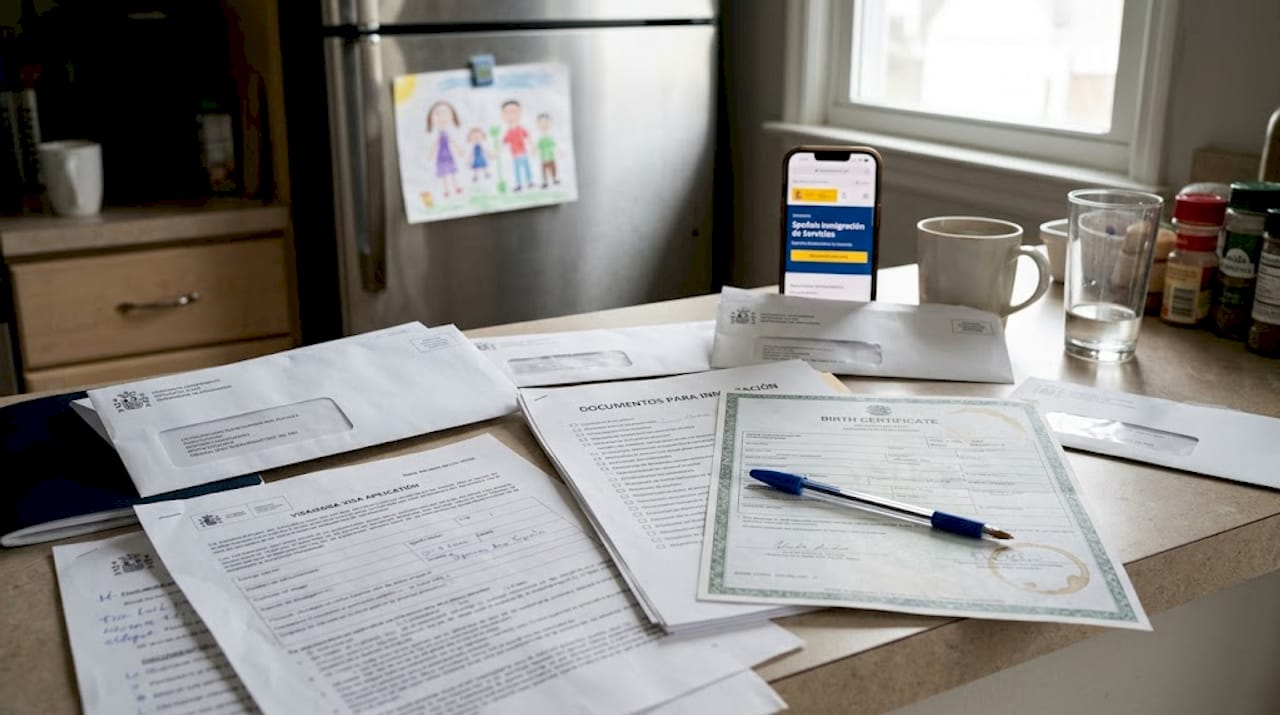
The standard process follows two phases. The sponsor applies at the Oficina de Extranjería (using form EX-02), which can take up to three months. Then family members apply for the actual visa at the consulate abroad, which takes up to two more months. After arrival in Spain, each family member must apply for their TIE (Tarjeta de Identidad de Extranjero, or foreigner identity card) within 90 days.
Core documents every family member needs:
- Valid national passport (at least six months of validity remaining)
- Birth certificates for all children (apostilled and officially translated into Spanish)
- Marriage or civil union certificate (apostilled and translated)
- Criminal background checks from every country of residence in the past five years
- Medical insurance policy covering Spain (required for most visa types)
- Completed visa application forms and recent passport photos
Additional documents for family reunification with a resident:
- Proof of income meeting the legal threshold (usually 150% of the IPREM per family member)
- Housing contract or property deed showing adequate space
- Proof of one year of legal residence for the sponsor
For families of Spanish citizens:
- Proof of the family relationship (birth or marriage certificate)
- Proof of dependency for adult children or caregivers
- No income proof required for most applicants
Important: All foreign documents must carry an apostille stamp under the Hague Convention. If your country is not a signatory, you’ll need a different legalization process. Start this step early since apostilles can take weeks.
Pro Tip: Consulate appointment availability varies wildly by city and country. In some locations, wait times for visa appointments stretch past three months. Book your consulate slot as soon as your documents are ready, not after. Check the specific consulate’s website for current availability.
Once you arrive in Spain, use the TIE application guide to make sure each family member registers correctly. If you’re planning to stay long-term, reviewing EU long-term residence tips early will help you plan for the five-year mark.
Step-by-step timeline: Application to arrival
Now that your documents are ready, here’s what your family can expect throughout the actual application journey.
Typical family reunification timeline:
| Stage | Who acts | Estimated time |
|---|---|---|
| Sponsor submits EX-02 at Oficina de Extranjería | Sponsor in Spain | Up to 3 months |
| Family applies for visa at consulate | Family abroad | Up to 2 months |
| Travel to Spain | Family | Flexible |
| Apply for TIE after arrival | Each family member | Within 90 days |
| Total | 3 to 6+ months |
For families of Spanish citizens, the process is faster because the sponsor phase is skipped. Family members apply directly at the Spanish consulate in their home country, which removes one full layer of bureaucracy.
Step-by-step breakdown:
- Choose your pathway and confirm eligibility for every family member
- Gather, apostille, and translate all required documents
- Sponsor submits the authorization application in Spain (for resident reunification only)
- Family submits visa applications at the consulate once authorization is approved
- Travel to Spain once visas are issued
- Register at the local town hall (empadronamiento) within the first weeks
- Book TIE fingerprint appointments for each family member
- Attend TIE appointments and collect cards
The full process takes 3 to 6 months in most cases, though backlogs at specific consulates can push this longer. Build this into your planning if children need to start school by September.
Pro Tip: If you have school-age children, aim to submit your initial application no later than March. This gives you a realistic shot at having all cards in hand before the September school enrollment deadline in Spain. For detailed guidance on each stage, visit detailed immigration timelines.
Compare requirements: Resident vs. citizen family applications
Understanding the differences upfront can save your family months of effort and make the process less stressful.
| Requirement | Family of resident | Family of Spanish citizen |
|---|---|---|
| Financial proof | Required (150% IPREM per member) | Not required for most |
| Housing proof | Required | Not required |
| Application fee | Paid | Free |
| Eligible relatives | Spouse, minor children, dependent parents | Spouse, children up to 26, caregivers |
| Processing speed | Slower (two phases) | Faster (direct consular) |
| Eligibility breadth | Narrower | Broader |
The contrast between these two routes is significant. Families of residents face a tougher financial bar and a longer process. Families of Spanish citizens benefit from EU-level protections and a streamlined path.
When is the non-lucrative visa a better fit? Consider it if:
- Your family has passive income, dividends, or rental earnings
- You want everyone to apply at the same time without a sponsor phase
- You prefer not to tie your residency to employment status
In 2026, the fastest route for most families remains the Spanish citizen family permit. If you’re navigating the EU free movement rules instead, check the differences in applying through EU family card to see if that path fits your situation better.
Expert perspective: The advantages (and pitfalls) most families miss
After seeing hundreds of family cases move through the system, one pattern stands out clearly: most families assume they can file everything together and move as a unit. Sometimes that’s true. But in many cases, splitting filings strategically, filing the anchor applicant first and dependents shortly after, actually speeds things up and reduces the risk of a group rejection.
The non-lucrative visa is genuinely underused. Families with remote work income, pension payments, or investment returns often qualify and don’t realize it. It sidesteps the entire sponsor-and-authorization phase and lets the whole family apply simultaneously from abroad.
Another overlooked angle: caregiver dependents. If an elderly parent provides regular childcare for a Spanish citizen’s children, they may qualify under the family of Spanish citizens route. Most families never ask about this.
Recent reforms have raised the stakes for documentation quality. A single inconsistency between a birth certificate and a passport name can trigger a request for additional documents, adding weeks to the process. The families who regret not getting advice early are almost always the ones who chose their route based on a quick internet search rather than their actual situation. Reviewing your options through Spanish nationality after residency can also open long-term planning opportunities that change which route makes the most sense today.
Personalized help for your family’s Spain immigration journey
Immigration mistakes don’t just cost money. They can delay your family’s move by months, leave a child without school enrollment, or create gaps in legal status that affect future applications. Getting the right guidance from the start is genuinely worth it.
At Vive Legal, we specialize in exactly these kinds of complex, multi-person cases. Our platform combines professional legal oversight with smart document review and appointment scheduling so nothing falls through the cracks. Whether you need to get your EU Family Card, navigate a tricky reunification case, or explore Arraigo Social guidance for a family member in a different situation, we can walk you through it step by step with full case tracking and expert support.
Frequently asked questions
How long does it take for a family to get residency in Spain?
The process usually takes 3 to 6 months from initial application to receiving residency cards, depending on the visa type and consulate workload.
Who qualifies as family for immigration to Spain?
Typically, spouses, dependent children under 18 (or up to 26 if dependent with Spanish citizens), and dependent parents may qualify; eligibility varies by pathway.
Is proof of income always required for family immigration?
Proof of income is critically required for family reunification with residents but not always required for families of Spanish citizens except when proving dependency.
Can I bring stepchildren or extended family members to Spain?
Stepchildren and extended family members may qualify if the main applicant has full legal custody or can prove dependency; broader eligibility for dependents applies especially under the Spanish citizen family route.
Recommended
Living legally in Spain shouldn't be difficult.
View services and pricesNot sure which procedure you need? Find out in 2 min
Questions? Message us on WhatsApp