
Legal compliance in Spain: Step-by-step guide for 2026

TL;DR:
- Spain’s residency process varies by nationality, purpose, and documentation, requiring careful category selection.
- Applicants must gather specific documents, complete forms, and book appointments early amid delays and reform changes.
- Recent reforms offer regularization opportunities for undocumented migrants and extend permit durations, emphasizing persistence.
Spain attracts hundreds of thousands of new residents every year, and the paperwork waiting for them is anything but simple. Between overlapping permit categories, strict document requirements, and 2025 to 2026 regulatory reforms reshaping who qualifies for what, many applicants hit walls they never saw coming. This guide cuts through the confusion. Whether you are an EU citizen registering for the first time, a non-EU worker applying for a residence permit, a student, or someone seeking regularization, you will find a clear, actionable roadmap here covering every key requirement, critical step, and recent legal change.
Living legally in Spain shouldn't be difficult.
View services and pricesNot sure which procedure you need? Find out in 2 min
Questions? Message us on WhatsApp
Table of Contents
- Understanding your residency category and requirements
- Documents and process checklist: Step-by-step compliance
- Special cases and recent reforms: What’s new for 2026?
- Troubleshooting, verification, and common pitfalls
- A reality check on Spanish legal compliance: What experts and veterans won’t tell you
- Expert help for seamless legal compliance in Spain
- Frequently asked questions
Key Takeaways
| Point | Details |
|---|---|
| Residency rules vary | EU and non-EU applicants face different compliance and documentation requirements in Spain. |
| Timely application is critical | Apply within the first months of arrival to avoid penalties or loss of rights. |
| Recent reforms ease access | 2025-2026 changes expand regularization and permit renewals, but documentation proof remains strict. |
| Prepare for common hurdles | Anticipate extra checks, slow processing, and the need for translated and apostilled documents. |
| Expert guidance helps | Professional assistance or digital gestorías can simplify even the toughest cases. |
Understanding your residency category and requirements
Before you fill out a single form, you need to know which residency category applies to you. Spain’s legal compliance system is not one-size-fits-all. Your nationality, the reason you are staying, your financial situation, and your employment status all determine which route you take and what documents you need.
EU and EEA citizens have the most straightforward path. You must register as an official resident within three months of arrival by obtaining the Certificado de Registro de Ciudadano de la UE. This certificate is not optional. You will need your passport, proof of sufficient financial means or employment, and health insurance if you are not working. Learn more about the EU registration process and what documentation is required before your appointment.
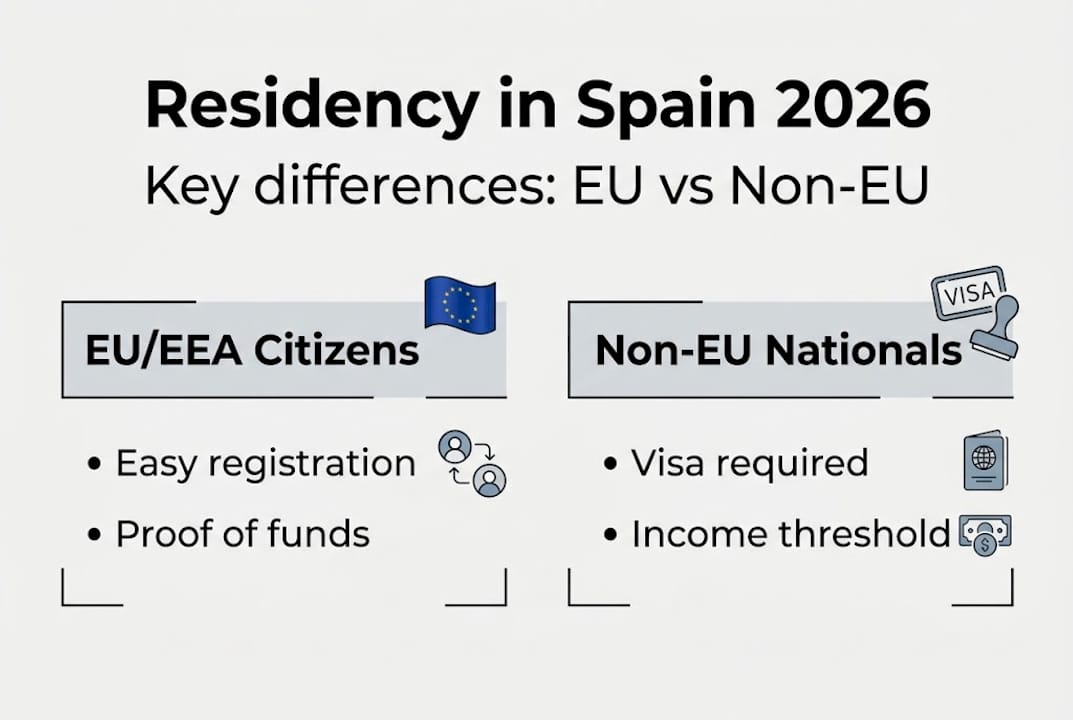
Non-EU nationals face a more layered system. Non-EU workers need a residence and work visa with minimum income thresholds that vary by permit type. Categories include the non-lucrative residence visa (for those with passive income), the work authorization permit, the highly skilled worker visa, and the digital nomad visa introduced in recent years.
Here is a quick overview of the main residency categories:
| Category | Nationality | Key requirement |
|---|---|---|
| EU/EEA registration | EU/EEA | Proof of means, employment, or study |
| Non-lucrative visa | Non-EU | Passive income above threshold |
| Work authorization | Non-EU | Job offer or employer sponsorship |
| Student visa | Non-EU | Enrollment in accredited institution |
| Family reunification | Any | Sponsor with legal residency in Spain |
| Arraigo (regularization) | Non-EU | Years of continuous stay, social ties |
For family members of EU citizens, the EU family card offers a separate pathway with its own documentation rules. Students doing internships may qualify for internship residence permits that allow limited work hours.
Key eligibility factors across all categories include:
- Nationality and whether bilateral agreements apply
- Purpose of stay (work, study, family, retirement)
- Financial means meeting Spain’s minimum thresholds
- Valid health insurance for non-working applicants
- Clean criminal record from your home country
Pro Tip: Gather original documents plus apostilled and officially translated copies before you arrive in Spain. Waiting until you are here to request apostilles from your home country can delay your application by weeks or even months.
Documents and process checklist: Step-by-step compliance
Once you know which route applies to you, assembling your documents and following Spain’s official registration steps is the next critical move. Missing even one item can result in a rejected appointment or a suspended application.
Here is a step-by-step checklist for most residency categories:
- Obtain your NIE (Número de Identidad de Extranjero), your foreign identification number. This is required before almost any official transaction in Spain.
- Register on the padrón municipal at your local town hall. This certificate proves your local address and is required for most permit applications.
- Gather your core documents: valid passport, visa (if applicable), two passport photos, proof of address, proof of financial means or employment contract, and health insurance.
- Complete the relevant form: EU citizens use form EX-18 for registration. Non-EU applicants use different forms depending on their permit type.
- Book your appointment at the Oficina de Extranjería (Foreigners Office) or the National Police station, depending on your category.
- Submit your application in person with originals and copies of all documents.
- Collect your TIE card (Tarjeta de Identidad de Extranjero). All residents must obtain the TIE within 30 days, with documents apostilled and translated where required. You can manage your TIE card application digitally to reduce errors and delays.
Here is a comparison of the two main processes:
| Step | EU registration | Non-EU work/residence permit |
|---|---|---|
| Initial visa needed | No | Yes, from home country consulate |
| Main form | EX-18 | Varies by permit type |
| Processing time | 1 to 3 weeks | 1 to 3 months |
| Renewal required | Every 5 years | Annually, then up to 4 years |
| Health insurance | Required if non-working | Required for most categories |
For non-lucrative applicants, the non-lucrative visa requirements include proving monthly income well above Spain’s IPREM (public income indicator). Review the key immigration forms you will need before your appointment.

Pro Tip: Book your Oficina de Extranjería appointment as early as possible. In major cities like Madrid and Barcelona, slots fill up weeks in advance. Use the official Sede Electrónica portal and set calendar alerts to catch newly released slots.
Special cases and recent reforms: What’s new for 2026?
With your main process in hand, it is smart to consider recent legal changes and edge cases that could drastically affect your options this year.
The biggest development is the extraordinary regularization program. Irregular migrants with 5 or more months of continuous stay before January 1, 2026 and no criminal record may apply for temporary residency during the April to June 2026 window. This is a rare opportunity, but it comes with strict criteria and limited spots.
Key stat: Analysts estimate over 500,000 people could be eligible for the 2026 regularization, but roughly 1 in 3 applications is expected to be rejected due to incomplete documentation or unmet criteria.
Beyond regularization, permit renewals now extend up to 4 years under the post-reform rules, and family reunification has been expanded to include dependents up to age 26. These changes reduce the administrative burden for established residents but add complexity for first-time applicants navigating a system in transition.
Edge cases worth knowing about in 2026:
- Student to worker transitions: Students finishing degrees can now apply for a work authorization without leaving Spain, provided they have a job offer within 12 months of graduation.
- Long-term unemployment: Permit holders who lose their jobs do not automatically lose their residency. A 12-month grace period applies in most cases.
- Arraigo social and arraigo formativo: These regularization pathways for long-term undocumented residents are still active. Arraigo social requires three years of continuous stay and social integration proof. Arraigo formativo links residency to vocational training enrollment.
Who should closely watch the 2026 reforms:
- Undocumented migrants approaching the 5-month stay threshold
- Students planning to transition into the workforce
- Non-EU workers approaching permit renewal deadlines
- Family members of EU citizens applying under expanded reunification rules
- Anyone who applied under old criteria and needs to reassess eligibility
If you are in one of these groups, check the 2026 regularization scheme details carefully before submitting anything.
Troubleshooting, verification, and common pitfalls
To ensure everything is in order, let’s cover what you should do when problems arise or when double-checking your compliance status.
After submitting your application, verification is not optional. Confirm that your TIE has been issued and your registration is active in the system. You can check your status through the Sede Electrónica using your NIE and digital certificate. Do not assume silence means approval.
Common pitfalls that derail applications:
- Missing or expired documents: Apostilles expire in some countries. Verify validity dates before submission.
- Padrón alone is not enough: Roughly 33% of regularization applications are rejected because applicants rely on the padrón certificate as their sole proof of stay. You need additional supporting evidence.
- Late appointments: Missing your appointment slot often means restarting the booking process from scratch, adding weeks to your timeline.
- Incorrect translations: Only sworn translators (traductores jurados) are accepted. Machine-translated documents will be rejected.
- Incomplete employment proof: Contracts must show start date, salary, and employer details. Informal arrangements are not accepted.
Important: If your application is rejected, you have one month to file an administrative appeal (recurso de alzada) or a reposition appeal (recurso de reposición). Missing this window closes your legal options without starting the process over.
For appeals and complex cases, review the Citizens Advice Spain tips for EU citizens, and browse the immigration guides for detailed breakdowns by permit type. If you are working toward permanent status, understanding long-term residence requirements early will save you from surprises later. Those on track for citizenship should also review the nationality process timeline.
Pro Tip: Keep digital backups of every document you submit, including appointment confirmation emails and receipts. If your file is lost or misprocessed, having timestamped copies lets you reconstruct your case quickly without repeating costly steps.
A reality check on Spanish legal compliance: What experts and veterans won’t tell you
Here is an honest perspective every applicant should know before diving into the process.
Official timelines are aspirational, not guaranteed. The 46% surge in residency applications following recent reforms has created real strain on processing offices. What the government says takes three weeks can easily stretch to three months in practice, especially in high-demand cities.
The bigger issue is that most guides, including official ones, assume a smooth, linear process. Real applicants deal with lost files, inconsistent officer interpretations, and systems that go offline at critical moments. Bureaucratic unpredictability is not a bug in Spain’s immigration system. It is a feature you must plan around.
What actually helps? Community support networks, legal professionals who know local office quirks, and platforms that track your case in real time. Exploring digital gestoría options is no longer just convenient. For many applicants, it is the difference between approval and a costly rejection.
The uncomfortable truth is that legal compliance in Spain rewards persistence and preparation over optimism. Tailor your strategy to your specific category, document everything obsessively, and build in buffer time for every step. Flexibility and patience are not soft skills here. They are survival tools.
Expert help for seamless legal compliance in Spain
If the process still feels overwhelming or delays are mounting, professional support can streamline your compliance journey.
Navigating Spain’s residency system in 2026 means managing more paperwork, tighter scrutiny, and faster-changing rules than ever before. One missed document or misunderstood requirement can set you back months.
Vive Legal offers full-service immigration support online, combining AI-powered document checks with professional oversight to catch errors before they reach the office. Whether you need help with 2026 regularization assistance, a smooth TIE application, or end-to-end case management, the platform handles every step digitally with real-time updates. Submit your case in as little as 24 hours and let professionals handle the complexity while you focus on building your life in Spain.
Frequently asked questions
What is the TIE card and who needs it?
The TIE (Tarjeta de Identidad de Extranjero) is the physical identity card mandatory for all non-Spanish residents in Spain and must be collected within 30 days of arrival or permit approval. Both EU and non-EU residents are required to hold one.
How can undocumented migrants regularize their status in 2026?
Undocumented migrants with at least 5 months of continuous stay before January 1, 2026 may apply during the April to June 2026 window, provided they have proof of employment, family ties, or vulnerability and a clean criminal record.
Can you study and work as a student in Spain?
Yes. Non-EU student visa holders can work up to 30 hours per week while enrolled full-time in an accredited institution, without needing a separate work authorization.
What is needed for EU citizens to register residency in Spain?
EU citizens must register within three months with a valid passport, proof of financial means or employment, health insurance if non-working, and a local padrón certificate confirming their address.
How long do initial non-EU permits last after the 2026 reforms?
Initial non-EU residence and work permits last one year, with renewals extending up to four years under the current 2025 to 2026 reform framework.
Recommended
Living legally in Spain shouldn't be difficult.
View services and pricesNot sure which procedure you need? Find out in 2 min
Questions? Message us on WhatsApp