
Legal guarantees for immigrants in Spain: rights explained

Spain’s 2026 extraordinary regularization has quietly shifted the ground beneath millions of immigrants’ feet. Many newcomers assume that legal status here is a distant, complicated dream, but the reality is far more accessible than most people realize. Recent legal reforms have opened clear, structured pathways to residency, and understanding them can mean the difference between uncertainty and a stable, lawful life in Spain. This guide walks you through the main residency guarantees, the core pathways, the 2026 regularization process, and the critical differences between EU and non-EU protections.
Table of Contents
- What are legal guarantees for immigrants in Spain?
- Core residency pathways and eligibility explained
- Understanding Spain’s extraordinary regularization process in 2026
- Legal rights for EU and non-EU citizens: vital differences
- Recent reforms: what changed for legal guarantees?
- How Vive Legal can simplify your residency process
- Frequently asked questions
Key Takeaways
| Point | Details |
|---|---|
| Multiple legal pathways | Spain offers several routes—work, student, family, and regularization—for immigrants seeking residency. |
| 2026 regularization impact | The extraordinary regularization in 2026 provides fast-track residency for many undocumented immigrants. |
| Critical document evidence | Proof of presence such as padrón or bills is key for eligibility in any legal process. |
| New rules favor compliance | Recent reforms make it easier to comply and maintain legal status with up-to-date guidance. |
| EU vs non-EU differences | Legal rights and procedures vary significantly for EU and non-EU nationals and their families. |
What are legal guarantees for immigrants in Spain?
Before exploring your residency options, let’s make sense of what Spain means by legal guarantees for immigrants. In immigration law, “legal guarantees” refers to the official protections, rights, and formal processes that ensure an immigrant can live and work in Spain without fear of arbitrary removal or denial of basic services. These are not vague promises. They are codified rules backed by Spanish and European law.
Living legally in Spain shouldn't be difficult.
View services and pricesNot sure which procedure you need? Find out in 2 min
Questions? Message us on WhatsApp
For 2026, Spain has sharpened its focus on both temporary and provisional rights, especially for those who have been living in the country without documentation. The most significant development is the extraordinary regularization process, which grants 1-year provisional residence and work authorization to undocumented immigrants present in Spain before December 31, 2025, with at least five months of continuous stay and no criminal record. Minors receive a five-year authorization. Applications open between April and June 2026.
Here is what these legal guarantees typically cover:
- The right to apply for and receive a formal residency document
- Protection from deportation while an application is under review
- Access to public services, including healthcare and education
- The right to work legally once authorization is granted
- A clear path toward long-term or permanent residence
Legal guarantees are not charity. They are enforceable rights built into Spain’s immigration framework, and knowing them puts you in control of your own process.
Core residency pathways and eligibility explained
Now that you understand what these guarantees mean, here’s how you can obtain them through Spain’s main immigration routes. Spain offers several structured pathways for non-EU citizens, and each one leads, eventually, to the same destination: long-term legal residence.
Non-EU citizens can obtain temporary residence through four primary routes: a work visa (valid for one to two years initially, requiring a salary above the minimum wage), a non-lucrative visa (requiring proof of funds at roughly 400% of the IPREM index for the applicant plus family members), family reunification, or a student visa. All four pathways lead to long-term residence after five years of continuous legal stay.

| Pathway | Initial duration | Key requirement | Leads to long-term? |
|---|---|---|---|
| Work visa | 1 to 2 years | Job offer, salary above minimum | Yes |
| Non-lucrative visa | 1 year | Proof of funds (400% IPREM) | Yes |
| Family reunification | 1 year | Sponsor with legal residence | Yes |
| Student visa | Course duration | Enrollment proof | Yes, via modification |
For those already in Spain without documentation, the social roots permit (arraigo social) is one of the most practical options, requiring three years of continuous presence and social integration evidence. The training-based roots path is ideal for those enrolled in vocational or educational programs. Students who finish their studies and want to stay can use the student to worker modification to switch their legal status.
Pro Tip: Gather your documentation before you even start the application. Missing a single certified translation or an outdated padrón certificate is one of the most common reasons for delays. Prepare everything in advance and have it reviewed by a professional.
Understanding Spain’s extraordinary regularization process in 2026
Beyond standard pathways, the extraordinary regularization offers a lifeline for many immigrants in 2026, and here’s how it works. This is not a general amnesty. It is a targeted, time-limited process with specific eligibility rules.
To qualify, you must have been present in Spain before December 31, 2025, with at least five months of continuous stay. You must have no criminal record. Applications are submitted online or in person with proof of presence such as padrón registration, utility bills, or medical records. Once your application is admitted, you receive immediate provisional rights. After one year, you transition to an ordinary permit.
Edge cases matter here. Asylum applicants who filed before December 2025 are eligible without needing to prove the five-month stay. Expulsion or return proceedings are suspended the moment you submit your application. Vulnerability is presumed for undocumented individuals, which means the system leans toward protection rather than removal.
Here is a breakdown of the key eligibility criteria:
| Category | Requirement | Authorization granted |
|---|---|---|
| General undocumented adults | Present before Dec 31, 2025, 5+ months stay, no criminal record | 1 year provisional |
| Minors | Present before Dec 31, 2025 | 5 years |
| Asylum applicants (pre-Dec 2025) | Filed asylum before Dec 2025 | Eligible without 5-month proof |
| Vulnerable individuals | Irregular status | Vulnerability presumed |
Here are the practical steps to apply:
- Confirm your eligibility based on presence dates and criminal record status.
- Gather proof of continuous presence: padrón certificate, utility bills, medical records.
- Obtain a clean criminal record certificate from your country of origin.
- Submit your application online or at the designated office between April and June 2026.
- Receive your provisional authorization and begin working legally.
- After one year, apply to transition to an ordinary residence permit.
For those who later want to build on this status, the arraigo social guide explains how to move toward a more permanent arrangement. If your situation involves a training or internship component, the internship residence permit may also be relevant.
Once your application is admitted, expulsion proceedings stop. You are protected while the system processes your case.
Legal rights for EU and non-EU citizens: vital differences
Not all legal guarantees are equal. Let’s clarify how protections differ for EU nationals, their families, and others. The gap between EU and non-EU rights is significant, and understanding it helps you plan your next move.
EU citizens and their family members have the right to reside in Spain for more than three months if they are employed, self-employed, have sufficient resources plus health insurance, or are enrolled as students. Permanent residence is available after five continuous years. Crucially, family members qualify regardless of their own nationality.
| Feature | EU citizens | Non-EU citizens |
|---|---|---|
| Entry right | Automatic | Requires visa |
| Residence registration | EU registration (simpler process) | TIE or residence card |
| Family members | EU family card regardless of nationality | Must meet reunification rules |
| Permanent residence | After 5 continuous years | After 5 years, stricter criteria |
| Long-term EU status | Available via EU long-term residence | Available but more complex |
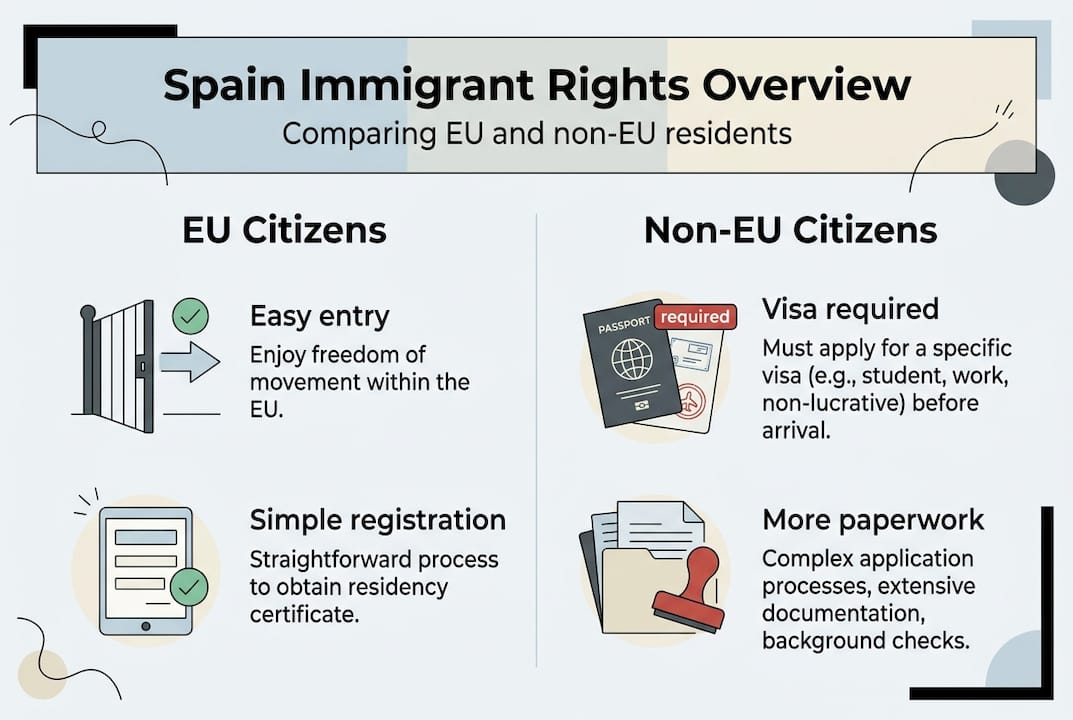
Non-EU citizens face more documentation requirements and longer processing times, but the destination is the same: a stable, long-term legal status in Spain.
Recent reforms: what changed for legal guarantees?
Spain’s legal landscape is always shifting, and here’s how the newest reforms could affect your guarantees. The new Immigration Regulations, effective May 2025, have had a measurable impact. Residence and work applications jumped 46%, rising from 495,000 to 724,000 between comparable periods. The reforms standardized the two-year residence requirement for arraigo permits and created entirely new categories, including the “second chance” and “socio-labour” permits.
The broader policy debate reflects real tension. The government and NGOs frame these changes as a rights guarantee and an economic boost. Critics worry about pull factors. But the data from past regularizations, including Spain’s 2005 process that legalized 700,000 people, consistently shows positive labor market outcomes.
Key changes under the 2025 reforms include:
- Standardized two-year residence requirement for arraigo permits
- New “second chance” permit for those who previously held legal status
- New “socio-labour” category linking residence to employment integration
- Faster processing timelines for certain categories
- Improved anti-discrimination protections aligned with MIPEX standards
Pro Tip: If you applied under old rules and were rejected, the new categories may make you eligible now. Check the latest guidance on the Vive Legal blog to see if a new pathway fits your situation.
How Vive Legal can simplify your residency process
Navigating Spain’s immigration system is genuinely complex, even when you know your rights. The paperwork, the deadlines, the specific document formats, and the appointment scheduling can overwhelm even the most organized person.
At Vive Legal, we combine legal expertise with smart automation to manage your entire residency process online. From your first diagnostic to document review, form preparation, and appointment booking, everything happens through a secure client portal with real-time notifications. Whether you are applying under the 2026 extraordinary regularization, pursuing an arraigo permit, or registering as an EU citizen, our team reviews every detail to maximize your approval chances. No office visits, no guesswork, and transparent pricing from the start. We handle the complexity so you can focus on building your life in Spain.
Frequently asked questions
Who qualifies for Spain’s 2026 extraordinary regularization?
Undocumented immigrants present before December 31, 2025, with at least five months of continuous stay and no criminal record, can apply between April and June 2026. Minors qualify for a five-year authorization.
What documents prove my continuous presence in Spain?
Common proofs include padrón registration, utility bills, and medical records, all showing your name and dates within the qualifying period.
How do EU citizenship and non-EU status affect my residency rights?
EU citizens and their families can secure residence more easily and reach permanent status after five years, while non-EU citizens face additional documentation requirements and must follow specific permit pathways.
Are there protections against deportation during the regularization process?
Yes. Expulsion proceedings are suspended the moment your application is admitted, and vulnerability is presumed for undocumented individuals throughout the review period.
What changed with Spain’s 2025 immigration reforms?
The new regulations caused a 46% jump in applications, standardized arraigo permit requirements, and introduced new permit categories including the second chance and socio-labour permits.
Recommended
Living legally in Spain shouldn't be difficult.
View services and pricesNot sure which procedure you need? Find out in 2 min
Questions? Message us on WhatsApp