
Legal representation in Spain: your guide for immigration success

TL;DR:
- Legal representation in Spain helps navigate complex immigration bureaucratic procedures effectively.
- Using a qualified professional reduces errors, delays, and rejection risks in visa and residency applications.
- Choosing a Credentialed, specialized, and transparent legal professional ensures a smooth immigration process.
Spanish immigration paperwork is notoriously difficult to navigate. Between bureaucratic deadlines, language barriers, and ever-changing regulations, many people find themselves stuck, confused, or facing rejection for reasons they don’t fully understand. Legal representation offers a clear path through this maze. In this guide, we’ll explain what legal representation actually means, how it works specifically for immigration in Spain, who benefits most from it, and what to look for when choosing the right professional to handle your case.
Living legally in Spain shouldn't be difficult.
View services and pricesNot sure which procedure you need? Find out in 2 min
Questions? Message us on WhatsApp
Table of Contents
- Understanding legal representation
- How legal representation works for Spanish immigration
- Who needs legal representation for immigration?
- Choosing the right legal representative in Spain
- Our perspective: Why legal representation is critical in Spain’s immigration landscape
- Partner with immigration specialists for a stress-free process
- Frequently asked questions
Key Takeaways
| Point | Details |
|---|---|
| Definition clarified | Legal representation means empowering a professional to handle immigration matters for you in Spain. |
| Critical for complex cases | Legal experts are essential for appeals and complicated immigration situations. |
| Choose carefully | Always check credentials and compare options before selecting a representative. |
| Proactive support prevents issues | Early legal assistance helps avoid costly mistakes and delays in your residency process. |
Understanding legal representation
Let’s start with the basics. Legal representation is the authority given to a qualified professional to act on your behalf in legal matters. In the context of Spanish immigration, this means a trained expert can file documents, attend appointments, communicate with government agencies, and manage your case while you focus on your life.
One of the biggest myths is that legal representation is only for people going to court. That’s simply not true. Most immigration procedures in Spain are administrative, meaning they happen through government offices and online portals, not in front of a judge. A representative handles all of that on your behalf.
Another common misconception is that hiring a legal professional is too expensive. In reality, the cost of a rejected application, a missed deadline, or an incorrectly filed form often far exceeds the cost of professional help. Think of it as insurance against costly mistakes.
Here’s what a legal representative in Spain can typically do for you:
- File residency applications and renewals on your behalf
- Prepare and review all required documents
- Communicate directly with immigration authorities
- Track your case status and respond to official requests
- Attend administrative appointments in your place
- Advise you on which permit type best fits your situation
The client and representative relationship in Spain is governed by clear legal terms. Your representative acts within the scope you define, which means you stay in control of your case at all times.
“The role of a legal representative is not to take over your life, but to make the legal parts of it easier. You set the direction, they handle the road.”
Working with immigration legal experts ensures you have someone who understands the current rules, knows the common pitfalls, and can anticipate problems before they become serious.
How legal representation works for Spanish immigration
Now that you understand what legal representation is, let’s look at how it actually works in practice for immigration in Spain.

The most important legal tool is the power of attorney, known in Spanish as poder notarial. A formal power of attorney is the most recognized tool for legal representation in Spain. It’s a notarized document that grants your representative the authority to act on your behalf for specific legal matters.
Here’s a simplified step-by-step of how the process typically works:
- Consultation. You meet with your legal representative to discuss your situation, goals, and the type of permit or procedure you need.
- Power of attorney. You sign a formal authorization document, either in person at a notary or through a recognized digital process.
- Document collection. Your representative provides a checklist of required documents and reviews everything for accuracy.
- Filing. The representative submits your application through the appropriate official channels, including online platforms or in-person offices.
- Tracking and communication. They monitor your case, respond to any official requests for additional information, and keep you updated.
- Resolution. Once a decision is made, your representative informs you of the outcome and advises on next steps if needed.
It’s worth being clear about what a representative cannot do. They cannot make major decisions about your case without your consent. They cannot sign contracts or agreements that go beyond the scope of your authorization. And they cannot guarantee outcomes, since final decisions rest with Spanish immigration authorities.
There’s also an important distinction between administrative and judicial representation. Most immigration cases, such as obtaining a NIE, renewing a TIE, or applying for an Arraigo permit, are administrative. Judicial representation, which involves courts, is a separate and more complex matter. Make sure you understand the legal notice requirements that apply to your specific situation.
Pro Tip: Always get the scope of your representative’s authority documented in writing. A clear written agreement prevents misunderstandings and protects both parties.
Who needs legal representation for immigration?
Not everyone is in the same situation, and legal representation means different things depending on your profile. That said, the range of people who benefit from it is wider than most expect.
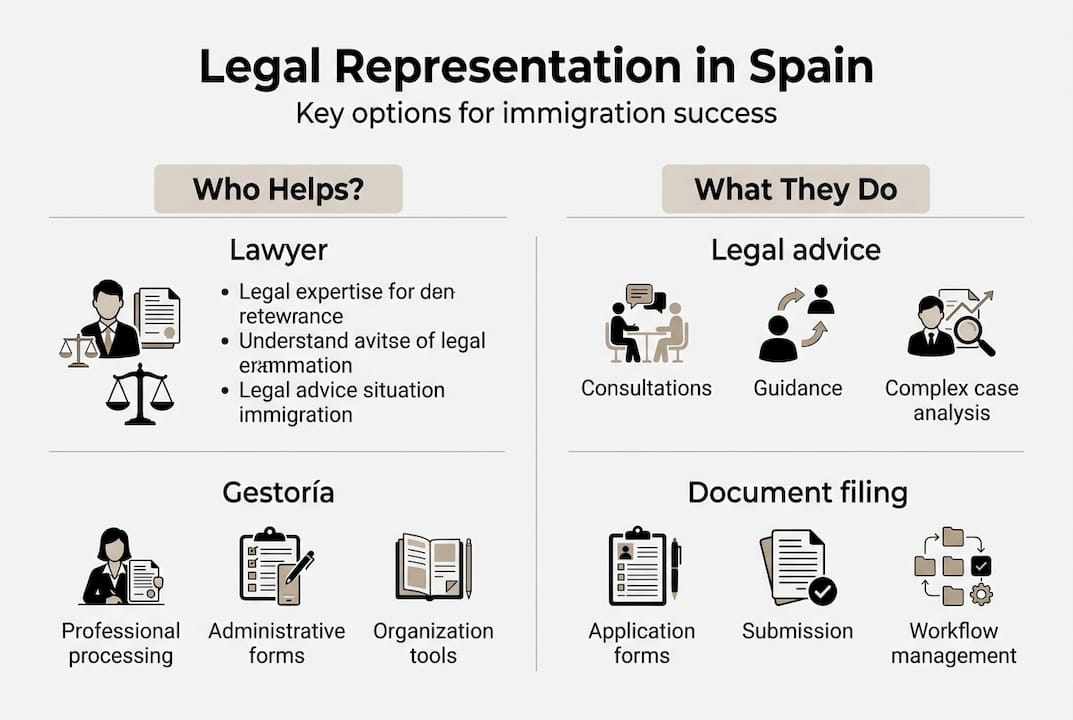
Expatriates and foreign workers are the most frequent users of legal representation for immigration procedures in Spain. But students, EU citizens regularizing their residency, and family members of Spanish nationals also rely heavily on professional help.
Here are the most common profiles that benefit from legal representation:
- International students transitioning from a student visa to a work permit after graduation
- Foreign workers applying for initial work and residency authorizations
- EU citizens registering their residency or applying for long-term status
- Expatriates renewing permits or dealing with gaps in their legal residency
- Family reunification cases where multiple applications must align perfectly
- Individuals with prior rejections who need to appeal or reapply correctly
Let’s take a real-world example. A student from Colombia finishes her degree in Barcelona and wants to stay in Spain to work. She needs to transition from a student visa to a work authorization, which involves coordinating with her employer, gathering employment documents, and filing within a strict window. One missed step could mean starting over or leaving the country. A legal representative manages that entire process, dramatically reducing the risk of error.
When is representation truly mandatory? In cases involving appeals to administrative courts, complex regularizations, or situations where previous applications were denied, professional assistance is not just helpful but essential.
Did you know? The vast majority of successful regularizations involve some level of professional assistance, according to our immigration experience working with clients across Spain.
Choosing the right legal representative in Spain
Knowing you need a legal representative is one thing. Finding the right one is another. This decision matters enormously, and not all representatives are equally qualified. Due diligence is essential.
Here’s what to look for when evaluating a potential representative:
- Credentials. Are they a licensed lawyer, a certified immigration consultant, or a registered gestoría?
- Specialization. Do they focus specifically on immigration, or is it just one of many areas they cover?
- Track record. Can they share success rates or client testimonials?
- Transparency. Do they clearly explain fees, timelines, and realistic expectations?
- Communication. Will you receive regular updates, or will you be left in the dark?
To help you compare your options, here’s a quick breakdown:
| Type | Legal advice | Document handling | Court representation | Cost range |
|---|---|---|---|---|
| Immigration lawyer | Yes | Yes | Yes | Higher |
| Immigration consultant | Limited | Yes | No | Moderate |
| Gestoría | No | Yes | No | Lower |
| Online platform (e.g., Vive Legal) | Yes | Yes | Limited | Transparent/competitive |
Watch out for red flags. Anyone who guarantees a specific outcome, asks for large upfront cash payments without documentation, or avoids answering questions about their credentials should be avoided. Legitimate professionals are open about their qualifications and honest about what they can and cannot promise.
Pro Tip: Before signing anything, ask for a written fee breakdown and a clear description of what services are included. Reputable professionals from our legal team and similar firms will provide this without hesitation.
Online platforms have become a strong alternative to traditional law firms. They offer faster processing, transparent pricing, and digital case tracking, all of which are particularly valuable when you’re managing an immigration process across time zones or from another country.
Our perspective: Why legal representation is critical in Spain’s immigration landscape
Here’s something most immigration guides won’t tell you: the biggest mistakes don’t happen during emergencies. They happen during routine applications when people assume the process is simple enough to handle alone.
We’ve seen it repeatedly. Someone applies for a residency renewal without realizing a regulation changed six months earlier. The application gets rejected. Now they’re out of status, scrambling to fix something that could have been avoided entirely with early professional involvement.
Spain’s immigration rules shift more often than most people realize. What worked for your friend’s application two years ago may not work today. The meet our team page reflects years of experience tracking exactly these kinds of changes.
Proactive representation is not a luxury. It’s a strategic choice. Getting professional guidance before you file, not after something goes wrong, is what separates smooth cases from stressful ones. The cost of prevention is always lower than the cost of correction.
Partner with immigration specialists for a stress-free process
Navigating Spanish immigration doesn’t have to feel like a guessing game. At Vive Legal, we combine professional legal expertise with smart digital tools to manage your immigration process from start to finish, with full transparency at every step.
Whether you’re pursuing an extraordinary regularization, working through the arraigo social process, or applying for EU long-term residence, our team handles the paperwork, appointments, and communications so you don’t have to. We offer 24-hour submission capabilities, personalized case diagnostics, and a secure client portal to track your progress in real time. Reach out today for a personalized assessment and take the first step toward a clear, confident immigration process.
Frequently asked questions
Is legal representation required for all Spanish immigration procedures?
Legal representation is not always mandatory, but it’s highly recommended for complex applications, appeals, or when you want assurance your case is handled correctly from the start.
Can someone represent me remotely in Spain?
Yes. Remote legal representation is permitted in Spain for most administrative immigration processes, as long as the proper authorization documents are in place.
What’s the difference between a lawyer and an immigration gestoría?
Different professionals offer varying levels of service. Lawyers provide full legal advice and can represent you in court, while gestorías typically focus on paperwork and basic administrative procedures.
How do I verify the credentials of a legal representative in Spain?
Request proof of professional memberships, certifications, and client references before signing any agreement. Due diligence prevents issues with unqualified or dishonest representatives.
Can legal representation speed up my immigration process?
A qualified representative helps you avoid errors and submit documents on time, which directly reduces delays. Professional help streamlines even the most complex immigration procedures.
Recommended
Living legally in Spain shouldn't be difficult.
View services and pricesNot sure which procedure you need? Find out in 2 min
Questions? Message us on WhatsApp