
Legal residency options in Spain for 2026: Your guide

Spain attracts thousands of international residents each year, yet many applicants still choose the wrong visa category or miss critical eligibility requirements. Understanding the nuances between digital nomad permits, work authorizations, student visas, and extraordinary regularization can mean the difference between approval and rejection. This guide breaks down the primary legal residency pathways available in 2026, helping you identify which option aligns with your circumstances and how to navigate the application process successfully.
Table of Contents
- Key takeaways
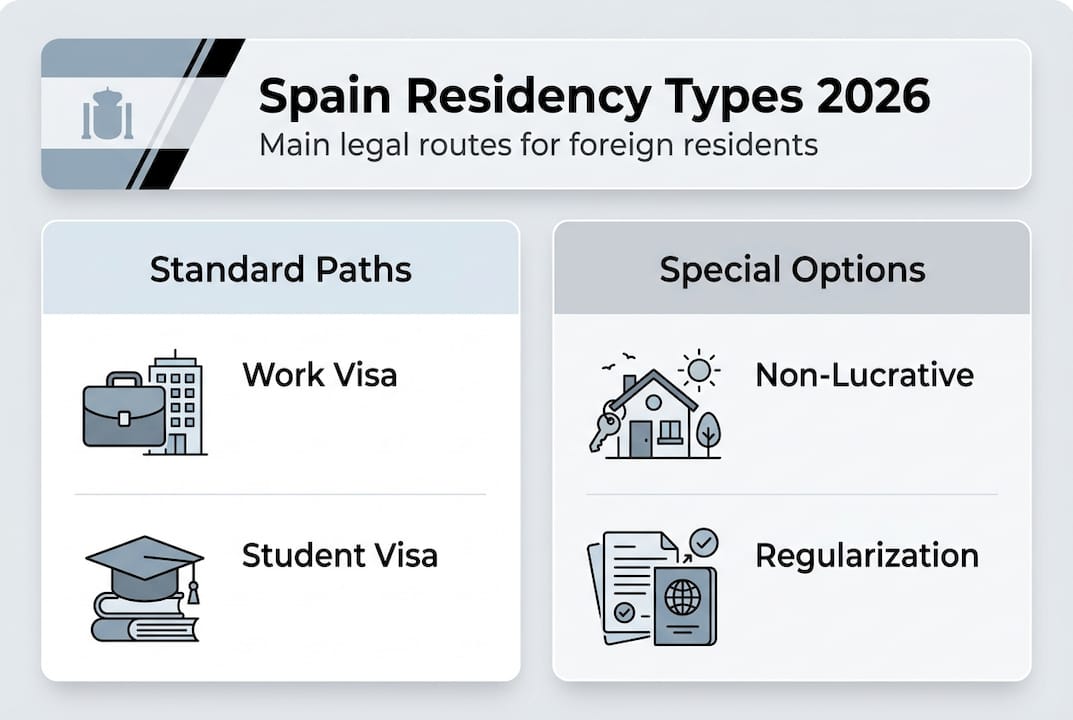
- Overview of residency types in Spain
- Deep dive into work-related residencies
- Residency options for students and retirees
- Extraordinary regularization and permanent residency in Spain
- Get expert help with your Spanish residency application
- FAQ
Key Takeaways
| Point | Details |
|---|---|
| Residency options overview | Spain offers digital nomad, nonlucrative, student, work visas, and extraordinary regularization as the primary legal residency pathways. |
| Nomad income limit | You must demonstrate roughly €2,763 in monthly earnings and limit work for Spanish clients to 20 percent of your total income. |
| Nonlucrative basics | Nonlucrative visa requires at least €2,400 monthly from pensions, investments, or rental income and prohibits any work in Spain. |
| Student visa benefits | Student visa requires enrollment in an accredited institution and proof of €600 per month, and allows part time work up to 30 hours weekly, with time counting at 50 percent toward the five year permanent residency requirement. |
| Extraordinary regularization | Undocumented migrants can apply during the April through June 2026 window to receive a one year residence and work permit if they prove continuous residence and meet the criteria. |
Overview of residency types in Spain
Spain offers multiple residency categories designed for different life situations and professional circumstances. The digital nomad visa targets remote workers and freelancers who earn their income outside Spain. You must demonstrate monthly earnings around €2,763 and limit Spanish client work to 20% of your total income. This visa appeals to location-independent professionals seeking legal status while maintaining international client bases.
Living legally in Spain shouldn't be difficult.
View services and pricesNot sure which procedure you need? Find out in 2 min
Questions? Message us on WhatsApp
The non-lucrative visa serves retirees and individuals with passive income streams. You need at least €2,400 monthly from sources like pensions, investments, or rental properties. This visa strictly prohibits any employment or business activity in Spain, making it unsuitable if you plan to work locally or remotely.
Student visas require enrollment in an accredited Spanish educational institution and proof of €600 monthly funds. Unlike the non-lucrative option, students can work part-time up to 30 hours weekly, providing valuable income opportunities while studying. Time spent on a student visa counts at 50% toward the five-year requirement for permanent residency.
Work visas split into three main categories. Employed worker visas require a valid job offer from a Spanish company. Self-employed visas demand a detailed business plan and proof of economic viability. The EU Blue Card targets high-skilled professionals with university degrees and job offers paying at least €40,000 annually. Processing times range from one to four months depending on visa type and application volume.
The extraordinary regularization pathway launched in 2026 provides undocumented migrants a route to legal status. Applicants must prove continuous residence in Spain and meet specific timeline requirements for the April through June 2026 application window. This one-year residence and work permit creates a bridge toward regular immigration status for eligible individuals.
Deep dive into work-related residencies
Work visas form the backbone of Spain’s economic immigration system. Employed worker visas require a formal job offer from a Spanish company willing to sponsor your application. The employer must demonstrate they could not fill the position with local talent, though this requirement relaxes for high-demand sectors. Your contract must meet minimum salary thresholds and include social security enrollment.
Self-employed visas demand more documentation but offer greater independence. You submit a comprehensive business plan outlining your service or product, target market, financial projections, and economic impact on Spain. Authorities evaluate whether your venture contributes meaningfully to the Spanish economy. Professional credentials, relevant experience, and sufficient startup capital strengthen your application. Processing typically takes two to three months.
The EU Blue Card attracts highly qualified professionals to fill specialized roles. You need a university degree or five years of comparable professional experience, plus a job offer paying at least €40,000 yearly. Blue Card holders enjoy streamlined family reunification, faster pathways to permanent residency, and easier mobility within the European Union. Tech professionals, engineers, medical specialists, and senior managers commonly qualify.
Application processes follow similar patterns across work visa types. You gather required documents including passport copies, job contracts, educational credentials, criminal background checks, and health certificates. Submit applications at Spanish consulates in your home country or, in limited cases, within Spain if you hold valid temporary status. Expect one to four months for processing, with complexity and consular workload affecting timelines.
Pro Tip: Research the Beckham Law if you earn over €600,000 annually. This special tax regime lets qualifying foreign workers pay a flat 24% rate on Spanish-source income up to €600,000 instead of progressive rates reaching 47%. You must not have been a Spanish tax resident in the prior 10 years and apply within six months of starting work. The savings can be substantial for high earners relocating to Spain.
Many applicants overlook the transition from student to worker status. If you complete a degree in Spain, you can convert your student visa to a job search visa allowing one year to secure employment. Once you land a qualifying job offer, switch to a regular work visa without leaving Spain. This pathway eliminates the need to return home and reapply from scratch.
Residency options for students and retirees
The non-lucrative visa attracts retirees and individuals with investment income, pensions, or rental properties generating at least €2,400 monthly. You must prove this income originates outside Spain and will continue reliably. Bank statements, pension award letters, investment account summaries, and rental agreements serve as documentation. The visa prohibits all work activity, including remote employment for foreign companies. Violating this restriction jeopardizes your residency status and future applications.

Student visas require acceptance to an accredited Spanish educational institution offering programs lasting over 90 days. Universities, language schools, vocational training centers, and research programs qualify. You demonstrate financial means of approximately €600 monthly to cover living expenses, though this amount increases for family members. Comprehensive health insurance covering your entire stay is mandatory.
Unlike non-lucrative visa holders, students can work part-time up to 30 hours weekly. This provision helps offset living costs and provides valuable Spanish work experience. Employment must not interfere with your studies, and you typically need university approval before starting work. Many international students find part-time roles in hospitality, tutoring, retail, or administrative support.
Student visa time counts at 50% toward the five-year continuous residence requirement for permanent residency. Two years of study equals one year of credit. This partial recognition acknowledges that student status differs from full residency but still demonstrates integration into Spanish society. After completing your studies, you can apply for a job search visa allowing one additional year to find qualifying employment and transition to a work visa.
Renewal processes require maintaining your original eligibility criteria. Non-lucrative visa holders prove continued passive income. Students show ongoing enrollment, satisfactory academic progress, and sufficient funds. Initial non-lucrative visas last one year, with renewals extending two years at a time. Student visas match your program length, with renewals possible for continued education.
Pro Tip: If you hold a student visa and plan to pursue permanent residency, document your continuous presence carefully. Keep copies of enrollment certificates, residence registration updates, and any part-time employment contracts. This paper trail proves your qualifying time when you eventually apply for long-term residence. Small gaps or administrative errors can delay or derail permanent residency applications.
Extraordinary regularization and permanent residency in Spain
The 2026 extraordinary regularization program offers undocumented residents a pathway to legal status. Eligible applicants must have lived continuously in Spain for at least five months before the application window opens in April 2026. The program runs through June 2026, creating a three-month filing period. Successful applicants receive a one-year combined residence and work permit, providing immediate employment authorization and legal protection.
Eligibility extends beyond simple presence requirements. You must demonstrate ties to Spain through employment history, family connections, or community integration. Supporting documentation includes rental agreements, utility bills, school enrollment records for children, or letters from employers confirming past work. The program aims to regularize individuals contributing to Spanish society despite lacking formal immigration status.
Benefits include immediate work authorization without employer sponsorship requirements. You can seek employment freely across industries and regions. The one-year permit provides time to establish stronger legal footing, build employment history, and prepare for standard residence permit renewals. After the initial year, you transition to regular renewal cycles if you maintain employment and meet standard requirements.
Permanent residency represents the ultimate immigration goal for most foreign residents. Spain grants permanent residence after five years of continuous legal residence. You must not have been absent from Spain for more than six consecutive months or 10 total months during the five-year period. Short trips for vacation, business, or family emergencies are acceptable, but extended absences reset the clock.
Application fees for permanent residency currently stand at €21.52 plus additional costs for biometric cards and processing. You submit proof of continuous residence through registration certificates, tax returns, social security records, and residence card copies. Criminal background checks from Spain and your home country are mandatory. Processing takes three to six months on average.
| Residency pathway | Initial duration | Renewal period | Years to permanent residency | Work restrictions |
|---|---|---|---|---|
| Digital nomad | 1 year | 2 years | 5 years | Remote only, 20% Spanish clients max |
| Non-lucrative | 1 year | 2 years | 5 years | No work allowed |
| Student | Program length | Program length | 10 years (50% credit) | Part-time 30 hrs/week max |
| Employed work | 1 year | 2 years | 5 years | Full-time with sponsor |
| Extraordinary regularization | 1 year | Standard renewal | 5+ years | Unrestricted work authorization |
Permanent residency holders enjoy nearly identical rights to Spanish citizens except voting in national elections. You can work without restrictions, access public services, and travel freely within the Schengen zone. Permanent residence cards renew every five years but do not expire if you maintain Spanish residence. After 10 years of legal residence, you become eligible for Spanish citizenship through naturalization if you meet language and integration requirements.
The pathway from extraordinary regularization to permanent residency requires careful planning. Your initial one-year permit counts toward the five-year requirement if you successfully renew it as a standard residence permit. Maintain continuous employment, avoid criminal issues, and keep your documentation current. Missing renewal deadlines or accumulating excessive absences can derail your progress toward permanent status.
Get expert help with your Spanish residency application
Navigating Spain’s immigration system demands attention to detail and current knowledge of evolving regulations. Vive Legal specializes in comprehensive immigration management, handling everything from initial visa applications to permanent residency processing. Our platform combines AI-powered document review with human legal expertise to catch errors before submission, dramatically improving approval rates.
We offer specialized support for extraordinary regularization applications, helping eligible applicants gather required documentation and meet tight deadlines. Our team tracks your case through every stage, sending notifications when action is needed and coordinating directly with immigration authorities. For those pursuing long-term residence, we ensure your five-year timeline is properly documented and your application meets all current requirements. Our secure client portal provides 24/7 access to your case status, uploaded documents, and upcoming appointments, giving you complete visibility into your immigration journey.
FAQ
What is the minimum income requirement for a digital nomad visa in Spain?
The digital nomad visa requires approximately €2,763 monthly income from remote work or freelancing. You must provide bank statements, client contracts, or tax returns proving this consistent earning level. Spanish client work cannot exceed 20% of your total income, ensuring you primarily serve international markets. Income must be stable and verifiable through official documentation.
How long must I reside in Spain to qualify for permanent residency?
You need five years of continuous legal residence with no single absence exceeding six months. Total absences across the five-year period must stay under 10 months. Each day outside Spain counts toward this limit, so track your travel carefully. Student visa time counts at 50%, meaning two years of study equals one year toward the requirement. Maintain updated residence registration and keep copies of all travel documents to prove continuous presence.
Can I work with a non-lucrative visa in Spain?
No, the non-lucrative visa strictly prohibits all employment and business activity in Spain. This includes remote work for foreign companies, freelancing, and any income-generating activity performed while physically in Spain. Violations can result in visa cancellation and future application denials. If you need to work, consider the digital nomad visa or standard work visa categories instead. The non-lucrative option suits only those with sufficient passive income from pensions, investments, or rental properties.
What documents do I need for a work visa application?
Work visa applications require your passport valid for at least one year, a formal job offer or employment contract from a Spanish company, educational credentials authenticated by apostille, criminal background checks from your home country and any country where you lived over one year, comprehensive health insurance, and proof of accommodation in Spain. Your employer must provide company registration documents and proof they advertised the position locally. Medical certificates confirming you have no contagious diseases are mandatory. Gather these documents early, as authentication and translation can take several weeks.
How does the extraordinary regularization program work in 2026?
The program runs from April through June 2026 for undocumented residents who lived continuously in Spain for at least five months. You submit proof of presence through rental contracts, utility bills, medical records, or employment evidence. Successful applicants receive a one-year residence and work permit with unrestricted employment authorization. After the initial year, you transition to standard residence permit renewals if you maintain employment and meet regular requirements. The program offers a bridge to legal status for those already integrated into Spanish society but lacking formal immigration documentation.
Recommended
Living legally in Spain shouldn't be difficult.
View services and pricesNot sure which procedure you need? Find out in 2 min
Questions? Message us on WhatsApp