
Legal Residency in Spain: Impact on Everyday Life

Sorting out legal residency in Spain goes beyond simply arriving or holding a tourist visa. For many international students and expatriates, confusion about the true meaning of legal residency and the rules that come with it can cause stress and uncertainty. This guide breaks down the essential details of legal residency and addresses widespread misconceptions so you can pursue a smoother, more secure future in Spain with confidence and clarity.
Table of Contents
- Legal Residency Defined And Common Misconceptions
- Main Types Of Residency Permits In Spain
- Eligibility Criteria And Application Process Explained
- Rights And Responsibilities Of Legal Residents
- Common Pitfalls And How To Avoid Them
Key Takeaways
| Point | Details |
|---|---|
| Understanding Legal Residency | Legal residency in Spain grants specific rights and requires compliance with detailed regulations; it is not automatically obtained through mere presence. |
| Types of Residency Permits | Spain offers various residency permits tailored to different circumstances, including student, work-based, family reunification, and retirement options. |
| Application Process Requirements | Completing the residency application necessitates thorough documentation and adherence to eligibility criteria specific to each permit type. |
| Rights and Responsibilities | Legal residents enjoy specific rights such as access to public healthcare and work opportunities, while also bearing responsibilities like permit renewals and tax compliance. |
Legal Residency Defined and Common Misconceptions
Legal residency in Spain represents more than just being physically present in the country. It’s a specific legal status that grants individuals certain rights and responsibilities within the Spanish legal system. Understanding the nuanced definition is crucial for international students, professionals, and expatriates planning to establish their life in Spain.
Living legally in Spain shouldn't be difficult.
View services and pricesNot sure which procedure you need? Find out in 2 min
Questions? Message us on WhatsApp
At its core, legal residency is a formal permission granted by Spanish authorities that allows non-EU citizens to live, work, and integrate into Spanish society for an extended period. This status is not automatically acquired simply by entering the country or staying for a short duration. Instead, it requires meeting specific legal requirements defined by EU migration policies.
Common misconceptions about legal residency in Spain include:
- Believing any extended stay automatically grants residency rights
- Assuming tourist visas provide the same protections as residency permits
- Thinking residency is a one-time application without ongoing compliance requirements
- Misunderstanding the difference between temporary and long-term residency status
The legal framework distinguishes between different types of residency permits, each with unique conditions and rights. These typically include:
For quick reference, here are key differences between temporary and long-term residency in Spain:
| Feature | Temporary Residency | Long-Term Residency |
|---|---|---|
| Minimum Duration | Less than 5 years | 5 years or more |
| Permit Renewal | Required frequently | Less frequent, every 5 years |
| Rights Granted | Limited | More comprehensive |
| Path to Citizenship | Not direct | Possible after long-term |
- Temporary Residency Permit (less than 5 years)
- Long-Term Residency Permit (5+ years)
- Work-based Residency
- Student Residency
- Retirement/Passive Income Residency
To qualify for legal residency, applicants must typically demonstrate:
- Sufficient financial resources
- Valid health insurance coverage
- Clean criminal record
- Specific purpose for residing in Spain (work, study, family reunification)
Pro tip: Always consult official Spanish immigration resources and consider professional legal assistance to navigate the complex residency application process accurately.
Main Types of Residency Permits in Spain
Spain offers several distinct types of residency permits designed to accommodate different life circumstances and professional objectives for international residents. Understanding these various pathways is crucial for navigating the complex immigration landscape and selecting the most appropriate legal route for your specific situation.
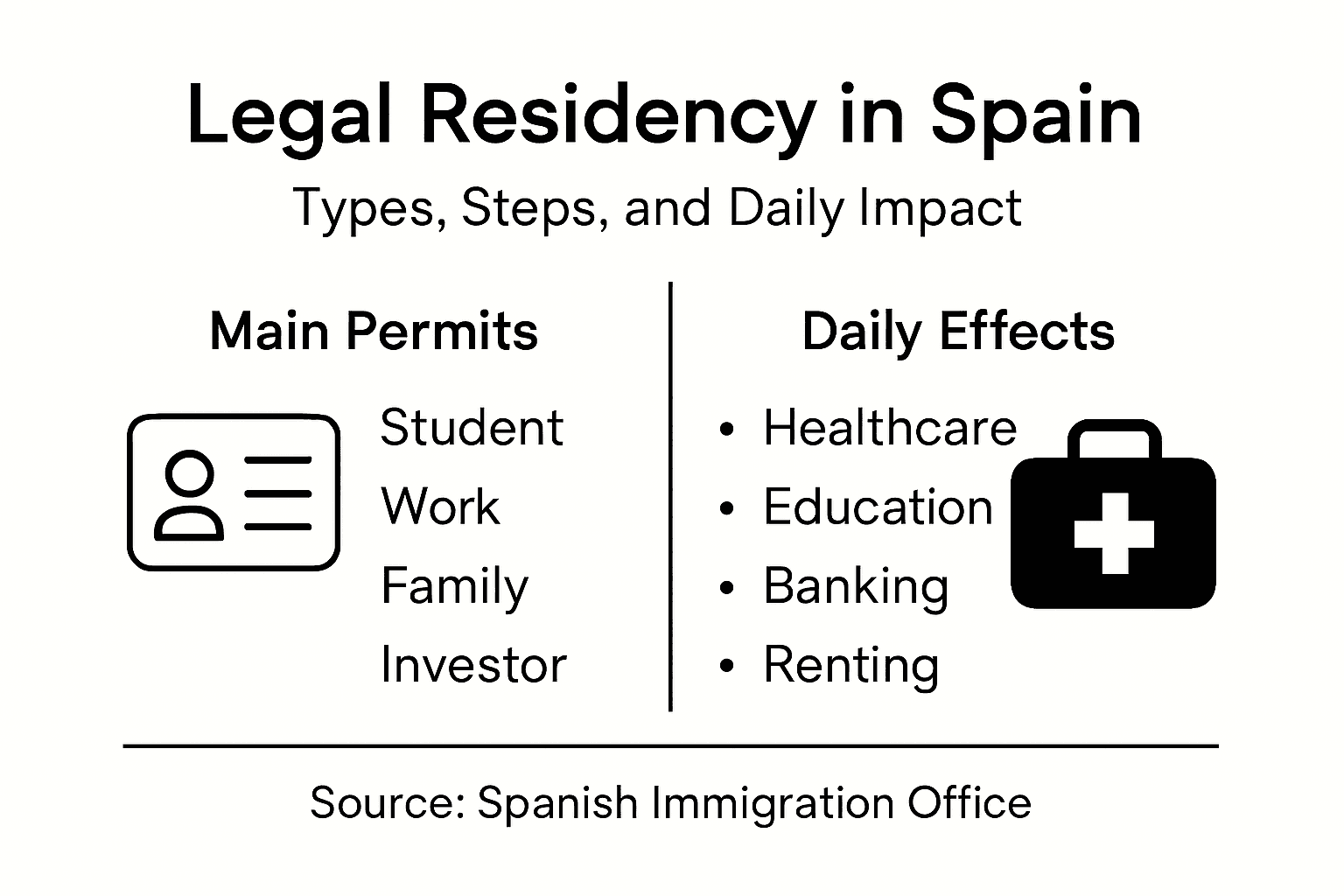
The primary categories of residency permits in Spain include specific immigration pathways for different applicant types. These comprehensive options typically cover:
- Student Permits: For individuals pursuing academic or professional education
- Work Permits: Allowing employment in specific professional sectors
- Family Reunification Permits: Enabling family members to join legal residents
- Retirement/Passive Income Permits: For individuals with stable financial resources
- Entrepreneur/Investment Permits: Targeting business professionals and investors
Each permit type has unique requirements and documentation standards. For instance, student permits demand:
Here’s a summary comparing the main residency permit types in Spain:
| Permit Type | Typical Duration | Primary Eligibility Factor | Common Use Case |
|---|---|---|---|
| Student Permit | 1 year, renewable | Admission to Spanish institution | Academic studies |
| Work-Based Permit | 1-2 years | Job offer from Spanish employer | Professional employment |
| Family Reunification | Up to 5 years | Relative of legal resident | Family joining resident |
| Retirement/Passive Income | 1-5 years, renewable | Stable financial resources | Retirement in Spain |
| Entrepreneur/Investor | 1-2 years | Significant business investment | Business or investment |
- Admission to a recognized Spanish educational institution
- Proof of sufficient financial means
- Comprehensive health insurance coverage
- Clean criminal record
Work-based residency permits are particularly nuanced, often requiring:
- Job offer from a Spanish employer
- Verification that no local candidate can fill the position
- Specific professional qualifications
- Compliance with labor market regulations
Successful residency permit applications require meticulous documentation and understanding of Spanish immigration regulations.
Pro tip: Consider consulting an immigration specialist who can provide personalized guidance through the complex residency permit application process and help you identify the most suitable pathway for your specific circumstances.
Eligibility Criteria and Application Process Explained
Navigating the residency application process in Spain requires careful preparation and a thorough understanding of specific eligibility requirements. Each type of residency permit demands unique documentation and compliance with Spanish immigration regulations, making it crucial to approach the process systematically and meticulously.
For student residency, applicants must meet comprehensive eligibility requirements for international students. The core eligibility criteria typically include:
- Confirmed admission to a recognized Spanish educational institution
- Proof of sufficient financial resources
- Comprehensive health insurance coverage
- Valid passport with minimum six months remaining validity
- Clean criminal background
- Medical certificate demonstrating good health
The application process involves several critical steps:
- Secure admission to a Spanish educational program
- Obtain necessary documentation from the educational institution
- Compile financial and health insurance proof
- Schedule an appointment at the Spanish consulate
- Submit complete application package
- Attend required personal interview
Work-based residency permits have additional complex requirements:
- Valid job offer from a Spanish employer
- Employer must demonstrate inability to fill position locally
- Professional qualifications matching job requirements
- Compliance with specific sector regulations
Successful applicants understand that meticulous documentation and patience are key to navigating Spain’s residency application process.
Documentation requirements vary significantly across different permit types, with each category demanding specific supporting materials:
- Student Permits: Academic acceptance letter, financial statements
- Work Permits: Employment contract, professional credentials
- Retirement Permits: Proof of stable income, health insurance
- Entrepreneur Permits: Business plan, investment documentation
Pro tip: Create a comprehensive digital and physical filing system for your residency documents, keeping multiple copies and tracking submission dates to ensure a smooth application process.
Rights and Responsibilities of Legal Residents
Legal residency in Spain is a nuanced status that comes with a comprehensive set of rights and obligations designed to integrate international residents into Spanish society while maintaining legal compliance. Understanding these rights and responsibilities is crucial for a smooth and successful experience living in Spain.
Legal residents can access extensive social and legal protections in Spain. The core rights typically include:
- Access to public healthcare systems
- Right to work in authorized professional sectors
- Social security benefit eligibility
- Public education access
- Equal employment protection
- Legal protection under Spanish law
Corresponding responsibilities for legal residents encompass:
- Maintaining valid residency documentation
- Renewing permits before expiration
- Reporting changes in personal circumstances
- Paying required taxes
- Complying with local and national regulations
- Maintaining health insurance coverage
Work-related rights are particularly important for legal residents:
- Protection against workplace discrimination
- Minimum wage guarantees
- Access to professional development opportunities
- Unemployment benefit eligibility
- Right to join labor unions
Legal residents must proactively manage their status, understanding that rights are interconnected with ongoing legal compliance.
Specific documentation and ongoing requirements include:
- Annual permit renewals
- Proof of financial stability
- Updated medical insurance
- Criminal background checks
- Continuous legal employment or study status
Pro tip: Create a digital and physical tracking system for all residency-related documents, setting calendar reminders for renewals and maintaining a comprehensive file to ensure smooth administrative processes.

Common Pitfalls and How to Avoid Them
Negotiating legal residency in Spain involves navigating a complex landscape of administrative requirements and potential obstacles. Understanding these challenges beforehand can significantly reduce stress and minimize the risk of legal complications that could jeopardize your residency status.
The most critical common residency application mistakes typically involve administrative oversights and procedural errors. These include:
- Missing critical renewal deadlines
- Incomplete documentation
- Failing to update personal information
- Unauthorized employment
- Inadequate health insurance coverage
- Not maintaining sufficient financial resources
Specific pitfalls to avoid during the residency process:
- Neglecting permit expiration dates
- Working without proper authorization
- Failing to register local residence
- Incorrect tax reporting
- Overlooking mandatory health insurance requirements
Documentation management is crucial for avoiding potential issues:
- Maintain digital and physical copies of all documents
- Create renewal reminders at least 60 days before expiration
- Track and organize permit-related paperwork
- Translate and authenticate required documents
- Understand specific requirements for each permit type
Proactive management and meticulous attention to detail can prevent most residency-related complications.
Key administrative requirements that often trip up applicants include:
- Precise translation of foreign documents
- Obtaining apostilles for international certificates
- Understanding complex tax reporting obligations
- Navigating healthcare registration processes
- Complying with local municipal registration rules
Pro tip: Create a comprehensive digital folder with scanned copies of all residency documents, setting automatic calendar alerts for renewals and critical administrative deadlines.
Simplify Your Legal Residency Journey in Spain Today
Navigating the complexities of legal residency in Spain can feel overwhelming with strict documentation requirements, renewal deadlines, and the need to maintain continuous compliance. Whether you are applying for a student permit, work-based residency, or managing renewals, mistakes can cause delays or jeopardize your status. The challenges described in the article reveal why professional guidance and organized support are crucial for a smooth process.
Take control of your residency application with personalized assistance from Vive Legal. Our platform offers full digital solutions designed to reduce errors and increase your approval chances through AI-driven document review and expert oversight. Stay informed with real-time notifications and track every step via our secure client portal. Start your stress-free residency procedure now by visiting https://vive.legal. Explore our Uncategorized Archives - Vive Legal for more insights and expert advice to successfully settle in Spain.
Frequently Asked Questions
What is legal residency in Spain?
Legal residency in Spain is a formal permission granted by Spanish authorities that allows non-EU citizens to live, work, and integrate into Spanish society for an extended period. It requires meeting specific legal requirements and is not automatically granted upon entry into the country.
How can I apply for a legal residency permit in Spain?
To apply for a legal residency permit in Spain, you must gather the necessary documentation based on the type of permit you are applying for, secure employment or academic admission if required, and submit your application to the appropriate Spanish authorities.
What are the different types of residency permits available in Spain?
Spain offers several types of residency permits, including student permits, work permits, family reunification permits, retirement/passive income permits, and entrepreneur/investment permits, each with unique requirements and benefits.
What rights do legal residents have in Spain?
Legal residents in Spain have access to public healthcare, the right to work in authorized sectors, eligibility for social security benefits, access to public education, and legal protections under Spanish law, among other rights.
Recommended
Living legally in Spain shouldn't be difficult.
View services and pricesNot sure which procedure you need? Find out in 2 min
Questions? Message us on WhatsApp