
Legal Status Regularization in Spain: Why It Matters

Facing uncertainty about your future in Spain can affect every part of your daily life, from finding work to accessing basic services. Regularization is more than just a legal concept—it is your opportunity to step out of the shadows and claim full belonging, with rights and real protection. Spain’s inclusive approach to regularization recognizes that people embedded in society deserve to participate openly. Understanding these pathways is the first step toward leaving legal limbo behind.
Table of Contents
- Definition And Purpose Of Regularization
- Types Of Regularization And Eligibility
- Key Requirements And Documentation Needed
- Application Procedures And Timelines Explained
- Risks, Costs, And Common Mistakes To Avoid
Key Takeaways
| Point | Details |
|---|---|
| Understanding Regularization | Regularization converts undocumented immigration status in Spain to legal status, providing protection and access to rights. |
| Key Benefits | Regularization allows access to legal work, social benefits, and freedom from fear of deportation. |
| Documentation is Crucial | Organize identity, employment, and integration documents to support your application effectively. |
| Application Process Awareness | Be mindful of application timelines and common pitfalls to avoid delays or denials in your regularization process. |
Definition and purpose of regularization
Regularization is the official process of converting your undocumented or irregular immigration status into a legal, recognized status recognized by Spanish authorities. Think of it as the government’s acknowledgment that you exist, you belong, and your presence matters.
Living legally in Spain shouldn't be difficult.
View services and pricesNot sure which procedure you need? Find out in 2 min
Questions? Message us on WhatsApp
For international students and expatriates, this concept matters because it transforms your position from invisible to protected. You move from operating in legal limbo to accessing real rights, real protections, and real pathways forward.
What regularization actually does
Regularization addresses a fundamental mismatch. Spain’s labor market and society need workers and skilled professionals, yet immigration policies often restrict who can enter legally. This gap leaves thousands of capable people in legal gray zones despite contributing to the economy and community.
When you regularize, you gain:
- Access to legal employment without restrictions or employer exploitation
- Social benefits, healthcare, and legal protections under Spanish law
- The ability to open bank accounts, sign rental agreements, and conduct normal life activities
- A pathway toward permanent residence and eventual citizenship
- Freedom from fear of deportation or legal sanctions
Why Spain implements regularization programs
Spain recognizes that regularization as a policy tool addresses real demographic and economic needs. Rather than ignoring undocumented populations, regularization brings them into the formal system where they contribute taxes, follow labor laws, and integrate properly into society.
The eligibility criteria reflect this practical approach. You typically need to demonstrate prior presence in Spain, a certain length of residence, employment history or social integration, and a clean criminal record.
The difference between regularization and other residency pathways
Regularization differs from standard visa applications in one crucial way: it acknowledges people already here, already integrated. You don’t need a job offer waiting or a sponsoring employer lined up beforehand.
Spain’s immigration system has evolved to offer many unauthorized immigrants the opportunity to secure legal residence by proving employment history or social integration. This approach recognizes reality: you’re already contributing.
Here’s how regularization compares to traditional residency applications in Spain:
| Topic | Regularization | Standard Visa Application |
|---|---|---|
| Requirement | Proof of integration in Spain | Valid job or study offer |
| Applicant’s Status | Already lives in Spain | Typically outside Spain |
| Sponsor Needed | Not required | Employer or school often needed |
| Processing Priority | Recognizes real-life ties | Follows strict entry quotas |
| Benefit Focus | Social and work inclusion | Admission under set profiles |
Regularization transforms your legal standing from precarious to protected, giving you access to the rights and protections that other residents enjoy.
Why it matters for you specifically
As an international student or expatriate, regularization matters because it removes barriers that complicate everyday life. Banking becomes possible. Renting becomes easier. Your work becomes legitimate.

Beyond practical benefits, regularization provides psychological relief. You stop worrying about random checks or sudden changes in circumstances. You can plan your future in Spain with actual confidence.
Pro tip: Document everything from day one: employment contracts, rental agreements, school enrollment, tax records, and social contributions. These materials form the foundation of a strong regularization application when the opportunity arises.
Types of regularization and eligibility
Spain offers multiple regularization pathways, each designed for different circumstances and population groups. Understanding which type applies to your situation is the first step toward converting your status from irregular to legal.
The primary distinction lies in how regularization programs target specific groups based on vulnerability, employment status, or social integration. One program may prioritize workers, while another focuses on individuals with family ties or health concerns.
Primary regularization pathways
Spain’s regularization schemes operate on a principle of clear and objective eligibility criteria. This means the rules don’t change based on individual discretion—if you meet the conditions, you qualify.
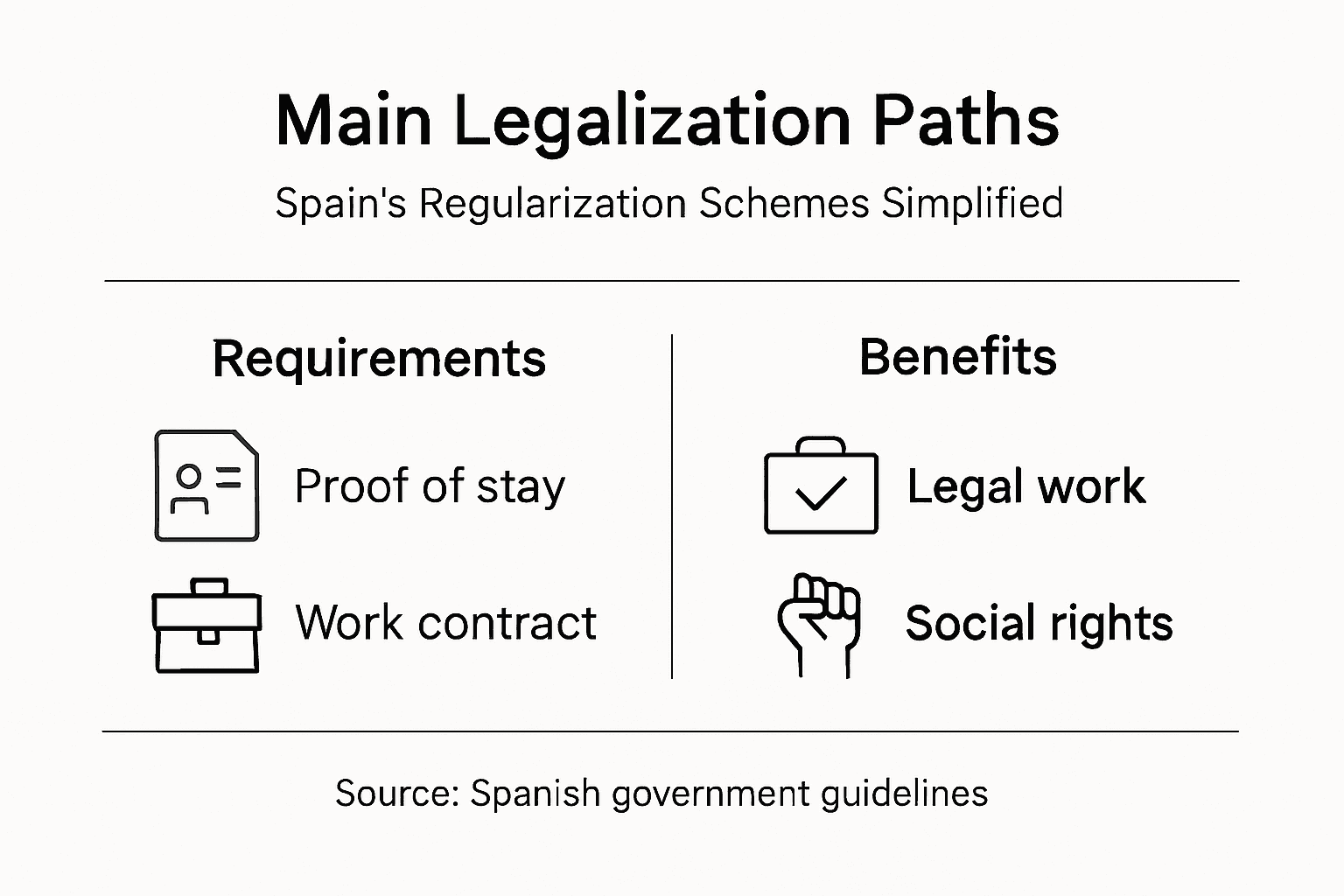
The main pathways include:
To see what each regularization pathway focuses on, review this comparison:
| Pathway Name | Target Group | Main Requirement |
|---|---|---|
| Large-Scale Worker | Employed migrants | Documented work history |
| Vulnerability-Based | Trafficking victims, ill | Prove vulnerable status |
| Family Reunification | Relatives of citizens | Family relationship proof |
| Long-Term Resident (Arraigo) | Unable to return home | Lengthy Spanish residence |
| Child-Focused | Minors in Spain | Born or raised in Spain |
- Large-scale worker regularization programs for employed migrants contributing to the economy
- Special provisions for vulnerable populations including trafficking victims and seriously ill individuals
- Family reunification regularization for those with Spanish or EU citizen relatives
- Arraigo programs targeting long-term residents unable to return to their countries of origin
- Child-focused regularization for minors born or raised in Spain
2026 regularization program specifics
Spain’s recent regularization program focuses on undocumented migrants embedded in society and the labor market. This program recognizes that you’ve already integrated into Spanish life, whether through employment, education, or community involvement.
The eligibility requirements are straightforward: prior presence in Spain, length of residence (typically measured in months or years), absence of serious criminal convictions, and evidence of employment or social ties.
Who qualifies for regularization
You likely qualify if you meet these conditions:
- You’ve been living in Spain for a specified period (usually six months to two years)
- You have employment history, income documentation, or proof of social integration
- You have no serious criminal convictions
- You’re not subject to deportation orders or security concerns
Proof of integration matters. This includes employment contracts, tax records, rental agreements, school enrollment, or letters from community organizations demonstrating your belonging in Spanish society.
Different schemes for different circumstances
Regularization schemes worldwide include various pathways targeting victims of crime, seriously ill individuals, or those unable to return to their country of origin. Spain incorporates these humanitarian provisions alongside standard worker regularization.
Special circumstances that may qualify you include trafficking situations, serious health conditions requiring ongoing Spanish medical care, or extreme hardship if returned to your home country.
Clear eligibility criteria mean you’re either eligible or you’re not—there’s no gray area once you understand the requirements.
Timeline and procedural safeguards
Regularization programs operate within specific timeframes. When a program opens, you typically have a limited window—sometimes 90 days, sometimes longer—to submit your application.
Procedural safeguards protect you throughout the process. Your application receives fair evaluation, you can appeal decisions, and confidentiality protections apply to your personal information.
Pro tip: Gather all required documentation before any regularization window opens, rather than scrambling during the application period. Having organized employment contracts, rental agreements, tax records, and integration evidence ready accelerates your application significantly.
Key requirements and documentation needed
Documentation is the backbone of any regularization application. However, Spain recognizes that undocumented people face real constraints—you may not have every official document perfectly organized or readily available.
The good news: regularization programs are designed around your actual living situation, not bureaucratic perfection. You won’t need impossible proof. You’ll need realistic documentation that reflects how you actually live and work.
What documentation actually proves
Regularization authorities evaluate documentation to verify three core things: you’re in Spain, you’ve been here long enough, and you’re contributing to society. Each document serves one of these purposes.
Effective regularization programs require accessible procedures with reasonable documentation demands that reflect living realities. This means you’re not penalized for lacking official paperwork that undocumented people realistically cannot obtain.
Essential documentation categories
Organize your documents into these categories for clarity:
- Identity documentation: passport, national ID, or travel documents proving your nationality
- Proof of presence: rental agreements, utility bills, school enrollment, or medical records dated during your time in Spain
- Employment evidence: employment contracts, payslips, tax records, or letters from employers confirming your work history
- Social integration: community organization letters, educational certificates, family ties, or volunteer records
- Criminal record: police clearance or declaration of no serious convictions
- Residence address: current rental agreement, lease, or housing proof
Employment documentation specifics
Employment proof matters most if you’re applying through a worker regularization program. Gather everything showing you work or worked:
- Employment contracts (even informal or verbal agreements documented by letters from employers)
- Recent and historical payslips or salary transfers
- Tax documentation (modelo 190, income tax returns)
- Social security contributions or affiliation records
- Letters from current or former employers confirming employment dates and position
- Bank statements showing regular income deposits
If you’ve worked informally, employer letters become crucial. Ask previous employers to write simple letters confirming you worked for them and during what period.
Residence and integration proof
Prove you’re established in Spain through everyday documentation:
- Rental contracts or lease agreements
- Utility bills (electricity, water, internet) in your name
- School enrollment records for you or your children
- Medical records or healthcare center registration
- Bank account statements showing Spanish bank account
- Proof of mobile phone contracts
- Community center or organization letters confirming your participation
Documentation should reflect your real life in Spain—bills, work records, and community ties matter far more than official certificates.
Handling incomplete documentation
Missing some documents? Don’t assume disqualification. Regularization programs expect gaps. Instead, prepare supporting statements explaining what you can’t provide and why.
For example, if you lack employment contracts, write a brief statement explaining the informal work arrangement, then provide employer letters and bank records showing income. Authorities understand informal employment exists.
Timeline for gathering documentation
Start collecting documents immediately, even before a regularization window opens. This prevents last-minute stress and missing deadlines.
Create a checklist matching your specific situation. Student? Gather school enrollment and housing records. Worker? Prioritize employment documentation. Both? Include everything relevant.
Pro tip: Make certified copies of all documents and organize them by category in a folder, with a written checklist showing what you’ve collected. Include English translations for non-Spanish documents, prepared by certified translators. This organization saves hours during application submission.
Application procedures and timelines explained
The regularization application process follows a structured timeline with clear stages. Understanding each stage removes anxiety and helps you prepare accordingly.
Spain’s approach prioritizes accessibility. The process avoids excessive bureaucracy and excessive fees that would lock out undocumented applicants. Instead, procedures are designed so people with limited resources can realistically participate.
The basic application timeline
Most regularization programs operate on a compressed timeline. When authorities announce a program, you typically have a specific window—often 60 to 90 days—to submit your complete application.
Here’s how it typically flows:
- Program announcement and eligibility period opens
- You gather documentation and complete application forms
- Submission deadline arrives (mark your calendar)
- Authorities process applications over several months
- Decisions are communicated with written explanations
- You can appeal if your application is denied
The entire process from submission to decision typically takes 3 to 6 months, though some cases resolve faster.
Where and how you submit
Submission typically occurs through Spanish immigration offices (Oficinas de Extranjería) or designated government centers. Some programs allow online submission through the official government portal.
Location matters. You usually submit in the province where you’ve been residing. If you’re in Madrid, submit to Madrid’s immigration office. Barcelona applicants submit to Barcelona’s office.
Bring original documents and certified copies. Arrive early on submission day—these offices get crowded during application windows. Some programs allow postal submission, so confirm the specific method before the deadline.
Decisions and timelines
Regularization application processes should ensure decisions are timely, based on clear criteria, with documented reasons and appeal mechanisms. Spain follows this standard: you’ll receive a written decision explaining why you were approved or denied.
Approved applicants receive temporary residence permits (TIE cards) allowing legal work and residence while permanent documents are processed. This temporary status protects you immediately—you can’t be deported during processing.
Denial letters explain specific reasons. Perhaps documentation was incomplete or eligibility criteria weren’t met. You have the right to appeal within a specified period, usually 30 days.
What happens after approval
Approval means you receive a residence permit card (Tarjeta de Identidad de Extranjero). This document grants you legal status, work authorization, and access to healthcare, education, and social services.
Your first permit typically lasts 1 year. After that period, you can renew for longer periods, eventually accessing permanent residence and citizenship pathways.
Temporary status during application protects your rights—you’re not deportable while authorities evaluate your case.
Appeal procedures if denied
If denied, don’t assume the decision is final. Spain’s regularization programs include documented appeal procedures. You have 30 days to formally appeal to the immigration authority.
Your appeal should address the specific reasons for denial. If documentation was incomplete, submit additional proof. If eligibility criteria were questioned, provide clarification or new evidence.
Many denials are overturned on appeal because applicants provide additional documentation or clearer explanations the second time.
Fees and accessibility
Regularization programs avoid excessive fees, recognizing that undocumented people have limited financial resources. Government processing fees exist but remain reasonable—typically under 200 euros.
Some programs waive fees entirely for vulnerable populations (trafficking victims, seriously ill individuals, minors). Ask about fee waivers when you submit.
Pro tip: Submit your application at least one week before the deadline, not on the final day. This buffer prevents technical problems, traffic delays, or last-minute document issues from causing you to miss the window entirely.
Risks, costs, and common mistakes to avoid
Regularization opens doors, but the process has real pitfalls. Knowing what goes wrong helps you navigate successfully and avoid costly errors that delay or derail your application.
The good news: most mistakes are preventable with awareness and proper planning. You don’t need to learn these lessons the hard way.
Financial costs and fee barriers
Regularization isn’t free, though costs remain reasonable compared to private immigration services. Government fees typically range from 100 to 200 euros for processing.
But costs extend beyond official fees. Translation services for non-Spanish documents cost money. Certified copies of documents cost money. If you hire legal assistance, professional fees add up quickly.
Budget realistically. Set aside 300 to 500 euros to cover all costs comfortably. Some vulnerable applicants qualify for fee waivers—ask about this when submitting.
Common documentation mistakes
Common mistakes involve failing to provide clear evidence or submitting incomplete applications. Here’s what typically goes wrong:
- Submitting original documents instead of certified copies—originals get lost
- Missing translation of non-Spanish documents into Spanish
- Vague employment letters lacking specific dates and position details
- Utility bills or rental contracts with names that don’t match your identification exactly
- No clear proof connecting documents to your timeline in Spain
Organization prevents these errors. Create a checklist. Cross-reference each document to requirements. Have someone review your application before submission.
The employer dependence trap
Never let your employer submit your regularization application for you. This creates dangerous dependency and invites exploitation.
When employers control your application process, they gain leverage over your status. They can threaten deportation or termination to suppress wage complaints or working condition demands. You lose bargaining power completely.
Submit independently. Gather your own documents, complete forms yourself, and submit directly to immigration authorities. Your employer can provide employment letters, but that’s where their involvement ends.
Timing mistakes
Missing the application deadline is irreversible. Once the window closes, you must wait for the next regularization program—which may take years.
Many applicants procrastinate, then rush at the last minute. Traffic delays, office crowding, or missing documents become catastrophic when you’re submitting on the final day.
Submit early—ideally two weeks before deadline—not on the final day when everything is stressful and mistakes multiply.
Insufficient evidence of presence
You must prove you’ve lived in Spain for the required period. Vague claims won’t work. Authorities need concrete documentation showing continuous presence.
Dated documents matter enormously. Utility bills, rental contracts, school enrollment, medical records—all should cover your entire claimed residence period. Gaps in documentation raise questions about when you actually arrived.
Keep every document with dates. Bank statements, payslips, phone bills—these create a timeline proving presence.
Seeking wrong advice sources
Some unscrupulous people exploit undocumented applicants by offering “guaranteed” regularization for excessive fees. They make promises no one can guarantee and disappear after taking money.
Applicants should seek independent advice from established civil society organizations, not private agents making guarantees. Legitimate sources include immigration law nonprofits, community organizations, and official government information centers.
Never pay upfront fees to private advisors claiming to accelerate your case. Legitimate services charge reasonable fees only after helping you understand your actual eligibility.
Pro tip: Contact established immigrant advocacy organizations or civil society groups in your region before submitting—they offer free guidance, review your documents, and catch mistakes before authorities see them.
Secure Your Legal Status in Spain with Confidence
Navigating the complexities of legal status regularization in Spain can feel overwhelming. The challenges of gathering the right documentation, meeting strict deadlines, and understanding eligibility criteria create real barriers for international students, expatriates, and workers. The key to success lies in clear guidance, expert support, and seamless process management so you can move from uncertainty to protected residency. If you want to avoid common mistakes like missing deadlines, incomplete evidence, or employer dependency, professional help is essential.
Take control of your residency journey today by partnering with Vive Legal. Our digital platform specializes in immigration and residency procedures, combining human expertise with smart automation. We offer personalized diagnostics, precise document reviews, and simple appointment scheduling to streamline your application for programs like Arraigo or worker regularization. Discover how easy legal regularization can be with a trusted service designed for your needs. Visit Uncategorized Archives - Vive Legal for insights and start your application confidently at https://vive.legal. Don’t wait—start your path to legal protection now.
Frequently Asked Questions
What is regularization in Spain?
Regularization is the process of converting undocumented or irregular immigration status into a legal status recognized by authorities, allowing individuals to access rights and protections.
Why is regularization important for expatriates and international students?
Regularization transforms an individual’s standing from legal limbo to a protected status, allowing them to work legally, access social benefits, and live without fear of deportation while planning their future with confidence.
What documentation is needed for regularization?
Essential documentation includes identity proof (passport or national ID), proof of presence in Spain (rental agreements, utility bills), employment evidence (contracts, payslips), and proof of social integration (community letters or school enrollment records).
How long does the regularization process take?
The regularization process typically takes between 3 to 6 months from the application submission to the decision, with a specific application window of 60 to 90 days for submitting documentation once a program is announced.
Recommended
Living legally in Spain shouldn't be difficult.
View services and pricesNot sure which procedure you need? Find out in 2 min
Questions? Message us on WhatsApp