
Unlock 6 key benefits of NIE registration in Spain

Navigating legal residency in Spain starts with one critical step: obtaining your NIE number. This foreigner identification number unlocks access to employment, banking, healthcare, property ownership, and essential bureaucratic processes that define daily life in Spain. Whether you’re an expatriate planning a long-term move, an EU citizen establishing residency, or a professional seeking work authorization, understanding the tangible benefits of NIE registration empowers you to make informed decisions about your legal status and future in Spain.
Table of Contents
- Key takeaways
- Why you need a NIE to live and work in Spain
- Top benefits of having a NIE number in Spain
- Comparing NIE registration with other residency identifiers in Spain
- How to apply for your NIE: key steps and expert tips
- How Vive Legal can help with your NIE registration
- FAQ
Key Takeaways
| Point | Details |
|---|---|
| Residency and work eligibility | The NIE is the tax identification for foreigners and is required for legal residency and employment in Spain. |
| Banking and financial access | Banks and lenders require the NIE to open accounts, apply for loans, and complete financial transactions. |
| Property ownership access | Property ownership and real estate transactions depend on NIE registration and related notarial filings. |
| Healthcare and government services | Healthcare access and other government services rely on the NIE for proper registration with authorities. |
Why you need a NIE to live and work in Spain
The NIE is the tax identification number for foreigners necessary for legal residency and employment in Spain. This unique identifier connects you to the Spanish legal system, enabling everything from signing employment contracts to filing tax returns. Without it, you cannot legally participate in the formal economy or access government services reserved for registered residents.
Living legally in Spain shouldn't be difficult.
View services and pricesNot sure which procedure you need? Find out in 2 min
Questions? Message us on WhatsApp
Who must obtain a NIE? The requirement applies broadly to anyone planning extended stays or legal activities in Spain:
- Expatriates from non-EU countries seeking work or residency permits
- EU citizens establishing permanent or long-term residence
- Foreign investors purchasing property or starting businesses
- Students enrolled in Spanish educational institutions for extended periods
- Retirees relocating to Spain under non-lucrative visa arrangements
The NIE legal documentation and compliance process requires specific identity documents, proof of your reason for residency, and completion of official application forms. Your NIE number remains tied to your legal identity throughout your time in Spain, serving as the primary reference for tax authorities, employers, healthcare providers, and government agencies. This single identifier replaces the need for multiple registration numbers across different administrative systems.
Think of your NIE as the foundation of your legal presence in Spain. Every official transaction, from opening a utility account to registering a car, requires this number. The Spanish government uses it to track your tax obligations, social security contributions, and legal residency status, making it impossible to operate within the formal system without one.
Top benefits of having a NIE number in Spain
Your NIE number transforms from a bureaucratic requirement into a practical tool that enables access to employment, bank accounts, property ownership, and healthcare in Spain. These benefits directly impact your quality of life and legal security as a resident.
Employment and business opportunities expand dramatically with a valid NIE. Spanish employers cannot legally hire you without this identification number, as it connects to social security registrations and tax withholdings. Self-employed professionals and entrepreneurs must present their NIE when registering business activities with tax authorities, obtaining professional licenses, or applying for commercial permits. The number appears on every payslip, tax filing, and employment contract you sign.

Financial services become accessible once you hold a NIE. Spanish banks require this number to open checking accounts, savings accounts, or investment portfolios. Your NIE links to tax reporting obligations, allowing banks to comply with financial regulations and anti-money laundering requirements. Credit applications, mortgage approvals, and loan agreements all demand a valid NIE as part of the verification process.
Property transactions depend entirely on NIE registration. You cannot purchase real estate, inherit property, or register vehicle ownership without this identifier. Notaries refuse to process property deeds lacking proper NIE documentation, and land registries reject filings that omit this critical number. The same applies to leasing commercial spaces or signing long-term rental agreements as a landlord.
Healthcare access through Spain’s public system requires NIE registration for enrollment. While emergency services treat anyone regardless of documentation, ongoing medical care, specialist appointments, and prescription medications flow through the public health system that uses your NIE to track coverage and contributions. Private insurance companies also request this number when issuing policies to foreign residents.
Pro Tip: Keep certified copies of your NIE certificate in multiple secure locations. You’ll need to present this document frequently during your first year in Spain, and replacement requests can take weeks to process.
The legal benefits and protections of NIE registration extend beyond immediate practical needs. Your NIE establishes a verifiable legal identity that protects you in disputes, supports visa renewals, and demonstrates compliance with Spanish immigration laws. This documentation proves invaluable when applying for permanent residency or citizenship in future years.
Comparing NIE registration with other residency identifiers in Spain
Spain’s residency documentation system includes several identifiers that serve different purposes. Unlike the EU registration card, the NIE number serves multiple critical legal and financial functions beyond residency proof. Understanding these distinctions helps you determine which documents you need for your specific situation.
The Registro de Ciudadanos de la UE, commonly called the EU registration certificate, confirms that EU citizens have registered their residence in Spain. This green certificate proves you live in Spain legally but doesn’t replace your NIE number. Many EU citizens mistakenly assume their registration certificate suffices for all transactions, only to discover that banks, employers, and property offices specifically require the NIE.
| Document Type | Primary Purpose | Legal Scope | Application Process | Limitations |
|---|---|---|---|---|
| NIE Number | Tax and legal identification | Employment, banking, property, taxes | Single application, permanent number | None for legal residents |
| EU Registration | Residency proof for EU citizens | Confirms legal residence status | Municipal registration | Cannot replace NIE for financial transactions |
| TIE Card | Combined residency and work permit | Non-EU citizens’ legal stay | Requires prior visa approval | Temporary, requires renewals |
| Spanish ID (DNI) | Full citizenship identification | All rights of Spanish nationals | Only for citizens | Requires nationality |
Non-EU residents receive a TIE card that combines residency authorization with work permissions. This physical card includes your NIE number printed on the front, integrating both identifiers into one document. The TIE serves as your primary identification within Spain, but the NIE number itself remains the key reference for financial and legal transactions.
When NIE registration becomes mandatory:
- Starting any form of paid employment or self-employment
- Opening bank accounts or investment portfolios
- Purchasing property or vehicles
- Enrolling children in public schools
- Applying for residency permits or renewals
EU citizens often manage with just their registration certificate for basic residency proof, but they still need a NIE number for economic activities. The residency identifiers comparison in Spain shows that while multiple documents exist, the NIE remains the universal requirement for participating in Spain’s legal and financial systems. Your passport proves nationality, your registration certificate confirms residency, but your NIE enables you to actually live and work within the Spanish framework.
How to apply for your NIE: key steps and expert tips
Applying for your NIE involves specific documentation and procedural steps that vary slightly based on whether you apply from within Spain or abroad. Following the correct process ensures faster approvals and avoids common delays.
Step 1: Gather required documents. You need a valid passport or national ID card, completed EX-15 application form (for applications within Spain) or EX-18 (for consular applications), and justification for requesting the NIE. Acceptable justifications include employment contracts, property purchase agreements, university enrollment letters, or proof of business registration intent. Make copies of everything, as offices often retain originals during processing.
Step 2: Choose your application method. Within Spain, you can apply at designated National Police stations or immigration offices that handle foreigner documentation. Schedule appointments through the online booking system, as walk-ins rarely receive same-day service. From abroad, Spanish consulates in your home country process NIE applications, though requirements and timelines vary by location. Some consulates require additional documentation or translated certificates.
Step 3: Pay the required fees and attend your appointment. The application fee uses Modelo 790 form, payable at designated banks before your appointment. Bring the stamped payment receipt along with all documentation to your scheduled slot. Officers may ask questions about your residency plans or employment situation, so prepare clear, honest answers. Processing begins once they accept your complete application package.
Step 4: Track processing and collect your NIE certificate. Proper documentation and timely submissions reduce delays in NIE processing. Standard processing takes anywhere from a few days to several weeks depending on application volume and location. You’ll receive notification when your NIE certificate is ready for collection. Some offices mail certificates to your registered address, while others require in-person pickup with identification.
Pro Tip: Verify specific requirements with your local immigration office or consulate before applying. Regional offices sometimes request additional documentation not listed in national guidelines, and knowing these details upfront prevents rejected applications.
Common pitfalls to avoid include submitting incomplete justification documents, using outdated application forms, missing appointment slots without rescheduling, and failing to pay fees correctly. Each mistake adds weeks to your processing time. The NIE application legal guidelines emphasize accuracy over speed. Rushing through paperwork creates errors that delay approvals far longer than taking extra time to verify everything before submission.
How Vive Legal can help with your NIE registration
Navigating Spain’s immigration bureaucracy becomes significantly easier with professional support. After understanding the critical benefits and complex requirements of NIE registration, many residents choose expert assistance to ensure accurate, timely processing.
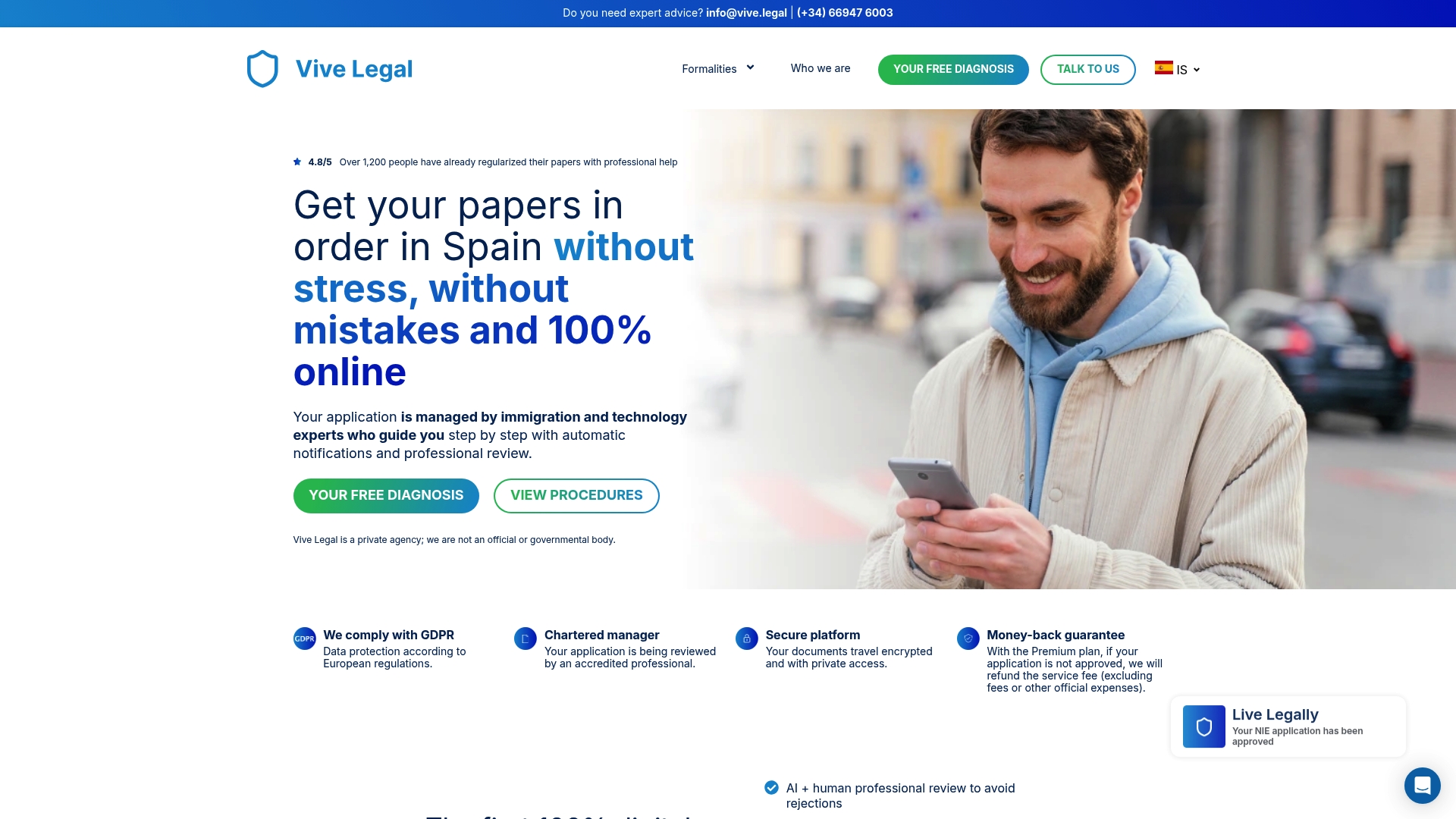
Vive Legal immigration management services combine artificial intelligence with human legal expertise to streamline your entire NIE application. The platform handles document review, form preparation, appointment scheduling, and submission tracking through a secure client portal. This approach minimizes errors that cause delays and increases approval chances by ensuring every requirement is met before submission. Beyond NIE registration, Vive Legal supports comprehensive residency procedures including TIE renewals, EU registration, and specialized pathways like the Extraordinary Regularization 2026 process. Professional NIE registration services deliver cases ready for submission within 24 hours, eliminating weeks of uncertainty and back-and-forth with immigration offices. The platform provides notifications at each stage, transparent pricing, and a satisfaction guarantee, positioning itself as a modern alternative to traditional legal consultancies for tech-savvy expatriates prioritizing efficiency and clarity.
FAQ
What is a NIE number and who needs it?
A NIE is a foreigner identification number assigned by Spanish authorities to anyone who is not a Spanish citizen but needs to conduct legal, financial, or economic activities in Spain. All expatriates, EU citizens establishing residency, foreign workers, students, property buyers, and business owners must obtain this number. It serves as your primary identifier for tax purposes, employment records, banking transactions, and government registrations. Learn more about NIE registration details and eligibility requirements.
Can I open a bank account in Spain without a NIE?
Most Spanish banks require a valid NIE number before opening any type of account for foreign residents. Some banks offer limited non-resident accounts for tourists or short-term visitors, but these come with restrictions on services and higher fees. For full banking access including mortgages, investment accounts, and standard checking services, you need a NIE. Attempting to bypass this requirement typically results in rejected applications or accounts with severe limitations that make daily financial management difficult. Review banking requirements in Spain for complete details.
How long does it take to get a NIE after applying?
Processing times vary significantly based on application location, time of year, and completeness of submitted documentation. Applications within Spain typically process within one to four weeks, though high-demand periods can extend this to six weeks. Consular applications from abroad may take longer due to additional verification steps and communication between consulates and Spanish immigration authorities. Incomplete applications or missing documentation add several weeks to processing times. Check current NIE application processing times and ensure all requirements are met before submission.
Is NIE registration valid indefinitely?
Your NIE number itself never expires and remains your permanent foreigner identification number in Spain. However, the physical certificate or card displaying your NIE may require renewal depending on your residency status. EU citizens with permanent NIE certificates typically don’t need renewals, while non-EU residents on TIE cards must renew their residency authorization periodically, which updates the physical card but keeps the same NIE number. Always update your registration when changing addresses or residency status to maintain accurate records. Explore NIE validity and renewals for specific situations and requirements.
Recommended
Living legally in Spain shouldn't be difficult.
View services and pricesNot sure which procedure you need? Find out in 2 min
Questions? Message us on WhatsApp