
Why online legal consultancy is better for immigration in Spain

TL;DR:
- Online legal consultancy offers faster, secure, and personalized support for Spanish immigration procedures.
- Some steps still require in-person attendance, but most documentation and application processes are manageable online.
- Verify provider credentials and transparency to ensure legal expertise and avoid potential application rejections.
Many people assume that getting legal help for Spanish immigration means sitting across from a lawyer in a stuffy office, shuffling through stacks of paper, and making multiple trips into the city. That assumption costs time, money, and often results in missed appointments or incorrectly filed forms. Online legal consultancy flips that model entirely, offering streamlined, secure, and personalized support for expatriates, foreign workers, international students, and EU citizens navigating Spain’s notoriously layered residency system. This article covers the real advantages, the honest limits, and the practical framework for choosing the right digital legal partner.
Living legally in Spain shouldn't be difficult.
View services and pricesNot sure which procedure you need? Find out in 2 min
Questions? Message us on WhatsApp
Table of Contents
- How online legal consultancy transforms Spanish immigration procedures
- Who actually benefits: Typical cases streamlined by online services
- Limits and safeguards: What stays in-person and why credentials matter
- How to choose the right online legal consultancy for your situation
- Expert perspective: The uncomfortable truth and what actually works
- How Vive Legal streamlines Spain’s immigration journey online
- Frequently asked questions
Key Takeaways
| Point | Details |
|---|---|
| Online consultancy saves time | Much of the Spanish immigration process can move faster and with less hassle when managed online. |
| Know in-person limits | Some official immigration steps still require a physical appointment for legal validity. |
| Verify consultant credentials | Choosing regulated, experienced providers avoids risky shortcuts and errors. |
| Tailored guidance is key | A top consultancy customizes steps by immigration route, client type, and required documentation. |
How online legal consultancy transforms Spanish immigration procedures
With the growing demand for remote solutions, let’s explore exactly how online legal consultancy changes the immigration landscape in Spain.
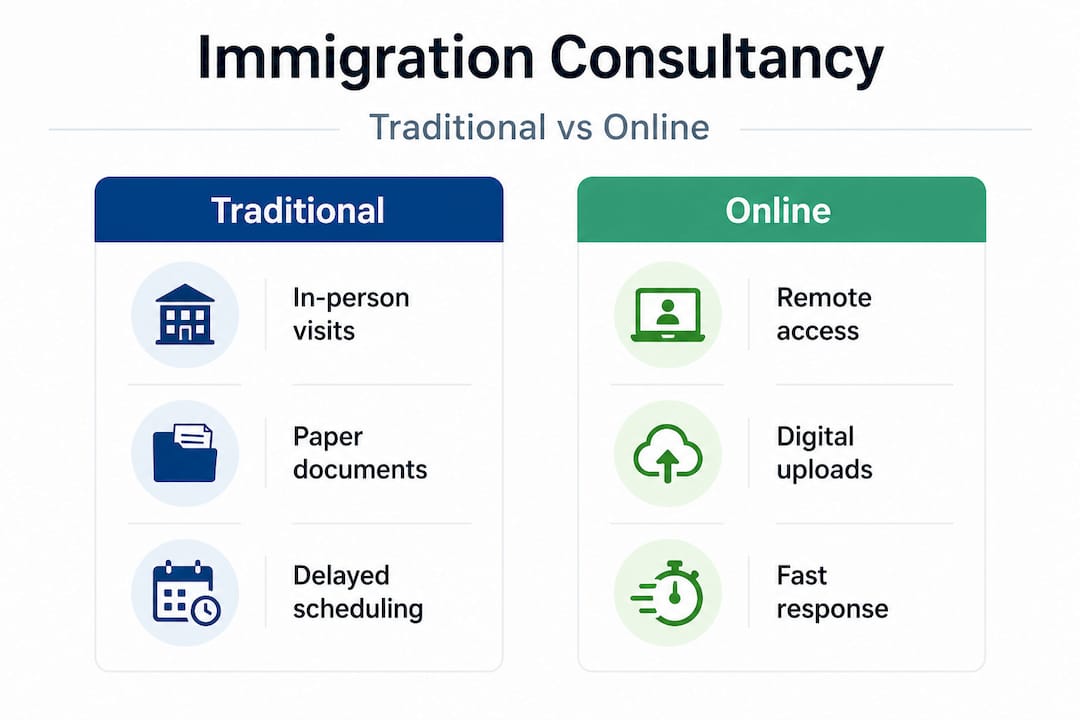
Traditional immigration legal support typically means scheduling appointments weeks in advance, commuting to a physical office, and waiting for callbacks. Online legal consultancy replaces that friction with secure portals, digital document uploads, automated status notifications, and video consultations. The core difference is not just speed. It is the ability to match each client to the exact procedural path their situation requires.
Spain’s immigration system is not one-size-fits-all. EU citizens and relatives use different appointment systems and face distinct documentation requirements compared to non-EU nationals. EU citizens typically need to register through the Registro Central de Extranjeros, while non-EU workers may require NIE numbers, TIE cards, and work authorizations through separate channels. An online consultancy that recognizes these distinctions can route each client through the right sequence from the first interaction.
Here is a simplified comparison of traditional versus online legal consultancy for Spanish immigration:
| Feature | Traditional gestoría | Online legal consultancy |
|---|---|---|
| Appointment scheduling | In-person, often weeks out | Digital booking within hours |
| Document handling | Physical copies required | Encrypted uploads and review |
| Case tracking | Phone or in-person updates | Secure portal with notifications |
| Pricing transparency | Fees often quoted verbally | Itemized, upfront pricing |
| Availability | Office hours only | 24/7 portal access |
| Error checking | Manual review | AI-assisted plus human oversight |
Different client groups also have very different priorities. International students often need to renew temporary residency tied to their enrollment status. EU citizens moving to Spain for work or retirement need to register correctly to access public services. Foreign workers may need to modify their work authorization when switching employers. Expatriates from outside the EU frequently face the most complex multi-step processes involving both consular and domestic procedures.
Key benefits of online consultancy that apply across all these groups include:
- Personalized eligibility checks completed digitally before any documents are submitted
- Guided form preparation that reduces the risk of rejections due to technical errors
- Appointment booking with authorities handled on your behalf
- Automated reminders so no deadlines are missed
- Real-time case tracking through a secure client portal
Pro Tip: When evaluating an online consultancy, check whether they offer a procedure matrix or diagnostic tool. A service that identifies your specific route based on your nationality, residency goal, and personal circumstances before charging anything demonstrates genuine expertise. You can also explore immigration guides for overviews of different procedural paths.
EU Registration in Spain is a good example of a procedure that benefits enormously from digital guidance because the documentation requirements vary significantly depending on whether you are employed, self-employed, or a student at the time of application.
Who actually benefits: Typical cases streamlined by online services
With online consultancies offering diverse tools, let’s break down which real-life cases benefit most and what’s actually possible fully online.
The range of immigration situations that online consultancies handle is broader than most people expect. International students and EU citizens each follow distinct procedural routes depending on their origin country and residency type, and the documentation needs for each group are genuinely different. Getting that right from the start is where digital guidance earns its value.

The following table illustrates how different client profiles map to online-compatible procedures:
| Client type | Common procedure | Estimated online completion rate |
|---|---|---|
| EU citizen registering in Spain | Registro Central de Extranjeros | 80% online |
| Non-EU student renewing residency | Renewal of student authorization | 75% online |
| Foreign worker changing employer | Work permit modification | 70% online |
| Non-EU national on Arraigo Social | Residency by social integration | 65% online |
| Expat applying for long-term residence | Larga Duración EU | 72% online |
These percentages reflect the proportion of the process that can be managed without physical presence. The remaining steps generally involve biometric data collection or official document collection, which must be done at a government office.
Tasks that online consultancies routinely manage on your behalf include:
- Reviewing all required documentation for completeness and accuracy
- Preparing and checking official application forms
- Booking appointments at the Oficina de Extranjería or police station
- Submitting applications electronically where Spanish regulations allow
- Monitoring case status and flagging issues early
- Advising on eligibility before a single euro is spent on fees
One common misconception is that online services only handle simple renewals. In practice, platforms that specialize in Spanish immigration regularly manage complex cases like Arraigo Social applications, which require demonstrating social integration through employment contracts, local ties, and a criminal record certificate. Another misconception is that digital consultancies are slower at booking government appointments. In fact, many automated systems can detect appointment availability far faster than a person manually refreshing a webpage.
For clients pursuing work-based residency through training or internships, internship residence guidance is available entirely online, including the eligibility review and document checklist, with only the final appointment requiring physical attendance.
Limits and safeguards: What stays in-person and why credentials matter
After seeing which cases are streamlined, it’s important to highlight the limits of online-only solutions and focus on client safety.
No online platform eliminates every in-person requirement. Some steps are legally mandated to happen physically, and a trustworthy online consultancy will be upfront about this rather than overpromising. For example, TIE applications require the applicant to appear in person at a police station for fingerprinting and biometric data collection. There is no workaround for this step, and any service claiming otherwise should raise immediate concern.
Steps that almost always require physical presence include:
- Biometric appointment at a police station for TIE card collection
- Submission of original documents when electronic certification is not accepted
- Oath or oath ceremony for certain nationality-related procedures
- Medical appointments linked to specific visa categories
- Final collection of physical residency cards or documents
Knowing this upfront allows you to plan travel, childcare, or work arrangements without surprises. A competent online consultancy does not hide these requirements. They integrate them into your case timeline so you can prepare.
“The quality of online legal services depends on lawyer credentials and process governance, not just tech convenience.”
This point cannot be overstated. Technology can organize your documents and book your appointments, but it cannot replace regulated legal judgment. A licensed lawyer reviewing your file can spot a missing apostille, an incorrect translation, or an eligibility issue that would cause an outright rejection. A tech platform without licensed lawyers behind it can only execute what it is programmed to check, and Spanish immigration law is too nuanced for algorithmic review alone.
When evaluating any provider’s TIE application guidance, look specifically at whether they clarify the in-person steps in advance. A platform that does not make this distinction clearly is either uninformed or deliberately vague.
The quality of online legal advice ultimately rests on whether the people providing it have actually practiced law and understand the regulations they are advising on.
Pro Tip: Before paying anything, ask any online consultancy for their colegio de abogados registration number or equivalent professional accreditation. In Spain, practicing lawyers must be registered with the local bar association. If they cannot provide this, walk away.
How to choose the right online legal consultancy for your situation
Once aware of the benefits and boundaries, readers need a clear process to find trustworthy online legal help.
Choosing an online immigration consultancy is a decision with real legal consequences. A poorly chosen provider can file incorrect forms, miss critical deadlines, or give you advice that leads to a rejection or even a fine. The following framework helps you evaluate options systematically.
Step-by-step evaluation process:
- Confirm lawyer credentials. Look for bar registration numbers, named legal professionals, and verifiable professional histories.
- Check for specialization in Spanish immigration. General legal platforms often lack the depth needed for complex residency procedures.
- Assess transparency of fees. Itemized pricing with no hidden charges is a baseline expectation, not a bonus.
- Review their case-type coverage. Do they handle your specific situation, whether that is long-term EU residence, student visa renewal, or Arraigo documentation?
- Test their diagnostic capability. A good platform should be able to route you correctly based on your nationality, residency type, and circumstances before you commit.
- Evaluate data security. Look for SSL encryption, GDPR compliance statements, and clear policies on how your documents are stored.
- Ask about in-person requirements upfront. A credible provider will immediately clarify which steps require your physical presence.
Warning signs that should make you look elsewhere:
- No physical address or legal entity disclosed on the website
- Fees are not published or are given only as verbal estimates
- No named lawyers or professional registration numbers are visible
- Promises that everything can be handled “100% online” with no exceptions
- No clear distinction between what they do and what the government authority requires
- Customer service that cannot answer basic procedural questions
Online legal support should offer tailor-made guidance for your specific group, whether you are an expat, student, or EU citizen, and clearly explain the relevant documentation and steps for your case. If the first interaction feels generic, that is usually a reliable signal of what the rest of the experience will look like.
Many reputable platforms offer a free initial assessment or diagnostic session. Use it. A good provider will use this session to identify your correct procedure, flag any potential issues, and outline the realistic timeline before asking for payment. If the free assessment is nothing more than a sales call, that tells you something important about how the platform operates.
Expert perspective: The uncomfortable truth and what actually works
The immigration tech space is full of platforms that lead with their interface and bury their legal expertise. This is exactly backwards. Sleek dashboards and instant notifications are nice features, but they are not the product. The product is the legal outcome: your application approved, your residency secured, your timeline respected.
Here is what most guides leave out. Many first-time users of online immigration services assume that “online” automatically means “faster” and “better.” Sometimes it does. But we have seen clients arrive at platforms that use automation to generate forms without a lawyer ever reviewing the final output. The form looks right. The portal confirms submission. Then the rejection letter arrives three months later because a supporting document was missing or a fee was underpaid.
The honest truth is that evaluating credentials and process controls matters more than the technology layer. An online consultancy with qualified lawyers who review every file before submission will consistently outperform a flashy app with no human oversight. The best digital platforms understand this and position technology as a support tool for lawyers, not a replacement.
What actually works is the combination: automated document checklists to catch obvious errors early, AI-assisted form preparation to reduce manual mistakes, and then a licensed lawyer doing a final review before anything is submitted. That combination delivers both speed and accuracy.
We also see a pattern with clients who have previously used low-cost or unregulated platforms. They often arrive needing remediation work because a previous application was filed incorrectly. Fixing a rejected application is almost always more expensive and time-consuming than getting it right the first time. Comparing digital gestorias in terms of their legal oversight model, not just their price, is a significantly smarter approach.
The best online consultancies are honest about what technology cannot do. They will tell you directly when a situation is genuinely complex, when additional legal judgment is needed, and when your case falls outside the standard process. That transparency is not a weakness. It is the clearest signal of professional integrity.
How Vive Legal streamlines Spain’s immigration journey online
Understanding the real mechanics of Spanish immigration procedures makes one thing clear: who you work with matters as much as the process itself.
Vive Legal is built on the principle that regulated legal expertise and digital efficiency are not competing values. The platform combines AI-assisted document review with oversight from licensed immigration lawyers, giving expatriates, EU citizens, foreign workers, and international students a process that is both fast and legally sound. From NIE and TIE applications to internship residence support and the Extraordinary Regularization 2026 program, Vive Legal manages the complexity so you can focus on building your life in Spain. Every case gets a personalized diagnostic, transparent pricing from the start, and real-time updates through a secure client portal. This is what responsible digital immigration support actually looks like.
Frequently asked questions
Can all Spanish immigration procedures be handled entirely online?
No, some steps like biometric appointments for the TIE card must be done in person, while much of the paperwork and preparation can be managed online through a qualified consultancy.
Is online legal consultancy safe for complex immigration cases?
It is safe when handled by properly credentialed and regulated lawyers. Always verify bar registration numbers and confirm that a licensed professional will review your file before any submission is made. The quality depends on credentials, not just the technology used.
Do EU citizens benefit from online legal consultancy in Spain?
Yes. EU citizens and relatives use the Extranjería appointment system with distinct documentation requirements, and digital guidance helps them navigate those formalities accurately from the start.
What should I look for when choosing an online immigration consultant in Spain?
Prioritize regulated lawyers with transparent credentials, a clear distinction between online and in-person process steps, and documented expertise in your specific case type. Platforms that cannot answer basic procedural questions or hide their legal team should be avoided, as credentials and process controls are the real indicators of service quality.
Recommended
Living legally in Spain shouldn't be difficult.
View services and pricesNot sure which procedure you need? Find out in 2 min
Questions? Message us on WhatsApp