
Padrón registration for residency in Spain: What you need
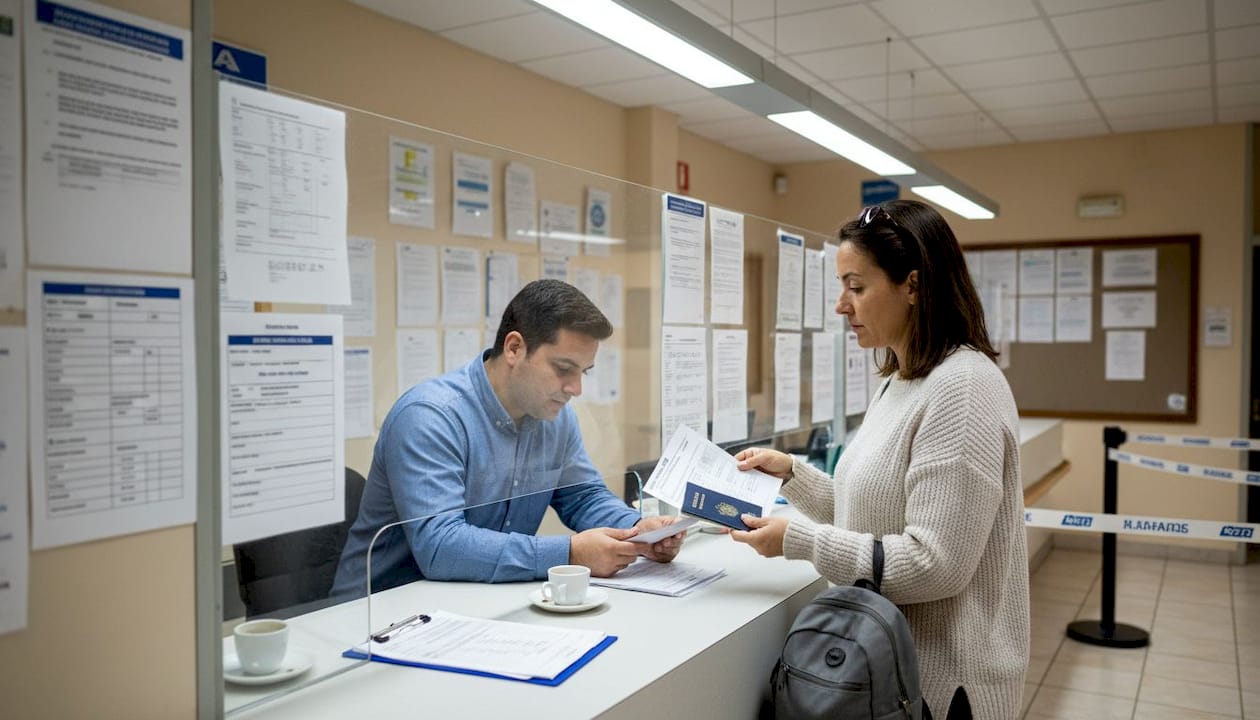
Many residency applications in Spain get denied not because of serious legal violations, but because of a single overlooked document: the padrón certificate. Many applications fail due to missing or poorly documented padrón registration, yet most people don’t realize this until it’s too late. The padrón, or empadronamiento, is Spain’s municipal population register, and it does far more than confirm your address. This guide walks you through what it is, why it matters, how to get it, and what to do when your situation changes.
Table of Contents
- What is padrón registration and who needs it?
- Why padrón registration matters for residency applications
- What the padrón does and does not do: Key facts
- How to register: The step-by-step empadronamiento process
- Renewal, updates, and edge cases: What if your situation changes?
- How Vive Legal can help streamline your residency process
- Frequently asked questions
Key Takeaways
| Point | Details |
|---|---|
| Mandatory proof of address | Padrón is legally required for anyone staying in Spain over 183 days. |
| Supports residency applications | A continuous padrón record is decisive for arraigo and citizenship. |
| Does not equal residency | The padrón does not grant legal status or work rights by itself. |
| Renewal prevents application issues | Keep your padrón updated to avoid gaps that may hurt future applications. |
| Process is accessible for all | Even undocumented individuals can register as long as they reside in Spain. |
What is padrón registration and who needs it?
The empadronamiento is Spain’s official system for registering residents at a local address within a specific municipality. Every town hall, or Ayuntamiento, maintains its own register. When you register, you receive a certificado de empadronamiento, a document that proves you live at a specific address in Spain.
Living legally in Spain shouldn't be difficult.
View services and pricesNot sure which procedure you need? Find out in 2 min
Questions? Message us on WhatsApp
This certificate is not just a formality. It is the administrative backbone of your life in Spain, from enrolling children in school to accessing public healthcare, and most importantly, supporting your immigration applications. Think of it as your proof of physical presence, the document that tells Spanish authorities: “I am here, I live here, and I have been here.”
Padrón registration is mandatory for anyone living in Spain more than 183 days per year. But here’s the part most people miss: you don’t need to already have legal residency or a NIE (Número de Identificación de Extranjero) to register. Even undocumented individuals can and should register.
Who needs to register on the padrón?
- EU citizens planning to apply for EU registration (the green certificate)
- Non-EU nationals pursuing any type of residency permit
- Workers, students, and family members staying longer than six months
- Undocumented individuals who want to begin building a legal presence record
- Anyone who wants access to local public services
“The padrón is not just paperwork. It is your legal footprint in Spain, and building that footprint from day one is the single most important thing you can do for your future immigration case.”
For more context on how this fits into broader immigration procedures, our immigration guides cover each permit type in detail. You can also review the official padrón guide for a general overview of the registration process.
Why padrón registration matters for residency applications
Now that you know who must register, it’s critical to understand why the padrón plays such a fundamental role in legal procedures. The padrón is not just useful; for many permit types, it is legally required.

Spain’s immigration system includes several regularization routes that depend entirely on how long you have lived in the country. The arraigo social permit, for example, requires proof of three years of continuous residence. The padrón is the primary document used to prove that. Without a consistent, uninterrupted padrón history, your application can be rejected outright.
Why the historical record matters so much:
- Arraigo social and arraigo laboral require a Certificado Histórico de Empadronamiento, which shows every address you’ve been registered at and for how long.
- EU long-term residence requires five years of legal, continuous residence, and the padrón supports that proof.
- Spanish citizenship applications require ten years of legal residence (or fewer for some nationalities), and the padrón history is reviewed closely.
- Authorities look for consistency. Gaps between registration periods, or addresses that don’t match other documents, raise red flags.
- Late registration cannot be backdated. If you arrived in 2023 and only registered in 2025, those two years are simply gone from your record.
As immigration experts note, start immediately upon arrival to build a historical record that will hold up under scrutiny. Waiting even a few months can create gaps that are very difficult to explain to immigration authorities. You can also review the residency process overview for more context on how arraigo permits work in practice.
Key stat: For arraigo social, you need 3 uninterrupted years of proven residence. A single gap in your padrón history can reset that clock.
What the padrón does and does not do: Key facts
After highlighting its power, it’s essential to be clear about what the padrón can’t do, and why that matters. Misunderstanding this point leads to serious legal mistakes.
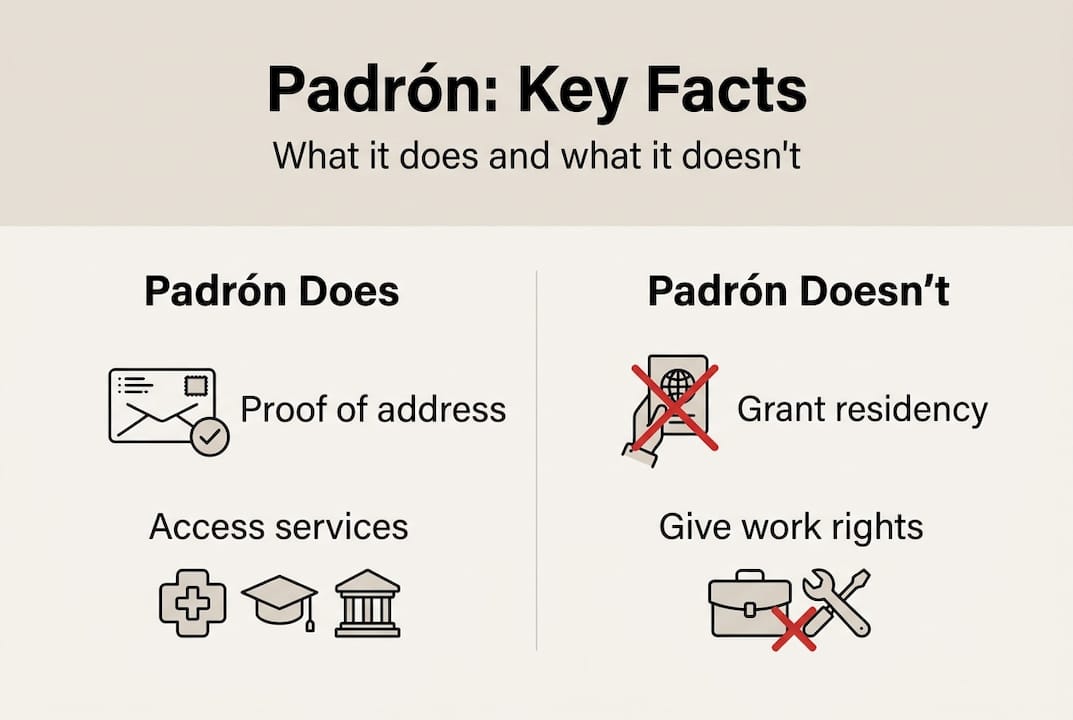
Here’s a clear breakdown:
| What the padrón does | What the padrón does NOT do |
|---|---|
| Proves your address and physical presence | Grant legal residency status |
| Enables access to public healthcare and schools | Authorize you to work in Spain |
| Supports residency and regularization applications | Replace a visa, NIE, or TIE |
| Counts toward required years of residence | Automatically regularize your immigration status |
| Available to undocumented individuals | Protect you from deportation on its own |
The padrón is an administrative tool, not a legal status. It does not grant legal residency, work rights, or substitute proper immigration status. It is available to all, regardless of documentation. This is actually a feature, not a flaw. It means that even if you entered Spain without authorization, you can still begin building a documented presence that may eventually support a regularization application.
One important nuance: having a padrón certificate does not mean immigration authorities will view your stay as legal. It simply means they can see you were physically present. That distinction matters enormously when you’re applying for residency rights that require legal continuous residence.
Pro Tip: Always keep a physical and digital copy of every padrón certificate you receive. Each one is dated, and together they form a timeline of your presence in Spain. Losing them can complicate your application significantly. The empadronamiento guide has useful advice on organizing your documents.
How to register: The step-by-step empadronamiento process
Once you understand the limitations and value, the next step is actually registering. The process is simpler than most people expect, but the details matter.
Step-by-step registration process:
- Gather your documents. You’ll need a valid passport or national ID, proof of your address in Spain (rental contract, utility bill, or a letter from the property owner), and your NIE if you have one. A NIE is not required to register.
- Find your local Ayuntamiento. Every municipality has its own process. Some allow online registration; most require an in-person visit.
- Book an appointment. Many cities like Madrid and Barcelona use online appointment systems. Smaller towns may accept walk-ins.
- Submit your form. Fill out the hoja de empadronamiento (registration form) at the office. Staff will review your documents.
- Receive your certificate. The process is free, often completed the same day, and you’ll receive your certificate immediately or within a few days.
| Document | Required? | Notes |
|---|---|---|
| Passport or national ID | Yes | Must be valid |
| NIE | No | Helpful but not mandatory |
| Rental contract | Preferred | Most common proof of address |
| Owner’s authorization letter | Alternative | If no contract exists |
| Utility bill | Alternative | In your name or owner’s |
Certificates are typically valid for 3 months from the date of issue. If your application takes longer, you may need to request a fresh certificate. Always check the specific requirements for your permit type, as some procedures like the nationality application have strict document freshness rules.
Pro Tip: If you’re renting a room and your name isn’t on the lease, ask your landlord for a signed authorization letter (autorización del propietario). Most Ayuntamientos accept this. Check the document list for padrón for your municipality’s specific requirements.
Renewal, updates, and edge cases: What if your situation changes?
After you’re registered, ongoing compliance is key. Here’s what to do as your situation evolves.
The padrón is not a one-time task. It requires active management, especially if your living situation changes or if you’re a non-EU national.
Key renewal and update rules:
- Non-EU citizens without permanent residency must renew every 2 years or risk being removed from the register entirely.
- If you move, you must update your padrón at your new Ayuntamiento. Your old registration does not transfer automatically.
- If you move in with friends or family, ask them to sign an authorization form so you can register at their address. You do not need to be on the lease.
- If you have no fixed address, some municipalities allow registration at a social services address or a shelter. This is rare but possible; check with your local padrón for edge cases resources.
- Van life or frequent moves are tricky. You should register at the address where you spend the most time, even if it’s a friend’s home.
Why does this matter so much? Because even a small gap in your registration history can jeopardize a future application. For permits like the arraigo formativo process, authorities will look at your full residential history and any unexplained gaps will require documentation to explain.
Pro Tip: Set a calendar reminder 6 weeks before your 2-year renewal deadline. This gives you time to book an appointment, gather documents, and handle any delays without creating a gap in your record.
How Vive Legal can help streamline your residency process
You now have a solid understanding of the padrón and why it matters. But knowing the rules and executing them perfectly are two different things. One missed renewal, one wrong document, or one misunderstood requirement can set your residency timeline back by years.
At Vive Legal, we specialize in exactly this kind of detail-oriented immigration support. Our platform combines legal expertise with smart automation to review your documentation, flag potential issues before they become problems, and guide you through every step of your residency process. Whether you’re preparing for arraigo social residency, exploring the extraordinary regularization process, or simply trying to make sure your padrón history is airtight, our team is ready to help. We handle the complexity so you can focus on building your life in Spain.
Frequently asked questions
What happens if I skip padrón registration?
Missing or outdated padrón registration can result in your residency or regularization application being denied. Gaps in the padrón weaken your proof of residence, which is often a legal requirement for permit approval.
Do I need a NIE to register on the padrón in Spain?
You can register on the padrón without a NIE; proof of address and a valid ID is usually sufficient. No NIE is needed initially, making early registration accessible to everyone regardless of immigration status.
How often must I renew my padrón registration?
Non-EU citizens without permanent residency must renew every 2 years or risk removal from the municipal register, which creates gaps that can harm future applications.
Does the padrón give me residency rights?
No. The padrón is proof of address, not legal residency or work authorization. It is administrative only and does not substitute for a valid visa, NIE, or residency permit.
Recommended
Living legally in Spain shouldn't be difficult.
View services and pricesNot sure which procedure you need? Find out in 2 min
Questions? Message us on WhatsApp