
Why Register as an EU Citizen in Spain

More than 80 percent of European citizens living in Spain report smoother access to healthcare and financial services after completing their registration. If you are an American, French, or Italian settling in Spain, the registration process secures not only your legal residency but also opens the door to crucial public benefits. Whether you are starting a job, enrolling your children in school, or planning long-term roots, understanding registration is key to a confident and stable life in Spain.
Table of Contents
- EU Citizen Registration: Definition And Purpose
- Legal Framework And Eligibility Criteria
- Registration Process Step By Step
- Rights And Access To Services Secured
- Consequences Of Not Registering In Spain
Key Takeaways
| Point | Details |
|---|---|
| EU Registration Essential | EU citizens must register within three months of arrival in Spain to obtain legal residency and access essential services. |
| Documentation Requirements | Applicants need to present proof of identity, financial resources, health insurance, and an address to complete the registration process. |
| Rights Upon Registration | Registration grants rights to work, healthcare, and education, equating EU citizens with Spanish nationals in most areas. |
| Consequences of Non-Registration | Failing to register can lead to restricted access to services and complicate future residency applications in Spain. |
EU Citizen Registration: Definition and Purpose
EU citizen registration in Spain is an official administrative process designed to formalize your legal residence and establish your rights as a European Union national living within Spanish territory. The registration process involves documenting your presence and intent to reside in Spain for more than three months, which transforms your status from a temporary visitor to a legal resident with specific entitlements.
Living legally in Spain shouldn't be difficult.
View services and pricesNot sure which procedure you need? Find out in 2 min
Questions? Message us on WhatsApp
The core purpose of registration is to provide EU citizens with a formal recognition of their right to live and potentially work in Spain. When you register with the local authorities, you receive an official certificate that validates your residential status. This document is crucial because it grants access to essential services like healthcare, social security, education, and other administrative benefits that are typically reserved for legal residents.
To complete registration, EU citizens must apply at the local Non-nationals Office or police station within three months of arriving in Spain. The process requires presenting documentation proving your identity, demonstrating sufficient financial resources, and providing proof of health insurance. The resulting EU Registration Certificate serves as an official recognition of your legal right to reside in the country, outlining your personal details including name, nationality, address, and a unique identification number.
Here’s a summary of key requirements and documents for EU citizen registration in Spain:
| Requirement | Example Proof | Why It’s Needed |
|---|---|---|
| Proof of identity | Passport or national ID card | Verify applicant’s nationality |
| Financial resources | Bank statements, job contract | Ensure self-sufficiency |
| Health insurance | Private policy, S1, or EHIC | Assure healthcare coverage |
| Address in Spain | Rental agreement or utility bill | Establish place of residence |
| Proof of purpose (if needed) | Student confirmation, work contract | Confirm reason for staying |
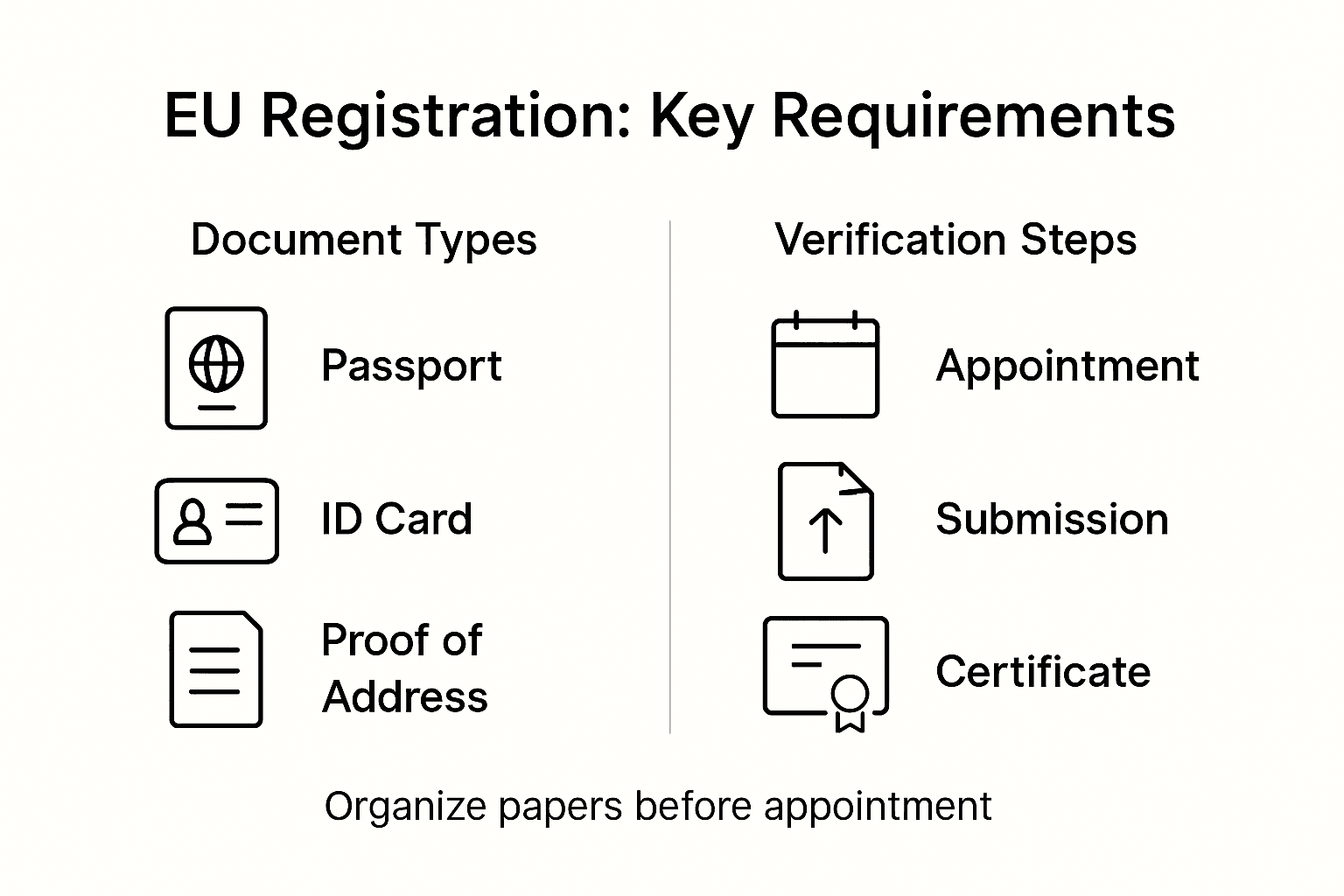
Pro tip: Gather all necessary documentation before your registration appointment to streamline the process and avoid potential delays in obtaining your residency certificate.
Legal Framework and Eligibility Criteria
The legal landscape for EU citizen registration in Spain is comprehensively defined by a robust set of regulations, including Royal Decree 240/2007 and Organic Law 4/2000, which establish the comprehensive guidelines for European Union nationals seeking residency. These legal frameworks are further supported by the European Union Directive 2004/38/EC, creating a clear and structured pathway for citizens from EU member states to establish legal residence in Spain.
To be eligible for registration, EU citizens must meet specific criteria that demonstrate their ability to contribute to and integrate into Spanish society. These requirements typically include being employed or self-employed, having sufficient financial resources, maintaining valid health insurance, or being enrolled as a student. The documentation must prove that the individual has the means to support themselves without becoming a burden on the Spanish social welfare system. Importantly, the registration process is mandatory for any EU citizen planning to stay in Spain for more than three months.
The registration process offers a tiered approach to residency rights. Initially, EU citizens receive a temporary registration certificate, which can transition to permanent residence status after five consecutive years of legal residence. This progression reflects the legal system’s approach of granting residency rights incrementally, based on sustained integration and contribution to the local community. The EU Registration Certificate serves as crucial documentation, providing legal recognition and access to essential services such as healthcare, education, and social security.
Pro tip: Consult with a local immigration specialist to ensure your specific documentation meets all current legal requirements, as immigration regulations can change frequently.
Registration Process Step by Step
EU citizens planning to register in Spain must navigate a structured administrative process that requires careful preparation and attention to detail. The initial step involves gathering all necessary documentation based on your specific residency status, which varies depending on whether you are a worker, student, self-employed professional, or financially independent individual. Essential documents typically include a valid passport, proof of employment or studies, comprehensive health insurance documentation, and evidence of sufficient financial resources to support yourself during your stay.
The registration procedure requires in-person application at the local immigration office or police station within three months of arriving in Spain. Applicants must schedule an appointment and arrive with a complete set of original documents and their copies. The process involves submitting a formal application, paying the required administrative fees, and undergoing a brief verification of your documentation. Foreigners Office Officials will carefully review your paperwork to ensure compliance with Spanish and European Union residency regulations.
Upon successful verification, you will receive your EU Registration Certificate immediately. This crucial document serves multiple purposes: it provides legal recognition of your residency, includes a unique identification number (NIE), and grants access to essential public services. The certificate is typically valid for five years, with the potential to transition to permanent residency status after continuous legal residence. Different requirements apply based on your specific situation, such as employment status, financial means, and duration of intended stay.
Pro tip: Make digital and physical copies of all your documents before your appointment, and organize them in a clear, chronological order to expedite the registration process and minimize potential administrative delays.
Rights and Access to Services Secured
Registering as an EU citizen in Spain unlocks a comprehensive set of legal rights and privileges that extend far beyond simple residency status. The EU registration certificate provides a critical gateway to accessing essential public services and social benefits, transforming your stay from a temporary arrangement to a fully integrated living experience. The NIE number obtained through registration becomes your key to navigating Spanish administrative systems, enabling everything from opening bank accounts to accessing healthcare and educational institutions.

The registration process secures fundamental rights that protect EU citizens in Spain, including the right to work, study, and receive social services on par with Spanish nationals. This includes comprehensive healthcare coverage through the national health system, the ability to enroll children in local schools, access to social security benefits, and legal protections against discrimination. Moreover, the certificate facilitates freedom of movement, allowing you to travel within Spain and other European Union countries with significantly reduced bureaucratic obstacles.
Beyond basic services, the EU registration certificate provides significant economic and professional advantages. It grants you the right to seek employment, establish a business, pursue further education, and enjoy the same treatment as Spanish citizens in most administrative and social contexts. The document serves as proof of legal residency, which is crucial for long-term financial planning, such as applying for mortgages, accessing pension systems, and establishing permanent residency status after five consecutive years of legal residence.
Pro tip: Request a comprehensive list of services associated with your NIE number during registration, as different regions in Spain might offer additional local benefits not universally advertised.
Consequences of Not Registering in Spain
Failing to register as an EU citizen within the mandated three-month period can trigger a cascade of complex legal and administrative challenges that significantly impact your ability to establish a stable life in Spain. The potential consequences extend far beyond simple administrative inconvenience, potentially undermining your entire residency strategy and creating long-term barriers to integration.
The most immediate and practical risks involve restricted access to essential services. Without official registration, EU citizens may encounter significant obstacles in accessing public healthcare, opening bank accounts, signing rental agreements, and securing employment. The NIE number obtained through registration is crucial for virtually every administrative process in Spain, and its absence can leave you in a bureaucratic limbo that makes everyday transactions extraordinarily challenging. Moreover, employers and financial institutions are legally required to verify residency status, meaning unregistered individuals may find themselves systematically excluded from standard economic opportunities.
Perhaps most critically, non-registration can severely compromise your future immigration status and path to permanent residency. While immediate expulsion is unlikely, the lack of an official registration certificate creates substantial legal uncertainty. This can directly impact your ability to apply for permanent residency after five years, potentially disrupting long-term plans for establishing roots in Spain. Future immigration applications may be scrutinized more heavily, and the burden of proving continuous legal residence becomes significantly more complicated when you lack official documentation from the initial registration period.
This comparison highlights the outcomes of registering versus not registering as an EU citizen in Spain:
| Area | If Registered | If Not Registered |
|---|---|---|
| Access to healthcare | Immediate, full coverage | Restricted, often unavailable |
| Ability to work | Legal, seamless employment | Difficult, often blocked |
| Financial services | Can open bank accounts | Denied most banking options |
| Residency progression | Eligible for permanent status | Limited, uncertain pathway |
| Legal security | Full protection under Spanish law | Vulnerable to legal issues |
Pro tip: Set a personal deadline two weeks before the official three-month registration window closes to ensure you have ample time to gather all necessary documentation and schedule your appointment.
Simplify Your EU Citizen Registration in Spain with Expert Legal Support
Navigating the complex requirements of EU citizen registration in Spain can be overwhelming. From gathering the right documents like proof of financial resources and health insurance to securing your EU Registration Certificate and NIE number on time, many face risks such as losing access to healthcare, employment, and permanent residency eligibility. You do not have to face these challenges alone. Vive Legal offers a streamlined, fully online solution tailored to your residency needs that combines artificial intelligence with expert legal oversight to minimize errors and speed up your application.
Take control of your residency process today by choosing Vive Legal. Benefit from personalized document reviews, appointment scheduling, and continuous case tracking through our secure client portal—all designed to ensure your registration as an EU citizen in Spain is smooth and compliant. Don’t wait until the three-month deadline is near or risk missing out on essential social and legal rights. Visit Vive Legal now and make your EU registration experience efficient, supported, and worry-free.
Frequently Asked Questions
What is the purpose of registering as an EU citizen in Spain?
Registering as an EU citizen in Spain formalizes your legal residence and grants you specific rights such as access to healthcare, social security, and education. It transforms your status from a temporary visitor to a recognized legal resident.
What documents are required for EU citizen registration in Spain?
You need to provide proof of identity (passport or national ID), evidence of financial resources (bank statements or job contracts), proof of health insurance, and confirmation of your address in Spain (such as a rental agreement).
What are the consequences of not registering as an EU citizen in Spain?
Failing to register can restrict access to essential services like healthcare and employment, complicate financial transactions, and jeopardize your path to permanent residency, creating legal uncertainties regarding your status.
How long does the EU registration process take in Spain?
The registration process is typically completed in a single appointment at the local immigration office, where you submit your application and required documents. Upon successful verification, you receive your EU Registration Certificate immediately.
Recommended
Living legally in Spain shouldn't be difficult.
View services and pricesNot sure which procedure you need? Find out in 2 min
Questions? Message us on WhatsApp