
How to renew a child's residency card in Spain: 2026 guide
TL;DR:
- Renewing a child’s residency card involves distinct procedures based on the card type and requires careful document preparation.
- Early planning and precise document gathering help avoid delays, fines, or rejection of the renewal application.
- Using expert assistance can streamline the process and reduce errors, especially for complex or time-sensitive cases.
Renewing your child’s residency card in Spain is one of those tasks that sounds straightforward until you’re staring at a stack of Spanish forms, a confusing government portal, and a deadline that’s closer than you’d like. The rules shift, regional offices have their own quirks, and one missing document can send you back to square one. This guide cuts through the confusion. You’ll find a clear breakdown of card types, a full document checklist, a step-by-step walkthrough of the renewal process, and the most common mistakes parents make, so you can handle this with confidence instead of dread.
Living legally in Spain shouldn't be difficult.
View services and pricesNot sure which procedure you need? Find out in 2 min
Questions? Message us on WhatsApp
Table of Contents
- Understanding child residency cards in Spain
- What you need: Documents and requirements
- Step-by-step renewal: How to renew your child’s card
- Common pitfalls and troubleshooting tips
- After renewal: What to expect and how to verify status
- Expert perspective: Realities and lessons from the renewal process
- Get expert help with child residency renewals
- Frequently asked questions
Key Takeaways
| Point | Details |
|---|---|
| Start renewal early | Initiate your child’s residency card renewal at least 60 days before expiration to avoid fines and delays. |
| Gather correct documents | Double-check all required forms, recent padrón, school proof, and appointment confirmation before your visit. |
| Attend biometrics together | A parent or guardian must go with the child to the police station for the fingerprinting step. |
| Watch regional timelines | Expect processing to take from 20 to 120 days depending on where you live in Spain. |
| Resguardo is your proof | The resguardo serves as valid proof of your child’s legal residency while waiting for the new card. |
Understanding child residency cards in Spain
Before you can renew anything, you need to know exactly which card your child holds. Spain issues two main types of residency cards for minors, and mixing them up is a surprisingly common mistake.
The TIE (Tarjeta de Identidad de Extranjero) is the card for non-EU children living in Spain. It’s a biometric card that proves legal residency status and must be renewed periodically. The second type is the Tarjeta de Residencia de Familiar de Ciudadano de la UE, which is for children of EU citizens who are exercising their right to free movement in Spain. As Spain’s official guidance confirms, these are distinct documents with different requirements and renewal timelines.
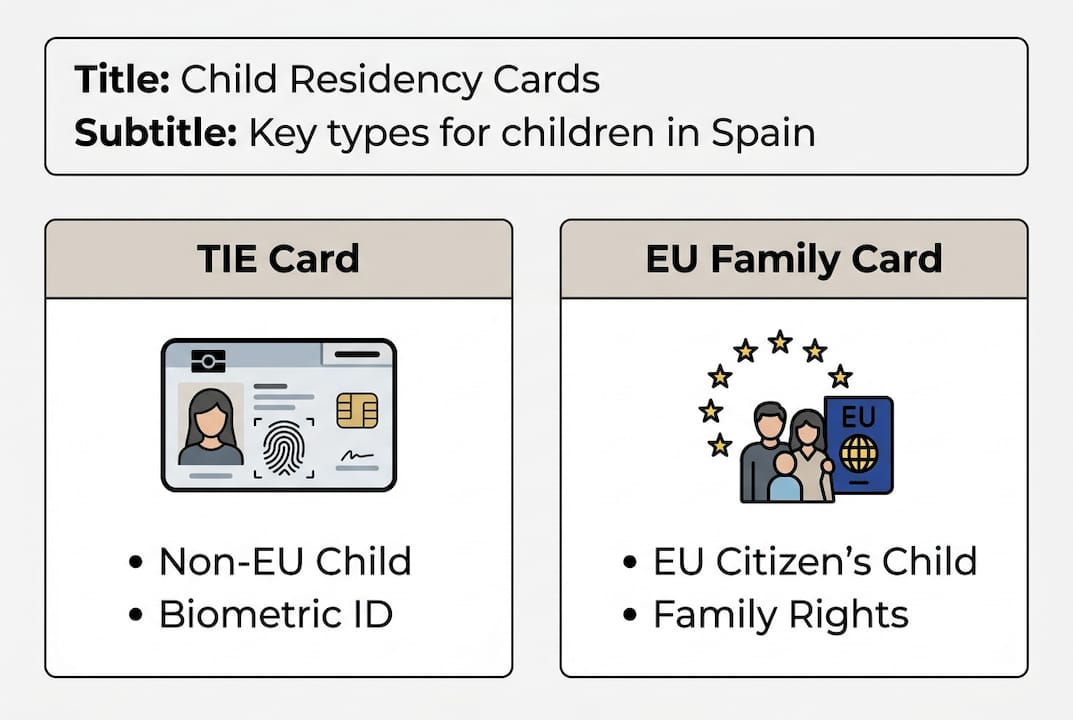
Here’s a quick comparison of the two main card types:
| Feature | TIE (non-EU children) | EU Family Card |
|---|---|---|
| Who it’s for | Non-EU minors | Children of EU citizens |
| Validity | 1, 2, or 5 years | 5 years |
| Renewal trigger | Expiry or change in status | Expiry or change in status |
| Governing form | EX-17 | EX-19 |
| Biometrics required | Yes | Yes |
For children under 14, the TIE is typically valid for two years. For those 14 and older, it may be issued for five years. The EU Family Card is generally valid for five years regardless of age. Renewal must be requested within 60 days before expiry and no later than 90 days after expiry, though acting early is always the safer choice.
Several rules apply specifically to children:
- A parent or legal guardian must accompany the child to all appointments.
- The child must be registered on the padrón municipal (local census register).
- School enrollment proof is required to demonstrate the child’s integration and presence in Spain.
- Changes in family status (divorce, new custody arrangements) can affect the card type and must be declared.
If your child is an EU citizen’s dependent, the EU registration process and the specific EU Family Card details differ meaningfully from the TIE route, so it’s worth understanding which path applies before gathering a single document.
With the groundwork established, let’s look at exactly what you’ll need before starting the renewal.
What you need: Documents and requirements
Gathering the right documents before your appointment is the single most important thing you can do. A missing or outdated paper is the number one reason renewals get delayed or rejected.
According to the full document checklist, here’s what parents typically need:
- Completed application form: EX-17 for TIE renewals, EX-19 for EU Family Card renewals
- Child’s valid passport (original and photocopy of all pages)
- Current or expired TIE (original and photocopy)
- Padrón certificate (certificado de empadronamiento), issued within the last 3 months
- Proof of school enrollment (certificado de escolarización)
- Proof of family ties: birth certificate, family book (libro de familia), or custody documents
- Recent passport-sized photos (usually 2, in color, white background)
- Fee payment receipt (Modelo 790 Código 012, paid at a bank or online)
- Parent’s valid ID or passport (original and photocopy)
As the application guide confirms, the core documents are forms EX-17 or EX-19, the child’s passport, TIE, padrón, proof of school enrollment, proof of family ties, and the fee receipt. The explanation of required documents for long-term residency situations can also be a helpful reference if your child’s case involves extended stays.
Here’s how the requirements differ between the two card types:
| Document | TIE renewal | EU Family Card renewal |
|---|---|---|
| Form EX-17 | Required | Not applicable |
| Form EX-19 | Not applicable | Required |
| EU citizen parent’s ID | Not required | Required |
| Proof of EU parent’s activity | Not required | Required (work, study, etc.) |
| Padrón certificate | Required | Required |
| School enrollment proof | Required | Required |
Both the parent and the child must attend the appointment. Children under 12 may not need to provide fingerprints, but they still need to be present.
Pro Tip: Check every document’s issue date before your appointment. The padrón certificate and any official certificates must be dated within the last 3 months. A certificate issued 4 months ago will be rejected on the spot, and you’ll need to rebook.
Once your documents are ready, you’re set for the main renewal process.
Step-by-step renewal: How to renew your child’s card
The renewal process has several distinct stages. Follow them in order and you’ll avoid the most common sources of delay.
- Complete the application form. Download and fill out EX-17 (TIE) or EX-19 (EU Family Card) from the Spanish government’s website. Double-check every field, especially the NIE number and personal data.
- Pay the fee. Use the Modelo 790 Código 012 form to calculate and pay the fee at a bank branch or via online banking. Keep the stamped receipt. The fee is typically around €16 for a TIE renewal.
- Book your appointment (cita previa). Use the Mercurio online system or the Sede Electrónica to book a slot at your local Oficina de Extranjería or National Police station. Appointments can fill up weeks in advance, so book early.
- Attend the appointment with your child. Both the parent and the child must be present. Bring all original documents plus photocopies. The officer will check everything and take the child’s biometric data (fingerprints and photo).
- Receive the resguardo. After the appointment, you’ll receive a resguardo (provisional receipt). This document proves the renewal is in progress and acts as a temporary residency proof while you wait.
- Collect the new card. When the card is ready, you’ll receive a notification (by SMS or via the system). Return to the same office to collect it, bringing the resguardo and the parent’s ID.
“The renewal process involves applying online or in person, paying the fee, booking a biometric appointment, attending with the child and documents, receiving the resguardo, and then collecting the card.” Source
Pro Tip: If cita previa slots are unavailable in your city, check neighboring towns or provinces. Many families successfully book appointments in nearby locations and travel for the day. It’s inconvenient, but far better than missing a deadline.
For ongoing processing advice and updates on wait times by region, it’s worth checking regularly, especially if your renewal is time-sensitive.
Even with a well-followed process, parents often trip up on common mistakes or encounter surprises. Here’s how to avoid them.
Common pitfalls and troubleshooting tips
Most delays and complications in child residency card renewals are avoidable. The problems tend to cluster around the same handful of issues.
The most frequent mistakes parents make:
- Submitting the renewal too late (after the 90-day post-expiry window)
- Using outdated documents, especially a padrón older than 3 months
- Not bringing the child to the biometric appointment
- Selecting the wrong application form (EX-17 vs. EX-19)
- Forgetting to bring originals alongside photocopies
- Paying the fee with the wrong Modelo code
Expired TIEs over 90 days can result in a fine of up to €500, and if your child has spent more than 6 months outside Spain in a given year, the residency status itself may be at risk. These are not minor administrative issues. They can affect your child’s right to remain in Spain.
“An expired TIE held for over 90 days may lead to a fine of up to €500, and absences exceeding 6 months per year can put residency validity at risk.”
Regional variation is a real factor. Processing offices in Madrid, Barcelona, and other major cities tend to be more backlogged than those in smaller provinces. Some regions require additional documents not listed on national guidance. Always confirm requirements directly with your local Oficina de Extranjería before your appointment.
If you lose your resguardo, contact the office immediately and request a duplicate. If your wait time stretches beyond the regional average, you can submit a formal written inquiry (escrito de solicitud de información) to the office. This often prompts a status update faster than simply waiting.
For EU Family Card renewals, the pitfalls are slightly different. The EU parent must demonstrate they are still actively exercising treaty rights (working, studying, or self-sufficient), and any gap in this proof can trigger a review. Check the UK TIE rules if you’re a British family navigating post-Brexit residency.
Knowing how to avoid pitfalls, you can expect a smoother post-submission period. Let’s look at what comes next.
After renewal: What to expect and how to verify status
Once you’ve submitted the application and received your resguardo, the waiting begins. Understanding what’s normal, and what isn’t, will save you unnecessary anxiety.
Processing times range from 20 to 120 days depending on the region. Here’s a regional snapshot:
| Region | Typical processing time |
|---|---|
| Madrid | 90 to 120 days |
| Catalonia | 60 to 90 days |
| Andalusia | 45 to 60 days |
| Valencia | 50 to 70 days |
| Smaller provinces | 20 to 45 days |
The resguardo is valid for the duration of the processing period and serves as legal proof that your child’s residency is being renewed. It can be used at border crossings within the Schengen Area, though always carry the expired card alongside it for clarity.
To check the status of your renewal, use the official Sede Electrónica portal with your NIE and the reference number from your resguardo. Updates are not always instant, but checking every two weeks is reasonable.
When the card is ready, you’ll typically receive an SMS or email notification. You have a limited window (usually 30 days) to collect it before it’s returned to the office. If there’s an error on the new card (wrong name spelling, incorrect date), report it immediately and request a correction in writing. Do not accept a card with errors, as correcting it later is a longer process.
For updates on processing periods and regional news, staying informed through reliable sources helps you plan pickup timing and avoid surprises. The official renewal timelines from the UK government are also a useful reference for British families specifically.
With the entire process covered, here’s a seasoned perspective on what truly matters when renewing a child’s residency card in Spain.
Expert perspective: Realities and lessons from the renewal process
At Vive Legal, we’ve seen hundreds of child residency renewals, and the pattern is consistent. The families who struggle are rarely the ones with complicated cases. They’re the ones who treated the renewal as routine paperwork rather than a legal deadline with real consequences.
Spanish immigration law does not offer much grace for late submissions. A missed deadline is a fine. A missed appointment is a rebooked wait. And a child without valid documentation can face complications at school registration, travel, or during any routine identity check.
The families who sail through renewals share one habit: they start 90 days early. They research their specific region’s requirements, not just the national guidelines. They set calendar reminders 6 months before expiry. And when something looks unclear, they call the local extranjería office directly rather than waiting for a problem to surface.
One often-overlooked trap is the padrón. Some municipalities require in-person renewal of the padrón certificate, and if your address has changed and you haven’t updated it, your certificate will be invalid. This single issue delays more renewals than almost anything else. Treat your real-world legal experience as a resource, not a last resort.
Get expert help with child residency renewals
Navigating Spain’s residency renewal system for your child doesn’t have to be something you figure out alone. Vive Legal’s immigration specialists handle the paperwork, prepare your documents, manage appointment scheduling, and communicate with authorities on your behalf.
Whether your child needs professional TIE renewal assistance or you’re managing an expert EU Family Card help situation, the platform covers both routes with tailored support. For families dealing with complex circumstances, address changes, or tight deadlines, full immigration management through Vive Legal means fewer errors, faster processing, and real peace of mind. Let the experts handle the bureaucracy while you focus on your family.
Frequently asked questions
How long does it take to renew a child’s residency card in Spain?
The renewal takes between 20 and 120 days depending on your region. Madrid can take up to 120 days, while Andalusia typically processes renewals in 45 to 60 days.
What happens if my child’s residency card expires before we renew?
If the card has been expired for over 90 days, you may face a fine up to €500, and residency validity can be at risk if your child has spent more than 6 months outside Spain in a single year.
What documents are required for child residency card renewal?
Essential documents include the correct application form, child’s passport, current or expired TIE, padrón certificate, proof of school enrollment, proof of family ties, recent photos, and the bank receipt for the fee.
Does my child have to attend the fingerprinting (biometrics) appointment?
Yes, the minor child must attend the biometric appointment at the police station, accompanied by a parent or legal guardian. There are no exceptions to this requirement.
Recommended
Living legally in Spain shouldn't be difficult.
View services and pricesNot sure which procedure you need? Find out in 2 min
Questions? Message us on WhatsApp