
Residency Proof in Spain: What Expats Need Now

For many expat professionals and international students in Spain, the process of proving legal residency can quickly become confusing. Registration must be completed within three months of arrival, yet misconceptions persist about what constitutes true residency status. Understanding the different responsibilities for workers, students, and retirees is vital, as each path demands specific documentation. Accurate residency proof is more than paperwork—it safeguards your rights and ensures full legal compliance in Spain.
Table of Contents
- Residency Proof Explained And Common Myths
- Accepted Documents For Proving Residency
- Key Legal Requirements For Residency Status
- How Proof Impacts Rights And Compliance
- Frequent Pitfalls And How To Avoid Delays
Key Takeaways
| Point | Details |
|---|---|
| Residency Registration is Mandatory | Non-nationals must register their residence in Spain within three months of arrival to secure legal residency status. |
| Documentation is Critical | Essential documents, such as the Certificate of Registration and proof of financial means, must be accurately compiled to validate residency. |
| Compliance is Essential | Maintaining valid residency documentation is vital to avoid legal penalties, including potential deportation. |
| Consult Professionals | Always seek official sources or legal advice to navigate complex residency requirements and avoid unnecessary delays. |
Residency Proof Explained and Common Myths
Understanding residency proof in Spain requires navigating complex legal requirements and dispelling widespread misconceptions. Non-nationals intending to stay must register their residence within three months of arrival, a critical step often misunderstood by many expats.
Living legally in Spain shouldn't be difficult.
View services and pricesNot sure which procedure you need? Find out in 2 min
Questions? Message us on WhatsApp
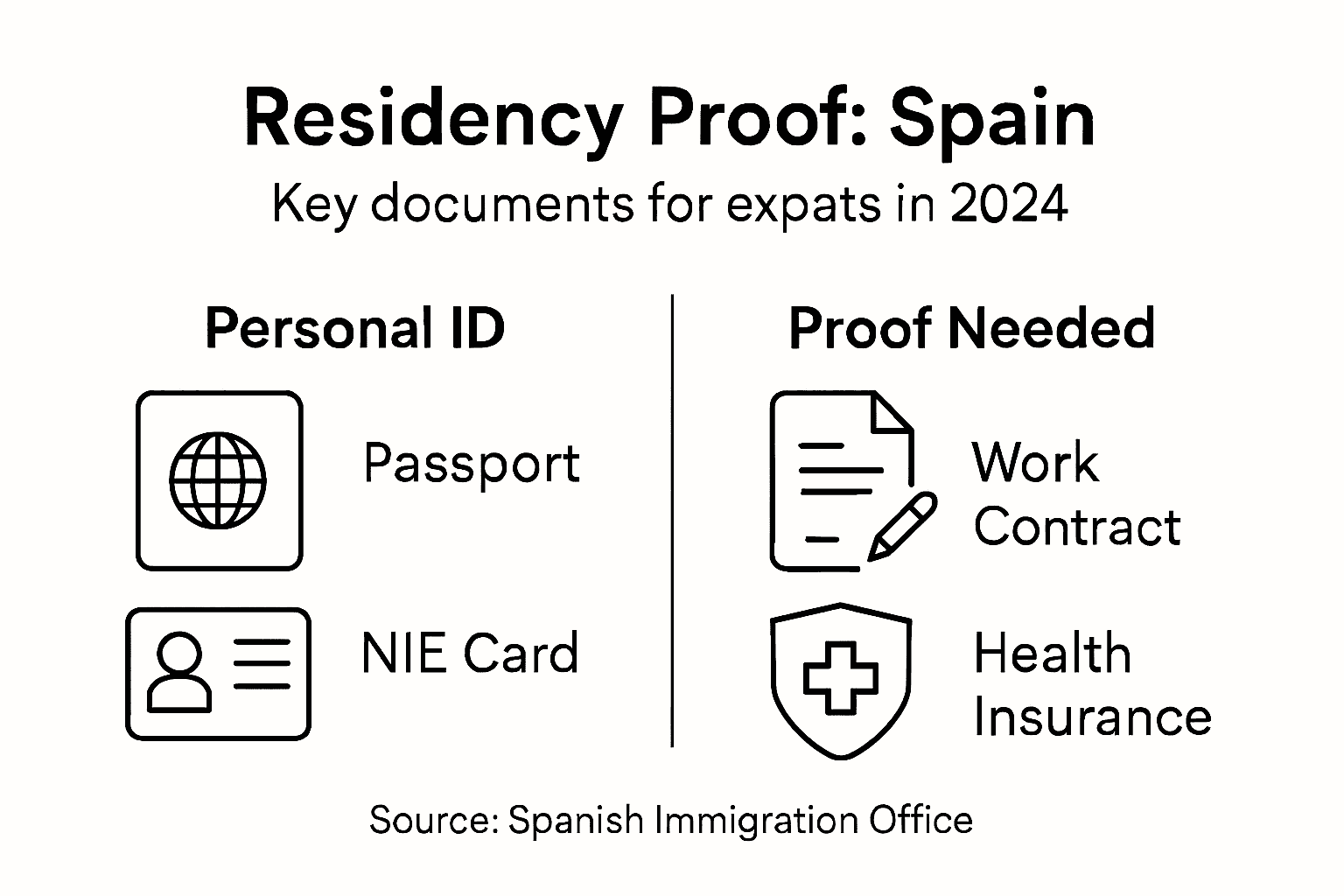
Residency proof is not simply a document but a comprehensive legal status involving multiple components. The key documents typically include:
- Certificate of Registration (Certificado de Empadronamiento)
- Foreigner Identity Number (NIE)
- Residency Card (TIE or Tarjeta de Identidad de Extranjero)
- Proof of financial means
- Health insurance documentation
Many expats mistakenly believe that having a visa automatically grants residency status. In reality, each document serves a specific legal purpose and must be obtained through precise administrative procedures. The registration process requires different documentation based on an individual’s specific circumstances - whether they are employed, studying, or retiring in Spain.
Residency proof is about demonstrating your legal right to live in Spain, not just possessing a piece of paper.
Common myths surrounding Spanish residency often create unnecessary confusion. Some expatriates believe they can extend tourist visas indefinitely or that marriage to a Spanish citizen automatically grants residency. These assumptions can lead to serious legal complications.
Pro tip: Always consult official sources and consider professional legal guidance when navigating Spanish residency requirements to avoid potential administrative pitfalls.
Accepted Documents for Proving Residency
Proving residency in Spain requires carefully compiled documentation that demonstrates legal right to reside. Expats must understand the specific requirements and prepare their documentation strategically to successfully navigate the bureaucratic process.
The essential documents for proving residency typically include:
- Passport or national identity document
- Proof of Employment Contract or self-employment status
- Financial Resources Documentation
- Health Insurance Certificate
- Proof of Accommodation (rental contract or property ownership)
Each document serves a critical purpose in establishing an expatriate’s legal status. For employed individuals, this means providing a valid work contract or proof of self-employment. Students must demonstrate enrollment in an educational institution, while retirees need to show sufficient financial means to support themselves.
Not all documents are created equal - immigration authorities scrutinize each submission carefully.
Different residency categories require nuanced documentation. Work permit applicants need employment contracts, while student visa holders must present academic enrollment proof. Retirement visa applicants typically must demonstrate substantial financial resources and comprehensive health coverage.

Here’s a summary of which documents are typically required based on different residency categories in Spain:
| Residency Category | Essential Proofs Required | Financial Evidence Needed | Health Coverage Requirement |
|---|---|---|---|
| Employee | Work contract | Proof of stable income | Valid insurance |
| Self-Employed | Self-employment registration | Business financial statements | Health plan |
| Student | Enrollment certificate | Study funding documentation | Health insurance |
| Retiree | Pension or savings letters | Substantial savings proof | Comprehensive policy |
| Investor (Golden Visa) | Investment documents | Asset investment receipts | Full medical insurance |
Pro tip: Always obtain officially translated documents and keep multiple certified copies to streamline your residency application process.
Key Legal Requirements for Residency Status
Spain’s legal residency framework involves complex requirements that vary significantly depending on an applicant’s nationality and specific visa type. Understanding these nuanced criteria is crucial for successfully obtaining and maintaining legal residency status.
The primary legal requirements for residency differ based on the applicant’s background:
-
EU Nationals
- Must register residence after 90 days
- Prove sufficient financial resources
- Provide valid health insurance coverage
-
Non-EU Nationals
- Meet specific visa category requirements
- Demonstrate substantial financial stability
- Obtain comprehensive health insurance
- Maintain a clean criminal record
Each residency pathway demands unique documentation and financial thresholds. Non-lucrative visas require substantial savings, while digital nomad visas necessitate consistent income from external sources. Investment-based golden visas have their own specific investment requirements, typically involving significant real estate or business investments.
Legal residency is not a one-size-fits-all process - each applicant’s situation is unique.
Specific visa categories come with distinct obligations. Work visas demand employment contracts, student visas require academic enrollment proof, and retirement visas mandate demonstrating consistent financial means. Immigration authorities meticulously review each application, examining documentation for completeness and authenticity.
Pro tip: Consult with a legal professional specializing in Spanish immigration law to navigate the complex residency requirements specific to your individual circumstances.
How Proof Impacts Rights and Compliance
Residency proof in Spain is far more than a bureaucratic formality - it’s a critical legal mechanism that directly determines an expatriate’s rights, obligations, and social integration. Residency documentation serves as the fundamental gateway to accessing essential services, legal protections, and social benefits within the Spanish system.
The key rights and compliance areas impacted by residency proof include:
-
Healthcare Access
- Eligibility for public healthcare system
- Ability to register with local medical facilities
- Prescription medication coverage
-
Social Security Benefits
- Pension contributions and future eligibility
- Unemployment protection
- Disability and social welfare support
-
Legal Protections
- Work authorization
- Right to rent or purchase property
- Protection under Spanish labor laws
- Legal representation and judicial rights
Without proper residency documentation, expats essentially exist in a legal limbo, unable to fully participate in Spanish society. Each document serves as a critical validation of an individual’s legal status, determining everything from employment opportunities to basic social service access.
Residency proof is not just paperwork - it’s your key to integration and rights in Spain.
Compliance goes beyond mere documentation. Spanish authorities maintain rigorous tracking systems to ensure that expatriates maintain valid status. Failure to renew or properly document residency can result in significant penalties, including potential deportation and future entry restrictions.
Pro tip: Maintain meticulous records of all residency documents and set calendar reminders for renewal deadlines to prevent accidental non-compliance.
Frequent Pitfalls and How to Avoid Delays
Navigating Spanish residency bureaucracy requires strategic preparation and understanding of common documentation challenges. Expats frequently encounter complex administrative hurdles that can significantly extend processing times or result in application rejections.
The most frequent residency application pitfalls include:
-
Documentation Errors
- Incomplete paperwork
- Missing original documents
- Incorrectly translated certificates
- Outdated supporting materials
-
Timing and Submission Issues
- Missing critical deadlines
- Submitting applications outside statutory windows
- Failing to renew documents promptly
- Incorrect application sequence
-
Financial and Insurance Complications
- Insufficient proof of financial means
- Inadequate health insurance coverage
- Inconsistent income documentation
- Failure to meet minimum financial thresholds
Many expatriates underestimate the complexity of Spanish administrative processes. Each visa category demands precise documentation, and even minor errors can trigger significant delays or outright rejections. Authorities meticulously review every submission, checking for completeness, accuracy, and compliance with current regulations.
This table highlights common mistakes and how to avoid them during your Spanish residency application process:
| Common Mistake | Typical Consequence | Smart Prevention Method |
|---|---|---|
| Missing documents | Application rejection | Prepare a detailed checklist |
| Outdated certificate copies | Extended processing times | Regularly update all records |
| Poor translation quality | Administrative delays | Use certified translators |
| Late renewals | Fines/loss of residency | Set up renewal reminders |
Bureaucratic precision is not optional - it’s mandatory in Spanish immigration procedures.
Recent regulatory changes, particularly following Brexit, have further complicated residency applications. Applicants must stay current with evolving requirements, understanding that immigration laws can shift rapidly. Maintaining meticulous, up-to-date documentation is no longer just recommended - it’s essential.
Pro tip: Create a comprehensive digital and physical filing system for your residency documents, with clear organization and easy accessibility for quick reference and renewal processes.
Simplify Your Residency Proof Journey in Spain with Professional Support
Navigating the complexities of Spanish residency proof can feel overwhelming. From assembling the right documents like the Certificate of Registration and NIE to meeting varied financial and health insurance requirements, the process demands precision to avoid delays and legal pitfalls. If you are struggling with paperwork errors, understanding nuanced visa rules, or staying compliant with deadlines, you are not alone. Many expatriates face these exact challenges while trying to secure their legal right to reside in Spain.
At Vive Legal, we specialize in making your residency procedures straightforward and stress-free. Our digital platform provides expert legal consultancy tailored to your unique situation whether you are an employee, student, retiree, or investor. With services including personalized diagnostics, document review, and appointment scheduling, we combine AI efficiency with professional oversight to maximize your approval chances. Learn how we tackle common residency challenges by exploring our Uncategorized Archives - Vive Legal and discover the convenience of managing your case online at https://vive.legal.
Don’t let administrative hurdles slow your residency progress. Gain peace of mind with Vive Legal’s full support and transparent pricing. Start your seamless residency application or renewal journey today by visiting Vive Legal and take the first step toward securing your future in Spain.
Frequently Asked Questions
What are the key documents required for residency proof in Spain?
Expats must provide essential documents such as a passport, proof of employment or self-employment, financial resources documentation, health insurance certificate, and proof of accommodation.
Do I need to register my residence in Spain as a non-national?
Yes, non-nationals must register their residence within three months of arrival in Spain to demonstrate their legal right to reside in the country.
What are the common myths about residency status in Spain?
Many believe that possessing a visa automatically grants residency status or that marriage to a Spanish citizen guarantees residency. These misconceptions can lead to serious legal issues.
How can I avoid delays in my residency application process?
To avoid delays, ensure all documents are complete, accurate, and up-to-date. Submitting a detailed checklist, setting reminders for renewals, and using certified translations can help streamline the application process.
Recommended
Living legally in Spain shouldn't be difficult.
View services and pricesNot sure which procedure you need? Find out in 2 min
Questions? Message us on WhatsApp