
The essential role of lawyers in Spain's immigration

TL;DR:
- Immigration lawyers in Spain handle legal interpretation, disputes, and complex documentation, unlike gestores.
- You need a lawyer for denials, eligibility issues, and complex family or permit transitions.
- Always verify legal credentials through the Colegio de Abogados before hiring an immigration professional.
The essential role of lawyers in Spain’s immigration
If you’ve ever searched for help with a Spanish visa or residency permit, you’ve probably stumbled across gestores, abogados, and immigration advisors all offering similar-sounding services. The confusion is real, and it has a cost. Choosing the wrong type of professional can lead to rejected applications, missed deadlines, and in some cases, serious legal consequences that take months to untangle. This guide cuts through that noise. You’ll learn exactly what immigration lawyers in Spain do, how they differ from gestores, and when their expertise is not just helpful but absolutely necessary.
Living legally in Spain shouldn't be difficult.
View services and pricesNot sure which procedure you need? Find out in 2 min
Questions? Message us on WhatsApp
Table of Contents
- The core responsibilities of immigration lawyers in Spain
- When and why you need a lawyer for immigration in Spain
- How lawyers support specific immigration procedures
- Common pitfalls: Vetting and choosing help the right way
- Our perspective: Why expert legal help is more than paperwork
- Connect with trusted immigration lawyers in Spain
- Frequently asked questions
Key Takeaways
| Point | Details |
|---|---|
| Lawyers vs gestores | Lawyers handle legal matters and representation, while gestores focus on paperwork. |
| When lawyers are necessary | Use a lawyer for disputes, appeals, and complex immigration scenarios. |
| Vetting professionals | Check Colegio de Abogados registration to confirm legal credentials. |
| Lawyers for student procedures | Lawyers help prepare student visa and permit applications, especially for complex cases. |
| Avoiding common setbacks | Hiring the wrong type of professional leads to costly errors and delays. |
The core responsibilities of immigration lawyers in Spain
Spain’s immigration system separates legal work from administrative work more sharply than most people realize. A lawyer (abogado) and a gestor (administrative agent) may both help you submit documents to government offices, but their scopes of practice are fundamentally different.
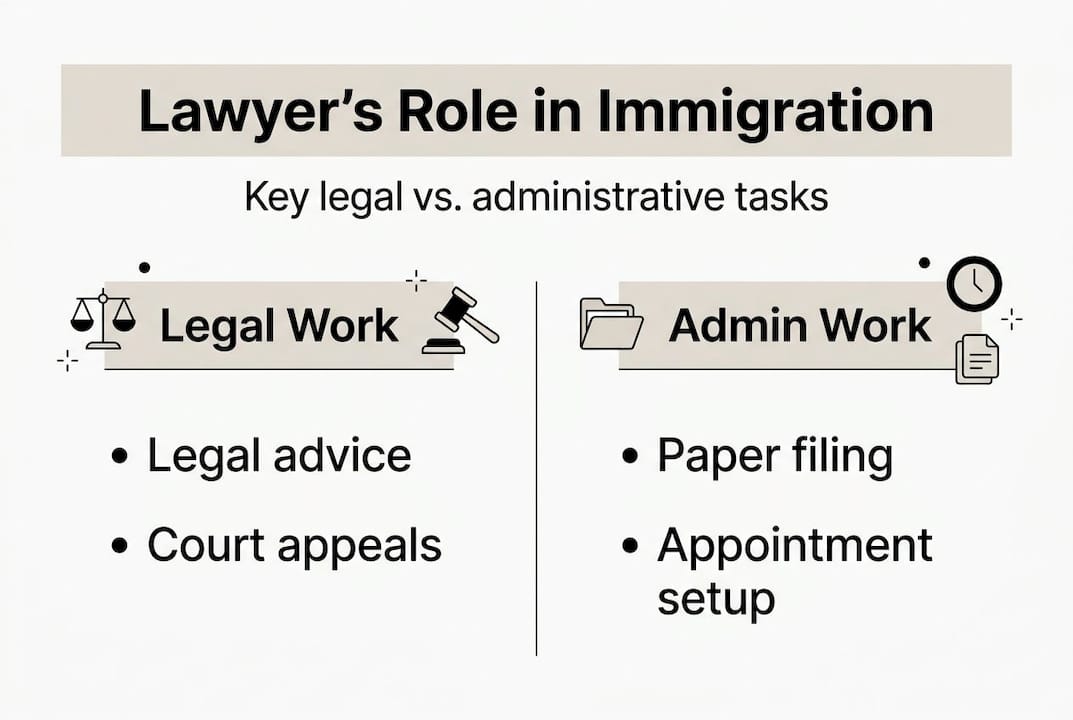
Lawyers focus on legal interpretation, drafting complex documents, and providing legal representation in disputes, while gestores focus on administrative execution and paperwork navigation. In practical terms, this means a gestor can fill out your forms correctly and submit them on time. But if your application is denied, a gestor cannot file a formal legal appeal, interpret the legal basis of the decision, or argue your case before an authority. Only a lawyer can do that.
Here’s a breakdown of the core tasks each professional handles:
| Task | Lawyer | Gestor |
|---|---|---|
| Legal advice and strategy | Yes | No |
| Document drafting (contracts, appeals) | Yes | Limited |
| Administrative form completion | Yes | Yes |
| Court or administrative representation | Yes | No |
| Interpreting immigration law | Yes | No |
| Appointment scheduling | Yes | Yes |
The most dangerous misconception in Spanish immigration is that a gestor provides legal protection. They don’t. Gestores are experts at navigating bureaucracy, and that skill is genuinely valuable for straightforward cases. But the moment your case involves ambiguity, a denial, or a question of legal eligibility, you need a lawyer in your corner.
“Many applicants assume their gestor can handle everything, including appeals and legal disputes. This assumption is one of the most common and costly mistakes in Spanish immigration.”
You definitely need a lawyer when:
- Your application has been denied and you want to appeal
- You are unsure whether you qualify for a specific permit type
- Your case involves criminal record disclosures or past immigration violations
- You are navigating a complex family reunification or EU citizen registration
- You need to pursue the arraigo social process after years of irregular residence
- Your employer or school is disputing supporting documentation
- You are facing deportation or an administrative sanction
Pro Tip: Before hiring anyone, ask to see their registration with the Colegio de Abogados (Spain’s official Bar Association). This is the only credential that confirms someone is legally authorized to give legal advice and represent you in formal proceedings. Anyone calling themselves an “immigration advisor” without this registration cannot legally protect your rights.
When and why you need a lawyer for immigration in Spain
Not every immigration case requires a lawyer from day one. But knowing when to bring one in early can save you enormous amounts of time, money, and stress. Lawyers are particularly valuable because they think ahead. Where a gestor checks whether your documents are complete, a lawyer asks whether your case is legally sound before a single form is submitted.

Consider this: checking professional registration categories is essential because Spain splits roles between Colegio de Abogados for lawyers and Colegio de Gestores Administrativos for gestores, and many unqualified “immigration advisors” operate in the gap between them without proper credentials. People in this gray zone may collect your fees, submit your paperwork incorrectly, and leave you with no recourse when things go wrong.
Here are the most common situations where legal help is not optional:
-
Application denial and appeal. If your residency or visa application has been refused, only a lawyer can prepare and file a formal appeal (recurso de alzada or recurso contencioso-administrativo). The appeal window is often 30 days, and missing it can be fatal to your case.
-
Eligibility uncertainty. If you’re not sure whether you qualify for a specific permit, a lawyer interprets the legal criteria and evaluates your situation against current case law. A gestor cannot make this judgment.
-
Work permit transitions. Switching from a student visa to a work permit, or modifying your authorization category, involves layered legal requirements. The internship residence process is one example where the sequencing of applications has to be legally correct or approvals can unravel.
-
Transitioning status categories. If you need to modify student to worker status, the legal requirements and timing matter enormously. Missing a filing window while your permit is in transition can result in a lapse of legal status.
-
Complex family cases. EU family reunification cases, dependent visa chains, and cases involving multiple nationalities require legal analysis to ensure every member of the family is covered correctly.
The practical outcomes of having a lawyer are significant. Applications handled with proper legal review have clearer eligibility arguments, stronger supporting documentation, and faster resolution when complications arise. Lawyers also ensure you stay compliant with Spain’s Ley Orgánica 4/2000 (the Foreigners Act), which governs almost every immigration procedure in the country.
Always confirm that your lawyer is registered in the Colegio de Abogados of their province. This is non-negotiable. Membership can usually be verified directly on the Colegio’s website for free.
How lawyers support specific immigration procedures
Let’s get concrete. Here’s what lawyer involvement looks like across some of Spain’s most common immigration procedures, step by step.
Student visas and stay permits involve multiple layers of documentation. Applicants must provide proof of admission, sufficient financial resources, and valid health insurance, and they must obtain both a student visa and a stay permit. However, if you are already legally residing in Spain, you can apply for a student residence permit directly without needing a prior visa. A lawyer ensures your documents meet the legal standard, not just the checklist standard, and flags any gaps before submission.
Here’s a data table showing procedure steps and where legal review is critical:
| Procedure | Key documents | Where legal review matters |
|---|---|---|
| Student visa | Admission letter, insurance, bank statements | Financial sufficiency threshold, insurance validity |
| Work permit (cuenta ajena) | Job contract, employer NIE, qualifications | Contract legality, quota compliance |
| EU registration | Passport, proof of activity | Eligibility classification, family member coverage |
| Arraigo social | 3-year residence proof, social integration report | Irregular period documentation, criminal record analysis |
| Appeal (recurso) | Denial letter, evidence | Legal argument drafting, deadline compliance |
For EU residency registration, lawyers help EU citizens and their family members understand which category of registration applies to their situation and ensure the correct documentation structure is in place. This matters especially for non-EU family members whose rights depend entirely on the EU citizen’s correct registration.
For work-related permits, especially initial work authorizations and renewals, lawyers review the employment contract for legal compliance, check that the employer meets sponsorship requirements, and confirm that the applicant’s qualifications are recognized correctly under Spanish law.
Key pain points that lawyers resolve:
- Proving financial sufficiency when income comes from multiple sources or foreign accounts
- Tracking legal deadlines across overlapping permit renewals
- Crafting compelling written arguments for borderline eligibility cases
- Clarifying ambiguous language in denial letters
- Coordinating with the job search process when transitioning between permit types
One thing many applicants underestimate is the value of a lawyer screening an application before it’s submitted. A strong legal review catches issues that neither the applicant nor a gestor would flag. An incorrectly labeled bank statement, a mismatched address, or a missing apostille can all trigger delays or denials. Catching these before submission saves weeks.
Common pitfalls: Vetting and choosing help the right way
Even people with the best intentions make expensive mistakes when selecting immigration help in Spain. The ecosystem of consultants, advisors, agencies, and online services can be genuinely hard to navigate.
The biggest risk is the unregulated “immigration advisor.” This title has no legal definition in Spain. Anyone can use it. Some advisors are genuinely knowledgeable and can help with basic paperwork. Others collect fees, submit incomplete applications, and disappear when things go wrong. Neither type can legally represent you in a dispute or give you an opinion that carries legal weight.
“Because Spain splits roles so clearly, assuming one provider ‘handles everything’ is a recurring failure mode. Vetting is not optional; it’s the first step in protecting your immigration case.”
Here’s a step-by-step checklist for vetting anyone who offers immigration help:
-
Ask for their registration. Lawyers must be registered in the Colegio de Abogados of their province. Gestores must be registered in the Colegio de Gestores Administrativos. Verify it directly with the relevant association.
-
Ask specifically what they can and cannot do. A qualified professional will answer this clearly. Anyone who says they “handle everything” without clarifying the distinction between legal and administrative work is a red flag.
-
Request a written service agreement. This should spell out exactly which procedures they are handling, what documents you are responsible for, and what recourse you have if they make an error.
-
Check for reviews and references. Not just Google reviews, but specifically from people who had complex cases. Positive reviews for simple NIE processing don’t tell you much about how someone handles an appeal.
-
Ask about their experience with Spanish nationality applications or the specific procedure you need. Immigration law has many sub-specialties, and experience matters.
-
Confirm how they communicate with immigration authorities on your behalf. Legally, only a registered lawyer or gestor with your written authorization can act on your behalf. Verbal assurances are not enough.
Pro Tip: Request proof of Colegio de Abogados membership in writing before signing any engagement agreement. Legitimate lawyers will provide this immediately and without hesitation. If someone is slow to produce credentials, walk away.
Knowing when you need a lawyer versus a gestor saves both money and frustration. For clean, straightforward renewals with no eligibility questions, a well-reviewed gestor is often sufficient. For anything involving legal interpretation, prior denials, or eligibility uncertainty, a lawyer is not a luxury.
Our perspective: Why expert legal help is more than paperwork
After working with clients navigating Spain’s immigration system, one thing becomes clear repeatedly: the people who struggle most are not those with complicated cases. They are the ones who underestimated their case until it was too late to fix.
There’s a persistent myth that if your paperwork is clean and complete, approval is guaranteed. It isn’t. Spanish immigration authorities have discretion, and denials happen even in cases that look straightforward on paper. What a skilled lawyer adds is not just accuracy but foresight. They read the legal landscape around your case, not just the checklist in front of them.
We’ve seen clients come to us after spending months with unqualified advisors, only to discover their application window had closed or their prior submission created a legal complication. Smart clients, in our experience, don’t just ask “can you file this for me?” They ask “what could go wrong, and how will you handle it?” That question separates administrative help from genuine legal expertise.
The Vive Legal blog covers many of these real-world case patterns in detail, and the lesson is consistent: investing in qualified legal support early almost always costs less than fixing mistakes made with unqualified help. Credentials matter. Strategy matters. And knowing the difference between legal and administrative help is the first step toward a successful outcome in Spain.
Connect with trusted immigration lawyers in Spain
Navigating Spain’s immigration system is significantly easier when you have the right professionals in your corner from the start. Whether you’re applying for the first time, renewing a permit, or dealing with a complex legal situation, getting qualified support early protects your case and your time.
At Vive Legal, we combine professional legal oversight with digital tools that keep you informed at every stage of your process. From complex situations like the arraigo social service to transitions through the internship residence service, our team handles your case with verified credentials, transparent pricing, and real accountability. You deserve legal support that’s clear, credentialed, and built around your specific situation.
Frequently asked questions
What is the difference between a gestor and a lawyer for immigration in Spain?
A lawyer provides legal advice, drafts complex documents, and represents clients in disputes, while a gestor handles administrative paperwork and form submission but cannot provide legal representation or formal legal opinions.
Do I always need a lawyer for Spanish residency applications?
Not always. You need a lawyer when facing denials, eligibility uncertainty, or complex situations, but simpler renewals can be managed by a gestor. That said, a legal review is always recommended to avoid costly errors before submission.
Can lawyers help with student visas and stay permits in Spain?
Yes. Lawyers validate that your admission documents, health insurance, and financial resources meet the legal standard, and they assist with both the visa and the residence permit, especially if you have prior rejections or a non-standard situation.
How do I confirm if an immigration advisor is a qualified lawyer in Spain?
Ask for written proof of registration in the Colegio de Abogados. Only registered lawyers can give legal advice and represent you in formal immigration proceedings. Advisors without this credential cannot legally protect your rights.
Recommended
Living legally in Spain shouldn't be difficult.
View services and pricesNot sure which procedure you need? Find out in 2 min
Questions? Message us on WhatsApp