
Secure online legal services for immigration in Spain

TL;DR:
- Submitting immigration documents online carries significant risks of data breaches and identity theft.
- Secure platforms should use encryption, two-factor authentication, clear policies, and comply with GDPR standards.
- Applicants must adopt best practices like strong passwords, active monitoring, and offline backups for protection.
Most people assume that submitting sensitive immigration documents through an online platform is safe by default. That assumption can be costly. A data breach at a Spanish government subcontractor exposed the personal information of foreign residents, proving that no system is untouchable. Whether you are renewing your TIE, applying for arraigo, or registering as an EU citizen, your passport numbers, addresses, and residency documents flow through digital pipelines that are only as secure as the weakest link. This guide walks you through the real risks, how to spot a secure platform, and the concrete steps you can take to protect your immigration journey.
Living legally in Spain shouldn't be difficult.
View services and pricesNot sure which procedure you need? Find out in 2 min
Questions? Message us on WhatsApp
Table of Contents
- Why security matters in online immigration legal services
- Common threats: Data breaches, outages, and third-party risks
- How to recognize secure online legal platforms
- Steps to improve your security: Actionable tips for applicants
- Why trusting ‘official’ isn’t enough: A fresh perspective on data security
- Take the next step with secure, expert-backed support
- Frequently asked questions
Key Takeaways
| Point | Details |
|---|---|
| Sensitive data is at risk | Immigration applications involve highly sensitive documents routinely targeted in recent data breaches. |
| No platform is immune | Even official government services have suffered security lapses and outages that affect legal outcomes. |
| Compliance signals matter | Check for strong authentication, updated privacy policies, and GDPR compliance before using any platform. |
| Be proactive | Monitor your applications, safeguard all submissions, and stay informed on breach response procedures. |
Why security matters in online immigration legal services
When you upload documents to an immigration platform, you are handing over some of the most sensitive personal data you own. We are talking about passport numbers, national identity numbers, home addresses, employment records, and biometric permits. If that information falls into the wrong hands, the consequences go far beyond spam emails.
The scope of damage from a single breach can be severe:
- Identity theft: Stolen passport data enables fraudsters to open bank accounts, apply for loans, or impersonate you in official proceedings.
- Denial of residency: If your application data is corrupted or manipulated during a breach, it can trigger automatic rejections or administrative holds.
- Prolonged delays: Agencies often freeze processing while investigating incidents, leaving applicants in legal limbo for months.
- Reputational harm: Leaked professional or financial records can affect your employment situation in Spain.
The 2026 breach that exposed tens of thousands of immigration records, including names, passports, and residency permits, made this risk impossible to ignore. That incident involved a government subcontractor, not a shady back-alley service. It was a licensed, official operation.
“The assumption that official automatically means secure is one of the most dangerous misconceptions in modern immigration administration.”
Private platforms carry their own vulnerabilities too. Many third-party gestorías and legal apps rely on external cloud providers, payment processors, and document storage services. Any one of those partners can become an entry point for attackers. If you are navigating residency applications and want broader context, the immigration guides blog covers how digital procedures interact with real-world legal outcomes.
The bottom line: the data you share during an immigration procedure is not recoverable the way a password is. Once your passport number is exposed, it stays exposed. That makes prevention the only real strategy.
Common threats: Data breaches, outages, and third-party risks
Security threats to online legal services fall into three broad categories: confidentiality failures, integrity failures, and availability failures. Most people think of only the first type, but all three can derail your immigration process.
Here is how each plays out in practice:
- Confidentiality breach: Unauthorized access to your stored documents or personal records.
- Integrity breach: Data is altered during transmission or storage, causing your application to contain incorrect information without your knowledge.
- Availability breach (outage): The platform goes down, and your submission window closes or your appointment slot is lost.
The availability threat is more serious than it sounds. A database failure at Adexttra halted 150,000 permit applications in Spain. Applicants had submitted their documents in good faith and then heard nothing. The system outage created administrative silence, which in immigration contexts can be interpreted as a denial by default.
Third-party risk is a category that rarely gets enough attention. When a legal platform outsources document storage, electronic signatures, or appointment booking to an external vendor, your data travels beyond the platform you thought you chose. That vendor may operate under different security standards, in a different jurisdiction, with fewer accountability mechanisms.

| Threat type | Example | Your risk |
|---|---|---|
| Confidentiality breach | Leaked passport scans | Identity theft, fraud |
| Integrity breach | Altered form data | Application rejection |
| Availability outage | Platform crash | Missed deadlines, denials |
| Third-party breach | Vendor storage hack | Multiple data exposures |
Pro Tip: Before trusting any platform with your documents, search the company name alongside terms like “breach notification” or “incident report.” A transparent platform will have public records of how it handled past incidents. If you find nothing at all, that is also a warning sign. Check how legal workflow disruptions have affected real applicants, and review whether the platform you are considering handles the arraigo formativo application process with documented security protocols.
How to recognize secure online legal platforms
Not every platform that looks professional is actually safe. Knowing what to verify before uploading a single document can save you from a breach that follows you for years.
Here is a practical checklist to apply before committing to any online legal service:
- HTTPS and SSL encryption: The site URL must begin with https. Look for a padlock icon. This confirms data is encrypted in transit.
- Two-factor authentication (2FA): Secure platforms require more than a password to access your file or portal.
- Clear, specific privacy policy: Vague phrases like “we take your data seriously” are not policies. Look for specifics about storage location, retention period, and third-party sharing.
- GDPR and AEPD compliance: Spain’s data protection authority, the AEPD, enforces strict rules. GDPR and AEPD guidelines require encryption, access controls, and breach notification within 72 hours. If a platform does not reference these standards, walk away.
- Breach notification commitment: Any trustworthy platform should tell you explicitly what happens if your data is compromised.
Comparing platform types helps clarify your options:
| Feature | Official government portals | Reputable private platforms | Unverified third parties |
|---|---|---|---|
| Encryption | Generally yes | Varies | Often unknown |
| GDPR accountability | Yes | Usually yes | Unclear |
| Breach history transparency | Partial | Better audited | Rarely disclosed |
| User reviews and accountability | Limited | Often available | Inconsistent |
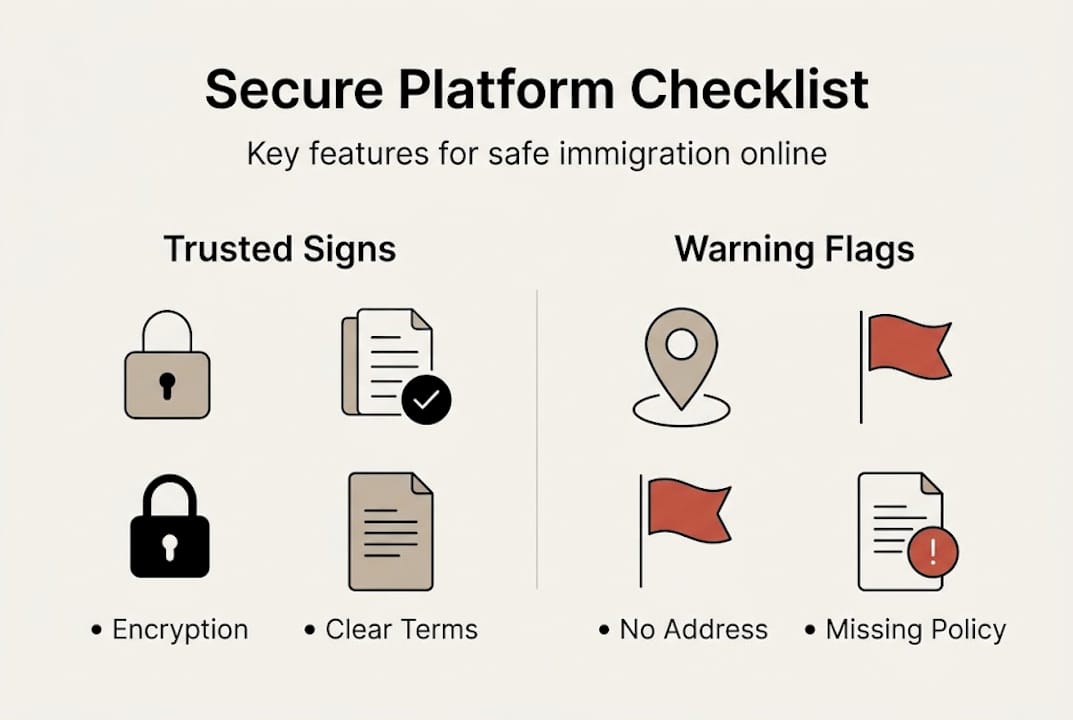
Pro Tip: Always read the terms of use and privacy policy before uploading documents. If those documents are missing or linked to a generic template, treat it as a red flag. Platforms handling sensitive materials like immigration records should also have clear protocols for managing sensitive documents and demonstrate professional accreditation.
Warning signs to exit immediately: no identifiable company address, no named legal team, no verifiable user reviews, and claims of “100% secure” with zero specifics.
Steps to improve your security: Actionable tips for applicants
Even when you choose a trustworthy platform, your own habits are a critical line of defense. These steps are ranked by impact.
- Create unique, strong passwords for every immigration platform. Reusing passwords means one breach anywhere exposes your accounts everywhere. Use a password manager.
- Enable two-factor authentication immediately. If the platform offers it, use it. If it does not, ask why.
- Verify the platform’s credentials before submitting anything. Look for a registered business address in Spain, professional accreditation, and published terms. Check the legal notice to confirm who is legally responsible for your data.
- Track your application status actively. Do not wait for the platform to contact you. If processing stalls unexpectedly, it could be an outage or integrity issue. Follow up in writing to create a paper trail.
- Ask about breach notification protocols directly. A legitimate service will answer this clearly. AEPD mandates timely breach response, risk assessment, and system updates for legal services handling personal data. If a platform is unaware of this obligation, that tells you everything.
“Your immigration file is not just a collection of forms. It is your legal identity in Spain. Treat its digital security with the same seriousness you would a physical passport.”
Pro Tip: After every major submission, save an offline backup. Download confirmation emails, submission receipts, and copies of every form. Store them in an encrypted folder on your device or on a secure external drive. If a platform crashes or your data is compromised, these records become your proof and your lifeline.
Finally, set calendar reminders to check your documents are still intact on any platform you use long-term. Data does not stay safe passively.
Why trusting ‘official’ isn’t enough: A fresh perspective on data security
There is a deeply ingrained belief that anything stamped with government authorization is inherently trustworthy. Recent events in Spain have shown that belief to be dangerously incomplete.
Official platforms prioritize security but recent outages and breaches show systemic limits that no reputation can paper over. Government systems run on aging infrastructure, procurement cycles that lag behind threat landscapes, and bureaucratic oversight that is slow to respond when things go wrong. Private legaltech platforms move faster but often lack the independent audits that would make their security claims verifiable.
The uncomfortable truth is this: the responsibility for your data does not stop with the platform you choose. It extends to how you use it, what you share, when you follow up, and whether you maintain your own backups. A secure platform reduces risk. It does not eliminate it. The most resilient approach treats digital risks and safeguards as an ongoing practice, not a one-time checkbox. Proactive users who ask hard questions, read policies, and monitor their applications are consistently better protected than those who assume the system will catch every problem.
Take the next step with secure, expert-backed support
You now have a clearer picture of what digital security in immigration actually requires. The next step is choosing a partner that takes that responsibility seriously.
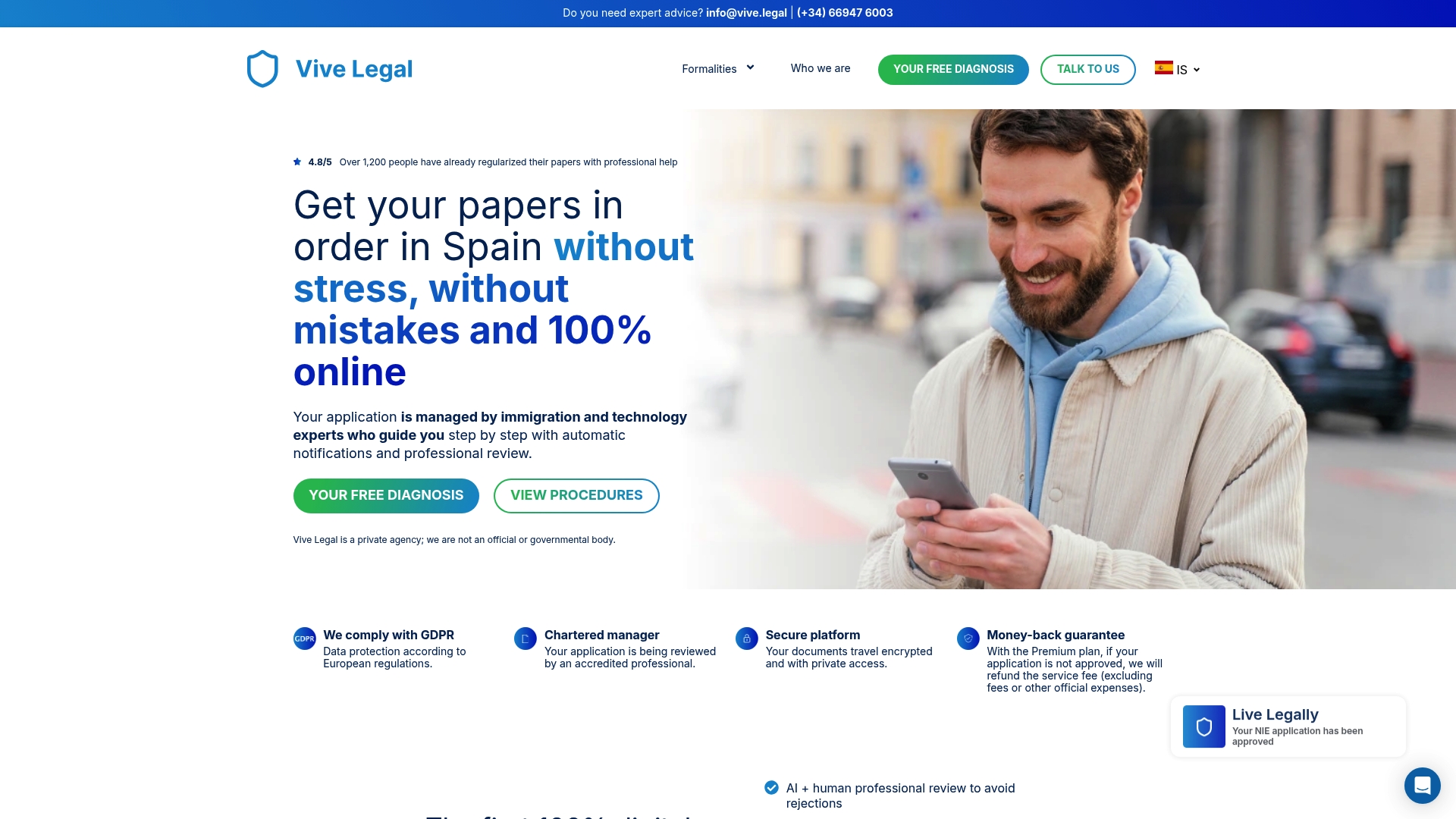
Vive Legal offers all-in-one immigration management built around privacy, compliance, and professional accountability. Every case is handled through a secure client portal with real-time notifications, so you always know where your application stands. Whether you are navigating the regularization process 2026 or need TIE application support, the platform combines AI-assisted document review with qualified legal oversight. Transparent pricing, GDPR-compliant data handling, and a satisfaction guarantee mean you are not just getting convenience but peace of mind at every stage.
Frequently asked questions
What personal data is most at risk in online immigration procedures?
Names, passport numbers, addresses, and residency documents are among the most sensitive and commonly exposed data points. A breach at a Spanish contractor confirmed these exact categories were compromised in a real incident.
How can I tell if an online legal service is GDPR compliant?
Check for clear privacy policies, terms of use, encryption disclosures, and breach notification timelines. AEPD guidelines specifically require encryption, access control, and notification within 72 hours of a confirmed breach.
What should I do if I suspect my data was compromised?
Contact the platform immediately, request a written explanation of the incident, and monitor your official immigration case status. AEPD requires legal services to notify affected individuals and the authority within 72 hours, so that deadline is your first benchmark.
Are government platforms always safer for immigration procedures?
Not automatically. While they tend to be better regulated, official Spanish platforms have suffered major outages affecting 150,000 applicants at once, proving that user vigilance remains essential regardless of who runs the system.
Recommended
Living legally in Spain shouldn't be difficult.
View services and pricesNot sure which procedure you need? Find out in 2 min
Questions? Message us on WhatsApp