
Spain immigration best practices: essential steps & tips

TL;DR:
- Spain’s immigration process is complex, with strict documentation and regional variations.
- Liquid funds and criminal record checks are critical barriers for applicants.
- Expert guidance and timely preparation significantly improve chances of success.
Spain’s immigration system is one of the most layered in Europe, with distinct rules for students, workers, EU nationals, and families. Many applicants start the process confident, only to hit unexpected roadblocks: missing a document, misreading a consulate requirement, or underestimating how long post-arrival paperwork takes. The result? Delays, rejections, and wasted months. This guide breaks down the real best practices for each major immigration route, compares your options clearly, and shares the insider details that most applicants only learn the hard way. Whether you’re planning to study, work, or reunite with family in Spain, you’ll leave with a concrete framework for moving forward.
Living legally in Spain shouldn't be difficult.
View services and pricesNot sure which procedure you need? Find out in 2 min
Questions? Message us on WhatsApp
Table of Contents
- Essential criteria for Spanish immigration success
- Best practices for student, worker, and family immigration
- Comparing EU, non-EU, and exceptional immigration paths
- Decision strategies and overlooked success factors
- Our perspective: What applicants overlook and what really matters
- Ready to streamline your immigration process?
- Frequently asked questions
Key Takeaways
| Point | Details |
|---|---|
| Eligibility basics matter | Meeting core criteria like funds, insurance, and a clean criminal record is the first step toward approval. |
| Tailor your approach | Choose the route that suits your status (EU, non-EU, exceptional) and adapt documentation for your consulate. |
| Document everything | Keep copies of approvals, renewals, and evidence handy for every stage of the journey. |
| Never skip NIE | Acquiring a NIE after arrival is essential for contracts, banking, and residency success. |
| Expert guidance helps | Specialist support saves time and minimizes risk, especially on complex or edge-case paths. |
Essential criteria for Spanish immigration success
Every immigration route into Spain starts with a core set of eligibility requirements. Get these wrong, and your application stalls before it begins. Get them right, and you’re already ahead of most applicants.
For non-EU nationals, the documentation bar is high. You’ll typically need proof of sufficient funds, a clean criminal record, valid health coverage, and a specific reason for your stay, whether that’s a job offer, an enrollment letter, or a family connection. EU nationals have it easier: they register rather than apply for a visa, and the process is faster with fewer documents. But even EU nationals can face complications if their paperwork is incomplete or their registration is delayed.
Here are the most common eligibility requirements across major immigration categories:
- Students (non-EU): Acceptance letter from an accredited institution, proof of funds (roughly €600 to €700 per month), private health insurance with no copays, a medical certificate, and a criminal record check
- Workers (non-EU): A job offer from a Spanish employer, employer-initiated authorization, and standard documentation including criminal records and health coverage
- EU nationals: Proof of identity, evidence of economic activity or sufficient funds, and registration at the local Oficina de Extranjería
- Family reunification: Proof of legal residency for the sponsor, documentation of family ties, and evidence of adequate housing and income
One of the most overlooked barriers is the criminal record check. Spain reviews your record from the last five years across every country where you’ve lived. Even a minor offense can block your application, including exceptional regularization routes. This is non-negotiable and applies at multiple stages of the process.
“Non-EU international students staying longer than 90 days must obtain a Type D student visa. Required documents include an acceptance letter, proof of financial means, private health insurance, a medical certificate, and a criminal record check.” — Official student visa overview
Another frequent stumbling block is proof of funds. Many applicants submit bank statements showing large balances tied up in fixed deposits or investment accounts. Consulates want to see liquid funds, meaning money you can actually access immediately. A long-term deposit doesn’t count.
Post-arrival, securing your NIE (Número de Identificación de Extranjero) is your first priority. Without it, you can’t open a bank account, sign a lease, or formalize any contract in Spain. Think of it as your administrative identity in the country.
Pro Tip: Before submitting your application, call or email your specific consulate to confirm their current document checklist. Requirements vary by location, and the official national list isn’t always what your consulate actually enforces.
Families applying for reunification face an additional layer: they must prove both the legal relationship and the sponsor’s ability to support dependents financially. Documentation errors here are common and costly in terms of time.
Best practices for student, worker, and family immigration
With the eligibility landscape clear, let’s look at how to optimize each major pathway, whether you’re a student, worker, or aiming for family reunification.
For students, the process starts before you leave your home country. Apply for your student visa at the Spanish consulate in your jurisdiction well in advance of your program start date. The student visa prerequisites include your acceptance letter, health insurance, medical certificate, criminal record check, and proof of funds. Once in Spain, you must apply for your TIE (Tarjeta de Identidad de Extranjero), your physical residency card, within 30 days of arrival.
A key detail many students miss: the student visa allows up to 30 hours per week of work, but only in jobs compatible with your studies. This flexibility is valuable, but it requires a separate work authorization step after arrival.
Here’s a practical checklist for the student route:
- Secure enrollment at an accredited Spanish institution
- Gather all required documents (acceptance letter, insurance, medical cert, criminal record)
- Apply at your local Spanish consulate at least 60 days before your start date
- Receive your visa and travel to Spain
- Register your address (empadronamiento) within the first week
- Apply for your TIE within 30 days of arrival
- Obtain your NIE to enable banking and contracts
For workers, the process differs significantly based on your nationality. Non-EU workers need their employer to initiate the authorization process through Spain’s immigration system. This is called a work permit (autorización de trabajo), and it’s employer-led, meaning you cannot start this process yourself.
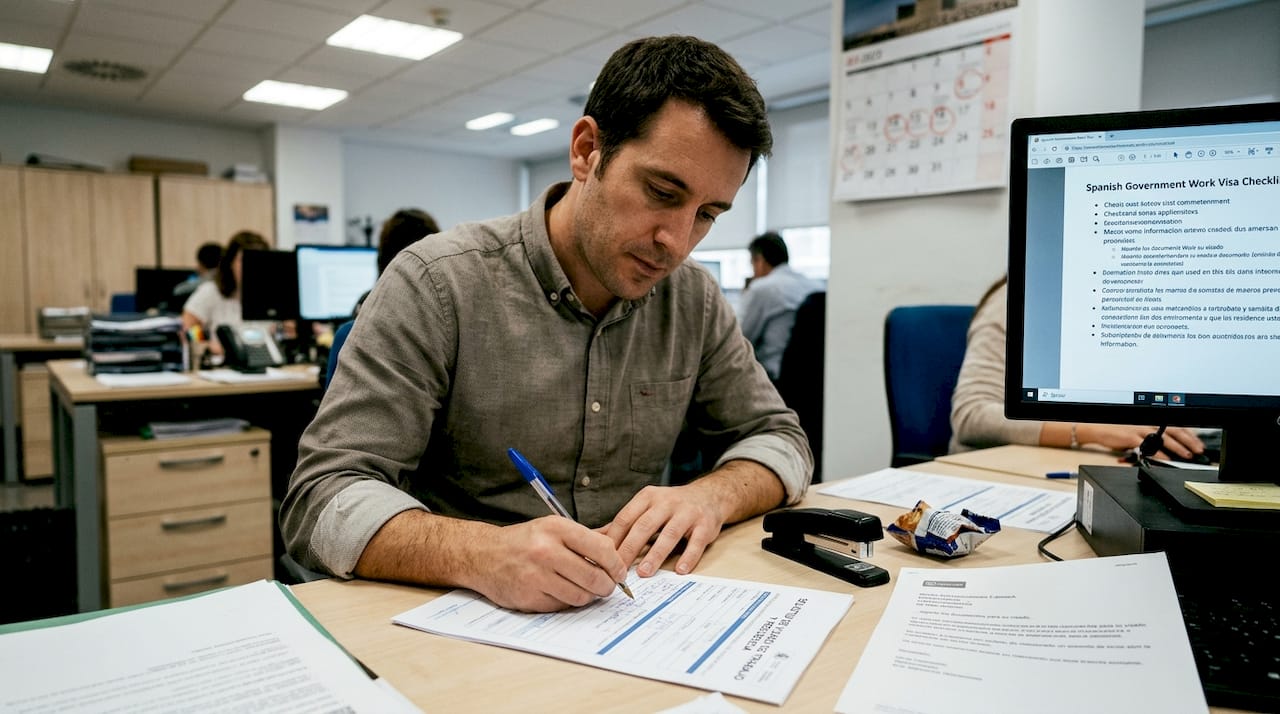
EU nationals, by contrast, can self-register through the EU registration process, which is far simpler. If you’re doing an internship or a practice-based role, the internship residence guide outlines a specific permit category designed for that situation.
For those already in Spain without regular status, the arraigo social option is worth exploring. It’s a regularization route for people who can prove continuous residence and social integration, but it has strict requirements.
For family reunification, gather everything that documents your relationship: marriage certificates, birth certificates, proof of cohabitation. All foreign documents must be apostilled and officially translated into Spanish.
Pro Tip: Don’t wait until you arrive to start your NIE process. Some consulates allow you to begin the NIE request before departure, which saves weeks once you land.
Comparing EU, non-EU, and exceptional immigration paths
To help decide which path suits your situation, here’s how the main immigration routes stack up in Spain, and what recent changes mean for each.
The contrast between EU and non-EU pathways is stark. EU nationals benefit from seamless registration with minimal bureaucracy, while non-EU applicants navigate employer-led visa processes that can take three to five years to reach long-term residency. The 2025 reforms simplified some administrative steps, but they did not relax criminal record or public order requirements.
| Immigration path | Who it’s for | Key documents | Typical timeline | Bureaucracy level |
|---|---|---|---|---|
| EU registration | EU/EEA nationals | ID, proof of activity or funds | 2 to 6 weeks | Low |
| Student visa (Type D) | Non-EU students | Acceptance letter, funds, insurance | 4 to 8 weeks | Medium |
| Work authorization | Non-EU workers | Employer offer, criminal record | 3 to 6 months | High |
| Family reunification | Non-EU families | Proof of ties, sponsor income | 3 to 6 months | High |
| Arraigo (regularization) | Long-term residents | Proof of residence, social ties | 6 to 12 months | Very high |
| Long-term EU residence | Non-EU after 5 years | Residency history, funds | 3 to 6 months | Medium-high |
For those on the student-to-worker pathway, Spain does allow modifications of your residency status once you’re legally in the country. This is a useful option for students who graduate and secure employment. The long-term EU residence permit becomes available after five continuous years of legal residency and offers significantly more stability.
Exceptional paths like arraigo are real options, but they’re not shortcuts. They require strict compliance with public order rules and thorough documentation of your time in Spain.
“EU registration remains the most accessible route, while non-EU applicants face employer-led processes and longer timelines. The 2025 reforms reduced administrative friction but left criminal and public order bars firmly in place.” — EU registration guidance
Decision strategies and overlooked success factors
With every route compared, here’s how to make your decision and avoid common pitfalls experienced applicants wish they knew earlier.
The single biggest mistake applicants make is treating the official national requirements as the complete picture. Spain’s consulates operate with a degree of independence. The consulate in Los Angeles may ask for additional evidence of funds compared to the one in New York. Always verify requirements directly with your consulate, not just the national immigration website.
Here are the most overlooked success factors:
- Liquid funds only: Your financial evidence must be liquid and immediately accessible. Fixed deposits, investment portfolios, and property values are not accepted as proof of means.
- Criminal record timing: Request your criminal record certificate early. In some countries, this takes four to six weeks, and it must be recent (usually issued within three to six months of your application).
- Post-arrival deadlines: You have 30 days after arrival to apply for your TIE. Missing this window creates complications that can affect your entire residency status.
- Renewal tracking: Residency permits have expiration dates. Missing a renewal deadline can reset your entire process.
- Document copies: Keep certified copies of every approval, stamp, and correspondence. Spain’s bureaucracy sometimes loses files, and having your own records is essential.
The NIE acquisition steps are straightforward but time-sensitive. Without your NIE, you’re effectively locked out of Spain’s financial and legal systems. Prioritize it from day one.
Pro Tip: Set calendar reminders 90 days before any permit expiration. This gives you enough time to gather documents, book appointments, and handle unexpected delays without risking your legal status.
For the most current rules and updates, the immigration guides blog tracks regulatory changes that affect timelines and requirements across all major permit categories.
Stat callout: According to immigration practitioners, applicants who prepare their financial documentation in the correct format and currency are significantly more likely to avoid delays at the consulate stage, with some reporting approval timelines cut by four to six weeks.
Our perspective: What applicants overlook and what really matters
Most immigration guides focus on the document list. What they don’t tell you is that the document list is the easy part.
The real challenge is understanding that Spain’s immigration system is not a single system. It’s a collection of regional offices, consulates, and local authorities, each with their own interpretation of national rules. We’ve seen applicants with perfect documentation get delayed because their consulate had an undocumented preference for a specific bank statement format. That’s not in any official guide.
Criminal record checks are another area where applicants consistently underestimate the stakes. A dismissed charge, a minor infraction from years ago, or a record from a country you briefly lived in can surface and derail an otherwise strong application. This is especially true for exceptional paths like arraigo.
Renewal deadlines trip up even experienced residents. The post-arrival paperwork, getting your NIE, registering your address, applying for your TIE, and then tracking renewal dates, is a continuous process, not a one-time event. Planning ahead isn’t optional; it’s what separates successful applicants from those who start over.
Our view, based on working with real cases, is that expert guidance pays for itself fastest in edge cases and exceptional routes. For standard paths, thorough preparation is enough. For anything unusual, the specialists’ perspective matters.
Ready to streamline your immigration process?
Knowing what’s required is a strong start. Executing it correctly, on time, and without errors is where most applicants need support.
Vive Legal offers end-to-end digital support for every major immigration route in Spain, from eligibility diagnostics and document review to appointment scheduling and renewal tracking. Whether you’re navigating a student visa, a work permit, or an extraordinary regularization, our platform combines AI-powered tools with licensed legal professionals to maximize your approval chances. For students, you can get your student visa case submission ready within 24 hours. No office visits, no guesswork, just a clear process managed entirely online with notifications at every stage.
Frequently asked questions
What are the main documents needed for the Spanish student visa?
You need an acceptance letter from an accredited institution, proof of €600 to €700 per month in liquid funds, private health insurance with no copays, a medical certificate, and a clean criminal record. Requirements may vary slightly by consulate.
Can a criminal record affect eligibility for immigration to Spain?
Yes, criminal records from the last five years can block most immigration paths, including exceptional regularization routes like arraigo.
How does the immigration process differ for EU and non-EU nationals?
EU nationals go through a simpler registration process with fewer documents, while non-EU applicants require employer support for work visas and face stricter documentation requirements across all categories.
What are the best practices for proving financial means during a Spanish visa application?
Always present funds as liquid and immediately accessible. Avoid fixed deposits or tied-up assets, and verify consulate-specific requirements since some locations demand stricter evidence than the national standard.
Why do applicants need a NIE after arriving in Spain?
The NIE is your official identification number in Spain and is required for opening a bank account, signing contracts, and completing any residency-related administrative process.
Recommended
Living legally in Spain shouldn't be difficult.
View services and pricesNot sure which procedure you need? Find out in 2 min
Questions? Message us on WhatsApp