
Spain immigration: how legal consultants simplify your process

TL;DR:
- Avoidable procedural errors cause nearly one-third of Spanish residence permit refusals.
- Legal consultants ensure correct documentation, manage local variations, and reduce rejection risks.
- Expert support is especially crucial for complex cases involving non-EU nationals or visa transitions.
Nearly one in three Spanish residence permit applications fails not because of ineligibility, but because of avoidable procedural errors. For expats, foreign workers, students, and EU citizens, the Spanish immigration system can feel like a maze of overlapping requirements, shifting deadlines, and bureaucratic surprises. A legal consultant does not just fill out forms. They map your specific situation, catch the errors before officials do, and guide you through a system that changes faster than most public guides are updated. This article breaks down exactly what legal consultants do, when you need one, and how to recover if things go wrong.
Living legally in Spain shouldn't be difficult.
View services and pricesNot sure which procedure you need? Find out in 2 min
Questions? Message us on WhatsApp
Table of Contents
- Why use a legal consultancy for Spanish immigration?
- Core services: How legal consultants manage the Spanish immigration journey
- Navigating different residency types: EU vs non-EU applications
- Handling refusals and appeals: What happens when things go wrong?
- The real difference: Lessons from working with Spanish legal consultants
- Take the next step: Get expert help for your Spanish immigration journey
- Frequently asked questions
Key Takeaways
| Point | Details |
|---|---|
| Legal support minimizes errors | Expert consultants help you avoid common pitfalls that cause delays or refusals in Spanish immigration cases. |
| Step-by-step guidance | From eligibility checks to biometric appointments and appeals, professionals handle every phase so you don’t miss critical steps. |
| Different routes, different rules | EU citizens face simple registration; non-EU and complex cases need more evidence, and legal help offers the safest path. |
| Appeals aren’t the end | If refused, lawyers help you quickly appeal or reapply, improving documentation and strategy for better results. |
Why use a legal consultancy for Spanish immigration?
Spain’s immigration system is not designed for self-service. Requirements vary by nationality, visa type, consulate, and even the specific Oficina de Extranjería handling your case. What works for one applicant in Barcelona may be rejected in Seville. For most people arriving from outside the EU, this unpredictability is the biggest hidden risk.
The most common DIY mistakes are not dramatic oversights. They are small, technical errors: submitting a bank statement that covers the wrong period, using a health insurance policy that does not meet the minimum coverage threshold, or missing a single apostille on a foreign document. These details are easy to overlook if you are not working with these forms every day.
Here is what typically goes wrong without professional support:
- Insufficient proof of financial means, often because the applicant did not know the exact minimum income threshold for their visa type
- Incorrect or incomplete health insurance documentation, especially for non-lucrative and student visas
- Missing or incorrectly certified translations of foreign documents
- Failure to account for local consular requirements, which can differ from national guidelines
- Submitting to the wrong authority, such as filing online when an in-person appointment was required
Legal consultants close these gaps by staying current on requirements, managing local variations, and reviewing every document before submission. Firms that apply rigorous pre-screening report 95% approval rates, processing 9 to 10 cases per day. That kind of consistency only happens with structured, expert-led processes.
“The difference between approval and rejection often comes down to one missing document or one misunderstood requirement. A consultant’s job is to make sure that never happens to you.”
If you are managing something like a student to worker transition or considering the Spanish nationality process, the stakes are even higher. These are multi-step procedures where a single error can set you back months.
Pro Tip: If you are an EU citizen applying for a simple NIE or basic registration, a DIY approach can work. But if you are a non-EU national, have dependents, or are applying for a work or student visa, professional help is not a luxury. It is risk management.
Core services: How legal consultants manage the Spanish immigration journey
Legal consultants do not just submit paperwork. They manage the entire process from the first eligibility check to post-approval steps. Here is what that looks like in practice:
- Eligibility assessment: The consultant reviews your nationality, income, employment status, and goals to identify the correct visa or permit pathway.
- Document preparation: They create a checklist tailored to your case, review every document, and flag issues before submission. This includes managing translations, apostilles, and biometrics.
- Application submission: Depending on your case, this may go through a consulate abroad, an Oficina de Extranjería in Spain, or an online portal. Consultants know which channel applies.
- Authority liaison: If officials request additional documents or clarification, your consultant handles the communication directly.
- Post-approval support: This can include tax registration, social security enrollment, and planning your next renewal.
Here is a general overview of timelines and typical costs by permit type:
| Permit type | Typical processing time | Approximate consultant fee |
|---|---|---|
| Digital Nomad Visa | 20 to 45 days | €2,000 to €3,500 |
| Non-Lucrative Visa | 1 to 3 months | €1,500 to €3,000 |
| Student Visa | 1 to 2 months | €1,500 to €2,500 |
| Work Permit (employed) | 1 to 3 months | €2,000 to €4,000 |
| EU Registration | 2 to 4 weeks | €300 to €800 |
For EU citizens, the EU registration process is relatively straightforward, but non-EU applicants dealing with job search documentation or planning for EU long-term residence will benefit most from full-service support.

Pro Tip: Know which authority handles your case before you start. Consulates process initial visas from abroad. Oficinas de Extranjería handle renewals and modifications inside Spain. Online platforms (Sede Electrónica) are used for certain permit types. Filing through the wrong channel is a common and entirely avoidable mistake.
Navigating different residency types: EU vs non-EU applications
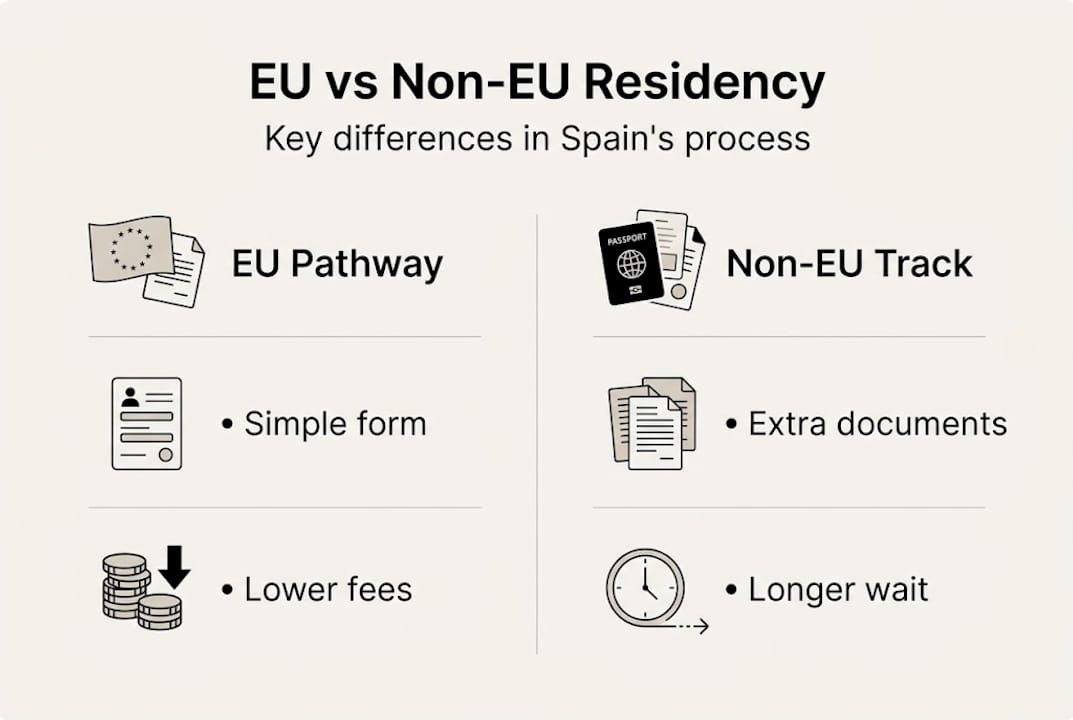
Not all applicants face the same process. The gap between EU and non-EU applications is significant, and understanding it helps you know where expert support matters most.
| Feature | EU citizens | Non-EU applicants |
|---|---|---|
| Main document | Green certificate or TIE | Residence visa plus TIE |
| Registration process | Simple EU registration | Full visa application |
| Income proof required | Generally not required | Required for most visa types |
| Health insurance | Not usually required | Mandatory for most permits |
| Biometrics | Not always required | Required for TIE |
| Renewal complexity | Low to moderate | High, with strict evidence rules |
For EU citizens, registering as an EU citizen is relatively simple. For non-EU applicants, the process involves stricter requirements for proof of income, insurance, and integration, with less room for error at each renewal.
Non-EU applicants face a distinct set of hurdles:
- Proof of sufficient income, which must meet specific thresholds tied to the IPREM (Spain’s public income indicator)
- Private health insurance that explicitly covers the applicant in Spain without copayments
- Biometric appointments at designated offices, which can have long wait times
- Integration requirements for long-term or permanent residency, including language and civic knowledge tests
- Family reunification rules that add complexity when dependents are involved
For families using the EU family card process, or individuals pursuing the Arraigo social pathway after years of irregular residence, legal consultants are not just helpful. They are often the difference between approval and a multi-year delay.
Handling refusals and appeals: What happens when things go wrong?
A refusal is not the end of the road. But how you respond in the days immediately after matters enormously. The most common refusal reasons include insufficient funds, incorrect insurance, excessive absences from Spain, and documentation errors. Critically, you have a one-month window to file an appeal.
Here is the sequence a legal consultant follows after a refusal:
- Review the refusal letter in detail to identify the exact legal grounds cited by the authority.
- Assess whether to appeal or reapply: Appeals (recurso de alzada or recurso de reposición) challenge the decision legally. Reapplication corrects the underlying problem and starts fresh.
- Gather additional evidence: This might mean obtaining updated bank statements, a new insurance policy, or a corrected document.
- Prepare the legal argument: For appeals, consultants draft a formal response that addresses each point in the refusal, citing applicable law.
- Submit within the deadline: Missing the one-month appeal window eliminates that option entirely.
“Most refusals are not final verdicts. They are instructions. A skilled consultant reads the refusal letter and turns it into a roadmap for what to fix.”
If you need support for renewals after a refusal, acting quickly is essential. Delays in reapplying can affect your legal status in Spain, which creates a second problem on top of the first.
Pro Tip: Many refusals are fixable within weeks if the error is purely documentary. The cases that take months to resolve are usually those where the applicant waited too long to seek help or tried to appeal without professional support.
The real difference: Lessons from working with Spanish legal consultants
Here is something most immigration guides will not tell you: legal consultancy is not a guarantee. Expert support reduces risk and speeds up the process, but every case remains unique. Spanish authorities have discretion. Local consular practice varies. Rules change mid-year without public announcement.
What truly separates good legal consultants from average ones is not their knowledge of the standard process. It is how they handle the edge cases: the applicant who was abroad for slightly too long, the family situation that does not fit neatly into any category, the consulate that applies a stricter interpretation than the law technically requires.
Most DIYers miss this. They follow a checklist from a forum post written two years ago and assume the rules have not changed. Some lawyers miss it too, especially those who handle immigration as a side practice rather than a specialty.
The uncomfortable truth is that sometimes you genuinely do not need a lawyer. A straightforward EU registration or a basic NIE application can be done independently with a bit of research. But the moment your situation involves irregular residence history, a gap in documentation, or a visa category with strict financial thresholds, the cost of getting it wrong far exceeds any consultant fee.
We think of legal consultancy as guidance from experienced digital gestorías combined with real legal oversight. Not a shortcut. Not a guarantee. A structured way to reduce the unknowns in a system that has plenty of them.
Take the next step: Get expert help for your Spanish immigration journey
Understanding the process is the first step. Acting on it is where most people get stuck. Whether you are starting a new application, facing a refusal, or planning your next renewal, the right support makes the difference between months of uncertainty and a clear path forward.
Vive Legal prepares your case within 24 hours, covers everything from arraigo social cases to TIE application support, and gives you full visibility through every stage via a secure client portal. Our team combines AI-powered document review with licensed legal professionals, so nothing gets missed. Start with a personalized assessment today and know exactly where you stand.
Frequently asked questions
Is hiring a legal consultant required for Spanish immigration?
No, it is not legally required, but for non-EU applicants or complex cases, a legal consultant significantly reduces refusal risk compared to a DIY approach.
How much does a Spanish immigration legal consultancy cost?
Typical fees range from €1,500 to €5,000 depending on the visa type and the complexity of your individual case.
How long does the immigration process take with professional help?
Most Digital Nomad Visa cases are processed in 20 to 45 days, while other residency permits generally take one to three months.
What are the most common reasons for rejection?
The leading causes are insufficient funds, insurance errors, excessive absences from Spain, and incomplete or incorrectly certified documents.
Does using a legal consultant guarantee a successful application?
No consultant can guarantee approval, but specialized support reduces errors and strengthens evidence, which meaningfully improves your chances of success.
Recommended
Living legally in Spain shouldn't be difficult.
View services and pricesNot sure which procedure you need? Find out in 2 min
Questions? Message us on WhatsApp