
Spain non-lucrative visa explained: your 2026 guide

Many believe the Spain non-lucrative visa permits part-time or freelance work. This is completely false. Spanish law explicitly prohibits any paid work on a non-lucrative visa, and violating this can lead to visa revocation. Understanding the strict rules, eligibility criteria, application steps, and renewal requirements is essential to maintain legal residency. This guide clarifies everything you need to know to navigate the process successfully and avoid common pitfalls that risk your status.
Table of Contents
- Understanding The Spain Non-Lucrative Visa
- Eligibility Criteria And Financial Requirements
- Application Procedure And Timeline
- Legal Restrictions And Rights Under The Visa
- Renewal Process And Maintaining Residency Status
- Common Misconceptions And Pitfalls
- Practical Tips And Real-World Cases
- Get Expert Help With Your Spain Non-Lucrative Visa Process
- Frequently Asked Questions
Key takeaways
| Point | Details |
|---|---|
| No work allowed | The visa strictly forbids any employment, self-employment, or freelance activity in Spain. |
| Financial proof required | Applicants must demonstrate a minimum monthly income of approximately 2,400 EUR or equivalent savings. |
| Private health insurance mandatory | Coverage must be without copayments and valid for the entire stay in Spain. |
| Timely renewal critical | Renewal applications must be filed within 60 days before the visa expires to maintain residency. |
| Common mistakes cost status | Misunderstanding work restrictions and missing renewal deadlines lead to visa denials or revocations. |
Understanding the Spain non-lucrative visa
The non-lucrative visa is a residence permit allowing financially self-sufficient non-EU nationals to live in Spain without working rights. It serves individuals who can support themselves through savings, pensions, investments, or passive income streams. Unlike work or student visas, this permit focuses solely on legal residency without labor market participation.
Living legally in Spain shouldn't be difficult.
View services and pricesNot sure which procedure you need? Find out in 2 min
Questions? Message us on WhatsApp
The initial validity typically lasts one year, with the possibility of renewal if you continue meeting eligibility requirements. This visa creates a legal pathway for retirees, remote workers with foreign income, and those financially independent to establish residency in Spain. Understanding this foundational purpose helps set realistic expectations for your residency experience.
Key characteristics include:
- Legal residency status without permission to work or operate a business in Spain
- Valid for one year initially, renewable for two-year periods thereafter
- Requirement to maintain financial self-sufficiency throughout the residency period
- Access to Spain and Schengen travel while respecting presence requirements
For additional context on Spanish residency options, explore our immigration guides covering various permit types and procedures.
Eligibility criteria and financial requirements
Applicants must demonstrate a minimum monthly income of 2,400 euros or equivalent savings to prove financial self-sufficiency. This translates to approximately 28,800 EUR annually. You can meet this requirement through bank account balances, pension statements, investment income documentation, or rental property revenues from abroad.

Private health insurance without copayments is mandatory for the entire duration of your stay. The policy must provide comprehensive coverage equivalent to Spanish public healthcare. Public insurance alone does not satisfy visa requirements, a common source of application rejections.
Additional eligibility criteria include:
- Clean criminal record from your home country and any country where you resided in the past five years
- Medical certificate confirming you have no diseases requiring quarantine under international health regulations
- Proof of accommodation in Spain through rental agreement or property ownership documentation
- Valid passport with at least one year remaining before expiration
All documents must be official, properly translated into Spanish by certified translators, and notarized or apostilled as required by your consulate. Incomplete or improperly certified documentation causes the majority of application delays and rejections.
Pro Tip: Maintain three to six months of financial statements showing consistent income or stable balances well above the minimum threshold to strengthen your application and demonstrate ongoing financial security.
Application procedure and timeline
You must submit your application at the Spanish consulate in your home country or country of legal residence. The process cannot be initiated from within Spain on a tourist visa. Typical processing time ranges from one to three months, though this varies by consulate workload and application completeness.
Follow these steps for a smooth application:
- Schedule a consular appointment as early as possible, as wait times can extend several weeks
- Gather and certify all required documents including financial proofs, insurance policy, criminal record, and medical certificate
- Complete the visa application form accurately with no errors or omissions
- Submit your complete application package at your scheduled appointment with all originals and copies
- Pay the applicable visa fee as specified by your consulate
- Await the consulate decision and respond promptly to any requests for additional documentation
Common causes of delays include:
- Incomplete application forms with missing signatures or dates
- Insufficient financial documentation or unclear proof of income sources
- Health insurance policies that include copayments or insufficient coverage
- Missing translations or improper document certification
- Failure to schedule timely consular appointments during peak application seasons
Timely follow-ups with the consulate and maintaining organized copies of all submitted materials helps track your application status. If you need guidance on related procedures, review our resources on student visa procedures, arraigo social process, and general visa application tips.
Legal restrictions and rights under the visa
Non-lucrative visa holders are prohibited from any work activity including freelance or business ownership in Spain. This restriction is absolute and non-negotiable. Engaging in paid employment, even part-time or remote work for foreign employers while physically present in Spain, violates your visa terms and risks revocation.
Permissible activities under the visa include:
- Voluntary or unpaid community service work
- Attending language courses, cultural programs, or educational activities for personal enrichment
- Managing foreign investments or businesses that do not require your physical presence or work in Spain
- Traveling freely within the Schengen area during your valid residency period
You access healthcare through your mandatory private insurance policy, not the Spanish public system. However, once you establish long-term residency, pathways to public healthcare may open. Travel rights allow you to move within Schengen countries for up to 90 days in any 180-day period while maintaining your Spanish residency base.
The following table clarifies how the non-lucrative visa compares to other common Spanish residence permits:
| Visa Type | Work Rights | Healthcare Access | Initial Validity | Renewal Period |
|---|---|---|---|---|
| Non-lucrative | None | Private insurance | 1 year | 2 years |
| Work visa | Full employment rights | Public system | 1 year | 2 years |
| Student visa | Limited part-time | Private insurance | Course duration | Course dependent |
| EU residency | Full rights | Public system | 5 years | Permanent |
For more information on alternative residency pathways, explore EU residency rights and travel within Schengen regulations.
Renewal process and maintaining residency status
Renewal applications must be filed within 60 days before your current visa expires. Missing this window creates complications and potential gaps in your legal status. The renewal process requires proving you continue to meet all original eligibility criteria including financial self-sufficiency and health insurance coverage.
Required documents for renewal include:
- Updated bank statements or income proofs demonstrating continued financial resources above the minimum threshold
- Current private health insurance policy valid for the renewal period without copayments
- Proof of accommodation in Spain such as updated rental contract or property ownership documents
- Clean criminal record certificate if requested by immigration authorities
- Completed renewal application forms with applicable fees
Physical presence requirements expect you to spend the majority of your time in Spain. Extended absences exceeding six months per year can jeopardize renewal eligibility, as authorities may question your genuine residency intent. Document all your time in Spain through utility bills, bank transactions, and other evidence of continuous residence.
Failure to renew on time results in losing your residency rights and potentially requiring you to restart the entire application process from your home country. Late renewals can trigger fines, administrative complications, and gaps in legal status that affect future immigration applications.
Pro Tip: Set multiple calendar reminders starting 90 days before your visa expiration to ensure you complete all document gathering and submit your renewal application within the required 60-day window. Keep digital and physical copies of all eligibility documents updated and readily accessible throughout your residency period.
For information on transitioning to permanent residency, review long-term residency options after completing the required years on the non-lucrative visa.
Common misconceptions and pitfalls
The most damaging misconception is believing that part-time, remote, or freelance work is permissible under the non-lucrative visa. Any form of paid employment while holding this visa violates Spanish immigration law and triggers revocation proceedings. Even working remotely for a foreign employer while physically present in Spain counts as prohibited work activity.
Other frequent errors include:
- Assuming public health insurance or travel insurance meets visa requirements when only comprehensive private policies without copayments qualify
- Underestimating the strict financial documentation standards and submitting incomplete or unclear proof of income or savings
- Ignoring the precise 60-day renewal application window and applying too early or waiting until the last minute
- Purchasing health insurance with copayments, deductibles, or coverage gaps that disqualify the policy
- Failing to maintain minimum physical presence in Spain and spending excessive time outside the country
Many applicants mistakenly believe they can switch to work authorization after arrival. While pathways exist to transition to work visas, you cannot perform any paid work on the non-lucrative visa itself. Planning this transition requires returning to your home country to apply for the appropriate work permit or exploring specific exceptions through legal counsel.
Insurance-related failures represent a significant rejection cause. Policies must explicitly state they cover all medical services without requiring the insured to pay copayments at the point of service. Review policy terms carefully and confirm with your insurer that the coverage meets Spanish non-lucrative visa requirements before submitting your application.
Practical tips and real-world cases
A comprehensive preparation checklist ensures you address every requirement:
- Secure a compliant private health insurance policy at least three months before your application to include coverage proof in your documentation
- Gather six months of consecutive bank statements showing balances well above the 28,800 EUR annual minimum
- Obtain and apostille your criminal record certificate within 90 days of application submission
- Schedule your consular appointment two to three months in advance to accommodate processing timelines
- Prepare certified Spanish translations of all foreign documents through accredited translation services
- Create a detailed spreadsheet tracking all document expiration dates, renewal windows, and compliance deadlines
Real rejection cases illustrate common pitfalls. One applicant was denied because their health insurance included a 50 EUR copayment per doctor visit, disqualifying the policy despite comprehensive coverage. Another faced rejection when bank statements showed income deposits but lacked official pension or investment documentation explaining the source.
Successful applicants typically over-prepare financial documentation by providing multiple income proofs such as pension statements, investment account summaries, and property rental agreements from abroad. They select insurance providers experienced with Spanish visa requirements and obtain written confirmation that policies meet all specifications.
Selecting compliant health insurance requires verifying:
- Zero copayments for any medical services including doctor visits, hospital stays, and emergency care
- Coverage valid throughout Spain for the entire visa duration
- Comprehensive benefits equivalent to Spanish public healthcare including preventive care, specialists, and hospitalization
- Clear policy documents in Spanish or with certified Spanish translations
Pro Tip: Maintain an organized digital filing system with scanned copies of all application materials, consular correspondence, and approval documents. Track your visa expiration date, 60-day renewal window, and physical presence days in Spain using a dedicated calendar or app to ensure you never miss critical compliance deadlines.
For additional practical guidance, explore visa practical tips and consider legal consultation advice to strengthen your application strategy.
Get expert help with your Spain non-lucrative visa process
Navigating the non-lucrative visa application and renewal process involves complex documentation, strict timelines, and zero margin for error. Vive Legal specializes in immigration procedures for Spain, offering comprehensive support that minimizes delays and maximizes approval chances.
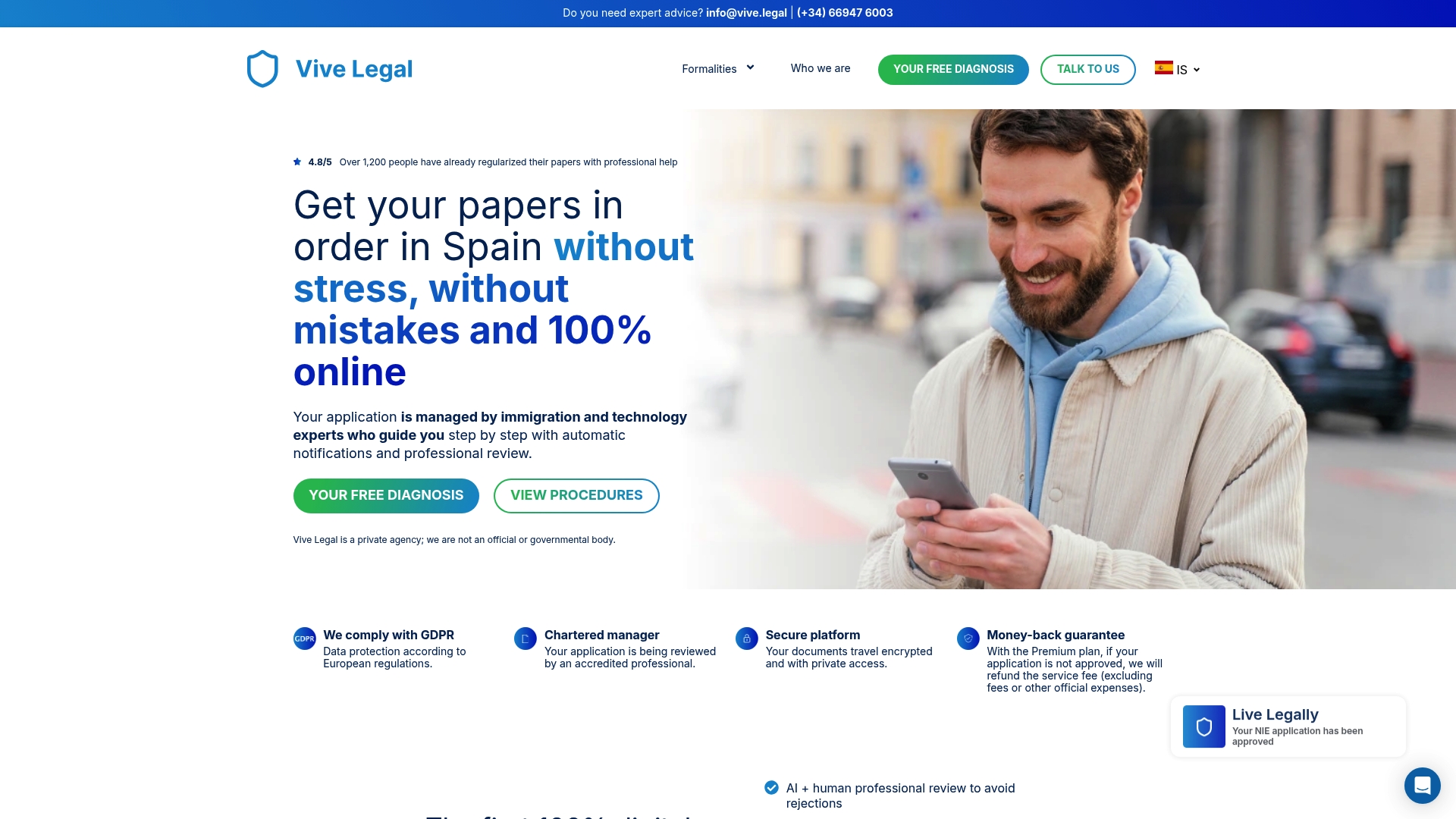
Our platform combines AI-powered document review with expert legal oversight to catch errors before submission. We handle form preparation, appointment scheduling, and case tracking through a secure client portal. Whether you need help with initial applications, renewals, or transitions to other residency types, our transparent pricing and professional accreditation provide confidence throughout your immigration journey.
Explore Vive Legal’s comprehensive immigration services for personalized diagnostics and end-to-end application management. If you’re considering alternative pathways, review our extraordinary regularization services and residency application support to find the solution that fits your situation best.
Frequently asked questions
What is the minimum income required for the Spain non-lucrative visa?
The minimum income is approximately 2,400 EUR per month or 28,800 EUR annually to demonstrate financial self-sufficiency. You must document this through bank statements, pension receipts, investment income records, or other verifiable financial proofs showing consistent access to funds.
Can I work part-time or freelance on a Spain non-lucrative visa?
No, employment or self-employment of any kind, including part-time, freelance, or remote work for foreign employers, is strictly prohibited under this visa. Violating this restriction results in visa revocation and loss of residency rights with potential impact on future immigration applications.
When should I apply for visa renewal?
Renewal applications must be submitted within 60 days before your current visa expires to maintain continuous legal status. Applying too early may result in rejection, while waiting too late risks gaps in residency and administrative complications that can jeopardize your status.
What type of health insurance is required for the visa?
Applicants must have private health insurance without any copayments covering the entire stay in Spain with benefits equivalent to the public healthcare system. Public health insurance alone does not meet visa requirements, and policies with copayments, deductibles, or coverage limitations will result in application rejection.
Recommended
Living legally in Spain shouldn't be difficult.
View services and pricesNot sure which procedure you need? Find out in 2 min
Questions? Message us on WhatsApp