
Spain Work Permit Pathways—Clear Steps for Success

Finding a legal job in Spain as a non-European Union worker often involves strict paperwork, employer sponsorship, and thorough checks by Spanish authorities. The process can feel confusing, especially with rules that prioritize local candidates and require specific permits. This article breaks down the Spain work permit system, showing each step you need for approval, the role of your employer, and how to avoid common mistakes that could slow your move to Spain.
Table of Contents
- Defining The Spain Work Permit System
- Permit Types And Their Key Differences
- Who Qualifies And What Employers Must Do
- Application Process—Steps And Documents Needed
- Rights, Limits, And Responsibilities For Permit Holders
- Costs, Common Pitfalls, And How To Avoid Delays
Key Takeaways
| Point | Details |
|---|---|
| Understanding Work Permit Types | Familiarize yourself with different categories, such as employment contracts and specialized professional roles, as each has specific requirements. |
| Employer Responsibilities | Employers must prove they are unable to find local candidates before sponsoring a work permit, involving thorough recruitment documentation. |
| Application Process Precision | Carefully prepare documentation to avoid common pitfalls such as unlegalized certificates or incomplete submissions which can delay the process. |
| Rights and Limitations | Know your rights as a permit holder, including work restrictions and compliance obligations, to avoid violations that could jeopardize your permit. |
Defining the Spain Work Permit System
Spain’s work permit system represents a complex regulatory framework designed to manage foreign labor entry while protecting domestic employment opportunities. For non-European Union citizens, navigating this system requires understanding multiple legal pathways and specific documentation requirements. The framework fundamentally aims to balance economic needs with structured immigration protocols.
Living legally in Spain shouldn't be difficult.
View services and pricesNot sure which procedure you need? Find out in 2 min
Questions? Message us on WhatsApp
The work permit process varies significantly depending on an applicant’s nationality and professional profile. Specific immigration regulations mandate that non-EU workers must obtain both a work and residence permit before commencing employment. This system includes crucial labor market tests that assess whether qualified Spanish or European workers are available for the same position, creating a protective mechanism for domestic job markets.
Typically, work permits in Spain fall into several key categories, including employment contracts, professional services, seasonal work, and specialized professional roles. Each category requires distinct documentation and meets different criteria. Employers often play a critical role in the application process, as they must demonstrate that they cannot find suitable candidates within the local labor market. The authorization process involves multiple government agencies, including the Ministry of Labor and the local immigration offices.
Pro tip: Before initiating a work permit application, thoroughly research the specific requirements for your professional sector and ensure all documentation is accurately prepared to minimize potential delays.
Permit Types and Their Key Differences
Spain’s work permit landscape encompasses multiple specialized categories designed to address diverse professional scenarios and economic needs. Each permit type represents a unique legal pathway with specific requirements, application processes, and associated rights. Understanding these distinctions is crucial for international workers seeking legal employment in Spain.
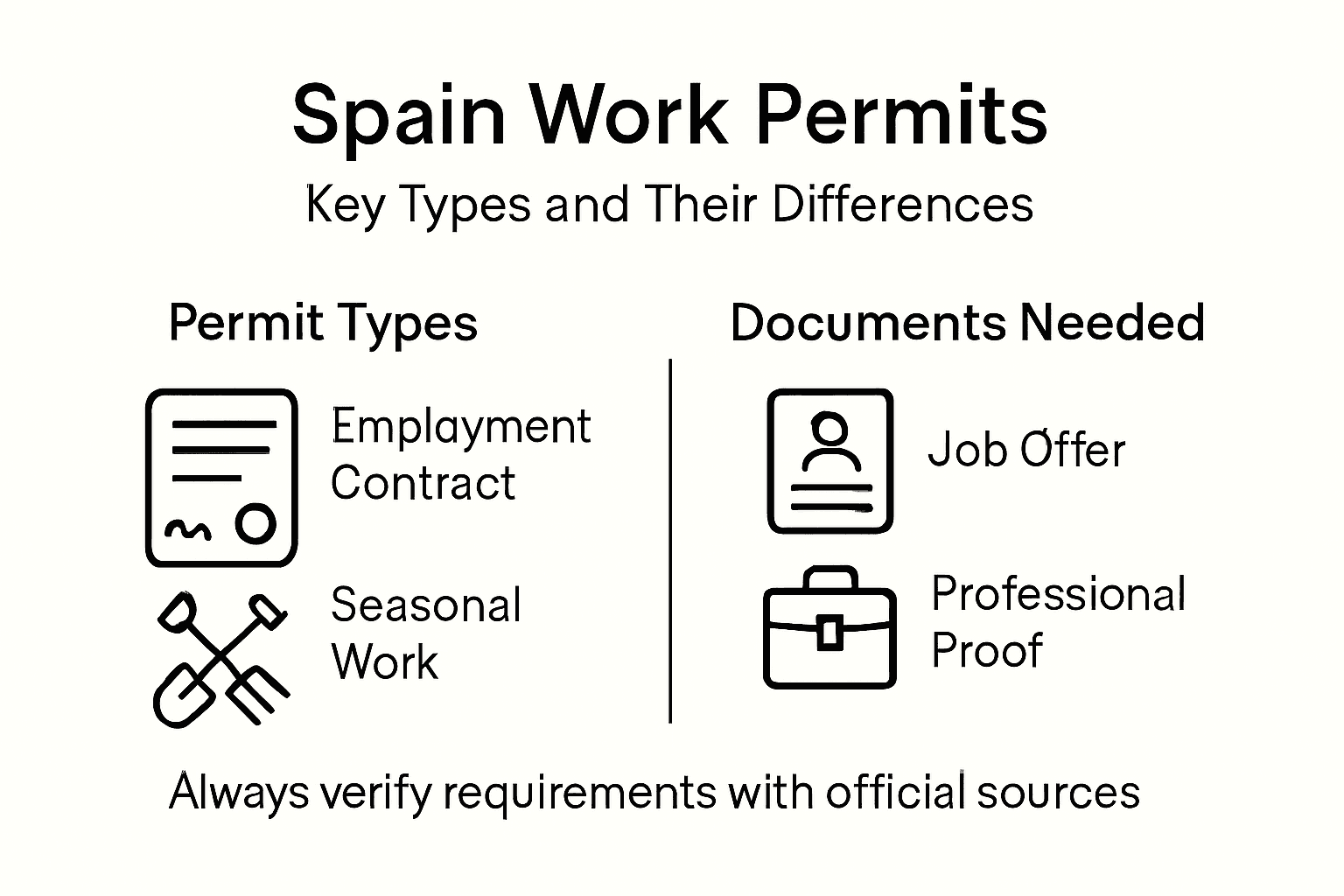
The primary work permit categories include employment contracts, professional services, seasonal work, and specialized professional roles. Highly qualified worker pathways represent a particularly strategic category, offering streamlined processes for professionals with advanced skills and educational backgrounds. These permits often provide additional flexibility, such as easier employer transitions and extended validity periods compared to standard work authorizations.
Each permit type requires distinct documentation and meets different regulatory criteria. For instance, employment contract permits typically demand a formal job offer from a Spanish employer, while professional services permits might cater to independent contractors or consultants. Seasonal work permits have unique limitations on duration and scope, often tied to specific industries like agriculture or tourism. Specialized professional roles, particularly in technology, healthcare, and scientific research, may benefit from accelerated processing and more comprehensive rights.
Pro tip: Carefully analyze the specific requirements for your professional category and prepare comprehensive documentation that precisely matches the regulatory expectations for your chosen work permit type.
Here’s a concise overview of the main Spain work permit types and their unique features:
| Permit Type | Main Beneficiaries | Key Document Needed | Distinct Feature |
|---|---|---|---|
| Employment Contract | Standard employees | Formal job offer | Labor market test required |
| Professional Services | Independent consultants | Proof of expertise | For self-employed work |
| Seasonal Work | Agriculture, tourism | Fixed-term contract | Limited duration, industry-specific |
| Specialized Professional Role | Scientists, tech, healthcare | Advanced qualification proof | Accelerated processing for some roles |
| Highly Qualified Worker | Skilled graduates, experts | Proof of advanced degree | Easier employer transition |
Who Qualifies and What Employers Must Do
Qualifying for a Spanish work permit requires meeting a complex set of legal, professional, and personal criteria that extend beyond basic educational credentials. Non-European Union workers must navigate a rigorous screening process that evaluates their professional skills, potential economic contribution, and alignment with Spain’s labor market needs. The qualification process involves multiple layers of assessment, focusing on both individual capabilities and employer requirements.
Employer sponsorship responsibilities represent a critical component of the work permit system. Employers must meticulously demonstrate that they cannot find suitable candidates within the local labor market, which involves conducting comprehensive recruitment searches and providing extensive documentation. This process includes proving the specific skills gap that the foreign worker will fill, registering for tax and social security obligations, and ensuring complete compliance with immigration regulations.
The qualification criteria typically encompass several key dimensions. Professional qualifications must match the specific job role, with emphasis on advanced degrees, specialized skills, and professional certifications. Personal requirements include clean criminal background checks, valid health certificates, and proof of financial stability. Age can also play a factor, with certain permits having specific age restrictions or preferences for younger professionals with high-potential skill sets.

Pro tip: Compile a comprehensive portfolio documenting your professional qualifications, including translated certifications, professional references, and detailed job descriptions that explicitly demonstrate your unique value to potential Spanish employers.
Application Process—Steps and Documents Needed
The Spanish work permit application process demands meticulous preparation and strict adherence to a comprehensive documentation protocol. Applicants must navigate a complex series of steps that require precise coordination between the potential employer, immigration authorities, and the individual seeking employment. Understanding the intricate requirements is essential for a successful application.
Work visa documentation requirements are stringent and involve multiple critical components. The process begins with the employer obtaining work authorization, followed by the applicant submitting a detailed national visa application. Essential documents include a valid passport, comprehensive job contract, authenticated criminal record certificate, medical health certificate, and official proof of residence authorization. Each document must be carefully prepared, with foreign-language documents requiring sworn translation and official legalization or apostille.
The application workflow typically follows a sequential process. First, the employer must secure a work permit from Spanish labor authorities, demonstrating the inability to find a suitable local candidate. Next, the applicant must compile a comprehensive documentation package, including educational credentials, professional certifications, and detailed employment contracts. The application must be submitted within one month of the initial work authorization, and applicants should anticipate that their passport will remain with the consulate during the processing period. Attention to detail is paramount, as any inconsistency can result in immediate application rejection.
Pro tip: Create a dedicated digital and physical folder with multiple certified copies of all required documents, ensuring you have backup versions of each critical paper to expedite potential replacements or additional submissions.
Rights, Limits, and Responsibilities for Permit Holders
Navigating the legal landscape of a Spanish work permit requires a comprehensive understanding of the rights, limitations, and critical responsibilities that come with foreign worker status. Each permit represents a carefully negotiated legal agreement between the worker, the employer, and Spanish immigration authorities, with specific parameters that must be meticulously followed.
Employment rights and legal protections are fundamental to the work permit system. Permit holders are legally entitled to work exclusively for the employer specified in their authorization, with access to standard labor protections, health services, and social security benefits. These rights also include protection against workplace exploitation, fair compensation, and equal treatment under Spanish labor laws. However, these privileges are contingent upon strict adherence to permit conditions.
The responsibilities and limitations of work permit holders are equally significant. Permit holders must maintain continuous compliance with immigration regulations, which includes timely permit renewals, reporting changes in employment status, and restricting work activities to the specified employer and role. Geographic mobility is often limited, meaning workers cannot arbitrarily change jobs or regions without obtaining additional authorization. Violations can result in permit revocation, potential fines, and future immigration complications. Criminal record maintenance, tax compliance, and ongoing documentation updates are additional critical responsibilities that permit holders must consistently manage.
Pro tip: Maintain a comprehensive digital and physical file of all permit-related documentation, including renewal dates, employment contracts, and communication with immigration authorities, to ensure seamless compliance and quick response to any administrative requirements.
Costs, Common Pitfalls, and How to Avoid Delays
Navigating the Spanish work permit application process requires strategic financial planning and meticulous attention to potential administrative obstacles. Applicants must anticipate a comprehensive range of expenses and procedural challenges that can significantly impact their immigration journey. Understanding these financial and logistical considerations is crucial for a smooth and successful application.
Document processing requirements involve multiple potential costs and critical administrative checkpoints. Typical expenses include official translation fees, medical examination costs, background check processing, consular application fees, and potential legal consultation charges. These can range from several hundred to potentially thousands of euros, depending on individual circumstances and professional category. Common pitfalls include incomplete documentation, missed deadlines, improper translations, and failure to meet specific legalization requirements.
The most frequent application delays stem from preventable administrative errors. These include submitting unlegalized documents, providing incomplete information, missing translation certifications, or failing to meet specific consular timelines. Applicants must ensure all foreign-language documents are professionally translated and officially authenticated, with sworn translators providing certified copies. Timing is critical, as applications filed late after initial employer authorization can face immediate rejection. Strategic preparation, including maintaining a comprehensive document portfolio and understanding precise bureaucratic requirements, can significantly mitigate potential complications.
For quick reference, compare the top reasons for work permit application delays and how to prevent them:
| Common Delay Cause | Preventive Measure | Impact if Ignored |
|---|---|---|
| Uncertified translations | Use approved sworn translators | Rejection or resubmission |
| Incomplete documentation | Double-check requirements checklist | Application put on hold |
| Missed deadlines | Track all submission dates | Permit becomes invalid |
| Unlegalized certificates | Obtain necessary apostille/legalization | Administrative rejection |
Pro tip: Create a dedicated digital and physical checklist tracking every document’s status, translation requirement, and submission deadline to proactively manage your work permit application process and minimize administrative risks.
Simplify Your Spain Work Permit Journey with Expert Support
Navigating Spain’s complex work permit system can feel overwhelming with its strict documentation, labor market tests, and precise legal requirements. If you want to avoid common pitfalls such as incomplete paperwork or missed deadlines the right help can make all the difference. At Vive Legal, we understand the challenges of securing employment contracts, professional services permits, and specialized roles in Spain. Our platform combines AI-driven automation with expert legal oversight to ensure your application is accurate, complete, and submitted on time.
Take control of your immigration process today by leveraging personalized diagnostics, document reviews, and appointment scheduling all from the convenience of your home. Don’t risk delays or rejections when you can access hassle-free legal consultancy designed for expatriates and skilled workers. Start your successful Spain work permit application with Vive Legal now and experience a streamlined approach that protects your future. Visit Vive Legal and explore expert solutions in our Uncategorized Archives - Vive Legal to get started immediately.
Frequently Asked Questions
What types of work permits are available in Spain?
Spain offers several work permit categories, including employment contracts, professional services, seasonal work, specialized professional roles, and pathways for highly qualified workers.
What is the application process for obtaining a Spanish work permit?
The application process involves the employer securing work authorization, followed by the applicant submitting a detailed national visa application with necessary documents like a valid passport, job contract, and health certificate.
What are the main qualifications required for a Spanish work permit?
Qualifications typically include professional credentials matching the job role, a clean criminal background, a valid health certificate, and proof of financial stability. Age requirements may also apply depending on the permit type.
What rights do holders of Spanish work permits have?
Permit holders are entitled to work for the employer specified in their authorization, access standard labor protections, and social security benefits. They must also adhere to strict compliance with permit conditions.
Recommended
Living legally in Spain shouldn't be difficult.
View services and pricesNot sure which procedure you need? Find out in 2 min
Questions? Message us on WhatsApp