
Spanish Residency Laws: What Expats Must Know

Moving from one EU country to Spain can leave even the most seasoned professionals confused about their legal status. European families often find that the process involves more than just showing up with a job contract and a passport. Spanish residency laws require careful attention to documentation, clarification of your rights, and understanding of your obligations as an EU citizen. This guide will help you untangle those rules so your move to Spain is as smooth and predictable as possible.
Table of Contents
- Defining Spanish Residency And Common Misconceptions
- Key Residency Types: EU, Non-EU, And Arraigo
- Spanish Residency Legal Framework And Application Steps
- Required Documents, NIE, TIE, And Registration Process
- Resident Rights, Obligations, And Mistakes To Avoid
- Costs, Renewals, And Legal Risks For Expats
Key Takeaways
| Point | Details |
|---|---|
| Understanding Residency | Spanish residency involves specific legal requirements and documentation, not just living in the country. It is essential to meet continuous presence and integration criteria. |
| Types of Residency Paths | Spain offers distinct residency categories such as EU residency, Non-EU professional visas, and different types of Arraigo, each with specific criteria that must be met. |
| Key Documentation | Applicants must provide essential documentation, including proof of financial means, health insurance, and a clean criminal record, during the residency application process. |
| Renewal and Legal Obligations | Timely permit renewals and compliance with local regulations are crucial to maintaining legal residency status and avoiding potential legal risks. |
Defining Spanish Residency and Common Misconceptions
Understanding Spanish residency laws can be complex, especially for international professionals seeking to establish legal status in Spain. Residency is not simply about living in a country, but involves specific legal requirements and documentation that determine an individual’s official status.
Living legally in Spain shouldn't be difficult.
View services and pricesNot sure which procedure you need? Find out in 2 min
Questions? Message us on WhatsApp
Spain’s residency framework is nuanced, with multiple pathways and specific conditions that often surprise newcomers. Spanish nationality law establishes clear guidelines for residency, which revolve around continuous legal presence and integration into Spanish society. The process is more flexible than many expats initially assume, with different tracks available depending on an individual’s professional background, country of origin, and personal circumstances.
Key aspects of Spanish residency include:
- Demonstrating legal, continuous presence in the country
- Meeting specific documentation requirements
- Proving financial stability
- Showing health insurance coverage
- Passing language and cultural integration assessments
Contrary to popular belief, Spain does not offer a straightforward citizenship-by-investment program. Instead, legal residency requires meeting specific conditions that vary based on an applicant’s background. Legal residency pathways typically involve a ten-year continuous residence requirement, with some exceptions for citizens from specific countries like Latin American nations, Andorra, and the Philippines.
Pro tip: Always consult with a legal expert specializing in Spanish immigration law to understand the most current requirements and ensure your specific situation qualifies for residency.
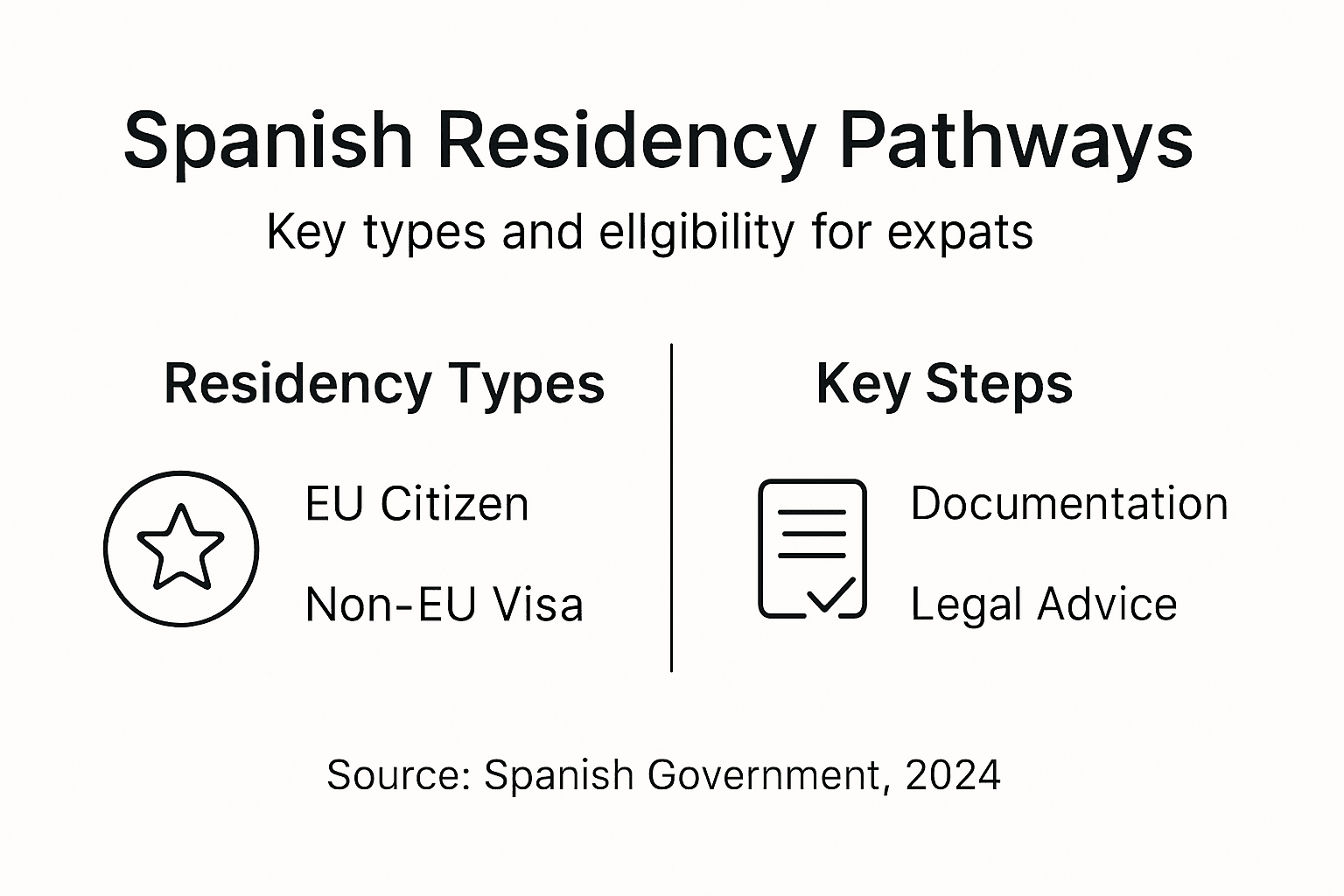
Key Residency Types: EU, Non-EU, and Arraigo
Spain offers multiple residency pathways for international professionals, each with unique requirements and processes. Understanding these different categories is crucial for successfully navigating the country’s immigration system and establishing legal status.

European Union Citizens benefit from more streamlined processes due to freedom of movement regulations. Residency rights under EU law provide significant advantages for citizens from member states, allowing relatively easy registration and movement within Spain.
Key residency categories include:
- EU Residency: For citizens of European Union countries
- Non-EU Professional Visas: Requiring specific employment or investment criteria
- Arraigo Permits: For individuals establishing social or professional roots
For non-European nationals, Arraigo represents a critical pathway to legal residency. Arraigo permits offer unique opportunities for individuals to regularize their status through various subcategories:
- Social Arraigo: Requires 3 years of continuous residence
- Labor Arraigo: Based on employment history
- Family Arraigo: Connected through family relationships
- Training Arraigo: Related to educational or professional development
Each Arraigo type has specific documentation requirements, demonstrating the complexity of Spain’s immigration framework. Non-EU citizens must carefully evaluate their specific circumstances to determine the most appropriate residency pathway.
Pro tip: Consult with a specialized immigration lawyer to precisely evaluate which residency type matches your individual professional and personal circumstances.
Here is a comparison of major Spanish residency options for professionals:
| Residency Pathway | Main Eligibility Criteria | Typical Time to Residency | Distinctive Advantage |
|---|---|---|---|
| EU Citizen Residency | EU citizenship, registration in Spain | Same day to 1 week | Streamlined process |
| Non-EU Professional | Work contract, financial proof | 1-3 months | Employment-based legal status |
| Arraigo Social | 3 years’ presence, social ties | 3 years | Regularizes informal residents |
| Arraigo Laboral | Work history, legal stay evidence | 2 years work, 1 year stay | Recognizes past employment |
Spanish Residency Legal Framework and Application Steps
The Spanish residency framework represents a complex legal system that requires careful navigation and precise documentation. Spanish nationality law establishes comprehensive guidelines that govern the intricate process of obtaining legal residency, with specific articles in the Civil Code defining the requirements and procedures for international professionals.
The application process involves multiple critical components that applicants must carefully address:
- Comprehensive documentation preparation
- Proof of financial stability
- Clean criminal record verification
- Health insurance coverage
- Demonstrated integration potential
Application Steps for residency typically follow a structured progression. Residency regulations mandate specific procedural requirements that vary depending on the applicant’s specific circumstances and residency category.
Key documentation requirements include:
- Valid passport
- Completed application forms
- Proof of financial means
- Medical certificate
- Criminal background check
- Relevant visa or permit documentation
The complexity of Spain’s immigration system demands meticulous attention to detail. Non-EU applicants must be particularly thorough, as each residency category has unique supporting document requirements and evaluation criteria.
Pro tip: Organize all documentation chronologically and create digital and physical copies of every submitted document to maintain a comprehensive record of your residency application process.
Required Documents, NIE, TIE, and Registration Process
Navigating the Spanish bureaucratic landscape requires understanding two critical identification documents: NIE and TIE. Foreigner identification requirements differ significantly between EU and non-EU nationals, with each category facing unique administrative procedures.
Key identification documents for expats include:
- NIE (Foreigner Identification Number): Administrative tax identification number
- TIE (Foreigner Identity Card): Official residency documentation
- Passport
- Proof of financial means
- Health insurance documentation
The NIE serves as a fundamental administrative identifier for foreign residents, necessary for tasks like opening bank accounts, signing contracts, and paying taxes. For EU citizens staying over three months, obtaining an NIE becomes mandatory.
TIE Application Requirements:
- Valid passport
- Completed EX-18 application form
- Visa or residency permit
- Passport-sized photographs
- Proof of payment for application fee
- Proof of health insurance
- Documentation proving financial stability
TIE card application involves a comprehensive process that requires meticulous document preparation and personal appearance at immigration offices. Non-EU nationals must undergo biometric data collection and provide extensive documentation to validate their legal residence status.
Pro tip: Digitize and create multiple copies of all required documents before your TIE appointment to streamline the application process and prevent potential delays.
Resident Rights, Obligations, and Mistakes to Avoid
Understanding the legal landscape of residency in Spain requires comprehensive knowledge of both rights and responsibilities. Migrant rights and obligations encompass a complex framework of legal protections and administrative requirements that expats must carefully navigate.
Key Resident Rights include:
- Access to public healthcare systems
- Right to education
- Social welfare services
- Protection against discrimination
- Legal employment opportunities
Residents must be acutely aware of their Obligations, which extend far beyond simple documentation compliance. These critical responsibilities involve:
- Timely permit renewal
- Compliance with local labor regulations
- Maintaining legal residency status
- Paying applicable taxes
- Participating in social integration processes
Asylum and migration policies emphasize the importance of understanding precise legal definitions and procedural requirements. Failing to maintain proper documentation or missing renewal deadlines can result in significant legal complications, including potential deportation.
Common mistakes expats frequently make include:
- Neglecting permit renewal timelines
- Misunderstanding residency status definitions
- Underestimating language integration requirements
- Not maintaining comprehensive documentation
- Failing to report changes in personal circumstances
Pro tip: Create a digital and physical filing system for all residency-related documents, with clear renewal reminders set at least three months before permit expiration.
Costs, Renewals, and Legal Risks for Expats
Navigating the financial and administrative landscape of Spanish residency requires careful planning and understanding of potential expenses and legal implications. Residency permit costs vary significantly depending on the type of application and individual circumstances, with expats needing to budget for multiple potential expenses.
Key financial considerations for residency include:
- Initial application fees
- Renewal documentation costs
- Required health insurance premiums
- Translation and notarization expenses
- Potential legal consultation fees
Typical Renewal Expenses:
- Permit renewal fee: €75-€250
- Health insurance documentation: €500-€1,200 annually
- Administrative processing costs: €50-€150
- Translation services: €30-€100 per document
Residence permit regulations emphasize the critical importance of timely renewals and comprehensive documentation. Failing to maintain proper legal status can result in significant legal risks, including potential fines, deportation, and future immigration complications.
Common legal risks for expats include:
- Overstaying permit validity
- Working without proper authorization
- Insufficient documentation
- Missing critical renewal deadlines
- Incomplete financial proof
Pro tip: Create a dedicated digital and physical folder for all residency-related documents, with clear reminders set at least four months before permit expiration to ensure smooth renewal processes.
Below is a summary of common permit renewal costs and legal risks for expats in Spain:
| Expense or Risk | Typical Range / Impact | Example Scenario |
|---|---|---|
| Permit Renewal Fees | €75 – €250 per renewal | Applying for next residency term |
| Health Insurance | €500 – €1,200 annually | Mandatory private policy |
| Translation/Notarization | €30 – €100 per document | Translating marriage certificate |
| Missed Renewal Deadline | Risk of legal status loss | Late application, possible fine |
| Insufficient Documentation | Application refusal possible | Missing proof of financial means |
Simplify Your Journey Through Spanish Residency Laws with Expert Support
Navigating Spain’s complex residency regulations can be overwhelming, especially when managing critical steps like obtaining your NIE, TIE, or Arraigo permits. If you feel burdened by strict documentation requirements, renewal deadlines, or language and legal obstacles, you are not alone. Vive Legal understands these challenges and offers a streamlined, fully digital solution designed to reduce stress and maximize your chances of success. Benefit from personalized diagnostics, expert document review, and seamless appointment scheduling all managed securely online.
Don’t let confusing residency procedures delay your plans in Spain. Visit Vive Legal to access professional immigration assistance tailored to your specific residency needs. Explore our Uncategorized Archives - Vive Legal for the latest insights or start your journey directly through our main landing page. Take the next step now toward legal peace of mind in Spain with convenient, accurate, and trustworthy service.
Frequently Asked Questions
What are the key requirements for obtaining Spanish residency?
Key requirements for obtaining Spanish residency include demonstrating legal, continuous presence in the country, meeting documentation requirements, proving financial stability, showing health insurance coverage, and passing language and cultural integration assessments.
What types of residency pathways are available for expats in Spain?
Expats in Spain can choose from various residency pathways, including EU citizenship residency, non-EU professional visas, and different types of Arraigo permits, which cater to unique circumstances such as social, labor, family, and training ties.
How can I prepare for the Spanish residency application process?
To prepare for the Spanish residency application process, ensure you have comprehensive documentation, including a valid passport, completed application forms, proof of financial means, a medical certificate, and a criminal background check. Organize all documents chronologically and make copies for your records.
What are the common mistakes to avoid when applying for Spanish residency?
Common mistakes to avoid when applying for Spanish residency include neglecting permit renewal timelines, misunderstanding residency status definitions, underestimating language integration requirements, and failing to maintain comprehensive documentation. Keeping organized records is vital to prevent issues.
Recommended
Living legally in Spain shouldn't be difficult.
View services and pricesNot sure which procedure you need? Find out in 2 min
Questions? Message us on WhatsApp