
Spanish Residency Terminology: Key Concepts Explained

Settling into life in Spain comes with more than just finding a new home or job—it often means decoding complex terms like NIE and TIE before you can live, work, or study legally. For many international residents, the difference between a tax identification number and an official residency card can feel confusing. With clear guidance on the core documents and legal steps required for expatriates and foreign workers, this overview helps you approach Spanish residency processes with confidence.
Table of Contents
- Core Definitions In Spanish Residency Law
- Types Of Residency Terms And Acronyms
- NIE, TIE, And EU Registration Differences
- Legal Requirements And Application Processes
- Rights, Obligations, And Common Pitfalls
Key Takeaways
| Point | Details |
|---|---|
| Understanding Residency Documents | Foreign nationals in Spain require a NIE and TIE to establish legal residency and carry out administrative tasks. Familiarity with these documents is critical for compliance. |
| Types of Residency Status | Temporary and permanent residency classifications offer varying rights and requirements. Non-EU nationals face a more rigorous process than EU citizens. |
| Application Process for Non-EU Nationals | Non-EU applicants must complete a stringent application process within 30 days of arrival, including biometric data collection and detailed documentation submission. |
| Rights and Obligations of Residents | Legal residents gain essential rights but must keep documentation up-to-date and comply with local laws to avoid penalties or revocation of residency. |
Core Definitions in Spanish Residency Law
Understanding Spanish residency law requires navigating complex terminology and legal frameworks that govern how foreign nationals establish legal status within Spain. Legal residency status involves several critical documents and processes that determine an individual’s rights and obligations.
Living legally in Spain shouldn't be difficult.
View services and pricesNot sure which procedure you need? Find out in 2 min
Questions? Message us on WhatsApp
The foundational elements of Spanish residency revolve around two primary identification documents: the NIE (Número de Identidad de Extranjero) and the TIE (Tarjeta de Identidad de Extranjero). The NIE serves as a tax identification number for foreign residents, while the TIE functions as an official residency card proving legal permission to live and potentially work in Spain. Non-European Union citizens must obtain these documents within specific timeframes after entering the country, typically within 30 days of arrival if holding a long-term visa.
Spain’s nationality and residency laws are primarily governed by the Civil Code, with specific provisions outlined in Articles 17 to 28. The legal framework emphasizes jus sanguinis principles, meaning citizenship is predominantly acquired through bloodline or ancestral connections. This approach differs from countries that rely more heavily on jus soli (birthplace) criteria. Spanish nationality law provides preferential treatment for individuals from former Spanish colonies, reflecting the country’s historical diplomatic relationships.
Pro tip: Always ensure your identification documents are current and properly renewed to maintain legal residency status in Spain.
Types of Residency Terms and Acronyms
Navigating Spanish residency requires understanding a complex landscape of legal terminology and official documentation. Residency classification systems involve multiple categories that define an individual’s legal status, rights, and potential pathways to long-term settlement in Spain.
Spanish residency terms are primarily categorized into several key classifications. Temporal Residency represents the initial stage, typically granted for one year and renewable for those with specific work contracts, study permits, or family reunification purposes. Permanent Residency represents the next tier, available after five continuous years of legal residence, offering more extensive rights and stability. For European Union citizens, a special Residencia Comunitaria status provides additional privileges, allowing relatively straightforward registration processes compared to non-EU nationals.
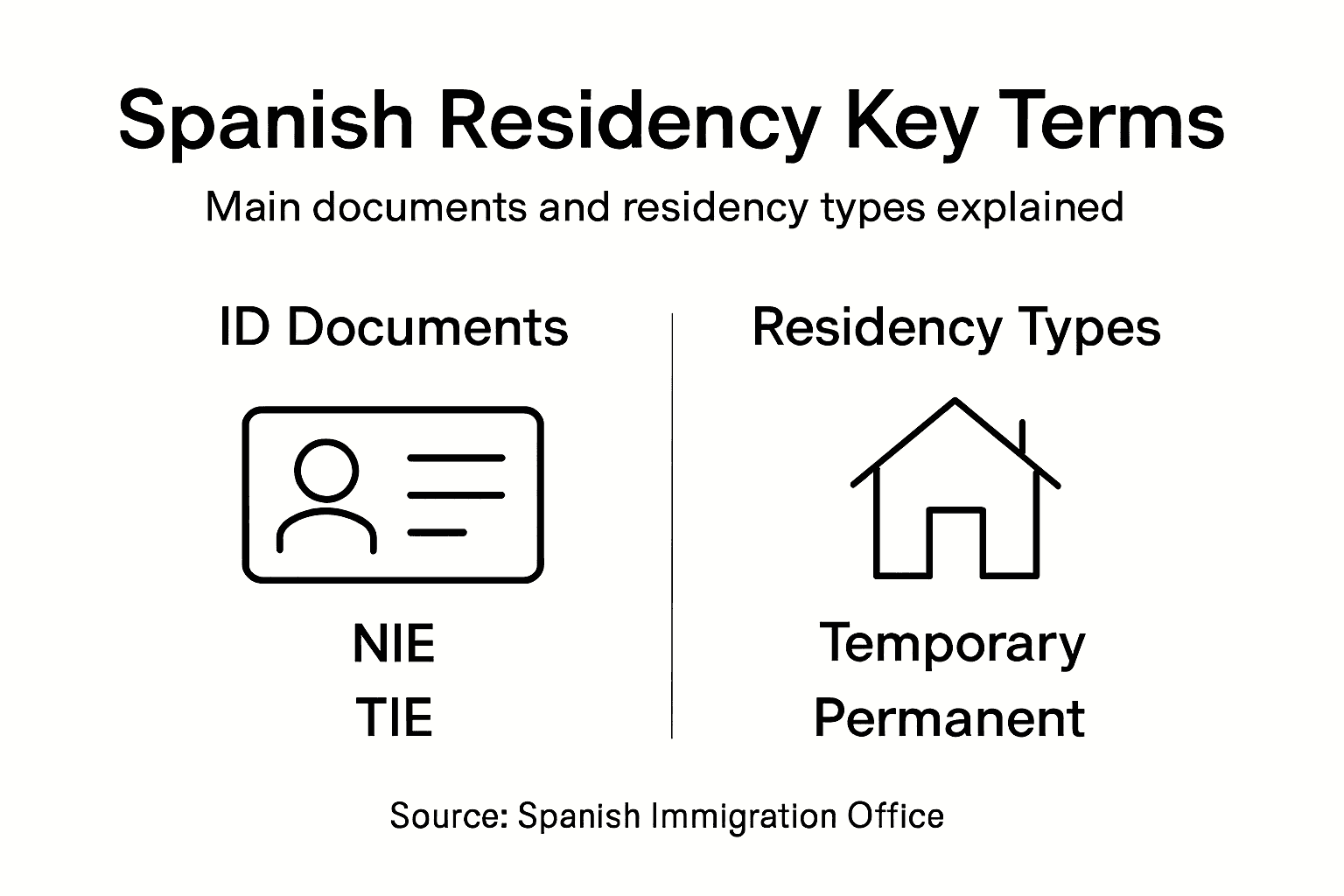
Specific residency acronyms play a crucial role in understanding an individual’s legal standing. The NIE (Número de Identidad de Extranjero) functions as a tax identification number, while the TIE (Tarjeta de Identidad de Extranjero) serves as the physical residency card. Other important terms include Arraigo Social (a residency pathway for individuals who have established significant social roots in Spain) and Reagrupación Familiar (family reunification permits that allow legal residents to bring immediate family members into the country).
Pro tip: Maintain meticulous documentation and track the expiration dates of your residency permits to ensure continuous legal status in Spain.
The following table summarizes typical residency types and their main features:
| Residency Type | Initial Validity | Main Eligibility Requirement | Key Benefits |
|---|---|---|---|
| Temporary Residency | 1 year (renewable) | Work, study, or family permit | Legal stay; basic rights |
| Permanent Residency | 5+ years continuous | Ongoing legal residency | Stability; expanded rights |
| EU Community Residency | Indefinite (with renewal) | EU citizenship or family relationship | Easy process; added privileges |
NIE, TIE, and EU Registration Differences
The Spanish residency system creates distinct pathways for European Union and non-European Union nationals, with critical documentation requirements that vary significantly based on citizenship status. Understanding these nuanced differences is crucial for successful legal registration and long-term residency planning.
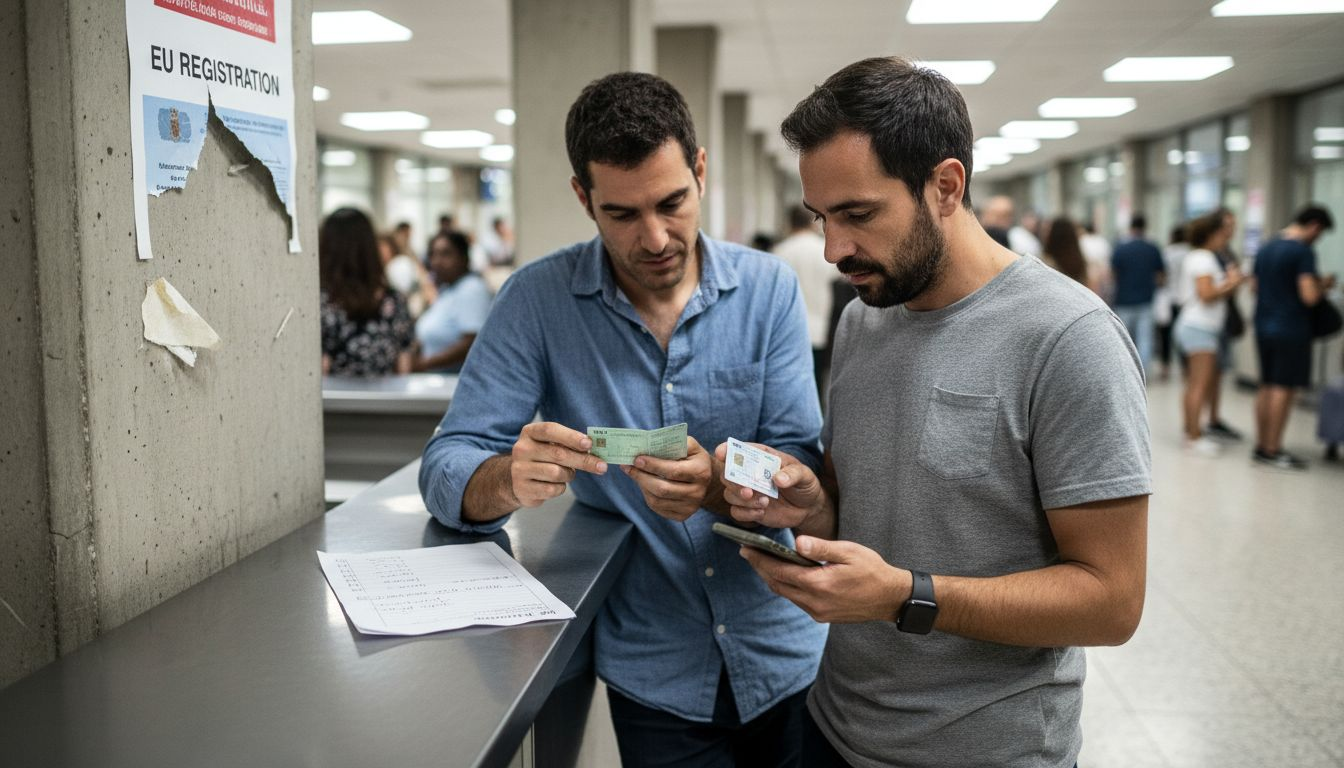
For European Union citizens, the registration process is comparatively straightforward. They must obtain a NIE (Número de Identidad de Extranjero), which serves as a tax identification number, when planning to stay in Spain for more than three months. This numerical identifier allows EU nationals to open bank accounts, sign contracts, and complete administrative tasks. Non-EU nationals, however, face a more complex process requiring a TIE (Tarjeta de Identidad de Extranjero), which is a physical residence permit that incorporates their unique identification number and provides more comprehensive legal documentation.
The key distinctions between NIE and TIE extend beyond mere documentation. While the NIE is primarily an administrative identifier, the TIE represents a more comprehensive legal proof of residency. Non-EU nationals must submit extensive documentation, including proof of financial means, health insurance, and valid reasons for extended stay (such as work contracts, study permits, or family reunification). EU citizens typically only need to register with local authorities and demonstrate sufficient financial resources to support themselves during their stay.
Here’s a concise comparison of key Spanish residency documents for EU and non-EU nationals:
| Document Type | Purpose | Who Needs It | Duration/Function |
|---|---|---|---|
| NIE | Tax identification & administrative number | All foreign nationals | Required for most legal/financial actions |
| TIE | Official residency card/proof | Non-EU nationals | Confirms legal residency; renewable |
| EU Certificate | Proof of residency (Registro de Ciudadano) | EU nationals | Documents stay over three months |
Pro tip: Always verify the specific documentation requirements for your nationality and intended duration of stay, as immigration regulations can change frequently.
Legal Requirements and Application Processes
Navigation of Spanish residency regulations requires a systematic understanding of the complex documentation and procedural requirements for both EU and non-EU nationals. Each applicant must meticulously prepare and submit specific documents that demonstrate their eligibility for legal residence.
Non-EU nationals face a more rigorous application process that begins within 30 days of arrival with a long-term visa. The process involves multiple critical steps: booking an initial appointment, submitting comprehensive documentation, and completing biometric data collection. Key forms include the EX-17 application and MOD 790 fee payment document. Applicants must provide extensive evidence including valid passport, proof of financial solvency, health insurance documentation, and specific justification for their extended stay such as work contracts, study permits, or family reunification purposes.
The residency application timeline is carefully structured to ensure thorough verification. After the initial appointment, authorities typically schedule a follow-up meeting approximately 40 days later for final document review and issuance of the physical residency card. Different categories of applicants—students, workers, family members—have nuanced requirements that demand precise documentation and adherence to specific legal guidelines. Failure to submit complete and accurate paperwork can result in significant delays or potential application rejection.
Pro tip: Organize your documentation chronologically and create digital and physical backup copies of all submitted paperwork to streamline your residency application process.
Rights, Obligations, and Common Pitfalls
Residency in Spain involves a complex landscape of legal rights and potential challenges that every foreign national must carefully navigate. Understanding these nuances is critical to maintaining legal status and avoiding potential complications during your stay.
As a legal resident, individuals gain significant rights within the Spanish legal system. European Union nationals enjoy additional privileges, including freedom of movement, voting rights in European Parliament elections, and access to social services. Non-EU residents have more restricted rights but are still protected by constitutional guarantees. Key obligations include maintaining valid documentation, reporting changes in residence or employment status, and adhering to Spanish tax regulations. Failure to comply with these requirements can result in fines, potential legal complications, or even revocation of residency permits.
Common pitfalls for expatriates often stem from misunderstanding bureaucratic processes or overlooking critical administrative details. These can include missing renewal deadlines for residency documents, failing to update address information with local authorities, or inadvertently violating work permit restrictions. Some expatriates struggle with the nuanced differences between temporary and permanent residency status, which can impact long-term legal standing. Certain nationalities may face additional scrutiny, with stricter legal barriers to nationality acquisition that demand meticulous documentation and adherence to specific regulatory requirements.
Pro tip: Maintain a comprehensive digital and physical file of all residency-related documents, and set recurring calendar reminders for critical renewal dates and administrative obligations.
Simplify Your Journey Through Spanish Residency Terms Today
Understanding terms like NIE, TIE, Temporary Residency, and Arraigo can feel overwhelming and confusing. Many face challenges such as missing deadlines, navigating complex paperwork, and the stress of potential application delays. If you want to avoid these common pitfalls and confidently manage your residency status, you need clear support that speaks your language.
At Vive Legal, we specialize in making Spanish residency procedures simple and error-free with personalized document reviews, secure case tracking, and professional guidance. Whether you are applying for your first residency permit or renewing your TIE, our online platform streamlines every step in one place. Don’t let misunderstandings of residency acronyms or legal obligations hold you back. Get started now with trusted help from Uncategorized Archives - Vive Legal and take control of your Spanish residency process today.
Frequently Asked Questions
What is the difference between NIE and TIE in the Spanish residency process?
The NIE (Número de Identidad de Extranjero) is a tax identification number necessary for all foreign nationals for administrative purposes, while the TIE (Tarjeta de Identidad de Extranjero) serves as the official residency card that proves legal residency status in Spain, particularly for non-EU nationals.
How long does it take to obtain a TIE for non-EU nationals?
After the initial application process, it typically takes around 40 days for authorities to review documents and issue the TIE, following a scheduled appointment for final verification and biometric data collection.
What are the main eligibility requirements for gaining permanent residency in Spain?
To obtain permanent residency, individuals must have been legally residing in Spain for at least five continuous years, maintaining compliance with the legal requirements, including valid documentation during that period.
What are the common pitfalls to avoid when applying for residency in Spain?
Common pitfalls include missing renewal deadlines for residency documents, failing to report changes in residence or employment, and misunderstanding the differences between temporary and permanent residency, which can affect legal standing.
Recommended
Living legally in Spain shouldn't be difficult.
View services and pricesNot sure which procedure you need? Find out in 2 min
Questions? Message us on WhatsApp