
Spanish Residency Types: Choosing Your Legal Pathway

Starting the Spanish residency process can feel like opening a box of hidden rules, especially when outdated advice is everywhere and laws have just evolved. For expat professionals and international students, misunderstanding permit types or missing a key detail could cost months and jeopardize your stay. This guide clarifies the critical differences between temporary and permanent residency, exposes common pitfalls, and highlights updated legal pathways so you can confidently manage your Spanish residency and avoid unnecessary bureaucratic obstacles.
Table of Contents
- Spanish Residency Basics And Misconceptions
- Temporary And Permanent Residency Categories
- Key Permit Types: Work, Study, Arraigo, Family, Digital Nomad
- Legal Requirements And Documentation Needed
- Rights, Obligations, And Financial Impacts
- Common Mistakes, Risks, And Change Procedures
Key Takeaways
| Point | Details |
|---|---|
| Understand Residency Categories | Distinguish between temporary and permanent residency as they involve different rights, obligations, and durations. |
| Stay Informed on Laws | Familiarize yourself with current residency laws through official sources to avoid misconceptions about their legality. |
| Ongoing Documentation Requirements | Maintain a checklist of required documents and deadlines to prevent application rejections and compliance issues. |
| Plan Financial Obligations | Be aware of the tax implications and financial responsibilities associated with residency status in Spain. |
Spanish residency basics and misconceptions
Misconception 1: All residence permits work the same way. This is perhaps the most common mistake expat professionals make. Spain’s residency framework is far more diverse than most people realize. Your specific permit type determines everything—what you can work, how long you can stay, whether you can bring family members, and what rights you have access to. Royal Decree 1155/2024 fundamentally restructured how Spain categorizes and administers residence permits, which means information you found three years ago might be completely outdated now.
Living legally in Spain shouldn't be difficult.
View services and pricesNot sure which procedure you need? Find out in 2 min
Questions? Message us on WhatsApp
The reality is that Spain distinguishes between temporary residence and permanent residence statuses, each with distinct requirements and benefits. Temporary residence permits are typically valid for one to three years and may come with conditions, such as employment sponsorship or financial thresholds. Permanent residence, by contrast, provides long-term legal stability and is available after meeting specific residency duration requirements. The evolving migration model in Spain explicitly defines rights for migrant workers and simplifies processes, yet many expats remain unaware that their current permit category may not grant them the freedoms they assume they have.
Misconception 2: Spanish residency laws are vague and constantly changing without warning. Actually, Spain’s residency regulations are grounded in a structured legal hierarchy that includes constitutional law, formal statutes, and international treaties. These provisions are formally published in the Official State Gazette, which means changes are transparent and accessible to anyone willing to look for them. The problem isn’t that the law is vague—it’s that most people don’t know where to find authoritative legal information. Understanding that Spanish legal provisions are published formally through official channels helps you distinguish between reliable guidance and hearsay from expat Facebook groups.
Misconception 3: Your residency status is permanent after you get it. Wrong. Most residence permits require active maintenance and renewal. If you leave Spain for an extended period without notifying authorities, you risk losing your status. Some permits have specific employment or financial requirements that you must continue satisfying. Switching jobs, changing your employment situation, or altering your financial circumstances might trigger obligations to update your documentation. As an international student or professional, understanding these ongoing obligations from day one prevents costly compliance problems later. The distinction between different residency types matters enormously here—a temporary work permit operates under completely different renewal rules than an EU citizen registration certificate.
Pro tip: Before accepting your first Spanish residency permit, request a written summary from a qualified legal advisor explaining your specific permit type’s renewal requirements, work restrictions, and any automatic expiration clauses. This prevents assumptions that cost months of bureaucratic corrections.
Temporary and permanent residency categories
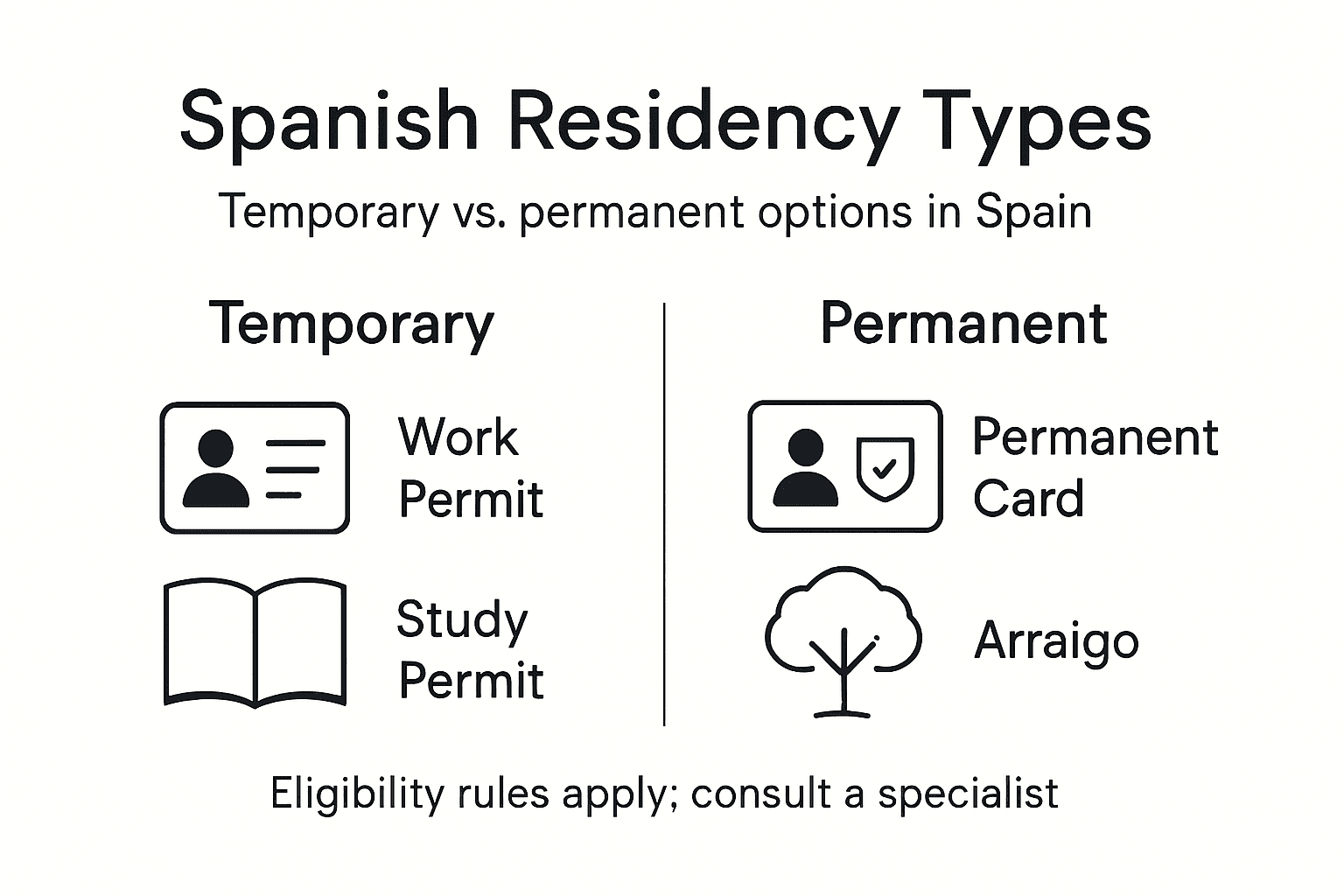
Spain’s residency system operates on two distinct tiers, and understanding which category applies to your situation is absolutely critical. The first tier covers temporary residency, which includes all residence permits issued for a fixed duration, typically ranging from one to three years. The second tier is permanent residency, which grants long-term legal status and represents the gold standard for expats seeking stability in Spain. The difference between these categories affects everything from renewal frequency to your ability to access social services, bring family members, and maintain unrestricted employment rights.
Temporary residency permits come in several flavors depending on your purpose for being in Spain. A professional visa for skilled workers operates differently from a student visa, which operates differently from a self-employment permit. Temporary permits usually require you to demonstrate ongoing compliance with the conditions that authorized your stay. For example, a work-based temporary permit might require proof that you are still employed by the sponsoring company, while a student permit requires enrollment documentation. The key advantage of temporary residency is that it allows you to establish yourself and determine whether long-term Spanish life suits you. The drawback is that you must actively manage renewals, and circumstances that change your employment or financial status can trigger requirements to update your documentation or potentially lose your status.
Permanent residency operates on an entirely different legal foundation. Most foreign nationals gain permanent residence rights automatically after five years of continuous legal residence in Spain. For EU citizens specifically, this timeline applies once you have maintained uninterrupted legal status for the full five-year period. Once you achieve permanent status, the bureaucratic burden drops significantly. You no longer face annual or triennial renewal cycles. Your residency no longer depends on maintaining specific employment or financial conditions. You retain broader access to Spanish social services and welfare benefits. Perhaps most importantly, your legal position becomes far more secure because permanent residency cannot be revoked for minor administrative oversights or changes in personal circumstances.
The pathway from temporary to permanent involves a formal application process. You cannot simply wait five years and automatically receive permanent status; you must actually apply for it. During those five years, your temporary permits must be continuously valid without significant gaps or breaks. Extended absences from Spain can reset your continuous residency clock, so maintaining physical presence matters. EU citizens benefit from certain advantages in this process, but the fundamental timeline and application requirement apply broadly. Once approved, permanent residence certification documents your legal status and provides legal protection that temporary permits cannot offer.
For international students and professionals evaluating their options, the choice between seeking temporary or permanent residency depends on your timeline and confidence level about staying in Spain. Many professionals start on temporary work permits while testing whether Spain aligns with their career goals. After one or two years of successful integration, they then strategically plan to transition toward permanent residency. Students often complete degrees on temporary student visas, then transition to work permits if employment opportunities arise. The key is recognizing that these categories are not equal, and planning your residency progression from the start prevents years of visa cycling and administrative frustration.
Pro tip: Start tracking your continuous residency period from day one by keeping copies of every renewal approval, entry/exit stamps, and residency documentation, because proving five continuous years requires documentary evidence when you apply for permanent status.
Key permit types: work, study, arraigo, family, digital nomad
Spain offers multiple residency permit pathways, each designed for different life situations and professional circumstances. Your career stage, employment status, educational goals, and family situation all determine which permit makes sense for you. Understanding the distinctions between these categories helps you avoid applying for the wrong permit and wasting months in bureaucratic processing. Let’s break down each major type so you can identify which one aligns with your current situation.
Work permits represent the most common pathway for international professionals. These come in various flavors depending on your employment situation. A standard work permit ties your residency directly to employment with a specific employer who sponsors your application. The employer must demonstrate that no qualified Spanish or EU citizen can fill the position, which creates a sponsorship dependency that some professionals find restrictive. Self-employment permits, by contrast, allow you to operate your own business or work as a freelancer without needing an employer sponsor. The catch is that self-employment permits require proof of financial viability and business planning that work permits do not. Highly skilled worker permits target professionals in specialized fields (tech, engineering, research) and often come with faster processing times and less stringent employer sponsorship requirements.

Study permits are straightforward in concept but require careful management during your academic career. If you are enrolled full-time in an accredited Spanish educational institution, you qualify for a student visa. The key word is full-time, because part-time study does not qualify. Some student permits allow limited work authorization (typically 20 hours weekly during academic terms), while others prohibit employment entirely. Once you complete your studies, your student permit expires, and you have a limited window to transition to a different permit type if you want to stay. Many students complete degrees, then switch to work permits if they secure employment before their student status terminates.
Arraigo permits exist specifically for non-EU nationals who have established deep roots in Spain through years of residence and employment but lack formal immigration status. There are three main arraigo categories. Arraigo laboral (work-based arraigo) applies if you have been residing in Spain for two years and have secured a job offer from an employer. Arraigo social requires three years of residence and demonstration of social integration through community ties, housing, and family connections. Arraigo familiar (family-based) requires three years of residence and family sponsorship. The practical appeal of arraigo is that it does not require an employer to initiate sponsorship from abroad; instead, you leverage your existing presence and relationships within Spain. Understanding arraigo permit requirements and strategic timing can transform a precarious irregular status into legal authorization.
Family reunification permits allow your relatives to join you in Spain once you have established residency. The definition of “family” is specific: spouses, registered partners, dependent children, and sometimes dependent parents qualify. Your relatives do not apply independently; instead, you (the principal resident) initiate the application process on their behalf. This creates a dependency structure where family members’ work rights and permit duration remain tied to your legal status. If your residency is terminated or changes, their permits are typically affected as well. Processing family reunification can take several months and requires extensive documentation proving relationship, financial capacity to support dependents, and adequate housing.
Digital nomad permits represent Spain’s newest residency category, introduced to attract remote workers and freelancers who work for foreign companies or clients. This permit requires proof of stable income (typically minimum 2,000 euros monthly), health insurance, and a clean background check. Unlike traditional work permits, digital nomad visas do not require a Spanish employer sponsor because you work remotely for foreign entities. The appeal is clear: you gain residency without needing local employment. The limitation is that most digital nomad permits are valid for one year and require renewal, and income thresholds must be continuously maintained.
Here’s a comparison of the main Spanish residency permit types for quick reference:
| Permit Type | Typical Duration | Main Eligibility Criteria | Flexibility and Limitations |
|---|---|---|---|
| Work Permit | 1-3 years | Employer sponsorship and job offer | Restricted to sponsor, renewal needed |
| Study Permit | 1 year (renewable) | Full-time enrollment in Spanish institution | Limited work rights, must transition after studies |
| Arraigo | 1 year (initially) | Years of residence, roots/integration | For long-term irregular residents only |
| Family Reunification | Matches principal’s permit | Relationship proof and support capacity | Tied to sponsor’s legal status |
| Digital Nomad | 1 year (renewable) | Remote work, income proof, insurance | No Spanish employer needed, strict income rules |
Comparing Your Options
Your choice depends on your employment type and timeline. Work permits suit traditional employees with employer sponsorship. Self-employment and digital nomad permits work for independent professionals. Study permits serve enrolled students. Family reunification works if you have relatives to sponsor. Arraigo exists as a lifeline for people with years of undocumented Spanish residence who want to regularize their status.
Pro tip: Before committing to any permit application, verify which category truly matches your situation by consulting with a qualified immigration advisor, because applying for the wrong permit type wastes 3 to 6 months and cannot be easily corrected mid-process.
Legal requirements and documentation needed
Documentation requirements vary significantly depending on which residency permit type you are pursuing, but certain foundational documents apply across nearly all categories. The Spanish government does not accept partial applications or documentation submitted in waves. You need to submit everything simultaneously and correctly formatted, or your application gets rejected and you restart the entire process. This is why understanding documentation requirements upfront saves you months of frustration. The core documents required for most residency applications include a valid passport, completed official application forms (typically the EX form series), proof of financial means, health insurance documentation, and a clean police background check from your country of origin.
Your passport must be valid for the entire duration of your intended stay plus additional validity time beyond that. A passport expiring in six months will not suffice if you are applying for a two-year permit. Photocopies alone are insufficient; you typically need certified copies or original documents presented in person. The completed application forms are specific to your permit type. A student applying for a study permit completes different forms than a professional applying for a work permit. Getting the wrong form or submitting an incomplete form is one of the most common reasons applications are rejected. Submitted government forms must conform to statutory requirements and procedural standards established by Spanish immigration authorities, which means using outdated or incorrect form versions will result in immediate rejection.
Proof of financial means demonstrates that you can support yourself without becoming a burden on Spanish social services. The required amount varies by permit type and family size, but typically ranges from 600 to 1,500 euros monthly. Bank statements covering the previous three months, proof of employment contract with salary information, or scholarship documentation all work. Health insurance is non-negotiable. Spanish public health coverage applies to residents, but many people carry private insurance during the application process to demonstrate financial responsibility. The police background check requires contacting authorities in your home country or each country where you have lived for more than six months in the past five years. This process alone can take 4 to 8 weeks, so initiate it early.
Permit-Specific Documentation
Beyond universal requirements, each permit type demands specific supporting documents. Work permit applicants need employment contracts clearly stating position, salary, duration, and employer commitment to sponsoring your residency. Self-employment permits require business plans, tax registration numbers, and proof of income from your enterprise. Study permit applicants submit enrollment confirmation from their Spanish educational institution plus proof of tuition payment. Family reunification requires marriage certificates, birth certificates for dependent children, and proof that the principal resident can financially support family members. Arraigo applications need documentation proving years of continuous residence (rental agreements, utility bills, tax records), employment history, and community integration (school enrollment for children, association memberships). Digital nomad permits require proof of remote employment or freelance contracts, typically showing minimum monthly income of 2,000 euros.
This table summarizes the core documentation required for each major residency pathway:
| Document Type | Work Permit | Study Permit | Digital Nomad |
|---|---|---|---|
| Employment Contract | Required | Not Needed | Not Needed |
| Enrollment Proof | Not Needed | Required | Not Needed |
| Proof of Remote Work | Not Needed | Not Needed | Required |
| Minimum Income Evidence | Needed | Sometimes needed | Mandatory monthly amount |
| Health Insurance | Mandatory | Mandatory | Mandatory |
| Police Background Check | Required | Required | Required |
| Certified Translation | For foreign docs | For foreign docs | For foreign docs |
Common Documentation Mistakes
Translations cause frequent rejections. All documents not originally in Spanish must be officially translated by a certified translator. Machine translations or informal translations do not count. Notarization matters. Some documents require official notarization or apostille certification, which is a specific international verification process. Missing originals or only submitting photocopies results in rejection. Payment receipts prove you have paid application fees, and submission without receipts invalidates your application. Address proof seems simple, but outdated utility bills or rental agreements create problems. Your documentation should reflect your current address where Spanish authorities can reach you. Understanding which legal documents are required for Spanish immigration helps you compile a complete and accurate package rather than discovering mid-process that you lack critical paperwork.
Pro tip: Create a detailed checklist of every required document for your specific permit type at least three months before your intended application date, then gather originals, certified copies, and professional translations in advance so nothing delays your submission.
Rights, obligations, and financial impacts
Residency status in Spain grants you specific rights, but it simultaneously imposes legal and financial obligations that many expats underestimate. Understanding this balance is crucial because mishandling obligations can jeopardize your residency status, even if you hold a valid permit. Your rights expand as your residency status becomes more permanent, and your obligations increase proportionally. Temporary residents enjoy fewer rights than permanent residents, and EU citizens benefit from distinct protections compared to non-EU nationals. The financial implications are substantial and often surprising to people accustomed to different tax systems.
Rights Associated with Residency Status
Healthcare access represents one of the most valuable benefits of Spanish residency. Once you achieve residency status, you qualify for Spain’s universal healthcare system, which provides free healthcare at point of service with minimal out-of-pocket costs. This is not a minor benefit. Routine doctor visits, hospitalizations, and emergency care incur no fees beyond modest co-payments for prescription medications and dental work. Non-residents or people on tourist visas lack this protection entirely. The healthcare system covers preventive care, chronic disease management, and catastrophic expenses, providing genuine financial security that would cost thousands annually in private insurance elsewhere.
Employment rights vary dramatically depending on your permit type. Standard work permit holders can only work for the employer who sponsored their visa. Self-employment and digital nomad permit holders enjoy broader employment flexibility. Permanent residents face virtually no employment restrictions and can change jobs freely without notifying immigration authorities. Family members sponsored under family reunification permits may have limited or restricted work authorization, depending on their relationship to the principal resident and their permit category. Understanding your specific employment entitlements prevents costly violations that could trigger visa revocation.
Education access for your children becomes available with residency. EU citizens’ children access Spanish public schools on equal footing with Spanish children. Non-EU residents’ children can attend public schools, though some communities prioritize Spanish citizens and EU nationals. Private school options always exist but require substantial tuition payments. Student residents gain access to Spanish universities at domestic tuition rates, which are dramatically lower than international rates. This benefit alone can save your children thousands of euros annually in education costs.
Social benefits and family support expand with permanent residency. Temporary residents have limited access to social safety nets, while permanent residents qualify for unemployment insurance, family allowances for dependent children, and housing assistance programs. These benefits become meaningful if you face job loss or financial hardship. They also provide peace of mind knowing your family has some protection during economic uncertainty.
Financial Obligations and Tax Implications
Residency triggers tax obligations that many professionals overlook until facing surprise tax bills. Your residency status determines whether Spain taxes your worldwide income or only Spanish-source income. Generally, if you establish residency and spend more than 183 days in Spain during a calendar year, Spain considers you a tax resident and taxes your global income. This includes salary, investment income, freelance earnings, and passive income from any source worldwide. Non-residents face taxation only on income derived from Spanish sources, such as Spanish-based employment or Spanish rental property.
The financial impact is substantial. Spanish income tax rates range from 19 percent on lower incomes to 45 percent on high earners, plus social security contributions for employees and self-employed individuals. A professional earning 50,000 euros annually faces roughly 12,000 to 15,000 euros in total tax and social obligations. Failing to file tax returns despite residency status triggers penalties, interest charges, and potential criminal consequences. Tax contributions and obligations depend on your residency status and income sources, which is why consulting a tax advisor before establishing residency makes financial sense.
Obligations You Must Fulfill
Beyond taxes, residency imposes specific compliance obligations. You must maintain continuous residence without absences exceeding what your permit allows. Extended trips outside Spain can interrupt your residency calculation if you apply for permanent status. You must keep your address current with authorities and notify them of changes. You must renew your residency documents before expiration. For work-based permits, you must maintain employment with your sponsoring employer or lose your residency authorization. For student permits, you must maintain enrollment status. Arraigo and family reunion permits require maintaining the relationships or circumstances that authorized them.
Criminal conduct, even minor offenses, can trigger deportation. Violations of immigration regulations, overstaying beyond your permit expiration, or working without authorization are serious breaches that result in residency revocation and entry bans.
Planning Your Financial Transition
The combination of healthcare access, education benefits, and social protections makes residency financially valuable. However, the tax obligations and compliance costs must factor into your decision. International professionals often find that the healthcare and education benefits offset the additional tax burden, particularly if they have families. Solo professionals without dependents need to evaluate whether the 20 to 25 percent increase in tax burden justifies staying in Spain. The key is planning this transition deliberately rather than discovering tax surprises after the fact.
Pro tip: Consult a tax advisor specializing in Spanish residency before establishing official residency status, because understanding your specific tax liability and planning your timing can save thousands in unexpected tax bills and penalties.
Common mistakes, risks, and change procedures
Most residency application rejections stem from preventable errors rather than eligibility issues. Understanding common pitfalls before you submit your application saves you months of delays and frustration. The mistakes professionals make fall into three categories: procedural oversights that miss critical deadlines, documentation errors that invalidate submissions, and compliance violations that occur after approval. Each category carries different consequences, but all are avoidable with proper planning and attention to detail.
Critical Procedural Mistakes
The first major mistake is missing the 30-day window to initiate your residence card process after arrival in Spain. Once you enter Spain on your approved visa or authorization, you have exactly 30 days to request an appointment with immigration authorities to process your physical residence card (TIE or residence certificate). Missing this deadline does not invalidate your visa, but it complicates your legal status and can trigger fines. You cannot work, open a bank account, or sign rental agreements without proof of residency. The 30-day clock starts ticking the moment you land, so schedule your appointment before you even arrive if possible.
Submitting incomplete documentation ranks as the second leading cause of rejection. Missing a single required document triggers automatic rejection, and you must restart the entire process from scratch. The typical rejection notice says something like “incomplete application” without specifying what you forgot. You then spend weeks guessing which document was missing. This is why creating a detailed checklist by permit type and verifying every item before submission is non-negotiable. Common procedural mistakes include failing to initiate required processes within specified timeframes, which is why understanding your specific deadlines matters more than anything else.
Incorrect form versions cause frequent rejections. Spanish government forms change periodically, and outdated forms are no longer accepted. Immigration offices reject applications with expired form versions immediately. Download official forms directly from the Spanish National Police website (Policía Nacional) rather than relying on forms from other websites or guides that may be outdated. Verify the form publication date matches the current year.
Address updates represent another overlooked requirement. If you change your residence during the application process or after approval, you must notify immigration authorities within 30 days. Failing to update your address means official correspondence goes to your old address and you miss critical notifications about appointment cancellations or additional document requests. This seemingly minor oversight has derailed countless applications.
Documentation and Compliance Risks
Translation errors create expensive problems. Using machine translation or informal translation by friends does not meet Spanish legal standards. All non-Spanish documents require certified translation by a professional translator. This costs 50 to 150 euros per document, but it is non-negotiable. Courts and government offices will not accept translations otherwise. Budget for this expense from day one rather than discovering it mid-process.
Failing to maintain continuous residence violates the conditions of most permits. Extended absences from Spain, particularly those exceeding 6 months or accumulating to more than 10 months per year, interrupt your continuous residency calculation. If you apply for permanent residency later, immigration authorities will question your absences and potentially deny your application. Document your time in Spain carefully if you plan to transition to permanent status. Short trips are fine, but working abroad for months or spending half the year outside Spain creates problems.
Employment violations carry serious consequences. Working for an employer other than your sponsoring employer while on a work-tied permit is a violation that can result in permit revocation and deportation. This applies even if your sponsoring employer goes bankrupt or lays you off. You must formally change employers through immigration procedures rather than simply taking a new job. Violating this rule does not just end your residency; it creates an entry ban that can last years.
Changing Permits and Personal Details
Changing your permit type or updating personal information requires formal procedures. If your circumstances change and you need to switch from a work permit to a self-employment permit, you cannot simply stop your employment and start a business. You must submit a formal application to change your permit category. The process typically takes 3 to 6 months and requires extensive documentation proving your new circumstances. Plan these transitions deliberately rather than discovering mid-change that you no longer have legal authorization to work.
Updating personal details like name changes, marital status, or address requires submitting official change forms and supporting documentation through immigration appointments. You cannot update these details online or by mail. Some changes require appearing in person with original documents and certified copies. Budget 4 to 8 weeks for processing these changes. Delaying updates creates problems when you attempt to renew your permit or apply for permanent residency.
Permit renewals must be initiated before your current permit expires. Late renewals can result in losing your legal status, even if only by a few days. Begin the renewal process at least 2 to 3 months before expiration. Do not wait until the final month. Processing delays are common, and missing your renewal deadline eliminates your legal authorization regardless of your application status.
Pro tip: Create a calendar reminder 90 days before your permit expiration date and set monthly reminders for any address changes or employment changes, because missing a single deadline can jeopardize your entire residency status.
Simplify Your Spanish Residency Journey with Expert Support
Choosing the right Spanish residency type can feel overwhelming with so many permit categories, documentation rules, and renewal requirements to manage. If you are concerned about navigating complex residency laws, avoiding costly mistakes, and securing your legal status confidently, you are not alone. Many expats struggle with understanding distinctions like temporary versus permanent residency, work permit conditions, and family reunification rights. This article highlighted the critical need for clear guidance throughout every stage of your application.
At Vive Legal, we specialize in turning these challenges into a smooth, transparent process. Our platform offers personalized diagnostics to pinpoint the exact permit that fits your situation. We help you prepare and review every document to avoid the common pitfalls that cause delays or rejections. With secure appointment scheduling and real-time case tracking, you stay informed from application start to finish. Whether you are applying for a work, study, arraigo, family reunification, or digital nomad permit, our blend of AI technology and legal expertise maximizes your chances of success.
Take control of your residency path now with the trusted guidance found in our Uncategorized Archives - Vive Legal. Don’t let uncertainty hold you back find clarity and compliance with our comprehensive online services at Vive Legal. The time to act is today secure your Spanish residency with confidence and ease.
Frequently Asked Questions
What are the main types of residency permits available?
Spain offers several types of residency permits, including work permits, study permits, arraigo permits for those with roots in the country, family reunification permits, and digital nomad permits for remote workers. Each type is designed for different situations and comes with specific eligibility criteria.
How long do residency permits typically last?
Temporary residency permits are usually valid for one to three years, while permanent residency provides long-term legal status without the need for regular renewal, following a continuous stay of five years.
What documentation is required to apply for a residency permit?
Common documentation includes a valid passport, completed application forms, proof of financial means, health insurance, and a police background check. Specific permit types may require additional documents, such as employment contracts for work permits or enrollment proof for study permits.
What are the rights and obligations associated with residency in Spain?
Residency grants rights such as access to healthcare, education, and social services. However, it also imposes obligations like timely renewal of permits, maintaining continuous residence, and meeting any specific employment or financial conditions depending on the permit type.
Recommended
Living legally in Spain shouldn't be difficult.
View services and pricesNot sure which procedure you need? Find out in 2 min
Questions? Message us on WhatsApp