
Step-by-step guide to child residency in Spain
TL;DR:
- Bringing a child to live in Spain involves complex bureaucracy and meticulous document preparation. Eligibility varies based on the child’s nationality, age, and dependency status, requiring careful assessment. Accurate, up-to-date documentation and timely post-arrival registration are essential to ensure a smooth residency process.
Bringing your child to live with you in Spain is one of the most emotionally charged processes a family can face as expatriates. The paperwork feels endless, the Spanish bureaucracy is notoriously complex, and one wrong document can push your timeline back by months. The good news is that Spain’s immigration framework is structured and, with the right preparation, entirely manageable. This guide walks you through every stage, from confirming your child’s eligibility to picking up their Foreigner Identity Card (TIE), so you can plan with confidence instead of guessing at every turn.
Living legally in Spain shouldn't be difficult.
View services and pricesNot sure which procedure you need? Find out in 2 min
Questions? Message us on WhatsApp
Table of Contents
- Who can apply and eligibility requirements
- Documents and prerequisites checklist
- Step-by-step process for applying
- Special cases: Reunification for children with disabilities and non-Spanish children
- What to do after approval: Receiving the TIE and setting up life in Spain
- What most families miss about Spain’s child residency process
- How Vive Legal can support your child’s residency process
- Frequently asked questions
Key Takeaways
| Point | Details |
|---|---|
| Eligibility clarity | Children under 26 and dependent adults with disabilities can qualify for Spanish residency with the right family proof. |
| Document precision | Critical documents like apostilled birth certificates, proofs, and translations are often where applications fail. |
| Step sequence | Residency application involves three steps—sponsorship, visa, and in-country TIE appointment. |
| Special cases | Children with disabilities and kids not born in Spain follow different rules—know these before applying. |
| Post-approval tasks | Get your TIE quickly and complete other required registrations to secure your child’s legal residency. |
Who can apply and eligibility requirements
Before you collect a single document, you need to confirm that your child actually qualifies. Spanish immigration law distinguishes between children of EU nationals and children of non-EU nationals, and the rules differ significantly.
For children of EU citizens living in Spain, the process is simpler. Minor children are automatically included as family members entitled to register alongside their EU parent using the EU Family Card eligibility route. Adult children who are still financially dependent or are studying may also qualify, as can children who have a recognized disability that makes them dependent regardless of age.
For children of non-EU Spanish citizens, children under 26 or disabled dependents are covered under the family reunification visa framework. Parents who are themselves dependent on the sponsor may also qualify under the same framework, though that is a separate scenario.
For children of non-EU, non-Spanish parents, the standard family reunification (reagrupación familiar) route applies. The parent already living legally in Spain must be the sponsor. This route is more document-intensive and includes economic and housing prerequisites, which we cover in the next section.
Key eligibility criteria at a glance:
- Children under 18 of any nationality, if the sponsor parent holds valid legal residency in Spain
- Children aged 18 to 26 who are still economically dependent on the sponsor parent
- Adult children with certified physical or mental disabilities that create dependency, regardless of age, under reforms like Real Decreto 316/2026
- Children must not be in a country where they hold independent legal residency of their own
If your child has already established residency in another country, that can complicate the process. Spanish law generally requires that the child be dependent on the sponsor and not have an independent right of residence elsewhere. If you are unsure which category applies to your situation, reviewing the EU long-term residence pathway may also be relevant for families who have been in Spain for several years.
Pro Tip: Always verify your child’s exact birth date relative to the application date. If your child turns 18 during the processing window, you may need to switch to a different legal pathway. Plan ahead and flag this risk early.
Documents and prerequisites checklist
Once eligibility is clear, you’ll need to gather the proper documentation before submitting any applications. Missing or expired documents are the single biggest cause of delays in child residency cases. The list below covers the standard requirements, though your specific consulate or immigration office may request additional items.
| Document | Who provides it | Common pitfall |
|---|---|---|
| Birth certificate | Civil registry in child’s country of birth | Must be apostilled if issued outside Spain |
| Proof of relationship (adoption decree, custody order) | Family court or civil registry | Needs certified Spanish translation |
| Sponsor’s valid residency permit or NIE | Spanish immigration authorities | Must be valid at time of application |
| Sponsor’s proof of income | Spanish tax agency (IPREM threshold) | Bank statements alone are often insufficient |
| Proof of adequate housing | Property lease or ownership deed | Must show sufficient space for the family |
| Child’s valid passport | Passport-issuing authority of child’s nationality | Must be valid for at least 6 months |
| Criminal record certificate (for children over 14) | National police of child’s country of residence | Must be apostilled and translated |
| Medical certificate | Authorized physician | Required for long-stay visas in some cases |
The documents required for a Spanish Family Card follow a similar structure, and reviewing that checklist alongside yours can help you spot gaps early. For families going through the EU registration route, the EU registration proofs page provides format-specific guidance.
One critical and often overlooked requirement: birth certificates, criminal records, and proof of relationship issued outside Spain must be apostilled under the Hague Convention if the issuing country is a member. If the country is not a member of the Hague Convention, full legalization through the Spanish consulate in that country is required. After apostilling, all non-Spanish documents need a certified sworn translation into Spanish, not a simple bilingual document.
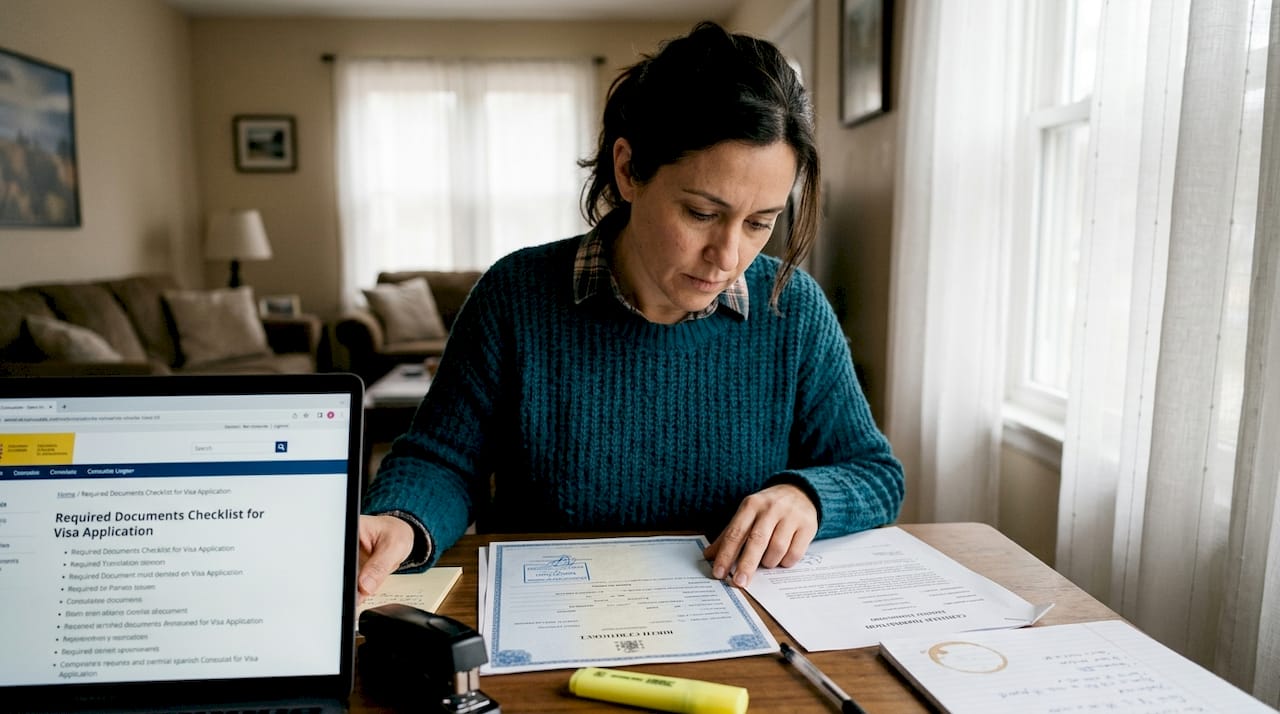
Pro Tip: Check the issue date of every document. Most Spanish consulates and immigration offices require documents to be issued within the last 3 to 6 months. An apostilled birth certificate from two years ago will often be rejected. Order fresh copies before starting your application, even if you already have originals at home. You can find a broader immigration document checklist to cross-reference your preparation.
Step-by-step process for applying
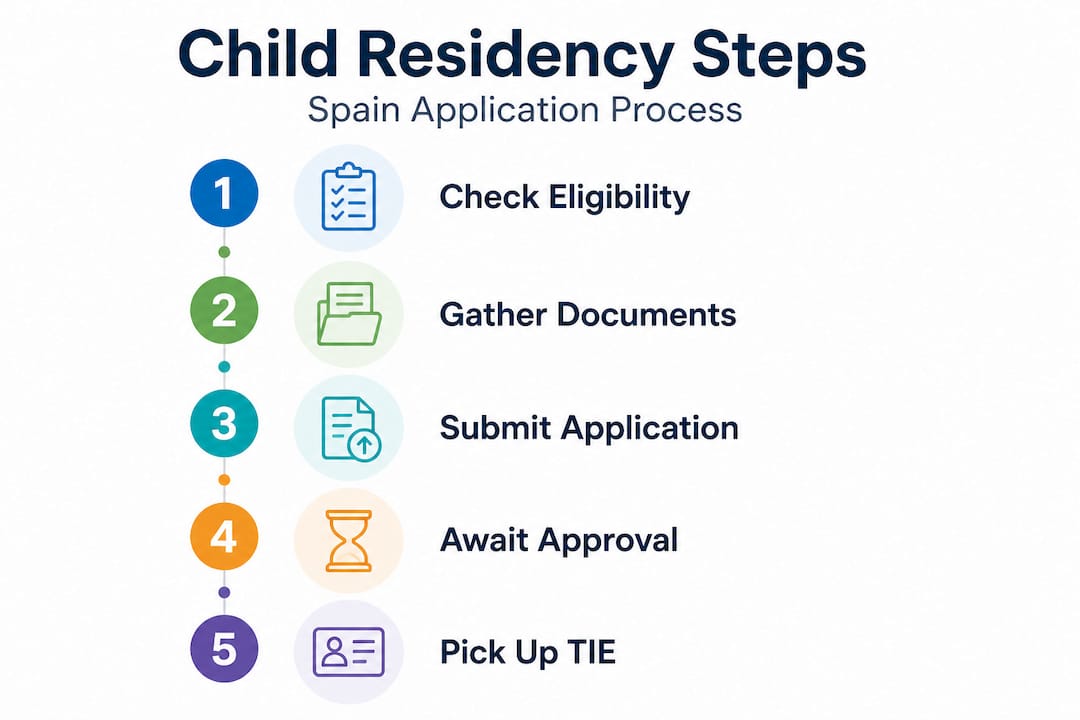
With documents ready, you’re prepared to navigate the formal application sequence from start to finish. The process has three main phases: authorization in Spain, visa application at the consulate, and the TIE appointment after arrival.
-
Sponsor files the authorization request. The parent living in Spain submits the family reunification authorization to the local Immigration Office (Oficina de Extranjería). They must demonstrate stable income, adequate housing, and a clean immigration history. This step can take up to 3 months for a decision.
-
Consulate processes the visa application. Once authorization is granted, the child (and accompanying parent if applicable) applies for a family reunification visa at the Spanish consulate in their country of residence. This 2-month processing window begins from the date of approval, not the date of the visa application.
-
The child enters Spain. Once the visa is granted, the family has a defined window (typically 3 months) to enter Spain. Do not delay entry, since an unused visa creates complications for future applications.
-
Apply for the TIE. Within the first month after arrival, the child must register for their TIE at the nearest National Police station (Comisaría de Policía). The TIE is the physical residency card that proves legal status in Spain.
-
Register for NIE. If your child does not yet have a NIE for children, this is assigned during the TIE process. The NIE (Número de Identificación de Extranjero) is a unique identification number needed for virtually every legal and administrative task in Spain, from enrolling in school to opening a bank account.
| Step | Standard process | EU family reunification |
|---|---|---|
| Who applies first | Sponsor in Spain | EU citizen parent in Spain |
| Authorization wait | Up to 3 months | Faster, no separate authorization |
| Visa required | Yes, at consulate abroad | Not always, depends on nationality |
| TIE required | Yes, within 1 month of arrival | Yes, within 3 months of registration |
| Income proof needed | Yes, IPREM thresholds apply | Proof of sufficient resources required |
If your family situation is less straightforward, searching for specific legal advice on your particular case can save you significant time before you commit to a specific pathway.
Special cases: Reunification for children with disabilities and non-Spanish children
Beyond the standard pathway, some families face special circumstances that require a different approach. Two of the most common are children with disabilities and children who were not born in Spain but have been living there with a parent.
Children with disabilities: Under Spain’s legal framework, and specifically following the updates introduced in Real Decreto 316/2026, adult children with physical or mental disabilities can be included in family reunification applications even if they are over 18 or even over 26. The key is proving the degree of dependency through certified medical documentation recognized in Spain. This is a significant expansion of rights that many families are not yet aware of.
Key steps for disability-related reunification:
- Obtain an official disability assessment certificate from your country of origin
- Have it translated and, if applicable, apostilled
- Include a medical report from a licensed physician that describes the nature and permanence of the disability
- Request that the Spanish immigration office evaluate the dependency as part of the authorization process
Children not born in Spain with non-EU parents: For minor children not born in Spain accompanying a non-EU parent, Article 160 of the Foreigners’ Regulation requires two years of continuous legal residency in Spain and proof that the sponsor meets both economic and housing requirements before the reunification can proceed.
Under Real Decreto 316/2026 and Article 160 of the Reglamento de Extranjería, Spain has expanded the rights of families with dependent children and disabled adults. Parents holding valid residency can include children with certified disabilities in their reunification applications regardless of the child’s age, provided dependency is medically proven and the sponsor meets income and housing criteria. This reflects Spain’s broader commitment to keeping vulnerable family members together.
For families already in Spain who may be approaching their regularization through the Arraigo Social process, including a dependent child in the application from the start is strongly advisable to avoid separate procedures later.
What to do after approval: Receiving the TIE and setting up life in Spain
After completing the application, there are several important tasks to finish before your family is fully settled in Spain. Getting the TIE is just the beginning.
-
Book your TIE appointment immediately upon arrival. Appointments at the National Police for TIE issuance are in high demand, especially in major cities like Madrid, Barcelona, and Valencia. Book online through the Spanish government appointment portal the same day or the next day after you land. You are legally required to have the TIE in hand within 1 month of arrival.
-
Register your child at the local Padrón. The Padrón Municipal is Spain’s census register, and enrollment is required for accessing public services including healthcare and schooling. Visit your local town hall (Ayuntamiento) with your lease or ownership documents and passport.
-
Enroll your child in school. Spanish law guarantees free education to all children registered in Spain, regardless of immigration status. Contact your local education authority (Consejería de Educación) to request placement based on your address and the child’s age.
-
Apply for your child’s health card (Tarjeta Sanitaria Individual). Once Padrón registration is complete, visit the nearest health center (Centro de Salud) to request the card. This gives your child access to Spain’s public health system.
-
Verify the TIE renewal date. Most child TIE cards are issued for 1 or 2 years. Mark the expiry date immediately and begin renewal at least 60 days before expiry. Letting the TIE expire creates significant legal complications. Visit the getting the TIE guide for step-by-step renewal details.
Pro Tip: Schedule the TIE appointment before you even land in Spain if the online system allows advance booking. Some families have family members or legal representatives make the booking from Spain while the visa is still being finalized abroad. Every day you delay after arrival is a day closer to the 1-month deadline.
What most families miss about Spain’s child residency process
After helping hundreds of families work through this process, one pattern stands out clearly: families invest enormous energy in the initial application and then underestimate everything that comes after approval.
The most damaging mistakes happen before the application is even submitted. Documents expire, translations are done by unauthorized translators, and apostilles from non-Hague countries are confused with proper legalization. These errors do not just cause delays. They can result in outright rejections that require restarting the entire process from zero, including new authorizations. The cost in time and money is severe.
The second blind spot is post-approval obligations. Getting the visa is not the finish line. The Padrón registration, health card, school enrollment, and TIE renewal are separate tasks with their own deadlines and requirements. Families who treat approval as the endpoint often find themselves scrambling six months later when they realize the TIE was never properly renewed or the child was never formally registered in the health system.
There is also a counterintuitive truth about self-managing the process: the families who try to handle everything alone tend to experience more delays, not fewer. The Spanish immigration system rewards preparation and precision. A single missing document or a form filled in incorrectly can cost you an extra 3 to 6 months. Professional legal help is not a luxury for complex cases. It is a practical shortcut that pays for itself in time saved.
Our immigration guides are a strong starting point for self-research, but when the stakes involve your child’s legal status in Spain, professional oversight is worth serious consideration.
How Vive Legal can support your child’s residency process
If any of these steps feel overwhelming, professional assistance can make the process almost effortless for your family.
Vive Legal has worked with families across Spain to navigate the most complex child residency scenarios, from reunification for disabled adult children to non-EU families with staggered arrival timelines. Our platform handles document review, form preparation, appointment scheduling, and case tracking through a secure client portal, all online and in real time. If you need to get your child’s TIE or need arraigo social help as part of a broader regularization, our team combines legal expertise with AI-assisted accuracy checks to keep your application on the right track. Start with a personalized diagnostic today and know exactly where you stand.
Frequently asked questions
What is the processing time for a child’s residency application in Spain?
The initial authorization can take up to 3 months, followed by a 2-month consulate visa window and a 1-month deadline to obtain the TIE after entering Spain.
Can children with disabilities apply for residency with their parents?
Yes, children and dependent adults with disabilities can obtain residency through family reunification even if they are adults, provided medical dependency is properly documented.
What documents are mandatory for a child’s residency application?
You must provide apostilled birth certificates, criminal records, proof of relationship, certified Spanish translations, and the sponsor’s proof of income and adequate housing.
Do children not born in Spain need to meet extra requirements?
Yes, minor children not born in Spain require 2 years continuous residency in Spain and their parents must meet economic and housing criteria under Article 160 of the Foreigners’ Regulation.
How soon should I book the TIE appointment after arriving in Spain?
Book immediately upon arrival since the TIE must be obtained within 1 month of entering Spain, and appointment availability in major cities fills up fast.
Recommended
Living legally in Spain shouldn't be difficult.
View services and pricesNot sure which procedure you need? Find out in 2 min
Questions? Message us on WhatsApp