
Streamline your residency application in Spain 2026

Navigating Spain’s residency application process can feel overwhelming, especially with evolving regulations and extensive documentation requirements. Whether you’re an expatriate, foreign worker, or international student, understanding the clear workflow is essential to avoid costly delays and rejections. This guide walks you through every critical step to successfully complete your residency application in 2026.
Table of Contents
- Preparing Your Residency Application: What You Need
- Step-By-Step Residency Application Process
- Post-Arrival Registration And Residency Verification
- Common Challenges And Expert Tips To Avoid Delays
- Streamline Your Residency Application With Vive Legal
- Frequently Asked Questions
Key takeaways
| Point | Details |
|---|---|
| Choose the right visa type | Understanding visa categories like student, work, non-lucrative, and digital nomad ensures you apply for the correct permit. |
| Submit applications in person | Most long-term visa applications require consular appointments and biometric data collection at Spanish consulates. |
| Register locally after arrival | Obtaining your TIE card and registering on the padrón municipal grants access to healthcare, schooling, and official services. |
| Joint family applications required | Family members relocating together must submit applications jointly to ensure coordinated processing. |
| Prepare thoroughly to avoid delays | Complete documentation, accurate financial proofs, and adherence to consular guidelines minimize processing complications. |
Preparing your residency application: what you need
Before you submit any paperwork, you need to identify which visa category matches your situation. Spain offers several main pathways: student visas, work permits, non-lucrative residence visas, digital nomad permits, and family reunification options. Each has distinct requirements, financial thresholds, and processing protocols.
Living legally in Spain shouldn't be difficult.
View services and pricesNot sure which procedure you need? Find out in 2 min
Questions? Message us on WhatsApp
The 2025 reform of Immigration Regulation introduced significant changes, especially for student visas. Students can now work during their studies and obtain permits covering the full program duration, making Spain more attractive for international education. If you’re applying for a Spanish student visa application, these updates streamline your ability to support yourself financially while studying.
Financial requirements vary by visa type. The non-lucrative visa requires proof of income around 400% of IPREM and prohibits employment. IPREM is Spain’s public income indicator, set at approximately €600 monthly in 2026. For a non-lucrative visa, you’ll need to demonstrate roughly €2,400 per month in stable income or savings. Work visas and digital nomad permits have different thresholds tied to Spanish minimum wage benchmarks.
Family members of Spanish citizens have preferential application rights and must apply jointly. This means if you’re relocating with your spouse or children, everyone submits documentation together, not separately. For those applying through family ties, the Spanish family card application process offers streamlined pathways.
Pro Tip: Start gathering documents at least three months before your intended move. Apostilled birth certificates, marriage licenses, and criminal background checks take time to obtain and translate.
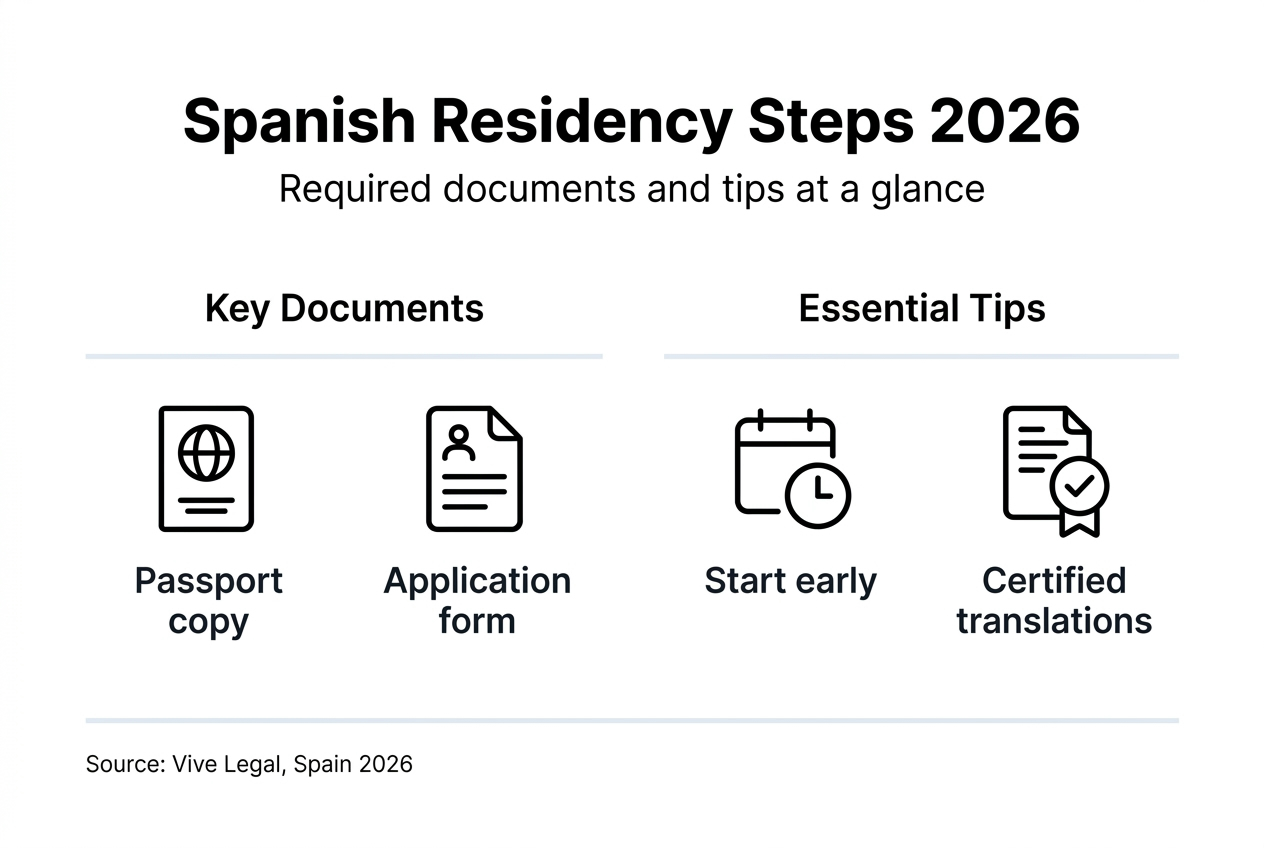
Here’s a breakdown of essential documentation across visa types:
| Document Type | Student Visa | Work Visa | Non-Lucrative | Family Reunification |
|---|---|---|---|---|
| Valid passport | Required | Required | Required | Required |
| Proof of income/savings | Moderate | High | Very High | Varies |
| Health insurance | Required | Required | Required | Required |
| Criminal background check | Required | Required | Required | Required |
| Proof of accommodation | Required | Required | Required | Required |
| Biometric data | Collected at consulate | Collected at consulate | Collected at consulate | Collected at consulate |
| Enrollment/job offer | Yes | Yes | No | No |
Every applicant must provide biometric data, proof of accommodation in Spain, comprehensive health insurance coverage, and a valid passport with at least one year validity. Missing even one document triggers automatic delays or rejections.
Step-by-step residency application process
Once your documents are ready, the actual application follows a structured sequence. Understanding each phase helps you anticipate timelines and avoid common mistakes that derail applications.
Step 1: Verify eligibility and gather complete documentation. Before booking any appointment, double-check that you meet all criteria for your chosen visa category. Review financial thresholds, employment restrictions, and family status requirements.
Step 2: Schedule your consular appointment. Long-term visa applications must be submitted in person at the appropriate Spanish Consular Office in your country of residence. Appointment availability varies widely, so book early. Popular consulates in major cities often have waiting periods of several weeks.
Step 3: Attend your in-person submission and biometric collection. Arrive on time with all original documents plus copies. Consular officers will collect your fingerprints and photograph. They may ask clarifying questions about your application. Remember, visa appointments do not guarantee authorization, and processing times vary.
Step 4: Submit joint family applications if applicable. If relocating with family, all members must submit together during the same consular visit. This ensures coordinated processing and prevents administrative complications.
Step 5: Wait for visa decision and collect your passport. Processing typically takes four to eight weeks, though complex cases may take longer. You’ll receive notification when your passport is ready for collection. The visa sticker allows entry to Spain but is not your final residence permit.
Step 6: Enter Spain and apply for your residence permit. After arrival, you have a limited window to apply for your Tarjeta de Identidad de Extranjero (TIE). This physical card is your official residence permit. The visa simply allows legal entry; the TIE grants you long-term stay and work authorization.
Pro Tip: Keep digital and physical copies of every submitted document. If consular officers request additional information, you can respond immediately without scrambling for paperwork.
For specialized cases like internship residence applications or employee work visa processes, additional employer documentation and labor market approvals may extend timelines.
Here’s a typical timeline overview:
| Phase | Estimated Duration | Key Activities |
|---|---|---|
| Document gathering | 2-3 months | Apostilles, translations, medical exams |
| Consular appointment booking | 2-6 weeks | Online scheduling, fee payment |
| Visa processing | 4-8 weeks | Background checks, file review |
| Entry and TIE application | Within 30 days of arrival | Local immigration office submission |
| TIE card issuance | 4-6 weeks | Biometric collection, card production |
Post-arrival registration and residency verification
Arriving in Spain with your visa is just the beginning. Completing local registrations solidifies your legal status and unlocks essential services.
Most residents must register and obtain a TIE after moving to Spain. Your TIE card serves as official proof of your legal residence status. You’ll need it for opening bank accounts, signing rental contracts, and accessing public healthcare.
The application involves visiting your local immigration office (Oficina de Extranjería), submitting your passport, visa, proof of address, and additional documentation specific to your permit type. You’ll also provide new biometric data for the card itself. Processing takes four to six weeks, and you’ll receive an appointment to collect your TIE once ready.

Equally critical is registering on the municipal padrón. This official census confirms your residence address and grants access to healthcare enrollment, school registration, and vehicle licensing. Visit your local town hall (Ayuntamiento) with your passport, rental contract or property deed, and completed registration forms.
Services requiring padrón registration:
- Public healthcare system enrollment
- Children’s school registration
- Vehicle registration and driver’s license exchange
- Tax residence declaration
- Voting in local elections (for EU citizens)
- Social services and benefits applications
Most official procedures in Spain require a recent padrón certificate (certificado de empadronamiento), typically issued within the last three months. Keeping your registration current is essential; you must update it whenever you change addresses.
Pro Tip: Register on the padrón immediately upon securing accommodation. Many immigration offices require a padrón certificate when you apply for your TIE, creating a catch-22 if you delay. The TIE card application process goes smoother when all supporting registrations are already complete.
Timing matters significantly. If you delay TIE application beyond 30 days of arrival, you risk fines and complications. Similarly, late padrón registration can cause gaps in healthcare coverage or school enrollment deadlines.
Common challenges and expert tips to avoid delays
Even well-prepared applicants encounter obstacles. Understanding frequent pitfalls helps you navigate proactively and maintain momentum through the process.
Incomplete documentation ranks as the number one cause of delays. Missing apostilles, outdated criminal background checks, or insufficient financial proof trigger automatic rejections. Before your consular appointment, create a checklist and verify every item against official requirements.
Improper financial proofs cause significant problems. Bank statements must show consistent balances meeting threshold requirements for at least six months. Sudden large deposits right before application raise red flags. Ensure your financial documentation tells a credible story of stable, ongoing income or savings.
Applications can be considered fraudulent if requirements are not genuinely met, risking permanent rejection and future application bars. Never submit falsified documents or misrepresent your situation. Consular officers are trained to spot inconsistencies, and Spanish immigration databases flag suspicious applications.
Missed consular protocols create unnecessary friction. Arriving late, bringing incomplete copies, or failing to follow specific consulate instructions wastes appointments that took weeks to secure. Each consulate posts detailed guidelines on their website. Read them thoroughly.
Communication gaps between applicants and consular offices extend processing times. If officers request additional information, respond immediately with complete answers. Set up email notifications and check your application status regularly.
Expert strategies to accelerate approval:
- Schedule consular appointments during off-peak months (avoid September and January when demand spikes)
- Use certified translators for all non-Spanish documents to prevent translation disputes
- Obtain health insurance from Spanish-recognized providers to avoid coverage questions
- Keep original documents accessible even after submission; officers sometimes request re-verification
- Maintain a dedicated email folder tracking all application correspondence
Pro Tip: If your case involves complex elements like self-employment, investment income, or mixed family nationalities, consulting immigration tips and updates or professional assistance prevents costly mistakes. The investment in expert review often saves months of processing delays.
For student visa application tips, ensuring your enrollment confirmation letter includes all required details (program duration, hours, tuition payment proof) prevents the most common student-specific rejections.
Streamline your residency application with Vive Legal
Navigating Spain’s residency requirements demands attention to detail and up-to-date regulatory knowledge. Vive Legal specializes in managing every stage of your immigration journey, from initial visa applications to TIE processing and ongoing permit renewals. Our platform combines professional legal expertise with efficient digital workflows, ensuring your application meets all current requirements while minimizing processing delays.
We handle document review, form preparation, appointment scheduling, and case tracking through a secure client portal. Whether you need support with student visa application services or TIE card application support, our team provides personalized guidance tailored to your specific situation. Access comprehensive immigration services designed to accelerate approvals and eliminate common application pitfalls that cause rejections.
Frequently asked questions
What is the difference between a visa and a residence permit?
A visa allows entry, while a residence permit grants long-term stay and work authorization. Your visa enables legal entry to Spain, but you must apply for a TIE card after arrival to establish formal residency status. The TIE serves as your official identification and permits extended stays beyond the visa’s initial period.
Can family members apply separately for residency in Spain?
No, family visa applications must be made jointly, not independently. When relocating as a family unit, all members submit applications together during the same consular appointment. This ensures coordinated residence permits and synchronized processing timelines.
What is a padrón and why is it important?
The padrón is Spain’s official municipal register of residents. Registering on the padrón is mandatory and required for accessing healthcare, enrolling children in schools, and completing many official procedures. Most immigration offices require a recent padrón certificate when you apply for your TIE card.
How long does the entire residency application process take?
From initial document gathering to receiving your TIE card, expect five to eight months total. Consular visa processing typically takes four to eight weeks, followed by TIE application processing of another four to six weeks after arrival. Planning ahead and submitting complete applications significantly reduces delays.
What happens if my visa application is rejected?
You’ll receive a formal rejection letter explaining the grounds for denial. Common reasons include insufficient financial proof, incomplete documentation, or failure to meet specific visa category requirements. You can reapply after addressing the identified issues, though some rejections may include temporary application bars. Consulting professional assistance before resubmission improves approval chances.
Recommended
Living legally in Spain shouldn't be difficult.
View services and pricesNot sure which procedure you need? Find out in 2 min
Questions? Message us on WhatsApp