
How to track your residency application in Spain (2026)
Waiting for residency application updates in Spain can feel frustrating and confusing. The Spanish government provides multiple official tracking methods including online portals, SMS services, and phone lines to check your status. This guide explains what information you need, how to use each tracking method effectively, and how to interpret status updates so you can monitor your application with confidence and take timely action when needed.
Table of Contents
- Prerequisites And Required Information
- How To Track Your Residency Application Online
- Alternative Methods: Sms And Phone Tracking
- Understanding Residency Application Statuses
- Expected Timelines And Non-Business Days Impact
- Troubleshooting Delays And Follow-Up Actions
- Common Mistakes And How To Avoid Them
- Advanced Tracking Options: Cl@Ve Digital Identity And Technological Improvements
- Summary And Next Steps
- How Vive Legal Can Support Your Residency Process
- Frequently Asked Questions
Key takeaways
| Point | Details |
|---|---|
| Accurate data entry is essential | NIE or expediente numbers, submission dates, and birth years must be entered correctly for successful tracking. |
| Multiple tracking methods available | Online portal, SMS service, phone line, and in-person appointments offer flexibility based on your preferences. |
| Status codes guide next steps | Understanding terms like ‘En trámite’, ‘Resuelto favorable’, and ‘Trámite requerido’ helps you respond appropriately. |
| Non-business days extend timelines | Weekends and official holidays pause processing, so plan accordingly when estimating response dates. |
| Cl@ve enhances security | Digital identity systems provide more secure and convenient access to tracking services and government platforms. |
Prerequisites and required information
Before you attempt to track your residency application, gather specific documents and data points. Applicants need their NIE number in the format starting with X, Y, or Z, followed by 8 digits (zero-padded if necessary), and ending with a capital letter, or their expediente number with exactly 15 characters to track application status. Your exact submission date and birth year are also mandatory for validation.
Living legally in Spain shouldn't be difficult.
View services and pricesNot sure which procedure you need? Find out in 2 min
Questions? Message us on WhatsApp
Keep digital or physical copies of these documents readily accessible. Your NIE (Número de Identidad de Extranjero) serves as your foreign identity number in Spain, while the expediente number is the unique file identifier assigned when you submit your application. The submission date refers to the exact day your application was filed at the immigration office or online portal.
Each piece of information matters for accurate status retrieval. The NIE or expediente number identifies your specific case in the system. The submission date helps the system locate your file chronologically. Your birth year provides an additional verification layer to protect your privacy and prevent unauthorized access to your application details.
Format requirements:
- NIE: Letter (X, Y, or Z) + 8 digits + verification letter (example: X12345678L)
- Expediente: Exactly 15 characters with no spaces
- Submission date: Day, month, and year in DD/MM/YYYY format
- Birth year: Four digits
For additional context on residency procedures, consult our EU long-term residence documentation or browse our immigration guides blog for related topics. You can also reference the official tracking information page for government updates.
How to track your residency application online
The online tracking portal offers the most convenient way to check your application status in real time. The official online portal allows real-time status updates by entering NIE, submission date, and birth year. Here’s how to navigate the system step by step:
- Visit the official online tracking portal using any web browser on your computer or mobile device.
- Select your preferred language (Spanish, English, or other available options) from the language menu at the top of the page.
- Choose whether to enter your NIE number or expediente number by clicking the appropriate radio button.
- Type your NIE or expediente number exactly as it appears on your documents, paying attention to uppercase letters and zero padding.
- Enter your exact application submission date in the DD/MM/YYYY format.
- Input your birth year using four digits.
- Complete the security verification (usually a CAPTCHA or similar system) to prove you’re human.
- Click the submit or search button to retrieve your status.
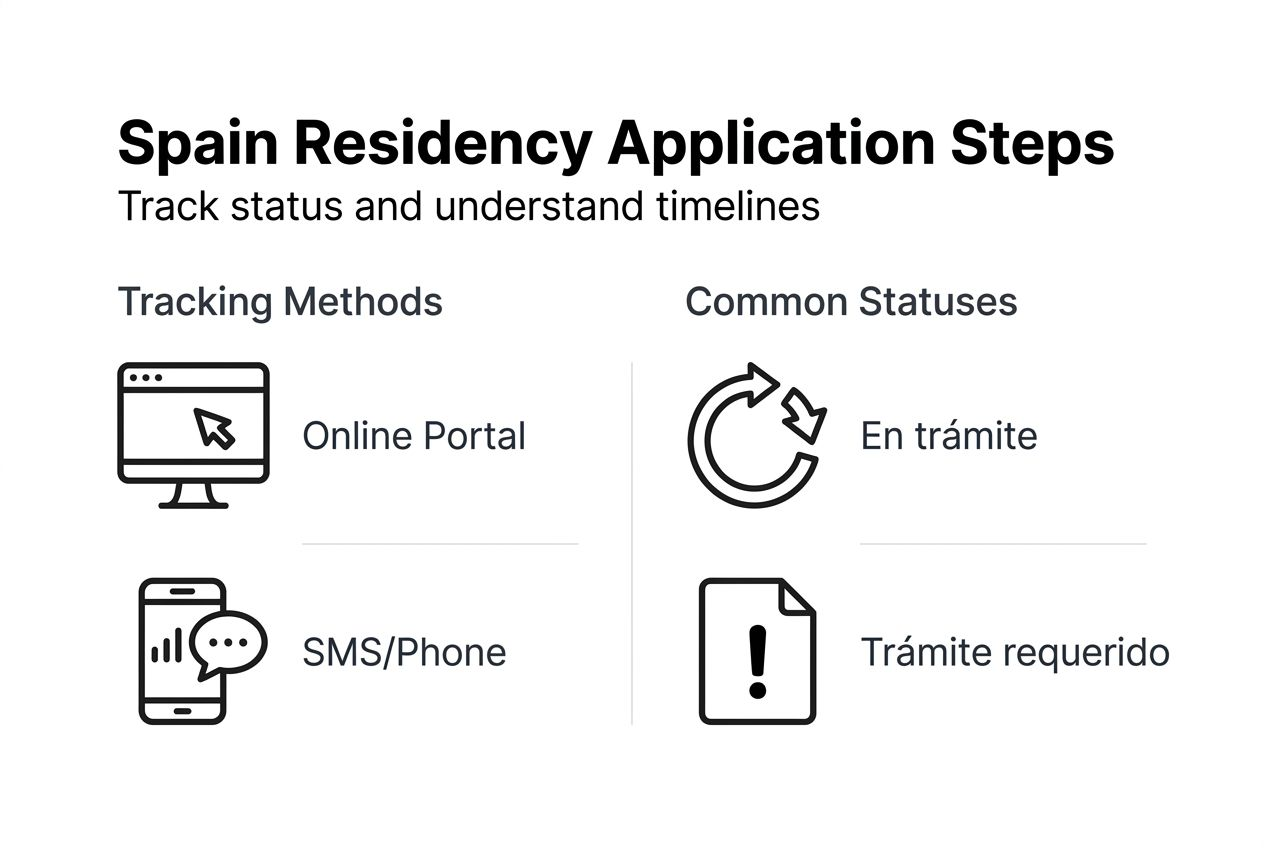
The system displays your current application status on screen immediately. Common status messages include “En trámite” (in process), “Resuelto favorable” (approved), “Resuelto no favorable” (denied), or “Trámite requerido” (action required). Take note of any dates, reference numbers, or instructions provided alongside your status.

Pro Tip: Bookmark the tracking portal URL in your browser for quick future access without searching for the page each time you want to check your status.
For specific application types, review our guides on arraigo social application guidance or residency for internships to understand unique requirements.
Alternative methods: SMS and phone tracking
If you prefer mobile communication or have limited internet access, Spain’s immigration system offers SMS and phone tracking options. The official SMS tracking system allows free status inquiries by sending ‘NIE’ followed by the NIE number or ‘EXPE’ followed by the 15-digit expediente number to the number 600124377.
SMS format examples:
- For NIE tracking: Send “NIE X1234567L” to 600124377
- For expediente tracking: Send “EXPE 123456789012345” to 600124377
You’ll receive a text reply with your current application status within minutes. The SMS service is free from most Spanish mobile carriers, making it an economical option for quick checks.
The automated phone service at number 902 02 22 22 provides residency application status but is not toll-free and is intended for informational purposes only. When you call, follow the automated voice prompts to select your language and input your NIE or expediente number using your phone keypad. The system reads your current status aloud.
Advantages of SMS tracking:
- Works without internet connection
- Quick response time
- Free on most mobile plans
- Convenient for on-the-go checking
Limitations of phone tracking:
- Incurs per-minute charges (not toll-free)
- Automated voice may be difficult to understand
- Limited to basic status information
- No visual reference or documentation
Pro Tip: Double-check your message format before sending SMS queries. Incorrect spacing or missing characters will cause failed queries and wasted attempts.
For EU citizens managing family applications, visit our EU registration process page. Additional SMS tracking instructions are available through third-party resources.
Understanding residency application statuses
Once you retrieve your status, you need to interpret what it means and determine your next steps. Spanish immigration uses standardized terms that signal different stages of your application journey.
Key status definitions:
- En trámite (In process): Your application is actively being reviewed. No action needed unless it remains in this state for over six months.
- Resuelto favorable (Favorably resolved): Your application is approved. Proceed to collect your residency card or TIE at the designated office.
- Resuelto no favorable (Unfavorably resolved): Your application is denied. You have the right to appeal or reapply with corrected information.
- Archivado (Archived): Your application was closed, often due to missing follow-up or incomplete documentation. Contact the office immediately.
- Trámite requerido (Action required): Immigration needs additional documents or information. Respond promptly to avoid rejection.
When you see “Trámite requerido,” check your registered email and physical mailbox for official communications detailing what’s needed. Common requests include additional proof of financial means, updated medical certificates, or clarification on employment contracts. Submit requested materials within the deadline specified in the notification, typically 10 to 15 business days.
Timely responses are critical. Missing deadlines can result in automatic rejection or archiving of your application, forcing you to restart the entire process. If you’re unsure what documents to provide, consult with immigration professionals or visit your local extranjería office for guidance.
For family-related applications, our EU family residency information page offers targeted advice.
Expected timelines and non-business days impact
Processing times vary based on application type, regional workload, and time of year. Understanding how non-business days affect timelines helps you set realistic expectations and avoid unnecessary anxiety.
Spain’s official holidays include national celebrations, regional festivals, and weekends. Immigration offices do not process applications on these days, effectively pausing your application timeline. When calculating estimated response dates, exclude Saturdays, Sundays, and public holidays from your count.
2026 National holidays affecting processing:
| Holiday | Date | Impact |
|---|---|---|
| New Year’s Day | January 1 | Full closure |
| Epiphany | January 6 | Full closure |
| Good Friday | April 18 | Full closure |
| Labor Day | May 1 | Full closure |
| Assumption of Mary | August 15 | Full closure |
| National Day | October 12 | Full closure |
| All Saints’ Day | November 1 | Full closure |
| Constitution Day | December 6 | Full closure |
| Immaculate Conception | December 8 | Full closure |
| Christmas Day | December 25 | Full closure |
Regional holidays add additional non-business days depending on your autonomous community. For example, Madrid celebrates May 2 as a regional holiday, while Catalonia observes September 11. Check your local calendar to account for these variations.
Standard processing times range from 3 weeks for simple renewals to 3 months for initial residence permits. Complex cases like arraigo applications can extend to 6 months. During peak periods (September through November when many applications are filed after summer), expect longer waits.
Pro Tip: Mark official holidays on your calendar when you submit your application. This helps you anticipate possible delays and plan follow-up actions at appropriate intervals.
Troubleshooting delays and follow-up actions
If your application remains stuck in “En trámite” status beyond expected timelines, proactive follow-up can prevent further delays. If an application remains in ‘En trámite’ status beyond six months without progress, applicants are advised to schedule an in-person appointment at the local extranjería office for clarification and to prevent further delays.
Here’s how to manage prolonged delays:
- Wait until the six-month mark from your submission date, accounting for holidays and weekends in your calculation.
- Visit your provincial extranjería office website or call their appointment line to schedule an in-person consultation.
- Gather all relevant documents: original application receipt, NIE or passport copy, proof of address, and any correspondence received from immigration.
- Arrive at your appointment 15 minutes early with all documents organized in a folder for easy reference.
- Explain your situation calmly to the immigration officer, providing your expediente or NIE number for file lookup.
- Take detailed notes of any information, instructions, or next steps the officer provides.
- Request a written summary or reference number for your inquiry if possible.
During the appointment, the officer can access internal systems to identify bottlenecks or missing information not visible through public tracking methods. They may discover that your file requires supervisor review, additional security checks, or interdepartmental coordination.
If problems persist after your first appointment, consider escalating through official complaint channels or seeking legal assistance. Our long-term residence application help connects you with experts who can intervene on your behalf. External resources on handling application delays offer additional strategies.
Common mistakes and how to avoid them
Many applicants encounter tracking failures due to preventable errors. Recognizing these pitfalls helps you achieve successful status checks on your first attempt.
Frequent mistakes:
- Incorrect NIE or expediente format: Entering lowercase letters instead of uppercase, omitting leading zeros, or adding extra spaces causes system rejections. Always match the exact format from your official documents.
- Wrong submission date: Confusing the date you prepared documents with the actual filing date leads to failed queries. Use only the date stamped on your receipt or confirmation email.
- Single method reliance: Depending exclusively on one tracking channel means you might miss urgent notifications sent through other channels. Use multiple methods for comprehensive monitoring.
- Ignoring “Trámite requerido” status: Dismissing action-required notifications as spam or not understanding their urgency results in automatic rejection. Treat these alerts as high priority.
- Assuming weekends count: Calculating processing times by including Saturdays and Sundays creates false expectations about when decisions should arrive.
Pro Tip: Always double-check all entered information before submitting tracking queries. A single typo can waste time and create unnecessary stress.
Create a simple spreadsheet or note tracking your NIE, expediente number, submission date, and birth year. Reference this document each time you check status to ensure consistency and accuracy. Save screenshots or print confirmations of your status checks to document your application journey.
Advanced tracking options: Cl@ve digital identity and technological improvements
Spain’s digital government services continue evolving to improve user experience. Setting up a Cl@ve digital identity account enhances secure and convenient access to track residency application status online and other Spanish government services.
Cl@ve offers several authentication levels: Cl@ve PIN (basic mobile verification), Cl@ve Permanente (reusable password), and Cl@ve Firma (electronic signature). For residency tracking, Cl@ve Permanente provides the best balance of security and convenience.
Benefits of Cl@ve:
- Single sign-on access to multiple government platforms
- Enhanced security through two-factor authentication
- Centralized management of all your official procedures
- Faster login without repeatedly entering NIE and birth year
- Access to additional services like tax filing and social security
To create a Cl@ve account, visit the official Cl@ve registration portal with your NIE or passport, proof of address, and a Spanish mobile number. The system guides you through identity verification, which may involve video call confirmation or in-person registration at designated offices.
Digitalized electronic registers and accredited online filing for visa and residence applications were launched in 2026 to speed up processing times and reduce errors in Spain’s immigration procedures. These technological improvements mean applications filed through electronic channels receive priority processing, automated error checking flags common mistakes before submission, and direct integration with tracking systems provides real-time updates.
The 2026 digital initiative reduced average processing times by approximately 30% for electronically filed applications compared to paper submissions. Error rates dropped significantly because the system validates data before acceptance, preventing incomplete applications from entering the queue.
Stay informed about digital updates through our immigration digital updates blog. Learn more about Cl@ve digital identity benefits and review the 2026 immigration digital register announcement for full details.
Summary and next steps
Tracking your residency application in Spain becomes manageable when you understand the available official methods and use them effectively. This guide equipped you with the knowledge to monitor your application confidently and take appropriate action at each stage.
Key takeaways for successful tracking:
- Use multiple official tracking methods (online portal, SMS, phone) for comprehensive monitoring and backup options
- Ensure accurate data input by double-checking NIE format, expediente number, submission date, and birth year before each query
- Understand key status terms to recognize when your application is progressing normally versus when intervention is needed
- Plan realistically by accounting for weekends, national holidays, and regional non-business days in processing timeline estimates
- Take timely follow-up action if your application exceeds six months in “En trámite” status without updates
Start by bookmarking the official tracking portal and testing your first status check using the information from your application receipt. Set calendar reminders to check status weekly during the first month, then biweekly afterward. Enable SMS tracking as a backup method for times when internet access is limited.
If you encounter issues or need clarification, don’t hesitate to schedule an appointment at your local extranjería office. Early intervention prevents minor questions from becoming major delays.
How Vive Legal can support your residency process
Navigating Spain’s immigration system requires accurate documentation, timely follow-up, and understanding complex procedures. Vive Legal immigration services provide comprehensive management of residency and immigration procedures, handling everything from initial document preparation through final card collection.
Our expert team assists with document preparation, application monitoring, and follow-up communications with immigration authorities. We specialize in managing extraordinary regularization 2026 applications and EU long-term residence application processes, ensuring your submission meets all requirements before filing. Our digital platform tracks your case in real time, sends automated notifications at each stage, and provides direct access to immigration specialists when questions arise. Contact Vive Legal for personalized support that reduces delays, avoids common mistakes, and increases approval chances.
Frequently asked questions
How long does it usually take to get an update on my residency application status?
Typical timelines range between 3 weeks to 3 months depending on application type and regional workload. Simple renewals process faster than initial residence permits or complex cases like arraigo. Delays occur around holidays and weekends, extending waiting times by several weeks during peak periods. If your application remains in “En trámite” for six months, schedule an in-person appointment at your extranjería office for clarification.
What should I do if my application status says ‘Trámite requerido’?
This status means immigration authorities need additional documents or information before proceeding with your case. Check your registered email and physical mailbox immediately for official communications detailing the specific requirements. Submit requested documents promptly, typically within 10 to 15 business days, to avoid automatic rejection or archiving. If the notification is unclear, contact the extranjería office or consult an immigration professional for guidance.
Can I track my application without internet access?
Yes, official SMS and automated phone services allow status checks without internet connectivity. The SMS service is free from most Spanish mobile carriers and provides quick responses by texting your NIE or expediente number to 600124377. The phone service at 902 02 22 22 offers automated status updates but charges per-minute fees. Both methods provide basic status information, though the online portal offers more detailed updates and documentation.
What does ‘Archivado’ status mean for my application?
Archivado means your application file was closed, typically due to missing follow-up on required documentation or failure to respond within specified deadlines. This status requires immediate action because archived applications do not proceed to approval. Contact your local extranjería office as soon as possible to understand why archiving occurred and whether you can reactivate the file or must submit a new application. In most cases, you’ll need to restart the process with corrected or complete information.
Is Cl@ve required to track my residency application online?
No, Cl@ve digital identity is not required for basic online tracking through the official portal. You can check status using just your NIE or expediente number, submission date, and birth year without creating a Cl@ve account. However, Cl@ve enhances security and convenience by enabling single sign-on access to multiple government services and faster authentication. Consider setting up Cl@ve if you frequently interact with Spanish government platforms or want streamlined access to additional administrative procedures.
Recommended
Living legally in Spain shouldn't be difficult.
View services and pricesNot sure which procedure you need? Find out in 2 min
Questions? Message us on WhatsApp