
UE Registration in Spain: What Every EU Citizen Needs

Moving to Spain as a European citizen often feels exciting at first, but questions around legal paperwork can quickly become overwhelming. The process of UE Registration is fundamental for securing your rights and accessing services in Spain, yet even small mistakes may delay your residency or access to healthcare. This guide explains each requirement and shows you how to prepare the correct paperwork so you can handle your registration with confidence and avoid unnecessary stress.
Table of Contents
- UE Registration Defined And Who Needs It
- Legal Basis And Registration Requirements
- Step-By-Step Application Process Explained
- Essential Documentation And Common Pitfalls
- Rights And Obligations After Registration
- Losing Or Renewing Your UE Registration
Key Takeaways
| Point | Details |
|---|---|
| UE Registration is Mandatory | EU citizens must register within three months of arriving in Spain for stays longer than three months. |
| Comprehensive Documentation Required | Applicants need valid ID, proof of financial means, and health insurance to complete the registration process. |
| Rights and Obligations Post-Registration | Registered EU citizens enjoy rights such as work authorization and access to healthcare while maintaining compliance with Spanish laws. |
| Renewal Awareness | Registration must be renewed after five years or upon significant changes, ensuring continuous legal residency status. |
UE Registration Defined and Who Needs It
EU citizens planning to reside in Spain for more than three months must complete a critical administrative process known as UE Registration. This official documentation certifies their legal residence status and provides essential administrative recognition. Official registration details from Spanish authorities outline specific requirements for EU nationals.
Living legally in Spain shouldn't be difficult.
View services and pricesNot sure which procedure you need? Find out in 2 min
Questions? Message us on WhatsApp
The UE Registration Certificate serves multiple important functions for European citizens. It provides:
- Official documentation of legal residency status
- A unique foreigner identity number (NIE)
- Proof of right to live and work in Spain
- Access to healthcare and social services
To qualify for UE Registration, applicants must meet several key criteria:
- Be a citizen of an EU member state or European Economic Area country
- Intend to stay in Spain longer than three months
- Have sufficient financial resources to support themselves
- Possess valid personal identification documents
Important: EU citizens must apply for registration within three months of entering Spain.
The registration process involves submitting specific documentation and personal information to Spanish immigration authorities. Applicants will need to provide proof of employment, student status, or sufficient financial means to support themselves during their stay.
Pro tip: Start gathering required documents immediately upon deciding to move to Spain to ensure a smooth registration process.
Legal Basis and Registration Requirements
The legal framework for EU citizen registration in Spain is grounded in several key legislative documents that define the rights and procedures for European nationals. Specific legal provisions outline the comprehensive requirements for residency and registration.
The primary legal foundations include:
- Organic Law 4/2000: Regulating foreigners’ rights and social integration
- Royal Decree 240/2007: Governing free movement and residence of EU citizens
- Order PRE/1490/2012: Providing detailed implementation guidelines
Under these regulations, EU citizens must meet specific criteria to establish legal residency in Spain:
- Possess valid identification from an EU member state
- Demonstrate financial self-sufficiency
- Have comprehensive health insurance coverage
- Provide evidence of intended residence purpose (work, study, retirement)
Critical Legal Requirement: Registration must be completed within three months of arrival in Spain.
Registration procedures under Royal Decree specify different documentation requirements based on an individual’s status. Employment status significantly impacts the specific documents needed, with distinct paths for workers, students, retired individuals, and those with independent financial means.
The registration process is not merely bureaucratic but serves as a crucial mechanism for protecting EU citizens’ rights and ensuring proper administrative tracking. Each applicant must personally submit their documentation at a designated Foreigners Office or local Police Station.
Pro tip: Consult with local immigration authorities or a legal professional to ensure you have the most up-to-date and comprehensive documentation for your specific situation.
Step-by-Step Application Process Explained
Navigating the EU registration process in Spain requires careful preparation and attention to detail. Certificate application procedures involve multiple critical steps that EU citizens must follow precisely to obtain their legal documentation.
Before beginning the application, gather all necessary documentation:
- Valid passport or national ID card
- Proof of employment or financial means
- Comprehensive health insurance documentation
- Completed Form EX-18
- Passport-sized photographs
- Proof of Spanish address (utility bill or rental agreement)
The application process follows these sequential steps:
- Schedule an appointment at local Foreigners Office or Police Station
- Complete Form EX-18 accurately
- Compile all required supporting documents
- Attend the scheduled appointment in person
- Submit documentation and pay administrative fee
- Receive Registration Certificate and NIE number
Important: Personal appearance is mandatory - applications cannot be submitted by proxy.
Official registration guidelines emphasize the importance of submitting documentation within three months of arrival. Processing typically occurs immediately during the appointment, with the certificate issued on the spot upon successful verification of all requirements.

Additional considerations include potential variations in documentation based on individual circumstances such as employment status, student enrollment, or retirement. Each applicant must demonstrate they meet specific residency criteria outlined in Spanish immigration regulations.
Pro tip: Make digital and physical copies of all submitted documents and request a receipt to track your application process effectively.
Essential Documentation and Common Pitfalls
The success of your EU registration in Spain hinges on meticulously preparing the right documentation. Document preparation strategies require careful attention to detail and comprehensive understanding of specific requirements.
Documentation requirements vary based on an applicant’s specific status, but typically include:
- Original identification documents
- Comprehensive proof of financial means
- Valid health insurance coverage
- Detailed employment or study verification
- Translated and legalized supporting materials
Common documentation pitfalls that can derail your registration include:
- Submitting photocopies instead of certified documents
- Incomplete or incorrectly filled Form EX-18
- Insufficient proof of financial stability
- Outdated or non-comprehensive health insurance
- Missing official translations of foreign documents
Critical Warning: Even minor documentation errors can result in application rejection.
Specific documentation requirements depend on your primary purpose of residence:
- Workers: Employment contract, recent payslips
- Students: Enrollment verification, educational institution documentation
- Self-employed: Business registration, tax documentation
- Retired individuals: Pension statements, comprehensive health coverage proof
Each category demands unique supporting evidence demonstrating your ability to sustain yourself during residency. Ensuring document authenticity and completeness is paramount to a successful registration process.
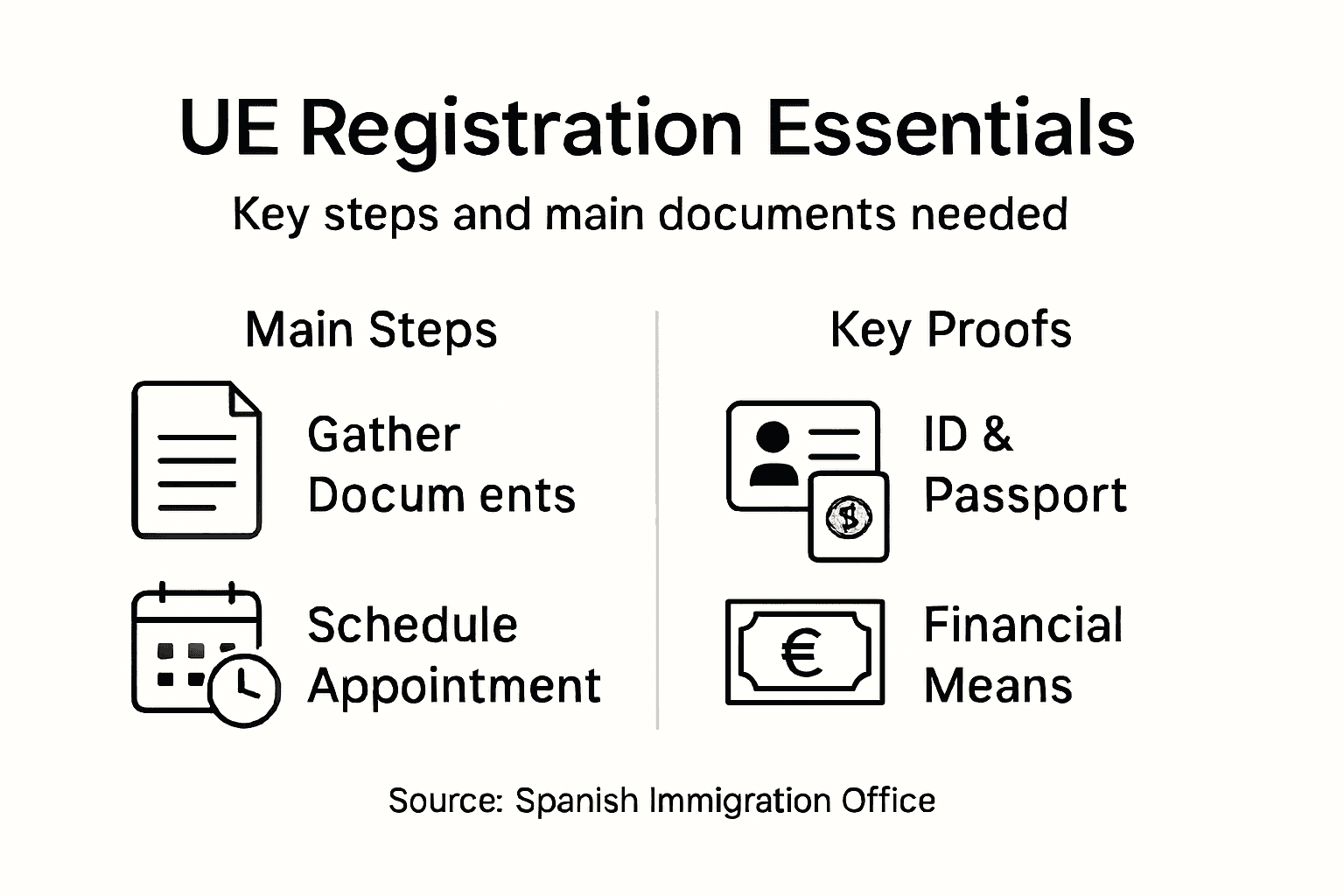
Here’s a summary of how documentation needs differ by applicant status for UE Registration:
| Applicant Type | Key Required Document | Main Proof Needed |
|---|---|---|
| Worker | Employment contract | Recent payslips |
| Student | Enrollment letter | School registration proof |
| Self-employed | Business registration | Current tax filings |
| Retired individual | Pension statement | Valid health insurance |
Pro tip: Have all documents professionally reviewed by an immigration specialist before submission to minimize potential errors and increase approval chances.
Rights and Obligations After Registration
Successful EU registration in Spain unlocks a comprehensive set of legal entitlements and responsibilities. Citizen rights framework provides a clear blueprint for understanding your legal standing.
Key rights for registered EU citizens include:
- Unrestricted work authorization
- Full access to public healthcare systems
- Enrollment in educational institutions
- Social security participation
- Freedom of movement within Spanish territories
- Protection under Spanish and European legal frameworks
Corresponding obligations require active compliance:
- Maintain valid residence documentation
- Comply with Spanish legal regulations
- Demonstrate financial self-sufficiency
- Maintain comprehensive health insurance
- Renew registration certificates as required
Critical Requirement: Continuous compliance ensures uninterrupted legal residence status.
Registered EU citizens must proactively manage their legal standing by:
- Updating personal information promptly
- Reporting changes in employment or residence
- Maintaining valid identification documents
- Ensuring financial stability
- Respecting local administrative procedures
Failing to meet these obligations can result in potential penalties, including registration cancellation or legal complications. Regular documentation review and timely renewals are crucial for maintaining your legal residence status.
The following table outlines main rights and obligations after successful registration:
| Category | Primary Benefit or Duty | Real-Life Example |
|---|---|---|
| Right | Access to public healthcare | Use local medical centers freely |
| Obligation | Maintain valid residence docs | Update NIE and keep address current |
| Right | Work authorization | Legally accept Spanish job offers |
| Obligation | Stay financially self-sufficient | Show bank statements if requested |
Pro tip: Create a digital and physical file system to track document expiration dates and required renewal processes.
Losing or Renewing Your UE Registration
Maintaining the validity of your EU Registration Certificate is crucial for preserving your legal residency status in Spain. Certificate renewal guidelines provide essential information for managing your documentation effectively.
Key scenarios requiring registration renewal include:
- Certificate expiration (typically after five years)
- Loss or theft of original document
- Significant changes in personal circumstances
- Approaching permanent residency status
The renewal process involves several critical steps:
- Gather updated identification documents
- Collect proof of continued residency
- Schedule an appointment at local Foreigners Office
- Submit renewal application
- Pay required administrative fees
Important: Failure to renew can result in loss of legal residency rights.
Specific documentation requirements for renewal typically include:
- Current valid passport or national ID
- Proof of employment or financial means
- Updated health insurance documentation
- Original expired registration certificate
- Recent passport-sized photographs
EU citizens who have legally resided in Spain for five consecutive years become eligible for permanent residence. This status provides additional stability and reduces renewal frequency.
Pro tip: Begin the renewal process at least 60 days before your current registration certificate expires to avoid potential legal complications.
Simplify Your UE Registration Journey with Expert Support
Navigating the complexities of UE Registration in Spain can feel overwhelming. Many EU citizens face challenges like strict document requirements, tight three-month deadlines, and understanding the legal obligations to maintain their residency status. If you want to avoid common pitfalls such as incomplete paperwork or missed deadlines, it is crucial to have reliable assistance that ensures accuracy and timely submission.
Take control of your residency process now by partnering with Vive Legal. Our platform offers personalized diagnostics, thorough document reviews, and professional form preparation tailored specifically for UE Registration cases. We combine cutting-edge technology with human expertise to help you avoid costly mistakes and accelerate your application approval. Start your hassle-free registration or renewal today and experience a smooth, fully digital process designed for busy expatriates, workers, and students in Spain. Visit Vive Legal and learn more about how we can help you secure your legal residency with confidence.
Frequently Asked Questions
What is UE Registration and why is it necessary for EU citizens in Spain?
UE Registration is an administrative process that EU citizens must complete if they plan to reside in Spain for more than three months. It certifies their legal residence status and provides access to essential services such as healthcare and work authorization.
What documents do I need to apply for UE Registration in Spain?
To apply for UE Registration, you typically need a valid passport or national ID, proof of employment or financial means, health insurance documentation, a completed Form EX-18, passport-sized photographs, and proof of your Spanish address.
How long do I have to apply for UE Registration after arriving in Spain?
EU citizens must apply for UE Registration within three months of arriving in Spain to comply with the legal requirements. Failing to do so may affect their residency status.
What are the rights and obligations of EU citizens after completing their registration in Spain?
After successful registration, EU citizens have rights such as work authorization, access to public healthcare, and freedom of movement within Spanish territories. Obligations include maintaining valid residence documentation, complying with local laws, and demonstrating financial self-sufficiency.
Recommended
Living legally in Spain shouldn't be difficult.
View services and pricesNot sure which procedure you need? Find out in 2 min
Questions? Message us on WhatsApp