
What Is NIE in Spain – Key Facts for Students

Starting your studies in Spain brings a whirlwind of new experiences, but the legal paperwork can feel overwhelming for non-European Union students. Securing your NIE (Número de Identidad de Extranjero) is absolutely necessary if you plan to stay in Spain for more than 90 days, giving you access to crucial services like university enrollment and healthcare. This overview simplifies the NIE process, highlighting exactly what you need and guiding you through each step so you can focus on your academic journey.
Table of Contents
- NIE in Spain Explained for Students
- Differences Between NIE, TIE, and Other IDs
- Step-by-Step NIE Application Process
- Legal Uses and Essential Requirements
- Costs, Timelines, and Common Mistakes
Key Takeaways
| Point | Details |
|---|---|
| NIE Importance | The NIE is essential for international students in Spain for tasks like university registration and banking. |
| TIE Requirement | Non-EU students staying over six months must also obtain a TIE, a physical residency permit. |
| Application Process | Prepare your documents early and book your NIE appointment as soon as you arrive in Spain to avoid delays. |
| Cost Expectations | Expect application fees of approximately €10-15, with additional potential costs for translations and copies. |
NIE in Spain Explained for Students
The NIE (Número de Identidad de Extranjero) is a critical identification number for international students planning to study in Spain. This unique identifier is essential for navigating administrative, legal, and financial processes during your academic journey. Mandatory documentation for non-Spanish residents makes obtaining an NIE a crucial first step for anyone staying in Spain longer than 90 days.
Living legally in Spain shouldn't be difficult.
View services and pricesNot sure which procedure you need? Find out in 2 min
Questions? Message us on WhatsApp
As an international student, your NIE serves multiple critical purposes across different aspects of Spanish life:
- University enrollment and academic registration
- Opening bank accounts
- Signing rental agreements
- Accessing healthcare services
- Applying for work permits
- Conducting official legal transactions
Unlike a physical identification card, the NIE is a unique alphanumeric number assigned specifically to foreign residents. Non-European Union students staying over six months will also need to obtain a TIE (Tarjeta de Identidad de Extranjero), which is a physical residency card that includes your NIE number.
The application process requires careful preparation and specific documentation. Comprehensive NIE application steps typically involve submitting:
- Valid passport
- Completed NIE application form (EX-15)
- Proof of academic enrollment
- Passport-sized photographs
- Payment of administrative fees
Pro tip: Begin your NIE application process immediately upon arrival in Spain to avoid potential administrative delays that could impact your study plans.
Differences Between NIE, TIE, and Other IDs
Navigating the complex world of Spanish identification documents can be challenging for international students. Key differences among identification documents reveal distinct purposes and requirements for various residency statuses. Understanding these nuances is crucial for smooth administrative processes during your time in Spain.
The primary identification documents for foreign residents include:
- NIE (Número de Identidad de Extranjero): A unique alphanumeric identifier
- TIE (Tarjeta de Identidad de Extranjero): Physical residency card
- White NIE: Paper document for administrative and tax purposes
- Green NIE: Laminated card for European Union citizens
Each document serves a specific function depending on your nationality and length of stay. The NIE is essentially a tax identification number used for administrative tasks, while the TIE is a comprehensive residency permit that provides more extensive rights. Non-European Union students staying over six months must obtain both documents to fully comply with Spanish legal requirements.

Here’s a concise comparison of Spanish identification documents for students:
| Document Type | Who Needs It | Format | Primary Purpose |
|---|---|---|---|
| NIE | All non-Spanish residents | Alphanumeric number | Tax ID; admin processes |
| TIE | Non-EU students (6+ months) | Physical card | Residency permit |
| Green NIE | EU citizens | Laminated card | Proves EU residency |
| White NIE | Any foreign resident | Paper certificate | Legal/tax formalities |
The documentation varies significantly based on your specific situation:
-
European Union Citizens
- Receive a Green NIE
- Typically easier registration process
- Less stringent documentation requirements
-
Non-European Union Students
- Must obtain NIE and TIE
- Require more extensive documentation
- Need to demonstrate academic enrollment and financial sustainability
Pro tip: Verify your specific documentation requirements with your university’s international office to ensure you have all necessary identification documents before arriving in Spain.
Step-by-Step NIE Application Process
Obtaining your NIE (Número de Identidad de Extranjero) requires careful planning and precise documentation. Navigating the NIE application process can seem complex, but breaking it down into manageable steps will help international students successfully complete their application.
Prepare the following essential documents before beginning your application:
- Valid passport
- Completed EX-15 application form
- Completed Form 790 (tax payment document)
- Proof of academic enrollment
- Passport-sized photographs
- Evidence of purpose in Spain (student visa or university acceptance letter)
The NIE application process typically involves several critical stages:
-
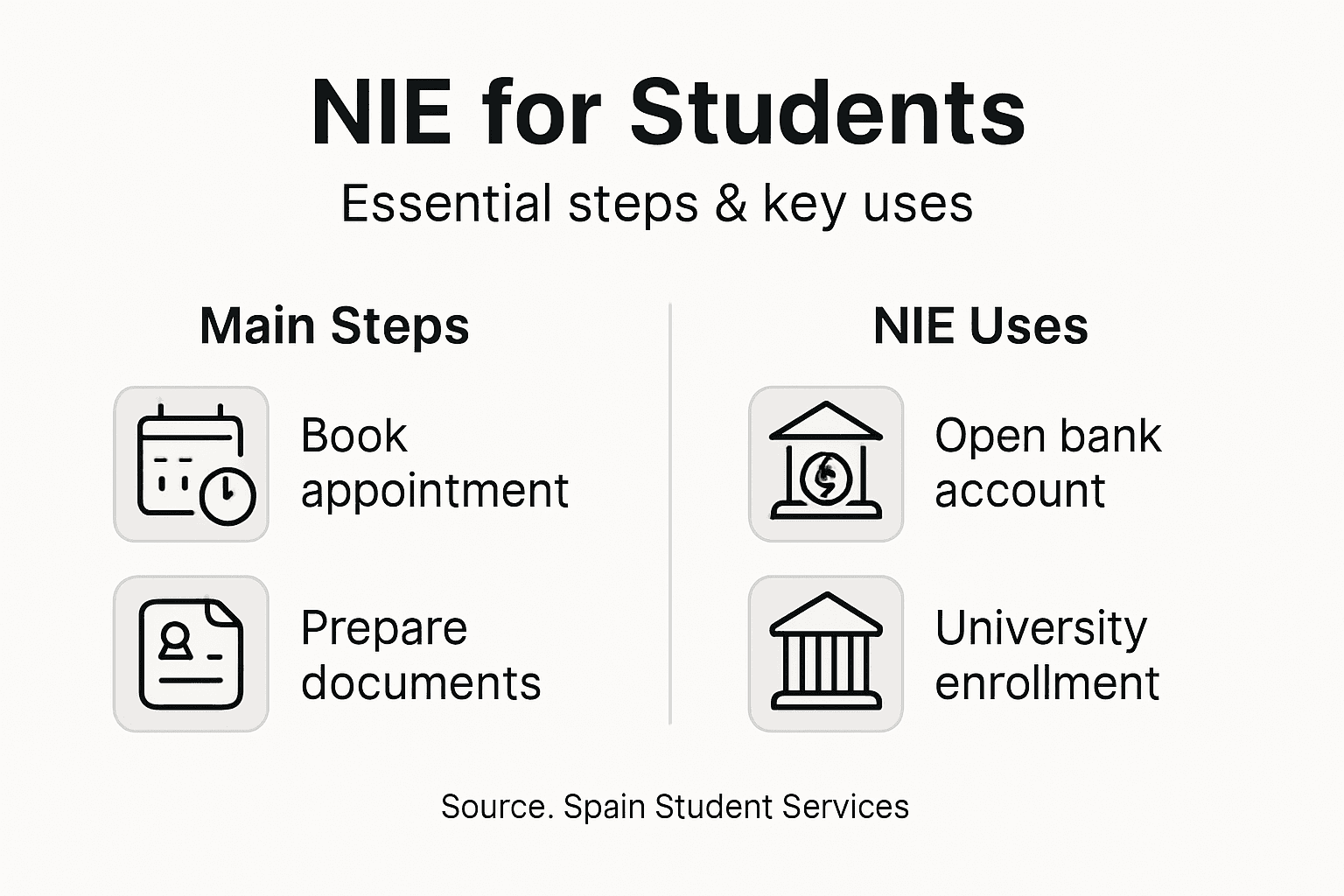
Book an online appointment (cita previa)
- Visit official government immigration website
- Select your nearest police station or immigration office
- Choose an available time slot
-
Gather and prepare required documentation
- Ensure all documents are current and translated
- Make multiple copies of each document
- Organize documents in a clear, logical order
-
Attend your scheduled appointment
- Arrive 15 minutes early
- Bring original documents and copies
- Pay required administrative fees
-
Wait for processing
- Processing times vary between 2-6 weeks
- Track your application status online
- Expect to receive your NIE number by mail
Important: Appointments in major cities like Madrid and Barcelona can be challenging to secure, so book well in advance of your planned arrival.
Pro tip: Schedule your NIE appointment at least one month before your university start date to avoid potential administrative delays and ensure smooth integration into Spanish academic life.
Legal Uses and Essential Requirements
The NIE (Número de Identidad de Extranjero) is far more than a simple identification number for international students in Spain. Critical legal documentation for foreigners serves multiple administrative and legal purposes that are essential for daily life and official interactions.
Legal uses of the NIE span numerous critical areas for international students:
- University registration
- Opening bank accounts
- Signing rental agreements
- Obtaining mobile phone contracts
- Accessing healthcare services
- Part-time work authorization
- Visa and residency extensions
- Tax identification
Essential documentation requirements for obtaining and using your NIE include:
-
Proof of legal status
- Valid passport
- Current student visa
- University enrollment certificate
- Proof of financial means
-
Additional supporting documents
- Passport-sized photographs
- Completed application forms
- Evidence of purpose in Spain
- Potential power of attorney documents
Important Clarification: The NIE does not automatically grant residency rights but is a fundamental legal identifier within Spain’s administrative system.
Key Legal Considerations:
- The NIE is required for most official transactions
- It serves as a unique tax identification number
- Does not provide automatic work or residence permissions
- Must be renewed periodically depending on your visa status
Pro tip: Always carry a copy of your NIE documentation and keep the original in a secure location to facilitate smooth interactions with Spanish authorities and institutions.
Costs, Timelines, and Common Mistakes
Understanding the financial and administrative nuances of obtaining your NIE is crucial for international students. NIE application complexities explained require careful planning and budget considerations.
Costs and Financial Expectations:
- Application Fee: 10-15 euros (Form 790, Code 012)
- Potential additional translation costs
- Possible courier or mailing expenses
- Budget for multiple document copies
Timeline Expectations:
Below is an overview of typical costs and timeframes for NIE application:
| Item | Estimated Cost | Timeline (Weeks) |
|---|---|---|
| Government fee (Form 790) | €10–15 | Immediate |
| Document translation | €15–50 per document | 1–2 |
| Appointment scheduling | N/A | 1–4 |
| NIE processing | N/A | 2–6 |
- Appointment Booking: 1-4 weeks
- Document Preparation: 1-2 weeks
- Processing Time: 2-6 weeks
- Total Estimated Duration: 4-12 weeks
Common Mistakes International Students Make:
- Waiting too long to start the application
- Incomplete documentation
- Incorrect form submissions
- Failing to pay required fees
- Misunderstanding NIE versus TIE requirements
Important: Processing times can significantly vary depending on your specific location and local immigration office workload.
Strategic Application Recommendations:
- Start process minimum 3 months before university start date
- Double-check all documentation
- Maintain digital and physical copies of everything
- Consider professional assistance if uncertain
Pro tip: Create a dedicated folder for your NIE application documents and track every step meticulously to minimize potential administrative complications.
Simplify Your NIE and Residency Process with Expert Support
Applying for your NIE or TIE in Spain can feel overwhelming with all the documentation, appointments, and strict deadlines involved. If you want to avoid common pitfalls like missing paperwork, long waiting times, or confusion between important terms such as NIE, TIE, and residency requirements, you are not alone. Many international students face these challenges while trying to secure their legal status and integrate smoothly into Spanish life.
Take control of your legal residency journey today by trusting Vive Legal, your dedicated online platform specializing in immigration and residency procedures. Vive Legal provides tailored services including document review, form preparation, appointment scheduling, and real-time case tracking all from the comfort of your home. Experience transparent pricing, personalized guidance, and professional oversight that minimize errors and maximize your approval chances. Don’t wait until administrative delays impact your studies. Visit Vive Legal now and start your hassle-free NIE application with confidence.
Frequently Asked Questions
What is the purpose of the NIE for international students?
The NIE (Número de Identidad de Extranjero) serves as a crucial identification number for international students, needed for tasks such as university enrollment, opening bank accounts, signing rental agreements, and accessing healthcare services.
How do I apply for my NIE in Spain?
To apply for your NIE, you need to book an online appointment, gather required documents such as a valid passport and proof of academic enrollment, attend your appointment, and wait for processing, which can take 2-6 weeks.
What are the differences between the NIE and TIE?
The NIE is a unique alphanumeric identifier for tax and administrative purposes, while the TIE (Tarjeta de Identidad de Extranjero) is a physical residency card for non-EU students staying over six months, giving them additional residency rights.
What documents are necessary to obtain an NIE?
Essential documents include a valid passport, a completed EX-15 application form, proof of academic enrollment, passport-sized photographs, and payment of any required administrative fees.
Recommended
Living legally in Spain shouldn't be difficult.
View services and pricesNot sure which procedure you need? Find out in 2 min
Questions? Message us on WhatsApp